



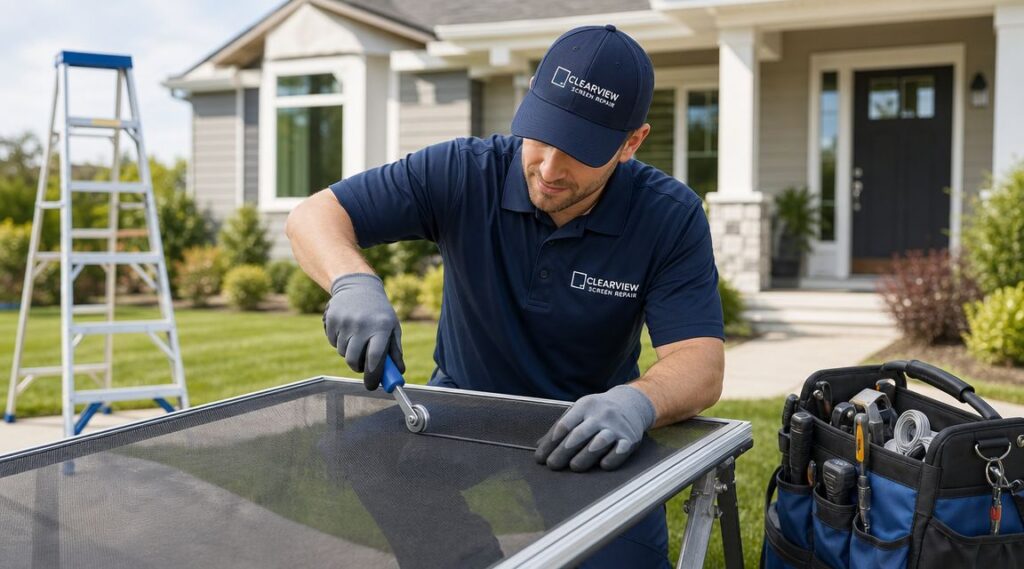
A lot of people search for a window screen service near me right after something small turns into a daily annoyance. The cat pushes through a loose corner. A brittle screen tears when you try to lift the sash. A frame that looked “mostly fine” keeps popping out of the track every time you open the window.
At that point, you're not shopping for a vague home service. You're trying to solve a specific problem without wasting money, inviting liability onto your property, or paying for the wrong fix. That's where most homeowners get stuck. They know the screen needs attention, but they don't know whether they need a patch, a rescreen, a whole new frame, or a company that can handle something less standard.
When Your Window Screens Need Professional Help
A torn screen rarely stays a small problem for long. One claw rip becomes a larger opening. Sun-baked mesh starts cracking at the corners. A bent frame that still “sort of works” stops seating correctly, and then the screen bows, rattles, or falls out when the window moves.

Well-kept screens do more than keep bugs out. They support natural airflow, improve how the home looks from outside, and help windows feel finished instead of neglected. When a screen is loose, torn, faded, or missing, the whole window starts to look uncared for even if the glass is spotless.
This is a common maintenance issue, not an unusual one. The U.S. Census Bureau reported 131.2 million occupied housing units in the United States in 2023, which means even a small repair rate creates an ongoing market for screen replacement, rescreening, and frame repair across a huge installed base of homes and rentals, as noted by Screenmobile's discussion of screen demand and housing scale.
Signs it's time to stop troubleshooting and call someone
Some screen problems are simple. Others waste hours if you try to force a DIY fix.
- The frame is bent or twisted. New mesh won't solve a frame that won't sit flat.
- The corners are loose. If the frame is separating, tensioning fresh mesh can make the fit worse.
- The spline won't hold. Worn spline channels often need a more experienced hand or a replacement frame.
- The screen keeps falling out. That usually points to hardware, sizing, or frame damage, not just torn mesh.
- You have multiple damaged screens. One screen is a project. Several screens become a workflow problem.
Practical rule: If the issue affects fit, hardware, or frame shape, not just the mesh, professional service usually saves frustration.
A good local company should be able to tell you whether you need rescreening, hardware work, or a full rebuild after a quick inspection. If you want to see what a focused repair service generally includes, this overview of window screen repair is a useful reference point before you start calling around.
What to Expect from a Professional Screen Service
Professional screen work should start with diagnosis, not with a sales pitch. The first question isn't “What mesh do you want?” It's “What failed?” Mesh, frame, corners, tabs, springs, rollers, latches, and track fit all fail differently, and each one points to a different repair path.

The three most common service paths
Rescreening means reusing the existing frame and replacing the mesh and, when needed, the spline. This makes sense when the frame is still square, the corners are sound, and the screen sits properly in the opening.
Repairing usually applies when the problem is smaller or more mechanical. That can mean replacing clips, tabs, or minor hardware, or addressing a frame issue that doesn't require full replacement.
New screen fabrication is the right move when the frame is bent, warped, badly corroded, incorrectly sized, or too worn to justify new mesh. This also matters for older homes and non-standard openings where off-the-shelf sizing doesn't work.
Material and product questions worth asking
Not every job should get basic insect mesh. The right company should explain options in plain language.
- Standard fiberglass mesh works well for many routine repairs.
- Pet-resistant mesh makes sense when claws have already tested the old screen.
- Solar or sun-control screen products may be a better fit where heat and glare are part of the complaint.
- Specialty systems need a different skill set than standard window screens.
A growing share of demand now involves retractable screens, motorized patio shades, and patio or porch enclosures, and providers in major markets actively advertise those categories. That's a sign that many homeowners asking for local screen service don't just need a basic bug screen, as reflected in Apollo Screen's specialty service offerings.
After you've seen the basics, it helps to watch a process in motion:
What a good service interaction looks like
A capable technician should be able to answer these clearly:
- Whether your current frame is worth saving.
- Which mesh types fit your use case.
- Whether hardware is reusable or needs replacement.
- Whether the work will be done on-site or taken off-site.
- What happens if the opening is non-standard.
If you call and the person answering can't sort basic questions or can't get your details straight, that tells you something. A lot of home service companies are trying to improve response quality, and this piece on AI call handling for home businesses is worth reading because fast, organized communication often signals whether the back end of the business is professional too.
A screen company doesn't need fancy language. It needs clear measurements, clear options, and clear accountability.
The Real Cost of DIY Screen Repair vs Professional Service
DIY screen repair can be worth it. It can also become one of those jobs that looks cheap until you've bought the wrong roll of mesh, fought a stubborn spline, and ended up with a loose, wavy result that you'll redo later.
For a first-timer, removing the old spline, cutting new mesh, and reinstalling the frame typically takes 20 to 45 minutes, and one handyman pricing example puts DIY materials for a standard fiberglass screen at about $15 to $30, compared with roughly $50 to $150 per screen when hiring a handyman, according to this window screen repair cost breakdown.
DIY works best when the job is simple
If the frame is intact and you're replacing mesh on one standard screen, DIY is reasonable. The job is straightforward in theory. Pull spline, remove old mesh, cut the new material with enough overhang, roll in the spline, trim the excess, reinstall.
Where people get into trouble is tension. Too loose, and the screen looks sloppy and flaps. Too tight, and the frame can bow. The other common mistake is cutting the mesh too close before seating it properly.
Field advice: DIY is most successful when you're fixing one standard frame that already fit correctly before the mesh failed.
Side by side comparison
| Factor | DIY Repair | Professional Service |
|---|---|---|
| Material cost | About $15 to $30 for a standard fiberglass screen setup in one handyman example | Usually bundled into the service price |
| Time | Often 20 to 45 minutes for a first-time repair | Homeowner time is minimal beyond scheduling |
| Tools | You may need a spline roller, utility knife, replacement spline, and work surface | Technician brings tools and materials |
| Fit quality | Depends on your measuring, tensioning, and frame condition judgment | Usually more consistent, especially on multiple screens |
| Best use case | One simple screen with a sound frame | Multiple screens, bent frames, hardware issues, specialty products |
| Main risk | Loose mesh, poor spline seating, wrong material choice | Higher out-of-pocket cost |
There's also the convenience factor. If you're comparing your options, this guide to the cost to repair a window screen helps frame the labor-versus-material trade-off in a practical way.
When professional work is the better value
Professional service usually makes more sense when:
- You have several screens and want them all to match.
- Frames are damaged and mesh replacement alone won't fix the problem.
- You don't know the material and don't want to guess between standard, pet-resistant, or solar products.
- The screens are hard to remove or tied to upper-story or awkward windows.
- You care about finish quality and don't want visible waves or uneven corners.
The cheapest route isn't always the lowest total cost. Redoing a bad repair is still paying twice.
How to Find and Vet a Trustworthy Local Pro
Typing window screen service near me into Google gives you a list. It doesn't give you a hire. The actual effort begins after the search, when you narrow the field and figure out who's operating professionally and who's just trying to book a quick cash job.
Build a shortlist the right way
Start with what the company shows, not what it claims. Look at job photos. Check whether the photos show actual screen work, not only spotless windows or generic stock images. Read reviews for details about communication, punctuality, clean-up, and whether the finished screens fit correctly.
Then read the website closely. You want to see whether they mention rescreening, new frames, hardware repair, specialty screen options, and service area coverage in a way that sounds specific instead of copied.
A practical way to understand what competent service usually requires is to review the basic window screen repair tools involved. If a company talks vaguely about “quick fixes” but never seems to reference real tools, materials, or process, that's worth noticing.
Questions that protect you as a homeowner
Ask these before scheduling:
- Are you insured for this work? You want confirmation of General Liability insurance and Workers' Compensation. If someone gets hurt on your property and they aren't properly covered, that problem can move toward you fast.
- Are you bonded or state-registered where required? Rules vary, but a legitimate business should be able to explain its status clearly.
- Will you repair my existing frame or recommend replacement if it's out of square? This tells you whether they diagnose first or just sell whatever is easiest.
- Do you handle specialty products? Important if you have retractable screens, patio screening, or non-standard systems.
- Can you explain how you price the job? A pro should be able to tell you whether the quote is per screen, by repair type, or based on fabrication and installation.
What legitimacy sounds like
Good companies answer directly. They don't get irritated when you ask for proof of insurance. They don't dodge licensing or registration questions. They don't insist that “it's all the same” when you ask about mesh types or frame repair.
If a contractor acts offended when you ask about insurance, keep looking. Professional operators are used to that question.
Also pay attention to who's showing up. If the company website suggests a structured operation but the communication is inconsistent, names don't match, and nobody can tell you what work is included, that's a warning sign. Reliable businesses document the job, confirm materials, and explain what happens if they discover bent frames, broken tabs, or sizing issues once they're on site.
Comparing Service Quotes and Avoiding Common Scams
The most misleading quote isn't always the expensive one. It's the vague one.
Many homeowners start with price, which is understandable. But broad market ranges don't tell you much about your specific job. Large marketplace pages often quote window and door screen repair at “between $65 and $150”, while still leaving a big gap around whether a torn screen should be repaired or fully replaced, as shown in The Home Depot's screen repair service page.

What a solid quote should include
A proper quote should tell you what you're buying, not just the final total.
- Scope of work. Is this rescreening only, frame repair, hardware replacement, or full new screen fabrication?
- Material type. Standard fiberglass, pet-resistant mesh, solar material, or a specialty product should be named.
- Unit of pricing. Per screen, per opening, or by project. If the company can't explain this, comparison gets messy.
- Trip or service call fees. Ask directly so you don't find them later.
- Warranty terms. Even a simple explanation is better than a shrug.
Red flags that show up before the work starts
Some warning signs are obvious. Others are subtle.
- A verbal-only estimate with no written summary.
- Pressure to pay cash immediately.
- No proof of insurance when requested.
- A promise to “repair anything” without seeing photos or measurements.
- No discussion of whether the frame is reusable.
Cheap screen work often becomes expensive when the mesh fails early, the frame still doesn't fit, or nobody answers after payment.
The lowest quote can be perfectly legitimate. It can also mean the company is skipping prep, using lower-grade materials, or assuming they can upsell you once they arrive. The highest quote isn't automatically better either. You're looking for clarity, not just a number.
How to compare apples to apples
Take two or three quotes and line them up. Check whether each company priced the same scope, the same material, and the same handling of damaged frames or hardware. If one quote covers only mesh replacement and another includes frame adjustment, tabs, and reinstall, those aren't equal offers.
A fair-value quote usually feels specific. It identifies the likely work, mentions possible exceptions, and leaves room for a technician to confirm fit before starting.
The Sparkle Tech Difference for Arizona Window Screens
Arizona screen work gets judged hard by sun, dust, repeated use, and long exposure. Homeowners here don't just need someone who can swap mesh. They need someone who understands when a brittle screen is only the visible part of the problem and when the frame, corners, tabs, or overall fit need attention too.

For Arizona homeowners who want a documented, local option, Sparkle Tech Window Washing & window screens is a family-owned business based in the Phoenix valley that services anywhere in Arizona. The company states that it carries Workers' Compensation, General Liability Insurance, and is Bonded, and that it is registered as a window cleaning service and window screen service in Arizona and organized as a registered LLC for customer protection.
Why that matters in practice
Those business details aren't just paperwork. They affect your risk.
- Insurance matters when someone works on your property.
- Bonding matters because it signals a more formal business structure.
- State registration matters because it separates a legitimate operator from a casual side job.
If you've read this far, you already know what to look for. Clear diagnosis. Straight answers about repair versus replacement. Written quotes. Proof of insurance. A company that treats screen work as a real trade, not an afterthought attached to some other service.
If you're in Arizona and want a straightforward quote from a company that handles window screens as part of a legitimate, insured service business, contact Sparkle Tech Window Washing & window screens. Send photos, describe whether the issue is torn mesh, a bent frame, or a screen that won't stay seated, and ask for the repair-versus-replacement recommendation in writing before you book.