

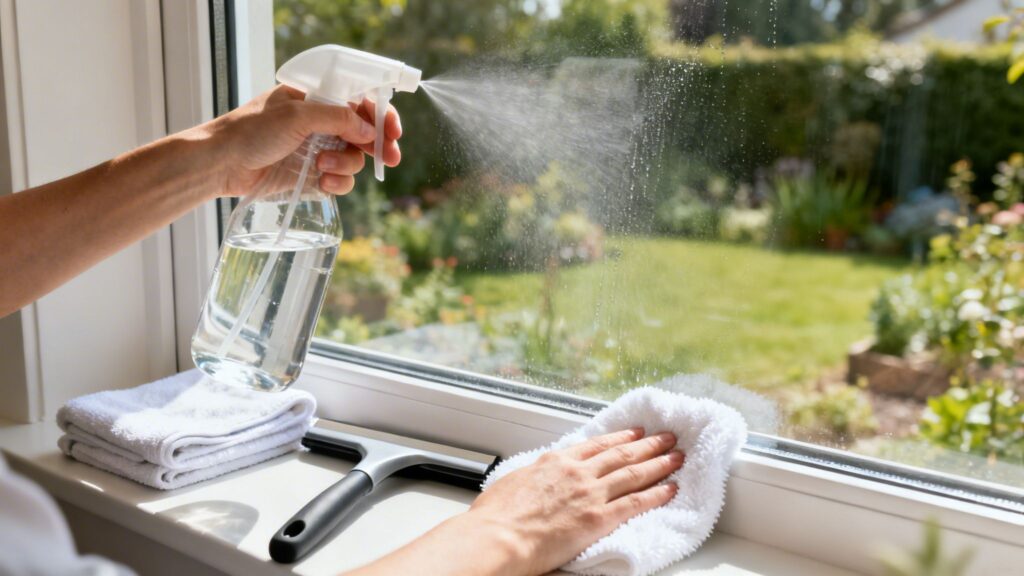
Forget those expensive, chemical-laden commercial cleaners. The secret to brilliantly clear, streak-free windows is probably already in your pantry. A simple mix of 50/50 distilled white vinegar and water in a spray bottle is all you need to cut through stubborn grime, fingerprints, and even tough hard water spots.
Your Go-To Guide for Vinegar Window Cleaning
Reaching for vinegar isn't some new-fangled cleaning hack; it's a time-tested method that professional window cleaners and savvy homeowners have relied on for generations. It’s a game-changer, especially if you live somewhere like Phoenix, Arizona, where the constant battle with desert dust and hard water residue can feel never-ending.
This technique has been around since at least the early 20th century, but it really took off during the environmental movement of the 1970s. In fact, the use of natural cleaners like vinegar shot up by 300% between 1970 and 1980! The magic is in the chemistry. The 5% acetic acid in standard white vinegar is just acidic enough to dissolve about 95% of common mineral deposits and grime without damaging the glass. Some studies even show it outshines ammonia-based products in delivering that coveted streak-free finish. If you're curious about how it stacks up against the latest store-bought options, the glass cleaner findings from Consumer Reports offer some great insights.
Now, before you get to mixing and spraying, let's talk about gear. Having the right tools on hand makes the entire process quicker, easier, and yields a much better result.
Your Vinegar Window Cleaning Toolkit and Formulas
Here’s a quick-reference table for everything you’ll need to get started, from the basic tools to the right vinegar mix for the job at hand.
| Item/Situation | Description/Ratio | Pro Tip |
|---|---|---|
| Basic Mix | 50/50 distilled white vinegar & water | Perfect for routine cleaning of interior windows and mirrors. |
| Tough Grime | 70/30 vinegar to water | For exterior windows with built-up dirt, pollen, or hard water spots. |
| Spray Bottle | Clean & empty | Label it clearly so you don't mix it up with other household sprays. |
| Squeegee | 10- or 12-inch professional-grade | This is non-negotiable for a streak-free finish. Don't skimp here. |
| Microfiber Cloths | At least two lint-free cloths | One for scrubbing, one for wiping the squeegee blade and catching drips. |
| Bucket | 2-3 gallon | Fill with your solution for outdoor work or just clean water for rinsing cloths. |
Getting your tools and solution ready ahead of time is half the battle. Once you're set up, the actual cleaning process is a breeze.
Pro Tip: I can't stress this enough: always use distilled water. Tap water, especially hard water, is loaded with minerals. When it dries, it leaves behind a chalky film, creating the very streaks you’re trying to eliminate.
Mastering the Vinegar Formula
That 50/50 ratio is your go-to for most everyday jobs, but don't be afraid to adjust it. If you're tackling windows that haven't been cleaned in a year, or they're covered in grime from a recent storm, a stronger mix can power through the buildup more effectively.
Understanding how and when to adjust your ratios is what separates an amateur from a pro. It's a key part of what we cover in our guide on the best homemade window cleaning solutions, which explores other natural additives you can use for even more cleaning power.
Mastering the Pro Technique for a Flawless Finish
Having the right vinegar mix is a great start, but it's your technique that will make the difference between clean windows and invisible windows. If you want that professional, streak-free shine, you have to move beyond a simple spray-and-wipe. It all comes down to prep work and mastering the squeegee.
First things first: protect your space. Before you even think about spraying the glass, lay an old towel or some newspaper along the windowsill and the floor below. This simple bit of prep saves you from a headache later, catching any drips that could harm your wood floors, sills, or furniture.
Prepare the Window Frame and Sill
Next, give the frame and sill a quick once-over. If you spray a window covered in dust and cobwebs, you're just making mud. Grab a dry microfiber cloth or a soft-bristled brush and wipe down the entire frame, sill, and tracks. This gets rid of all the loose gunk that would otherwise turn into a streaky mess the moment it gets wet.
Think of it as the first line of defense against streaks. By cleaning the frame first, you ensure you’re only cleaning the glass, not the grime built up around it.
The Secret to Squeegee Success
This is where you'll see the biggest results. A quality squeegee is, without a doubt, the most important tool in your kit. Ditch the paper towels and the circular wiping motions that just smear dirt around. The professional method is systematic and clears the glass in one clean sweep.

Start by lightly misting the top half of the window with your vinegar solution. You want the glass to be wet, but not so soaked that solution is pouring down.
From there, it’s all about a few key moves:
- Create a "Dry Edge." Place your squeegee at the top corner of the pane, angled slightly, and pull it straight across the top by about an inch. This gives you a dry strip to start your main pass from.
- Wipe Your Blade. After that first pull, wipe the rubber blade clean with a dry microfiber cloth. This is the single most critical, and most often forgotten, step. A clean blade is what prevents streaks.
- Use the "S-Pattern." Now, place your squeegee back in that dry strip, overlapping it by an inch. Pull it down the window in a smooth, continuous "S" motion. This keeps the dirty water moving down ahead of the blade, preventing drips.
- Maintain the Right Angle. Keep the squeegee angled at about 30 degrees from the glass. This angle lets the blade slice the water off the surface cleanly instead of just pushing it around.
- Apply Gentle, Steady Pressure. Don't white-knuckle it. Just apply enough consistent pressure to keep the entire rubber blade flush against the glass.
The real secret to a perfect finish isn't just the S-pattern; it's wiping the blade clean after every single pass. Dirty water on the blade is the number one cause of frustrating streaks, and this one-second action eliminates the problem entirely.
The Final Touch for Perfect Edges
After you’ve squeegeed the whole pane, you’ll probably notice a thin line of moisture left around the very edges of the glass. That's perfectly normal—the squeegee can't get right into the corners.
This is where your second, dedicated dry microfiber cloth comes in. Simply run it along the perimeter of the glass to wipe away that last bit of moisture. This final buff gives you those crisp, perfectly clean edges. Your tools are just as important as your technique, so check out our recommendations for the best window cleaning tools to build your pro kit.
How to Tackle Stubborn Streaks and Hard Water Stains

It's a frustrating moment. You've followed all the steps for cleaning your windows with vinegar, but you’re still seeing stubborn streaks or spots. Don't throw in the towel just yet. This doesn't mean the method failed; it just means we need to do a little detective work to pinpoint the problem.
More often than not, the issue is simply timing. Trying to clean windows while they're being blasted by hot, direct sunlight is a classic mistake. The heat makes your vinegar solution evaporate in seconds, leaving all the dirt and minerals behind before you even have a chance to wipe them away. The pro-level secret? Always work on a cool, overcast day or wait until the sun has moved off your windows.
Eliminating Pesky Streaks
If you’ve ruled out the sun, there are a few other common missteps that can leave streaks behind. Let’s get that crystal-clear finish by figuring out what’s going wrong.
Here are the top three things I see causing streaks:
- A Dirty Squeegee: If you aren't wiping the rubber blade with a clean cloth after every single pull, you're just smearing dirty water back onto the glass. This is, without a doubt, the number one cause of streaks.
- Bad Water: Using regular tap water is a huge gamble, especially in areas with hard water. The minerals in the water will dry on your window and create a hazy film. Stick with distilled water—it’s a non-negotiable for a perfect finish.
- Worn-Out Tools: Take a close look at your squeegee blade. If the rubber is nicked, cracked, or has gone hard, it can't make solid contact with the glass. This leaves tiny trails of water that dry into fine streaks.
The whole point is to pull the dirty water completely off the glass, not just push it around. A clean, sharp squeegee and pure ingredients are the only way to win that battle.
Conquering Hard Water Stains and Other Tough Spots
Hard water stains are in a league of their own. Those chalky, white spots that look almost etched into the glass won’t budge with a standard cleaning solution. They’re mineral deposits from evaporated water, and they need a stronger approach.
To break them down, you'll need to increase the acidity. Mix a stronger solution of 70% white vinegar and 30% distilled water. Spray this directly and generously onto the stains and—this is the important part—let it sit for at least five to ten minutes. This "dwell time" gives the acid a chance to dissolve the stubborn calcium and magnesium.
After it's had time to work, give the area a firm scrub with a non-abrasive pad before squeegeeing the window clean. For a deeper dive, check out our full guide on how to remove hard water stains from windows.
What about other stubborn messes?
- Bird Droppings & Bug Guts: Don't just wipe these. Saturate the spot with your vinegar mix and let it sit for a minute or two. This will soften and rehydrate the mess, making it much easier to wipe away without smearing.
- Paint Specks: For tiny specks of dried latex paint, you can often use a fresh, sharp razor blade. Hold it at a 45-degree angle to the glass and gently push to lift the paint off. Always proceed with caution and test in a hidden corner first to avoid any scratches.
Why Vinegar Is a Smarter Choice for Your Home
Walking down the cleaning aisle, it’s easy to get drawn in by the brightly colored bottles promising a perfect, streak-free shine. But when it comes to cleaning windows, I always find myself coming back to a simple, time-tested solution: plain old white vinegar. It's not just a nostalgic choice; it’s a genuinely smarter one for your wallet, your health, and the planet.
Let's talk about the most obvious win first: the cost. It’s staggering how quickly the expense of commercial cleaners adds up. With U.S. households projected to spend $12 billion a year on cleaning products by 2026, every little bit counts. A homemade vinegar solution costs a mere $0.10 to $0.20 per diluted gallon, while a standard store-bought spray is closer to $1.50.
That’s a 90% savings every single time you mix a new batch. Here in dusty climates like Arizona's Phoenix Valley, where windows can collect pounds of dust each year, that simple switch can even trim professional cleaning prep bills by around $50 per home. You can see a full breakdown from these window cleaning equipment experts.
A Healthier Home Environment
The savings are great, but for me, the real peace of mind comes from knowing what’s not in my cleaning solution. Most commercial glass cleaners are loaded with ammonia and other chemicals that release volatile organic compounds (VOCs). Every time you spray, those VOCs hang in the air, contributing to poor indoor air quality and potentially triggering issues for anyone with allergies or asthma.
Vinegar, on the other hand, is completely free of those harsh additives. That signature sharp scent you smell is just acetic acid, and it fades completely as it dries. You’re left with clean glass and nothing else. No lingering chemical smells, no holding your breath while you clean.
- No Harsh Fumes: This is a big one. You’re protecting your family from inhaling chemicals they don't need to.
- Pet-Safe Alternative: Ammonia-based cleaners can have smells that confuse pets, but vinegar is a much safer option to have around your furry friends.
- Reduced Irritants: It's the perfect choice for homes with young children or anyone sensitive to strong, artificial fragrances.
By making the switch, you're not just cleaning your windows; you're actively choosing to improve the air quality inside your home. It’s a small change that makes a big difference in creating a non-toxic environment.
An Eco-Friendly Cleaning Choice
Then there’s the environmental angle, which is becoming more important to all of us. Think about how many plastic spray bottles you’ve thrown away over the years. Each one often ends up in a landfill, contributing to a massive waste problem.
When you mix your own vinegar solution in a good reusable spray bottle, you immediately sidestep that cycle of waste. Better yet, vinegar is completely biodegradable. It breaks down naturally and won’t harm waterways or local ecosystems. It’s a powerful cleaner that works with the environment, not against it, helping you build a more sustainable home one clean window at a time.
When to Avoid Using Vinegar on Windows

As great as vinegar is for most glass, it's definitely not the right tool for every window. The very thing that makes it so effective—its acidity—can cause real, irreversible damage to certain materials. Knowing when to reach for a different cleaner is just as crucial as knowing the right mixing ratio.
The first thing to look for are sensitive surfaces around your windows. Natural stone is the biggest red flag. If you have window frames or sills made of marble, granite, limestone, or travertine, you need to be extremely careful.
Even a stray drip of a vinegar solution can etch the stone, leaving a dull, cloudy spot that can only be fixed by a professional. Before you even think about spraying, completely cover these surfaces with plastic sheeting and old towels.
Surfaces That Don't Mix With Vinegar
Beyond the surrounding stonework, some types of glass and window treatments are a hard "no" for vinegar. Using an acidic cleaner here can turn into an expensive mistake that’s nearly impossible to fix.
You should never use a vinegar solution on these types of windows:
- Aftermarket Tinted Windows: That tint on your car is usually a thin film applied to the inside of the glass. The acid in vinegar can slowly eat away at the adhesive, leading to bubbling, peeling, or discoloration.
- Leaded or Decorative Panes: Older, antique windows with glass held together by lead or zinc cames (the metal dividers) are vulnerable. Acidic cleaners can speed up oxidation, causing the metal to corrode and weaken.
- Windows with Special Coatings: Many modern windows have special low-emissivity (Low-E) or anti-glare coatings. These can be sensitive to acids, so it’s always best to check with the manufacturer before you clean with vinegar.
The rule of thumb is simple: if a material is acid-sensitive, keep vinegar away. This one precaution can save you from turning a quick cleaning job into a permanent headache.
Interestingly, while you need to be careful, research is also showing vinegar's benefits on other surfaces. Studies on glass railings and even solar panels found that diluted vinegar removed 92% of bird droppings without etching the surface. That’s a huge improvement over the 15% failure rate seen with some soaps. A 2026 market analysis even points to this growing trend of using natural cleaners, which is helping save millions of plastic bottles each year. You can read more professional insights on using vinegar for window cleaning to learn about its performance in other scenarios.
A Few Common Questions About Vinegar Window Cleaning
Even with the best instructions, you're bound to have a few questions once you get the squeegee in your hand. That's perfectly normal. Let's tackle some of the most common ones I hear so you can get to work with confidence.
Can I Add Dish Soap to My Vinegar Mix?
You absolutely can, but a little goes a long way. For those really grimy outdoor windows caked with dirt or greasy film, adding a few drops of a simple dish soap (like the classic blue Dawn) to your 50/50 vinegar and water mix can make a world of difference. The soap helps cut through the heavy stuff your vinegar solution might struggle with on its own.
The trick is to be incredibly stingy with it. If you add too much, you’ll trade dirt streaks for soap streaks, which are just as frustrating. As a rule of thumb, I never add more than half a teaspoon of soap for a full gallon of cleaning solution. Any more than that and you're just making more work for yourself.
What Is the Best Time of Day to Clean Windows?
This is a big one. The perfect time to wash your windows is on a cool, overcast day. If the sun is out, stick to the early morning or late evening hours when your windows are still in the shade.
Why? Because direct sun is your worst enemy. It heats up the glass and makes your cleaning solution evaporate in seconds, leaving behind all the dirt and minerals you were trying to wash away. That rapid drying is the #1 culprit behind those stubborn streaks and spots.
By working in the shade, you give yourself plenty of time to methodically spray, scrub, and squeegee off the solution for a truly flawless finish. It’s a simple change that makes a huge difference.
How Often Should I Clean My Windows?
For most homes, a deep cleaning twice a year is the sweet spot. A good scrub in the spring gets rid of all the winter grime, and another one in the fall preps your home for the holidays by clearing away summer dust and pollen.
Of course, your local environment plays a big role. If you live near a busy road, in a high-pollen area, or on a dusty lot, you might need to clean them quarterly. Don't feel like it has to be an all-day project every time, though. Sometimes a quick spot-clean is all you need.
- Standard Maintenance: Aim for a full interior and exterior cleaning twice a year.
- High-Traffic Areas: If you get a lot of dust or pollen, consider a quick exterior rinse every 2-3 months.
- Spot Cleaning: Wiping away fingerprints, smudges, and pet nose prints as you see them will keep your windows looking great in between the big cleans.
Ready to let the sunshine in without the hassle? If you'd rather leave the ladders and squeegees to the experts, the team at Sparkle Tech Window Washing is here to help. We provide professional, streak-free window cleaning services across the Phoenix valley. Visit us online to get your free quote today