



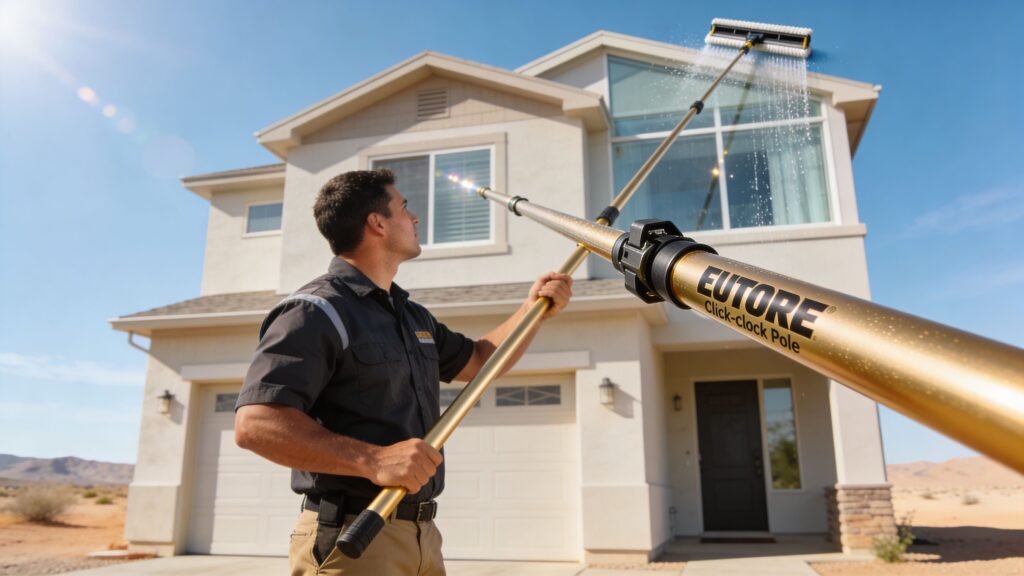
You know the job. The glass is up high, the sun is already cooking the stucco, and the pole in your hands either feels too short, too flexy, or too heavy by the time you reach the last pane. That’s where a lot of streaks start. Not with soap. Not with rubber. With the wrong pole.
In Arizona, an ettore extension pole isn’t just a reach tool. It’s part of how you stay off ladders, keep your work controlled, and get through a long day without burning out your shoulders. The desert is hard on equipment. Fine dust works into locks. Hard water leaves residue where sections meet. Heat exposes every weak point in a cheap pole.
A lot of generic buying guides skip that reality. They list features and move on. What matters in the field is different. You need to know which Ettore pole fits the kind of work you do, how to run it without bounce, and how to keep it working after weeks of heat, dust, and solar jobs.
Why Your Extension Pole Is Your Most Important Tool
A bad pole ruins a simple job fast. You start with a second-story window that should take a few controlled passes. Then the sections twist, the head shifts, and every correction travels down the pole into your wrists. By the time you finish, the glass is clean enough from the ground, but not clean enough for a client standing inside looking out.
That’s why professionals treat the pole differently than homeowners do. The pole isn’t an accessory. It’s the backbone of high-reach work. A solid ettore extension pole lets you keep your feet planted, your pressure consistent, and your line of work moving without dragging a ladder around every corner.

The difference shows up in three places:
- Safety on routine jobs. A longer professional pole helps you reach difficult glass without defaulting to a ladder on every stop.
- Quality at the edge of your reach. If the pole stays stable, the tool head stays where you put it.
- Fatigue over a full day. Weight and balance matter more at the fifth house than at the first.
What pros notice right away
Cheap poles feel acceptable when collapsed. They tell the truth when extended. That’s when flex, slipping locks, and poor tip fit start costing time.
An Ettore pro pole is built for repeated extension, repeated collapse, and daily attachment changes. That matters on real routes where you move from windows to screens, from glass railings to dusty transoms, and sometimes over to solar panel cleaning.
Field reality: The pole that feels “fine” for one window often feels terrible after a full afternoon in Phoenix heat.
When your pole works, the whole job feels calmer. Movements get smoother. Detailing gets lighter because your top passes were cleaner. You spend less energy fighting the tool and more energy cleaning glass.
The Anatomy of a Professional Extension Pole
A professional pole works like a good tripod. Every part matters. If one connection point is weak, the whole system feels loose no matter how good the rest looks.
The main parts are simple. The tubing, the lock, and the tip. What separates a pro pole from a bargain pole is how well those parts work together under load.

The tubing
The pole body does most of the hard work. On Ettore pro poles, aluminum construction is the big story, but shape matters too. Fluted or ribbed sections add control and stiffness compared with a slick, round-feeling tube.
The InterPro line is a good example. The pole uses ribbed aluminum sections and twist-to-lock collars for quick adjustments, and its included Ettore Pro+ Pole Tip (1700) uses a locking button for secure tool attachment, as described by Detroit Sponge’s InterPro product listing. In day-to-day use, ribbing helps your hands stay engaged with the pole when everything is wet, soapy, or dusty.
The locking mechanism
Locks decide whether a pole feels dependable or annoying.
Some poles use twist-to-lock collars. These are quick, familiar, and easy to adjust when you only need a little extra reach. They’re good for jobs where you’re changing length often. The trade-off is that collars need to stay clean. Grit in the threads or joint area changes how they feel.
Other pro poles use clamp or positive-lock systems. These usually feel faster at set heights and more confident when you’re working at longer extension. They also make it easier to repeat the same setup window after window.
The tip and tool connection
The tip gets ignored until something slips. Then it becomes the only part you care about.
A pro tip should do two things well:
- Hold tools securely so a washer or scraper doesn’t rotate when you apply pressure
- Let you swap attachments quickly without wrestling threads every time
Ettore’s Pro+ style tip with a locking button is useful because it gives you a more secure connection than a basic friction fit. That matters when you’re scrubbing upper glass or using a tool at an angle.
The best pole in the truck still underperforms if the tip lets the head wobble.
If you understand these three parts, product choices get easier. You stop shopping by length alone and start shopping by how the pole will behave at full extension on a real job.
Ettore REA-C-H vs InterPro A Head to Head Comparison
Most cleaners don’t need every pole Ettore makes. They need the one that matches their route, their attachment style, and the amount of abuse the pole will take in a normal week.
The broad split is easy. REA-C-H is the pro telescopic family typically chosen when serious reach is needed. InterPro makes more sense when the work is shorter-range, quicker, and more residential in feel.

What the REA-C-H line does better
If you clean taller homes, upper atrium glass, or awkward exterior elevations, REA-C-H is the line most pros should look at first. Ettore’s Pro REACH extension poles come in lengths from 2 feet to 32 feet, with 3-section models reaching up to 27 feet and 4-section variants hitting 32 feet, while consumer-grade poles typically max out at 16 feet, according to Ettore’s professional vs consumer pole guide.
That difference matters in the field. Consumer poles are fine until they aren’t. Once you’re stretching to finish an upper pane or trying to cheat reach with your body position, you’ve already chosen the wrong tool.
Where InterPro fits better
InterPro works best when you don’t need big extension and you value quick setup. It’s a practical choice for lower second-story work, interior glass, and shorter repeat tasks where constant extension changes matter more than maximum height.
It also suits cleaners who want a lighter, more compact setup for tight residential work. On homes with landscaping, furniture, or narrow side yards, that can be the difference between a smooth job and a clumsy one.
Side by side in the real world
| Pole family | Best fit | Main strength | Main trade-off |
|---|---|---|---|
| REA-C-H | Multi-story residential, tougher high-reach exterior work, larger properties | More reach, more professional-range options | Longer poles demand better technique and more storage care |
| InterPro | Lower-height residential work, quick adjustment tasks, compact setups | Fast adjustments, simple handling, easy to carry | Not the choice when you regularly need serious height |
How I’d choose by job type
- Mostly second-story homes with varied rooflines. Go REA-C-H.
- Primarily shorter residential glass and frequent in-and-out work. InterPro makes sense.
- Solar plus windows on the same route. Lean toward the pole with the more stable feel and the attachment setup you trust most.
- You already fight tool-head movement. Prioritize a better connection system over saving a little weight.
A pole that’s slightly more than you need is useful. A pole that’s slightly less than you need becomes a problem on every tall house.
The right answer usually isn’t about brand loyalty inside the same brand. It’s about matching the pole family to the jobs that pay your bills most often.
Choosing Your Ideal Ettore Pole Length and Material
Most cleaners buy too much pole or not enough. Both mistakes hurt. Too short and you overreach, lose pressure, and start chasing the glass. Too long and you carry extra length and force you don’t need, which makes fine control harder.
For a lot of Arizona residential work, the sweet spot is the pole that clears upper windows comfortably without forcing you into a steep working angle. One strong middle-ground option is the Ettore REA-C-H 3-section pole, which extends to 18 feet, weighs 3.52 pounds, and uses gold anodized aluminum construction, as listed by On Time Supplies for model ETO1692.
How to think about length
Start with your most common jobs, not your tallest occasional one.
If your route is mostly single-story homes with a few higher accent windows, a shorter pole usually gives you better control. If your regular work includes multi-story homes, upper transoms, or glass over patios, you need enough reach to work comfortably from the ground without muscling the last few feet.
A few practical checks help:
- Watch your hand position. If your top hand keeps climbing too high, the pole is probably too short for that task.
- Notice your body angle. If you’re leaning back to create reach, control drops fast.
- Pay attention to the finish quality at full extension. If the top edge is where mistakes show up, you may be maxing out the pole.
Why anodized aluminum makes sense in Arizona
Gold anodized aluminum is a good fit for desert work because it balances manageable weight with durability. It’s light enough to use through long residential days, but it still feels substantial when you need to scrub harder on dusty glass or exterior buildup.
That balance matters even more if your work includes solar. A pole used around panel arrays needs to stay predictable under pressure. If the shaft feels too whippy, it’s harder to maintain even contact across the surface. If you’re evaluating methods beyond traditional tools, this guide to a water fed pole cleaning approach is useful context for deciding how much versatility you need from one setup.
Buy for the jobs you do every week. Rent your thinking out to rare jobs and you’ll carry the wrong tool all year.
Material choice and job mix
Aluminum is the practical choice for many window cleaners because it’s durable, proven, and easier on the budget than specialty materials. It also stands up well to regular attachment swaps and rough handling in trucks.
If your workday is mostly traditional window cleaning with some solar and exterior detailing mixed in, an aluminum Ettore pole is often the right place to start. Choose length first, then judge whether the handling matches your route.
Mastering Control for Streak-Free High-Reach Cleaning
A good pole doesn’t clean the glass for you. It gives you a stable platform to do clean work. Technique is what turns reach into results.
The biggest mistake I see is people trying to work a long pole with their arms only. That burns you out and makes the head twitch across the glass. Control comes from your stance, your hips, and how you guide the pole through the stroke.

Start with body position
Stand far enough back that the pole works at a natural angle. Too close and the tool head gets cramped against the glass. Too far and everything feels loose.
Then do this:
- Keep one hand as the guide hand near your midsection. That hand aims.
- Let the lower hand drive. That hand supplies movement and pressure.
- Use your core to move the pole instead of lifting with your shoulders every pass.
That one change makes a huge difference on long days.
Find the balance point
Every extension setup has a balance point. If you grip too low, the top gets away from you. If you grip too high, you lose control.
Before you start cleaning, lift the pole into working position and make one dry pass. Adjust your hands until the head tracks smoothly without wobble. It only takes a moment, and it saves a lot of correction once the glass is wet.
For more practical high-window technique, this walkthrough on how to clean high windows is worth reviewing.
Don’t force the pole to behave. Set your grip so the pole wants to move correctly.
Control pressure without bounce
Pole bounce is what leaves those little misses and edge marks that are hard to see from the ground. It usually comes from too much force, jerky direction changes, or trying to rush the top of the pane.
A better method is simple:
- Scrub with measured pressure, not maximum pressure.
- Pause briefly before changing direction at the top of the glass.
- Let the pole settle before the next stroke.
Here’s a useful visual reference for movement and attachment handling:
What works better than brute force
When the glass is higher up, cleaner technique beats stronger effort. Slow down the first pass. Watch what the head does at the farthest point from your hands. If it chatters or skips, change your angle or reduce pressure.
For squeegee work, finish strokes need the same discipline. Keep the channel flat, don’t snap the turn, and don’t overwork one edge trying to fix what was really a setup problem. On high glass, smooth beats aggressive every time.
Beyond the Squeegee Unlocking Advanced Pole Uses
A pro pole should do more than hold a washer and squeegee. If that’s all it does, you’re leaving value in the truck.
The obvious next step is water-fed pole compatibility, which often leads to frustration for many cleaners. Ettore’s standard product info focuses heavily on traditional setups, but a major real-world issue is that professionals often need third-party conversion kits to attach WFP brushes, especially for work tied to solar cleaning and hybrid service routes, as noted in Ettore’s adapter guide.
What to expect with WFP conversions
Don’t assume every Ettore pole will accept every brush head cleanly out of the box. That’s where loose connections, awkward brush angles, and unreliable fit start.
When you’re evaluating a conversion setup, pay attention to:
- Connection security. If there’s even a little play at the tip, it gets worse under use.
- Angle control. A brush that sits wrong at the glass is tiring and inefficient.
- Repeatability. If you remove and reinstall parts often, the setup needs to go back together the same way every time.
For solar panel cleaning, this matters even more. Uneven brush contact makes the job slower and less predictable.
Other attachments that earn their keep
An Ettore pole becomes more useful when you build around it instead of treating it as a one-tool stick.
Good uses include:
- High-reach dusting for ledges, beams, and interior corners
- Scrapers for specific debris removal where pole work is appropriate
- Brushes and washers for standard glass and railing work
- Angle adapters for skylights, overhead glass, and awkward geometry
That flexibility is part of the value. One dependable pole can cover a lot of situations if the connection points are solid and the attachments don’t fight you.
The more jobs your pole can handle well, the less clutter you carry and the faster your setup gets.
The key is to test attachments like a skeptic. If the fit feels improvised on the ground, it will feel worse in the air.
Extending Your Poles Lifespan in the Arizona Heat
Generic maintenance advice falls apart in Phoenix. “Store in a cool, dry place” sounds nice, but it doesn’t help when your day starts in dust, runs through hard water, and ends with tools baking in a truck.
In harsh climates like Arizona, professionals report issues like pole warping and clamp slippage due to extreme heat and UV exposure, and standard manufacturer guidance usually doesn’t address those field conditions, as reflected on Ettore’s extension pole collection pages. That tracks with what cleaners see. Desert use exposes weaknesses fast.
Clean the joints before they feel bad
Don’t wait for a lock to start grinding. By then, dust is already packed into the working parts.
A simple routine works:
- Wipe down each section after dusty jobs. Fine grit travels farther than you think.
- Collapse the pole and inspect connection points before storage.
- Remove visible residue early so locks don’t start compensating for contamination.
If you use the pole around sprinklers, hose spray, or panel rinse work, residue buildup is even more of a problem. Hard water dries where sections overlap. Then the pole feels rough even if nothing is broken.
Heat changes how a pole behaves
A pole that feels normal in the morning can feel different later in the day. That doesn’t always mean failure. It does mean you should pay attention.
Check for these signs:
- Locks that need more force than usual
- Unexpected flex under routine pressure
- Sections that don’t slide smoothly
- Tool heads that seem to shift more than before
If something feels off, don’t push through it. Clean it, inspect it, and keep it out of prolonged heat when you can.
Storage habits that actually help
Store the pole where it isn’t taking direct sun through glass for hours. Don’t leave it dirty. Don’t put it away wet if you can avoid it.
A practical end-of-day habit is better than occasional deep cleaning. Wipe the shaft, check the lock areas, and make sure the tip connection is clean before the next route.
Desert maintenance is about prevention. Once dust and heat combine with neglect, the pole starts aging faster than it should.
That routine doesn’t take long, and it saves a lot of frustration when the next tall job comes up.
Work Smarter Not Harder with the Right Tools
The right ettore extension pole saves effort in places that matter. It helps you stay off ladders more often, work high glass with better control, and avoid the wasted motion that wears cleaners out over time. The wrong one does the opposite. It adds correction, strain, and little quality issues that show up on the hardest panes.
The smart choice comes down to three things. Match the pole family to your regular work, choose a length you can control, and maintain it like a working tool instead of a disposable one. That’s what keeps a good pole useful in Arizona.
If you run a service business and care about the systems behind growth as much as the tools in your hand, Transactional LLC's marketing system is a useful example of how home service companies can build a stronger operating foundation. On the equipment side, keeping a reliable setup starts with understanding your core gear, and this roundup of the best window cleaning tools is a strong place to compare what belongs in a serious kit.
If you want professional help from a team that understands Arizona glass, solar, screens, and the challenges of desert conditions, Sparkle Tech Window Washing is ready to help.