




Ever wondered how professional window cleaners get those upper-story windows sparkling without ever leaving the ground? The answer is often a water fed pole window cleaning system, a clever setup that ditches ladders and chemicals for pure water and a very long pole. It's a completely different way of thinking about window cleaning, leaving glass with a streak-free shine using nothing but the power of H₂O.
How a Water Fed Pole Window Cleaning System Works

At its core, a water fed pole system is all about transforming regular tap water into an aggressive cleaning agent. It takes your everyday water supply and runs it through a multi-stage filtration process, stripping out every last mineral and impurity—the very things that cause spots and streaks when water evaporates.
This ultra-pure water is then pumped up a lightweight, telescopic pole to a specially designed brush at the end. From the safety of the ground, the operator scrubs the window, frames, and sills to loosen up all the built-up dirt and grime. All the while, a steady stream of that pure water flows from the brush, washing everything away.
The Science of a Spotless Finish
So, where does the magic come in? It's all about what happens when the window dries. The purified water is deionized, meaning it’s hungry to bond with any impurities it can find. As it rinses the glass, it acts like a magnet, pulling all the dirt and contaminants away with it.
The result is a window that can simply air-dry to a perfect, spot-free finish. You don't need a squeegee because there are no minerals or residue left behind to squeegee off. This is the simple scientific principle that makes the whole system work.
This modern approach is quickly becoming the new standard. The global market for these systems was valued at around USD 83.1 million in 2024 and is expected to climb to an estimated USD 138 million by 2032. This surge is fueled by the growing need for safer, more efficient cleaning methods, especially for today's high-rise buildings. You can dig deeper into these market trends on 24marketreports.com.
Key Advantages of This Method
The benefits of switching to a water fed pole system go way beyond just getting clean glass. It’s a powerful combination of safety, speed, and quality that old-school methods just can't compete with. For starters, keeping operators on the ground practically eliminates the risks that come with working on ladders at height.
But the advantages don't stop there. This method is also incredibly efficient and much better for the environment.
- Increased Speed: An operator can clean the window, sills, and frames all in one go, often completing jobs in half the time it would take with a ladder and squeegee.
- Eco-Friendly: The entire process relies on purified water, cutting out harsh detergents and chemicals that can damage landscaping and pollute waterways.
- Superior Reach: High-quality poles can easily reach windows up to five or six stories high, turning previously inaccessible jobs into straightforward work.
Understanding the Science of Pure Water Cleaning

The incredible, streak-free results you get from a water fed pole system aren't magic—it's all down to science. The real secret is turning regular tap water, which is surprisingly full of invisible impurities, into a powerful cleaning agent that leaves absolutely nothing behind.
Ever washed your car on a sunny day, only to see ugly white spots appear as it dries? Those are mineral and salt deposits left over from the water. In professional window cleaning, we measure this using a metric called Total Dissolved Solids (TDS).
TDS is measured in parts per million (PPM). Depending on where you live, your tap water could have a TDS reading anywhere from 50 PPM to over 500 PPM. When that water evaporates on glass, every single one of those dissolved solids gets left behind, creating the frustrating spots and streaks we all hate.
The Purification Power Duo: RO and DI
To get that perfect, flawless finish, a water fed pole system has to strip out all of those dissolved solids. The goal is a TDS reading of 0 PPM. This is done through a powerful, two-stage purification process using Reverse Osmosis (RO) and Deionization (DI).
Think of it as a one-two punch for purifying water.
- Reverse Osmosis (RO): This is the heavy lifter. Water gets pushed through an incredibly fine membrane. This membrane acts like a filter, letting pure water molecules pass through while physically blocking up to 98% of the larger mineral and salt particles.
- Deionization (DI): This is the finisher. After the RO membrane does its job, the DI system uses special resin beads that work like tiny magnets. These beads attract and trap the handful of charged ions that might have slipped through, polishing the water to a pristine 0 PPM.
Together, these two stages are what create truly pure water.
Why Pure Water Cleans So Effectively
Once the water is stripped of all its minerals, it becomes unstable. In its natural state, water wants to hold onto minerals. So, when it's pure, it aggressively seeks them out. This is the real key to its cleaning power.
When 100% pure water hits a dirty window, it immediately grabs onto dirt, dust, and grime. It acts like a natural solvent, pulling contaminants right off the glass and holding them in suspension as it runs down the surface.
This process is so effective that you don't need any chemical soaps or detergents. The pure water does all the hard work itself. And since there are no minerals or soap residue left on the window, there's nothing there to create a spot or a streak.
The final rinse with pure water simply washes away all the loosened dirt. All that's left is a thin film of H₂O, which evaporates completely, leaving behind a perfectly clear, spotless shine. This ability to air-dry to a flawless finish is exactly what makes water fed pole systems so efficient.
Breaking Down Your Water Fed Pole System Components
A water fed pole system might look complicated at first glance, but it’s really just a few key parts working in perfect harmony. Think of it as a well-oiled machine where every component has a critical job to do. Once you understand how each piece works, you’ll be well on your way to mastering this incredibly efficient cleaning method.
From the purification system on the ground to the brush head scrubbing glass several stories up, every part is designed to deliver a flawless finish. Let’s pull back the curtain and look at the essential components that make this technology a game-changer for window cleaners.
The Heart of the System: The Purification Unit
This is where the magic begins. The purification unit takes regular tap water and transforms it into an aggressive cleaning agent. It's the true foundation of the whole setup, typically using a multi-stage process involving Reverse Osmosis (RO) and Deionization (DI) filters.
The RO filter gets the ball rolling, stripping out up to 98% of all dissolved solids and impurities. Then, the water flows through a DI resin tank, which acts like a magnet for any leftover ions, polishing the water to 100% purity. This ultra-pure water is the secret ingredient for that perfect, spot-free shine, making this part of the system absolutely essential for professional results.
The Backbone: The Telescopic Pole
The pole is what gives you that incredible reach, letting you clean windows high above the ground safely and efficiently. These poles are engineered from materials that are both incredibly lightweight and surprisingly strong, allowing you to clean windows several stories high without ever leaving the pavement. The goal is to have a pole that’s rigid enough to give you precise control, even when it’s extended 40 or 50 feet into the air.
The material your pole is made from has a huge impact on its performance, weight, and price.
Comparison of Water Fed Pole Materials
Choosing the right material is a balancing act between budget, ergonomics, and the kind of work you do most often. Here's a quick look at the most common options.
| Material Type | Key Benefit | Weight | Rigidity | Ideal For |
|---|---|---|---|---|
| Aluminum | Cost-effective and durable for lower-level work. | Heavier | Less rigid | Residential jobs up to 30 feet. |
| Carbon Fiber | Extremely light and stiff for maximum control. | Lightest | Most rigid | High-reach commercial jobs above 30 feet. |
While aluminum is a great starting point, carbon fiber is the undisputed champion for high-reach work. Its exceptional stiffness and low weight make a world of difference in reducing fatigue and improving control over a long day.
The Workhorse: The Brush and Hose
At the business end of the pole, you’ll find the specialized brush head. These aren’t your average scrub brushes; they feature soft, flagged bristles that gently agitate and lift dirt from the glass without leaving a single scratch. Integrated jets in the brush continuously spray a fan of pure water onto the window, rinsing away the loosened grime as you work.
The whole system is connected by a durable, lightweight hose that runs up the length of the pole, managed by a hose reel to keep things tidy and prevent tangles. This makes setting up and packing away a breeze.
The real power of the system comes from the synergy between the pole's rigidity, the brush's gentle scrubbing action, and the constant flow of pure water. It's this combination that lets you clean the glass, frames, and sills all in one fluid, efficient motion.
This visual breaks down the key performance metrics you'll be dealing with: water purity, pole length, and flow rate.
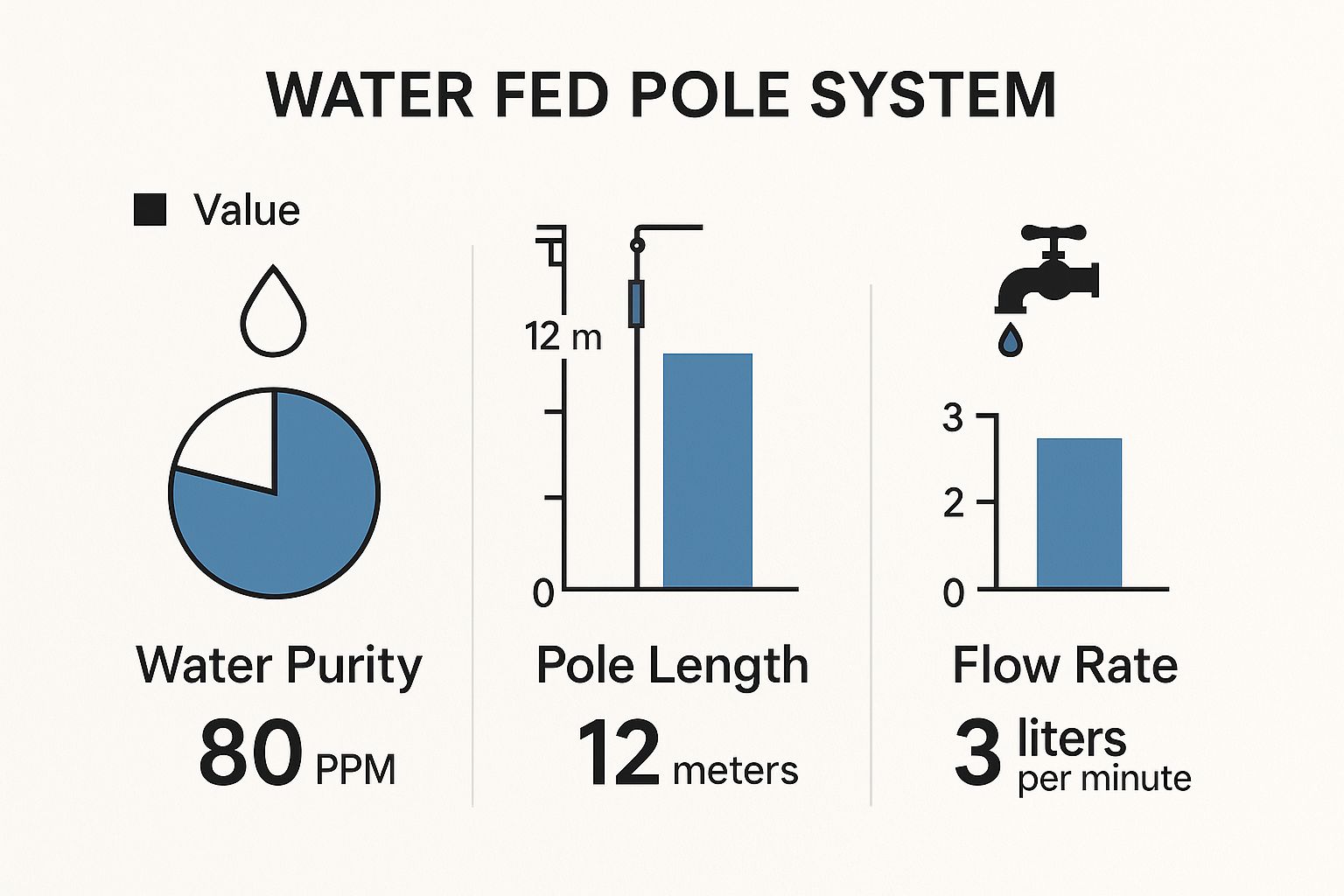
As you can see, getting that water purity (measured in PPM) as close to zero as possible is the top priority. The pole length and flow rate, on the other hand, are variables you'll adjust to match the specific demands of each job.
Why Professionals Are Making the Switch to Water Fed Poles

If you've been in the window cleaning business for a while, you've seen the shift. The old-school ladder and squeegee method is quickly being replaced by a much smarter approach: the water fed pole window cleaning system. This isn't just about a fancy new tool; it's a fundamental change that delivers three huge wins for any serious professional: unparalleled safety, game-changing efficiency, and a truly flawless finish.
This move is part of a bigger picture. The entire window cleaning services market, valued at an estimated USD 4.12 billion in 2024, is on track to hit USD 6.57 billion by 2033. Why? Because as buildings get bigger and more complex, the demand for safer, more effective cleaning methods is skyrocketing. You can dig into the numbers and trends in this detailed industry report.
Elevating Safety by Staying Grounded
Let's be honest: climbing a ladder always carries a risk. Traditional window cleaning is one of the more dangerous trades out there, with falls being a constant concern. This is where the water fed pole completely changes the game.
By keeping your feet firmly on the ground, you virtually eliminate the single biggest danger in the profession. Operators can easily reach windows up to five or even six stories high, all from the safety of the pavement. This isn't just about protecting the technician; it drastically reduces liability for the business and the property owner, too.
Boosting On-The-Job Efficiency
In this business, time is literally money. Think about the old way: set up the ladder, climb up, soap the window, squeegee it off, wipe the edges, then move the ladder and do it all again. It's a slow, repetitive process.
Now, imagine cleaning the glass, the frames, and the sills all in one smooth, continuous motion. That's what a water fed pole does. The brush scrubs everything at once while the pure water rinses it all clean. It's not uncommon for technicians to cut their job time in half, which means they can fit more clients into a single day and seriously boost their earning potential.
Think of it this way: instead of treating each part of the window as a separate task, the system cleans the entire unit—glass, frame, and sill—in a single, efficient pass. This is a fundamental change in workflow that boosts productivity.
Delivering a Superior and Greener Clean
The final piece of the puzzle is the quality of the clean, and it's second to none. The magic is in the 100% pure water. With all minerals and impurities filtered out, it dries to a perfect, spot-free finish. There’s no soap scum or residue left behind to attract more dirt, so windows actually stay cleaner for longer.
This method is also a huge selling point for clients who care about the environment. You're not using harsh chemicals that can damage landscaping or pollute local waterways. It’s a powerful way to stand out from the competition. You can read more about why this matters in our article on the revolution of eco-friendly window cleaning. When you combine top-tier safety, incredible speed, and a pristine, eco-friendly result, it’s easy to see why the water fed pole has become the new standard.
How to Choose the Right Water Fed Pole System
Taking the plunge and investing in a water fed pole window cleaning system is a big deal. With so many options out there, it’s easy to feel a bit lost. But here’s the secret: the "best" system is simply the one that’s right for your jobs.
Getting this right from the start saves a world of headaches, not to mention time and money. It all boils down to two key questions: How high are you cleaning, and what’s your local water like? Nail these two, and you’ll land on the perfect setup for your day-to-day work.
Assess Your Working Height Needs
First things first, think about the buildings you actually clean. The height of the windows you're tackling will dictate everything about the pole you choose—its length, material, and feel. A pole that’s too short is obviously useless, but one that’s way too long is a clumsy, heavy nightmare to handle.
If you’re mostly doing residential work—say, one or two-story houses—a pole that extends up to 30 feet will cover most of your bases. For this kind of work, an aluminum or hybrid pole strikes a great balance between cost and performance. But if you're regularly cleaning multi-story commercial buildings, don't even think about it. You need a carbon fiber pole. The incredible rigidity and light weight make them essential for safely and efficiently working at heights of 40 feet or more.
Determine Your Local Water Hardness
Next up is your water. You have to know what you're working with. The amount of Total Dissolved Solids (TDS) in your tap water will decide which purification system makes the most financial sense. The good news is you can figure this out in seconds with a cheap handheld TDS meter.
This little number is a huge deal because it tells you how much work your purification system has to do.
- Soft Water (TDS below 100 PPM): If you're lucky enough to live in a soft water area, a straightforward Deionization (DI) only system will likely do the trick. The DI resin can handle the light workload of polishing the water to 0 PPM without getting used up too quickly.
- Hard Water (TDS above 100 PPM): For anyone dealing with hard water, a multi-stage system featuring Reverse Osmosis (RO) isn't a luxury—it's a necessity. The RO membrane acts as the workhorse, stripping out up to 98% of the minerals before the water ever touches your DI resin. This saves your expensive resin from getting fried, which in turn saves you a ton of money on replacements.
One of the most common rookie mistakes is running a DI-only tank in a hard water area. Sure, you'll get pure water for a little while, but you'll blow through resin so fast that an RO/DI system would have paid for itself in just a few months.
To Kit or Not to Kit
The last piece of the puzzle is deciding how you want to buy your gear. Are you a "kit" person or a "build-it-yourself" pro? There's no wrong answer.
Complete, pre-packaged kits are fantastic for anyone just starting out. They come with everything you need, and you can be confident that all the parts are designed to work together perfectly.
On the other hand, building a custom setup gives you total control. You can hand-pick every single component to match your exact workflow, preferences, and budget. This is usually the path for seasoned pros who know precisely what they like. No matter which way you go, a smart choice here is what unlocks all the important benefits of professional window cleaning that make these systems so valuable.
Common Questions About Water Fed Pole Systems
It's one thing to see how a water fed pole system works, but it's another to wrap your head around the day-to-day practicalities. This technology is a big leap from the old bucket-and-squeegee method, so it’s completely normal to have a few questions before you feel comfortable.
Let’s dig into some of the most common things people ask, whether they’re seasoned pros or just starting out. I'll give you the straight scoop so you can get fantastic results right from the get-go.
Can I Use Hot Water with My System?
You sure can, and on really grimy jobs, it's a game-changer. Hot water turbocharges the cleaning power of your pure water, especially when you’re up against greasy smudges or years of caked-on dirt. It’s the same idea as washing a greasy pan in the sink—hot water just cuts through oily messes in a way cold water can't.
The only catch? You have to make sure your gear is built for it. The pole, hose, and all your fittings need to be rated for hot water, otherwise you risk damaging the equipment. Most pro-grade systems are designed with this in mind because they know how valuable heated water can be.
Pro Tip: Using hot water is a great trick for first-time cleans or messy post-construction jobs. It can seriously cut down your scrubbing time and makes you look like a hero when you deliver sparkling results on tough windows.
How Often Do I Change Filters and Resin?
This is the number one question I hear, and the honest answer is: it depends. It all comes down to two things: how often you’re out there cleaning and how hard your local water is. This is where your TDS meter becomes your most important tool—it completely removes the guesswork.
Here's a quick guide:
- DI Resin: This is the final step that gets your water ultra-pure. As soon as your TDS meter starts showing a reading above 10 PPM coming out of the pole, it's time to swap out the resin. If you're in a soft water area, you might get hundreds of gallons out of it. In a hard water zone? It’ll get used up much, much faster.
- RO Membranes: These are the heavy lifters of the system and are built to last. If you stay on top of changing your pre-filters and give the membrane a regular flush, a quality one can easily last 2 to 5 years.
Is This System Good for Very Dirty Windows?
Absolutely, but you might need to tweak your approach a bit. If you're tackling a window that hasn't seen a good cleaning in a decade, a quick rinse isn't going to cut it. The real secret is to give the glass a good, aggressive scrub with the brush. You need that friction to physically break the bond between the grime and the glass surface.
For those extra-filthy jobs, I always use a two-step method. First, do a heavy initial scrub and a quick rinse just to get the worst of the muck off. Then, go back for a slow, deliberate final rinse, working from the top down. This makes sure every last speck of dirt is washed away, leaving the window free to dry perfectly clear. If you want to dive deeper into other tricky scenarios, you can read through more common questions about window cleaning.
Do I Still Need a Squeegee?
For all your exterior work, the water fed pole is designed to make your squeegee a thing of the past. The whole point of using pure water is that it evaporates without leaving behind any mineral spots or soap scum. There's literally nothing left on the glass to squeegee off.
The only time you might pull out a squeegee is for interior windows, where you have to be extremely careful about controlling every drop of water. But for everything outside, your pole is the only tool you need to scrub, rinse, and walk away from a perfect, spot-free window.
Ready to see the difference a professional touch can make on your property? Sparkle Tech Window Washing offers expert services using state-of-the-art equipment to deliver a perfect shine every time. Visit us online to get your free estimate!