

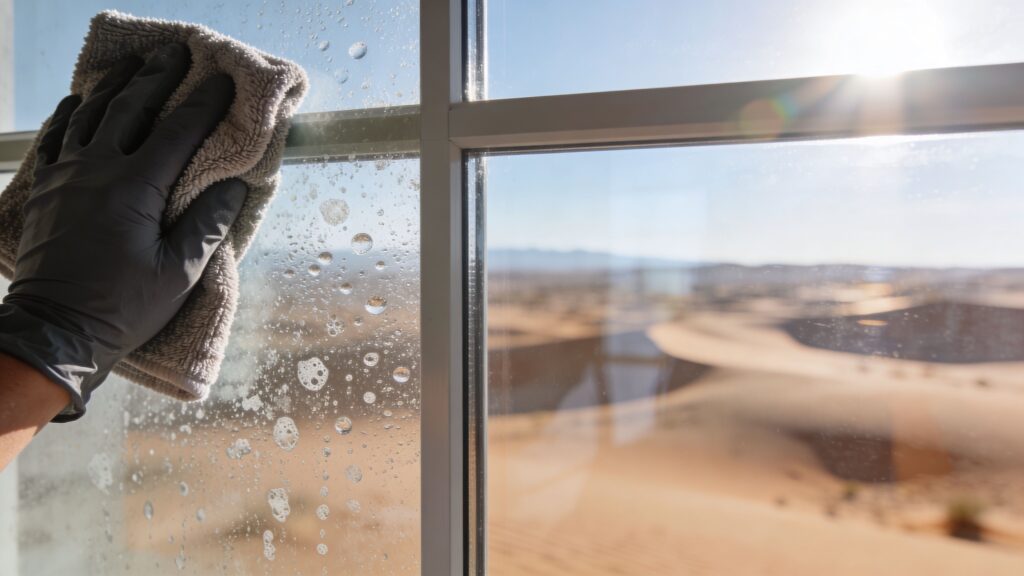
You wash the glass. The sun hits it an hour later. The spots are still there.
That’s the Arizona version of “clean windows.” A lot of homeowners in Phoenix think they’re dealing with dust, bad soap, or a sloppy rinse. More commonly, the core problem is mineral-heavy water that dries fast and leaves glass looking chalky, hazy, or permanently dull.
I work in the Phoenix Valley, and window water spots here behave differently than they do in softer-water areas. They bake on faster, they etch sooner, and they don’t stop at house windows. The same mineral buildup shows up on solar panels, glass railings, screens, and trim. If you treat every spot the same way, you’ll either waste time or damage the surface you’re trying to save.
The Primary Reason Your Windows Are Consistently Spotty
If your sprinklers hit the glass in the morning, Arizona sun can turn that overspray into visible spotting before you’ve finished your coffee.

The issue isn’t “water” by itself. It’s hard water, which carries dissolved minerals, mostly calcium and magnesium. When the water evaporates, those minerals stay behind and bond to the glass. In Phoenix, that process happens fast because heat accelerates drying and gives the deposits less time to run off.
Why Phoenix glass gets hit harder
In the Phoenix Valley, water hardness can reach high levels, and at those levels water spots can form quickly. Left untreated, they can reduce natural light transmission by 15% and shorten a window’s lifespan by 10 to 15 years (Sparkle Tech Window Washing).
That’s why a quick hose rinse often makes things worse. You remove loose dust, but you lay down another mineral layer as the water dries.
A lot of homeowners notice the problem after:
- Sprinkler drift: Irrigation heads clip the lower panes every day.
- Washdowns with tap water: The glass looks clean wet, then spots return once it dries.
- Light rain after dust: Rain mixes with airborne dirt and leaves a gritty mineral film.
Practical rule: If the marks disappear when the glass is wet and reappear when it dries, you’re usually looking at mineral residue, not ordinary dirt.
It’s not just a window issue
Hard water leaves the same kind of deposits on RV glass, shower glass, solar panels, and exterior railings. If you’re dealing with mineral-heavy water across multiple surfaces, it also helps to understand broader water treatment options like these RV water softeners, because the principle is the same. Reduce mineral load before the water dries.
The mistake I see most is waiting too long. Fresh spots are a cleaning problem. Old spots become a restoration problem. Once minerals start etching into the surface, you’re no longer just wiping off residue. You’re trying to reverse damage.
Your First Line of Defense Against Mild Water Spots
Fresh spots deserve a gentle first pass. Don’t start with aggressive chemicals or abrasive pads if the spotting is recent and light.

For many homeowners, the simplest starting point is a vinegar solution. It won’t solve every case, but it can loosen mild mineral residue without a lot of risk.
What to use
Keep the setup basic:
- White vinegar: The active ingredient that helps break down light deposits.
- Distilled water: Better than tap water for mixing and rinsing because it won’t add new minerals.
- Spray bottle: Any clean bottle with an even mist works.
- Microfiber cloths: Use one for application, one for drying.
- Optional non-abrasive sponge: Useful when the spot has a little buildup.
If you’re trying to keep the whole process lower-toxicity, this guide to natural cleaning products for your home is a solid reference for choosing cleaners and materials that are less harsh around the house.
How to clean mild window water spots
Mix equal parts white vinegar and distilled water. Then work in this order:
- Choose the right time. Clean when the glass is cool. Early morning shade is better than direct afternoon sun.
- Spray the affected area well. Don’t mist lightly. You want the mineral film wet enough to soften.
- Let it sit briefly. Give it a little dwell time so the vinegar can do some work.
- Wipe with a microfiber cloth. Use overlapping passes rather than random circles.
- Rinse with distilled water. This matters more than people think.
- Dry immediately. A clean microfiber or a good squeegee keeps the residue from re-drying on the surface.
What this method does well and where it falls short
Vinegar is a first-step method. It’s good for fresh spotting and light haze. It’s not the tool for thick, layered deposits or etched glass.
You can tell it’s time to move on if:
- The glass feels rough after cleaning
- The spots look white or crusty at an angle
- You see a dull outline that doesn’t change after repeated cleaning
Mild spots often come off with patience. Etched spots don’t. They may lighten, but they won’t disappear with household spray alone.
A quick demonstration helps if you want to see the basic technique in motion:
Two common DIY mistakes
| Mistake | What happens |
|---|---|
| Cleaning hot glass | The solution dries too fast and leaves more residue |
| Using paper towels | You smear loosened minerals and leave lint behind |
If the glass improves after one or two careful attempts, keep going. If it barely changes, stop escalating with elbow grease alone. That usually means the mineral bond is stronger than the vinegar.
Tackling Severe and Etched-In Mineral Stains
Once vinegar stops helping, you need to decide whether the stain is built up on top of the glass or etched into it.
Built-up deposits feel gritty or raised. Etching looks more like a cloudy shadow or dull patch that stays even after the surface feels smooth. Those are two different problems, and they respond to different methods.

When stronger chemistry makes sense
For stubborn mineral buildup, commercial hard water spot removers with oxalic acid show 85 to 95% removal success on 1 to 3 year buildup. The method involves applying a 10% oxalic acid paste, agitating in tight circles for 2 to 5 minutes, and rinsing thoroughly with deionized water. That success rate is markedly higher than vinegar, which has 45% efficacy (Hillyard).
That’s the difference between a household acid and a purpose-built mineral remover. Vinegar can help with fresh deposits. Oxalic acid is designed to chelate mineral buildup more aggressively.
Safe way to use a commercial remover
Here, discipline matters more than force.
- Test first: Check a small, less visible area before doing the full pane.
- Wear gloves and eye protection: These products are meant to react with deposits. Treat them accordingly.
- Apply with microfiber or a non-abrasive sponge: Don’t use anything that can leave deep scratches.
- Work in tight circles: Small, controlled motion beats broad scrubbing.
- Never let the product dry on the glass: Especially in Phoenix heat.
- Rinse thoroughly: A deionized or purified rinse leaves a much cleaner finish than tap water.
Acid removers are for mineral contamination. They are not “stronger glass cleaner.” Use them only where mineral spotting is the actual problem.
Where steel wool fits
Professional cleaners sometimes use #0000 steel wool on suitable glass as a controlled mechanical aid. It can help break loose mineral crust after the surface is lubricated with the right cleaner.
Use caution here. Steel wool isn’t appropriate for every surface, and it’s a bad choice if you’re guessing about coatings, tint, or existing damage.
A simple decision guide helps:
| Surface condition | Better first move |
|---|---|
| Chalky deposit sitting on top | Commercial mineral remover |
| Smooth but cloudy glass | Assess for etching |
| Low-E coated or uncertain surface | Test first, go conservative |
| Deep white crust at sprinkler line | Chemical removal before any abrasive help |
What usually goes wrong
Most DIY damage comes from one of three habits:
Over-scrubbing
People assume pressure equals progress. On glass, pressure can leave haze or fine scratches.
Mixing methods randomly
A harsh pad, a random cleaner, and direct sun is a bad combination.
Treating etching like residue
If the mineral has already changed the surface, scrubbing won’t fully restore it.
There’s also a practical middle ground. Some homeowners can remove the deposit layer and live with a faint etched shadow. Others want full restoration, which may require professional polishing or replacement depending on severity.
The key is honesty. If you’ve cleaned it carefully and the mark still looks embedded in the glass, the problem isn’t dirt anymore.
Protecting Your Solar Panels and Glass Railings
In Phoenix, I see this all the time. The windows get attention, but the solar panels and glass railings keep taking hard water abuse until the problem is expensive, obvious, or both.
These surfaces deal with the same mineral-heavy water as your windows, but the stakes are different. Panels lose efficiency when residue builds up. Railings lose clarity fast, especially around pools, second-story balconies, and patios with constant overspray.
Solar panels lose performance when minerals stay on the glass
Arizona sun is brutal on deposits. A light film that looks harmless in the morning can bake onto panel glass by afternoon, especially if someone rinsed the array with hard tap water and let it dry on the surface.
That residue blocks clean light transmission and leaves you with a panel that looks only slightly dirty but works below its potential. The mistake I see most is treating panels like outdoor furniture. Homeowners spray them off, the water evaporates, and the mineral layer gets worse.
Safe cleaning matters here because panel glass, frames, seals, and electrical components all limit what you can use and how aggressive you can be. If you want the process spelled out, this guide on how to clean solar panels covers the right approach.
Glass railings have their own problems
Railings catch everything Phoenix throws at them. Sprinkler mist. Pool splash. Dust from wind. Hand oils. Hard water on top of all that.
The result is a cloudy film that stands out even more than it does on windows because railings sit at eye level and reflect light differently. On stair landings and pool decks, heavy residue can also leave the surface slicker when wet. That is a real safety issue, not just a cosmetic one.
Clear railings matter. You want clean sightlines, a dry feel, and no crust building up around the edges or hardware.
Use the right method for each surface
The trade-off is simple. Push too hard, and you can damage expensive glass or coatings. Go too light, and the deposits keep baking in.
For solar panels and railings, avoid these common mistakes:
- Aggressive scraping: It can score the glass or damage specialty surfaces.
- Strong chemicals left to dwell too long: Frames, gaskets, and edge materials often react before the glass does.
- Cleaning in direct heat: Products dry too fast in Arizona sun and leave fresh residue behind.
- Using the same process you use on standard windows: Panel glass and railing systems often need a more controlled method.
If spotting has spread beyond your windows, treat it like a whole-property hard water problem. On solar panels, that buildup costs output. On glass railings, it affects appearance, visibility, and footing.
Smart Prevention Strategies to Keep Spots Away for Good
The cheapest water spot removal job is the one you never have to do.
In Arizona, prevention beats cleanup because the environment keeps feeding the same cycle. Heat, irrigation overspray, dust, and mineral-heavy water will keep rebuilding the problem unless you interrupt it.

Start with the obvious source
The first question I ask on exterior spotting jobs is simple. Are the sprinklers hitting the glass?
If the answer is yes, fix that before you buy another cleaner.
- Adjust sprinkler heads: Change angle, distance, or spray pattern so mist doesn’t reach windows or railings.
- Watch the timing: Running irrigation during windy periods sends overspray farther than people expect.
- Check hose habits: A final rinse with ordinary tap water often recreates the spotting you just removed.
Add a barrier after cleaning
Once the glass is properly cleaned, a protective treatment can make future spotting easier to manage. Hydrophobic products help water bead and roll off instead of drying flat on the surface.
There’s a useful distinction between how different glass-friendly coatings behave, and this overview of the difference between hydrophilic and hydrophobic glass lays that out clearly.
The trade-off is practical:
| Prevention method | What it does | Limitation |
|---|---|---|
| Sprinkler adjustment | Stops repeat overspray at the source | Doesn’t help with rain or wash water |
| Distilled or purified rinse | Leaves less mineral residue | Less practical for large jobs |
| Hydrophobic coating | Makes maintenance easier | Needs reapplication over time |
| Whole-home softening | Reduces mineral load across the property | Bigger upfront commitment |
Think year-round, not just summer
Consumer demand for water spot removal products follows a seasonal pattern, with search interest peaking during summer, especially in August, which is one reason year-round prevention usually makes more sense than seasonal cleanup alone (Accio).
That lines up with what happens on the ground. Summer means more washing, more outdoor maintenance, more evaporation, and more visible spotting.
If your plan is “I’ll clean it when it gets bad,” you’ll always be reacting. A better plan is to stop the next round before it dries.
A workable prevention routine
You don’t need a complicated system. You need consistency.
Try this rhythm:
- Monthly exterior walkaround: Look for sprinkler lines on lower panes, railings, and screens.
- Prompt cleanup after overspray: Fresh spots come off easier than baked-on ones.
- Purified-water rinse when possible: Especially on delicate or highly visible glass.
- Protect high-hit areas: Lower windows near turf and planters usually need the most attention.
That approach isn’t flashy, but it works. Most bad window water spots start as small repeat exposures that nobody interrupts.
When to Call a Professional Window Cleaner
Some jobs stop being DIY long before homeowners admit it.
If the glass is high, heavily etched, or connected to specialty surfaces, forcing the issue usually costs more in the end. At that point, the question isn’t whether you can scrub harder. It’s whether your method matches the problem.
The line where DIY stops making sense
Call for help when you’re dealing with:
- Hard-to-reach glass: Second-story windows, large entry glass, or awkward exterior panels.
- Etched stains that stay after cleaning: The deposit may be gone, but the damage remains.
- Sensitive surfaces: Low-E glass, solar panels, or glass near trim and frames you don’t want to stain.
- Recurring spotting after every wash: The rinse water itself may be the source of the problem.
A lot of homeowners also underestimate the safety side. Ladders, wet surfaces, chemicals, and oversized panes are a bad mix when you’re already frustrated.
What professionals do differently
Professional pure water filtration systems used by services like Sparkle Tech Window Washing achieve 95 to 100% spot-free results by reducing water TDS levels to below 10 ppm. Industry benchmarks show 98% client satisfaction with this method in hard water areas, versus 60 to 70% for traditional squeegee methods (Unger Global).
That matters in Phoenix because the final rinse is often where DIY cleaning fails. If you wash with mineral-heavy water, you can remove dirt and still leave spots behind as the glass dries.
Professionals also use water-fed poles and purified rinse systems to clean from the ground on many jobs. That improves safety and reduces the chance of ladder damage around landscaping, screens, or trim.
If you’re deciding whether to stop
Ask yourself three questions:
- Is the stain improving, or am I just repeating the same process?
- Am I confident this surface can handle the product or tool I’m using?
- Would a mistake cost more than a service call?
If the answers point toward risk, stop. This guide on knowing when to call a professional window washing company is a practical benchmark for that decision.
A good pro doesn’t just clean the glass. They identify whether the issue is residue, etching, bad rinse water, overspray, or a mix of all four.
Frequently Asked Questions About Window Spots
Will vinegar damage window tint or Low-E coatings
Sometimes, yes. The risk is highest when the glass has a film, a factory-applied coating, or damage around the edges that lets cleaner work its way underneath.
On plain exterior glass, diluted vinegar can help with light mineral residue. On tinted patio doors, certain dual-pane windows, and some specialty glass, I treat vinegar as a maybe, not a default. If you do not know what is on the glass, test a small corner first and keep the solution off frames, seals, and edges.
How often should Phoenix homeowners check for window water spots
Use your irrigation schedule as the trigger, not the calendar.
Check within a day or two if:
- sprinklers were adjusted
- a broken head sprayed the house
- monsoon dust mixed with irrigation overspray
- hard water hit solar panels or glass railings as well as windows
In Phoenix, fresh spots are much easier to remove than deposits that have baked on for weeks.
Can I use a razor blade to scrape off water spots
Only on the right glass, with the right technique, and after the surface is fully wet and free of grit. Even then, a razor is for isolated debris, paint specks, or construction residue more than mineral spotting.
What catches homeowners is tempered glass. Some tempered panes have fabrication debris that can drag and scratch during scraping. Glass railings can have the same risk. If you are not sure what type of glass you have, scraping is a poor gamble.
Why do the spots come back right after I clean the window
Two causes show up over and over in Phoenix homes. The first is the water source never changed, so the glass dried with minerals on it again. The second is residue from the cleaning step itself, especially if soap, hard tap water, and sun all hit the glass at once.
Solar panels add another wrinkle. A panel can look cleaner from the ground and still lose performance if mineral film remains on the surface. The same hard water that spots your windows can leave a stubborn haze on panels and exterior glass features around the property.
Are cloudy marks always removable
No. A quick field check helps.
If the mark changes when the glass is wet but returns as it dries, that usually points to surface deposit. If it stays dull no matter what and the glass feels smooth, the minerals may have already etched the surface. At that point, more scrubbing usually adds risk, not improvement.
If your windows, solar panels, or glass railings keep spotting no matter what you try, Sparkle Tech Window Washing handles hard-water cleanup and purified-water maintenance for Arizona properties. If you’re not sure whether you’re dealing with fresh deposits or etched glass, getting the surface assessed first can save you a lot of time and prevent expensive mistakes.