

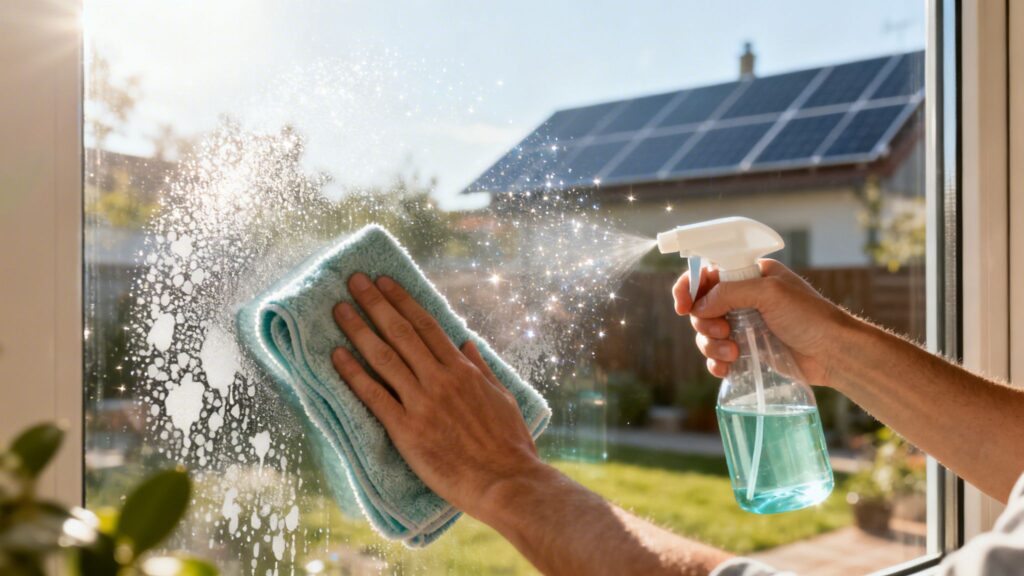
If you’ve ever noticed those stubborn, milky splotches on your windows that no amount of Windex seems to remove, you're dealing with hard water spots. They're the ghosts of water droplets past—chalky mineral deposits left behind long after the water itself has evaporated.
This is a huge headache, especially in areas with hard water. But these spots are much more than just an eyesore. If you let them sit for too long, the minerals can actually bond with your glass and cause permanent damage.
Why Your Windows Have Stubborn Water Spots
So, where do these frustrating marks come from? The main culprit is hard water, which is just a term for water that’s packed with dissolved minerals like calcium and magnesium.
When water from a sprinkler, a hose, or even just mineral-rich rain lands on your window, the sun and air get to work evaporating the H₂O. The problem is, those heavier mineral particles get left behind. They have nowhere to go, so they stick to the glass, forming that all-too-familiar chalky film.
The Science Behind the Stain
What’s really happening here is a chemical process, not just a bit of dirt. Glass might feel perfectly smooth to the touch, but it's actually a porous surface on a microscopic level. The minerals from the hard water seep into these tiny pores. Over time, the alkaline minerals start a chemical reaction, bonding directly with the silica in the glass itself.
This progression from a simple spot to permanent damage creates a few headaches:
- It Ruins Your View: At first, the spots are just ugly. They cloud your view and can make a perfectly clean home look neglected.
- It Leads to Etching: As those mineral deposits sit, they begin to corrode the glass surface. This is called etching, and it's physical damage that can't just be washed away.
- It Attracts More Grime: The rough, textured surface of mineral buildup is a magnet for dirt, dust, and other pollutants. This means your windows will get dirtier, faster.
The problem is more widespread than you might think. Industry data shows that up to 85% of households in the southwestern U.S. struggle with hard water spots every year. Left untreated, this can shorten a window's lifespan by a staggering 20-30%.
The glass itself also plays a part. Some types of glass have surface properties that can either repel or attract water. To really dive into the details, you can learn about the difference between hydrophilic and hydrophobic glass and see how it impacts staining. The key takeaway is to act fast on water spots on windows—the sooner you tackle them, the better your chances of preventing permanent damage.
How to Diagnose Your Water Spot Damage
Before you reach for any cleaner or start scrubbing, you need to know exactly what you're up against. Not all water spots are the same, and what works for a minor stain could be a complete waste of time on a more serious one—or worse, it could scratch your glass.
Taking a moment to diagnose the severity is the most important step. It tells you whether you're dealing with a simple surface stain or something that has started to damage the glass itself. Thankfully, this is easier than it sounds.
The Fingernail Test
All you need is your own fingernail. It’s a surprisingly effective tool for gauging the extent of the mineral buildup.
Gently run your fingernail across one of the spots. Pay close attention to what you feel.
- Feels completely smooth: You’re in luck. The minerals are just sitting on the surface and haven’t bonded with the glass yet. This is Stage 1 damage, and it’s the easiest to remove.
- Feels slightly gritty or bumpy: The minerals have begun to bond and are creating a textured layer. This is Stage 2 damage. It’s still treatable, but it’s going to take more than a basic window cleaner to break down the deposits.
- Feels rough, pitted, or seems hazy even when clean: This is a red flag. The minerals have corroded the glass, causing permanent etching. This is Stage 3 damage, and it’s usually beyond what a DIY approach can fix without risking further harm.
Think of it like this: Stage 1 is just dirt on the glass, while Stage 3 is damage to the glass. The goal is always to intervene before a simple surface issue becomes a structural problem.
This diagram shows how quickly those innocent-looking water droplets from a sprinkler or rain can turn into a real headache.

As the water evaporates, it leaves behind a concentrated patch of minerals that starts bonding to the surface. Over time, this process is what causes the staining and eventual corrosion.
Matching Water Spot Severity to the Right Solution
Now that you’ve done the fingernail test and identified the stage of damage, you can choose the right tool for the job. You wouldn't use a sledgehammer to hang a picture frame, and you don't want to use an abrasive compound on a light surface stain.
Use this guide to match the stage of water spot damage with the most effective removal method, from simple DIY solutions to professional intervention.
| Stage of Damage | Visual Cues & Feel | Recommended Action |
|---|---|---|
| Stage 1 | Faint, whitish spots that disappear when wet. Feels smooth to the touch. | DIY methods like vinegar/water solution, or a dedicated mild hard water spot remover. |
| Stage 2 | More defined, opaque spots that remain visible when wet. Feels slightly gritty. | Commercial hard water removers, mild abrasives like a non-scratch pad, or a professional-grade mineral spot remover. |
| Stage 3 | Glass appears cloudy, hazy, or rough even after cleaning. Feels pitted or bumpy. | Professional polishing with a cerium oxide slurry and machine buffer. DIY attempts are not recommended. |
Choosing your method based on this table will save you time and frustration, ensuring you use a solution that’s strong enough to work without being so aggressive it damages the glass.
What to Do About Light Mineral Stains
Good news. If you've caught those spots early and they feel smooth to the touch (what we call Stage 1), you can often get your glass crystal clear again using things you probably already have in your pantry. The idea is to use a mild acid to gently dissolve the mineral deposits without scratching the glass.
For this, we turn to an old-school, tried-and-true method.
The Classic Vinegar Solution
Your best starting point is a simple mix of distilled white vinegar and water. The acetic acid in vinegar is just the right strength to break down the chalky calcium and magnesium deposits that cause those cloudy marks.
Grab a clean spray bottle and mix a 50/50 solution of white vinegar and distilled water. I can't stress this enough: use distilled water. Using regular tap water just puts more minerals back onto the window, which is the very problem you're trying to solve.
Spray the solution generously onto the spots. You want the glass to be wet, but not dripping everywhere. Let it sit for a minute or two—you need to give the acid time to work, but don't let it dry on the glass. Then, take a clean microfiber cloth and wipe with firm, circular motions.
A Pro Trick: For really stubborn spots, soak a small towel in the vinegar mix, wring it out slightly, and press it directly against the glass. Hold it there for about 5-10 minutes. This constant contact gives the vinegar a much better chance to dissolve those tougher deposits.
Once the spots are gone, always finish by buffing the glass with a separate, clean, and completely dry microfiber cloth. This two-cloth system—one for cleaning, one for drying—is the secret to a streak-free shine.
When Vinegar Isn't Quite Enough
Sometimes, you’ll find spots that just won't budge, no matter how much vinegar you use. If you've tried the soak and scrub method and still see faint outlines, it's time to step up to a dedicated hard water spot remover. These are cleaners made specifically for this job and have a bit more chemical muscle than plain vinegar.
When you're picking a product from the store, aim for a non-abrasive liquid or cream. And before you start, a few words of caution:
- Wear Gloves: These formulas are stronger, so it's smart to protect your hands.
- Do a Test Spot: Always try the cleaner on a small, hidden corner of the glass first. You want to make sure it doesn’t etch or discolor anything.
- Get Some Airflow: Open some other windows or a door. You don't want to be breathing in those fumes in a closed-off space.
Even with the right products, technique makes all the difference. It's interesting to note that in North America, which accounts for 37.52% of the global cleaning services market, improper rinsing is a huge problem. It affects an estimated 70% of DIY attempts, often leaving windows looking worse and forcing homeowners to call in an expert.
With the U.S. residential window cleaning industry growing by 4.2% each year, it's clear that getting a perfectly clean finish is harder than it looks. Here in the Phoenix Valley, the combination of hard water and intense sun creates the perfect recipe for stubborn spots, making professional help the quickest path to clear views. For more on the industry, you can explore data on the cleaning services market and its trends.
Advanced Techniques for Stubborn Buildup

So, your vinegar spray didn't make a dent. If you're looking at gritty, almost opaque spots that feel rough to the touch, you've moved past simple cleaning. This is what we call Stage 2 damage, where minerals have physically started to bond with the glass.
At this point, a chemical cleaner alone won't cut it. You need to introduce a mild abrasive to physically break that bond. But—and this is the most important part—you have to do it right to avoid scratching the glass.
The absolute key is lubrication. Never, ever take an abrasive pad to a dry window. Keeping the glass soaking wet with water or a cleaning solution is what lets the abrasive scrub off the minerals without digging into the glass itself.
Using #0000 Steel Wool Safely
I know what you're thinking: steel wool on glass? It sounds like a recipe for disaster. But believe it or not, #0000 grade steel wool is your best friend for this job. It’s the finest grade available, and its fibers are actually softer than glass. When used with plenty of lubrication, it’s amazing at shearing off mineral deposits without leaving a scratch.
Start by drenching the window with your cleaner or just plain water. Take a small pad of the #0000 steel wool, get it wet too, and start working on a small test area. Use gentle, circular motions. You’ll feel a gritty resistance at first, which should gradually smooth out as the minerals break down.
Rinse the area often with a squeegee or a wet rag to check your work. Once the spots are gone, give the window a final, proper cleaning to get rid of any residue and dry it completely. For many tough water spots on windows, this method is a complete game-changer.
A Pro Tip: Let the tool do the work. If you feel like you're putting your whole body into scrubbing, you’re either using the wrong grade of steel wool or the damage is too severe for this technique.
When to Use a Polishing Compound
If even the steel wool isn’t enough, it’s time to bring out a specialized glass polishing compound. These are typically light abrasive pastes containing an ingredient like cerium oxide, which basically exfoliates the surface of the glass on a microscopic level.
You’ll apply a dab of the compound to a non-scratch applicator pad and work it into the glass in small, overlapping circles. This isn't a fast process; it takes patience and consistent, even pressure to slowly grind down the baked-on minerals.
These exact principles are used by professionals in other fields, too. The techniques for removing stubborn mineral buildup and hard water stains on other surfaces like pool tiles are surprisingly similar to what we do for heavily damaged glass.
This whole problem of etched-in mineral stains became widespread in the 1980s and '90s. As energy-efficient double-glazing became standard, it was found to trap minerals 25% more effectively, leading to spots in an estimated 75% of U.S. homes.
Here in Arizona's Phoenix Valley, where water hardness can be as high as 250-300 ppm, these spots can form in under 10 minutes. Left alone, they can cut natural light by 15% and even reduce the lifespan of your glass by 10-15 years. That's why Sparkle Tech Window Washing's pure-water system, which can cut new spot formation by 95%, is so critical for homeowners in this area.
Knowing When to Call a Window Cleaning Pro
While it's great to tackle home projects yourself, there comes a point with mineral stains where the best DIY move is to pick up the phone. Knowing your limits is key. It can be the difference between a simple cleaning and an expensive restoration project, especially if you accidentally damage the glass.
So, when is it time to call in the pros? The biggest red flag is what we in the business call Stage 3 damage. If you run your hand over the glass and it feels rough, pitted, or has a permanent haze that won't budge, the minerals have started to corrode the surface. At this stage, you're not just cleaning a stain anymore—you're dealing with etched glass. Trying to scrub this out with aggressive pads or harsh chemicals almost always leads to a window full of scratches.
The Professional Advantage in Equipment and Safety
When we at Sparkle Tech Window Washing show up to a home with etched water spots on windows, we don't bring vinegar. We roll out professional-grade mechanical polishers and specialty compounds designed to gently resurface the glass without leaving swirls or distortion. It’s a delicate process that requires a skilled hand and the right tools to get that perfectly clear, factory-new finish.
Safety is another huge piece of the puzzle. Are the stained windows on the second story? What about that massive picture window above the entryway or the glass railing on your deck? Getting up on a ladder with cleaning supplies is always a risk.
Hiring a bonded and insured professional like Sparkle Tech Window Washing transfers all that risk from you to us. Our crews are trained to work safely at heights, and our insurance covers your property, giving you peace of mind.
Beyond the polishers, our most effective weapon against mineral spots is a technology most homeowners don't have access to: a pure water system. We use a sophisticated, multi-stage filtration process that strips water of 100% of the dissolved minerals that cause spots in the first place. You can discover the science behind our water-fed pole window cleaning system and see why this is such a game-changer.
This pure water technology is absolutely essential for delicate surfaces like solar panels. Mineral buildup doesn't just look bad; it can drastically cut down on your energy production. Using the wrong cleaning technique can even void your warranty. Our water-fed poles let us scrub and rinse your panels from the safety of the ground, leaving a spot-free surface that maximizes their efficiency.
When the stakes are that high—whether it’s protecting your windows, your safety, or your solar investment—calling an expert isn’t giving up. It’s making a smart decision.
How to Prevent Future Water Spots on Windows

You’ve put in the work to get your windows sparkling clean. So, how do you keep them that way? The secret isn’t more cleaning—it's smart prevention. An ounce of prevention is truly worth a pound of cure, especially when it comes to saving yourself from scrubbing away mineral deposits later on.
The number one cause of water spots on windows, particularly here in Arizona, is almost always the sprinkler system. A single misdirected sprinkler head can douse a window day after day, baking hard water minerals onto the glass in the sun. It's a relentless cycle, but thankfully, it's an easy one to break.
Control Your Water Sources
Before you do anything else, you need to identify and manage any water that’s hitting your glass. Think like a detective: where is the water coming from, and how can you stop it?
- Audit Your Sprinklers: Turn on your irrigation system and take a walk around your property. Watch exactly where the water lands. Often, a tiny adjustment to a sprinkler head is all it takes to keep the spray pattern off your windows and glass railings.
- Wipe Down Overspray Immediately: Washing your car or hosing down the patio? That overspray will leave spots. Keep a squeegee or a clean microfiber cloth handy and give any affected glass a quick wipe before the sun has a chance to do its work.
- Manage Pool and Spa Splash: If you have windows near a pool, they’re getting hit with chlorinated water. Make it a habit to wipe them down regularly to stop those tough, chemical-laden spots from forming in the first place.
Building these simple habits into your routine can dramatically cut down on new spot formation.
Apply a Hydrophobic Sealant
For next-level protection, a hydrophobic glass sealant is one of the best tools in your arsenal. These treatments create an invisible, super-slick coating on the glass surface. Water can't cling to it; instead, it beads up and rolls right off, taking dirt and minerals along for the ride.
This is a true game-changer for keeping glass clean. By making the surface too slippery for water to stick, a good sealant effectively stops mineral spots before they can even begin to form. Your windows stay clearer, for much longer.
Application is usually a simple spray-on, buff-off process. It's not a permanent fix—you’ll need to reapply it every few months—but it's an incredibly effective barrier against the elements.
Ultimately, the most reliable long-term strategy is to partner with professionals who use purified water. A pro cleaning doesn’t just remove the spots you have; it leaves behind a perfectly clean slate with zero mineral residue, something that’s nearly impossible to achieve with tap water. This resets the clock on spot formation. If you want to see how the pros get that flawless, spot-free finish, you can learn more about pure water window cleaning and why it’s so effective.
Common Questions We Hear About Water Spots
Even after you've got a game plan, a few questions always seem to come up when tackling water spots. As a pro who's seen it all, let me clear up some of the most common points of confusion for homeowners.
So, Can I Just Use Windex on These Spots?
It's tempting to grab that familiar blue bottle, but for hard water stains, it’s a waste of time. Your standard glass cleaner is great for things like fingerprints and everyday dust, but it doesn't have the muscle to break down mineral deposits.
The tough spots you're seeing are caked-on calcium and magnesium. To beat them, you need something that can dissolve those minerals, which means either a mild acid (like our 50/50 vinegar solution) or a cleaner specifically formulated for hard water. A regular cleaner will just leave you with a smeared, still-spotted window and a lot of frustration.
Are Water Spots Really Going to Damage My Windows?
Unfortunately, yes. If you let them sit for months or years, they can cause permanent damage. We see it all the time. Over time, the minerals don't just sit on the glass; they start a chemical reaction that corrodes the surface. This is called etching.
This is what we call Stage 3 damage. At this point, you're no longer dealing with a stain on the glass, but physical damage to the glass itself. It often leaves a permanent haze that you can't wash off, and the only fix is professional-grade polishing or, in the worst cases, replacing the window entirely. That's why catching these spots early is so important.
What About My Tinted Windows? Is It Safe to Clean Them?
This is where you have to be extra careful. Most window tint is a thin film applied to the inside of your glass, and it's surprisingly delicate. Using anything abrasive—from #0000 steel wool to harsh chemical removers—can easily scratch, bubble, or peel the tint right off.
If you have aftermarket tint on your windows, play it safe.
- Always start with the gentlest method: a 50/50 mix of distilled water and white vinegar.
- Never, ever use an abrasive pad, polishing compound, or razor blade.
- Before you do anything, test your cleaning solution on a small, hidden corner to see how the film reacts.
If that gentle approach doesn't cut it, don't push your luck. It's much cheaper to call a professional than it is to replace a ruined window tint.
Don't let stubborn water spots on windows get the best of you or cause costly damage. For a perfect, streak-free result that protects your glass for the long haul, sometimes you need to call in the experts. Sparkle Tech Window Washing provides safe, professional cleaning for windows, solar panels, and more. Schedule your service today and see the difference a pro can make.