

You walk outside, look up, and see exactly where the problem starts. The second-story windows have a film on them. The glass railing is spotting. The skylight catches the sun and shows every streak. If you're managing a commercial property, the problem gets bigger fast. Upper-floor glass collects dust, runoff, and hard water residue, and nobody wants to explain why the front elevation looks neglected.
Ladders are a common initial thought. That instinct makes sense, but it usually points in the wrong direction. Once height, rooflines, landscaping, parapets, solar panels, or fragile surfaces get involved, the primary question isn't how to reach the glass. It's how to reach it safely, repeatably, and without damaging the building.
That is where window washing platforms come in. These aren't just for skyscrapers. They include suspended systems, davits, aerial lifts, and hybrid access setups that professionals match to the building. On taller structures, the market has expanded because owners and developers increasingly need engineered access systems. The market for building-mounted window-cleaning systems reached approximately USD 2,067.5 million in 2024 and is projected to reach USD 5,930.91 million by 2032, with growth tied to safety rules that increasingly require permanent or semi-permanent access platforms for structures over roughly 75 to 100 feet, according to Credence Research's building window cleaning systems market report.
For a homeowner, that may sound far removed from everyday maintenance. It isn't. The same principle applies at every scale. Good access equipment protects the worker, the property, and the finish.
The View from the Ground Up
A homeowner usually notices the issue from the driveway. A property manager notices it from the curb before a tenant or client does. In both cases, the reaction is similar. The glass is dirty, it's too high to handle comfortably, and the obvious tools don't look like enough.
Professionals don't solve that by bringing a taller ladder and hoping the angle works. They solve it by choosing access equipment built for the shape of the property. A narrow side yard needs a different plan than a flat-front office building. A home with solar panels, sloped roofing, and glass railings needs a different setup than a mid-rise with roof anchors and open staging areas.
Why height changes the whole job
Once a building gets tall enough, access becomes an engineering problem as much as a cleaning problem. The platform, support points, load rating, operator protection, and rescue planning all matter. That is one reason permanent and semi-permanent systems have become common on larger buildings.
Dirty upper glass often looks like a cleaning issue from the ground. Up close, it's usually an access and safety issue first.
Owners who understand that make better decisions. They ask smarter questions. They stop comparing a licensed crew with engineered access equipment to a handyman with a ladder, because those are not the same service.
What a professional sees that most owners don't
A trained crew looks at more than height. They look at:
- Roof access: Can the crew rig safely from the roof, or is the building better served from the ground?
- Facade shape: Deep setbacks, fins, overhangs, and railings change what platform works.
- Surface sensitivity: Coated glass, solar panels, and specialty railings can be damaged by the wrong brush or pressure.
- Ground conditions: Soft landscaping, slopes, entry canopies, and tight drive aisles can rule out some machines.
That difference in perspective is what separates a clean-looking result from a risky one.
The Six Main Types of Window Washing Platforms
Some window washing platforms are permanent parts of the building. Others are brought in for a day and removed when the work is done. The right choice depends on the structure, the task, and how much control the crew needs over height and position.

Suspended platforms
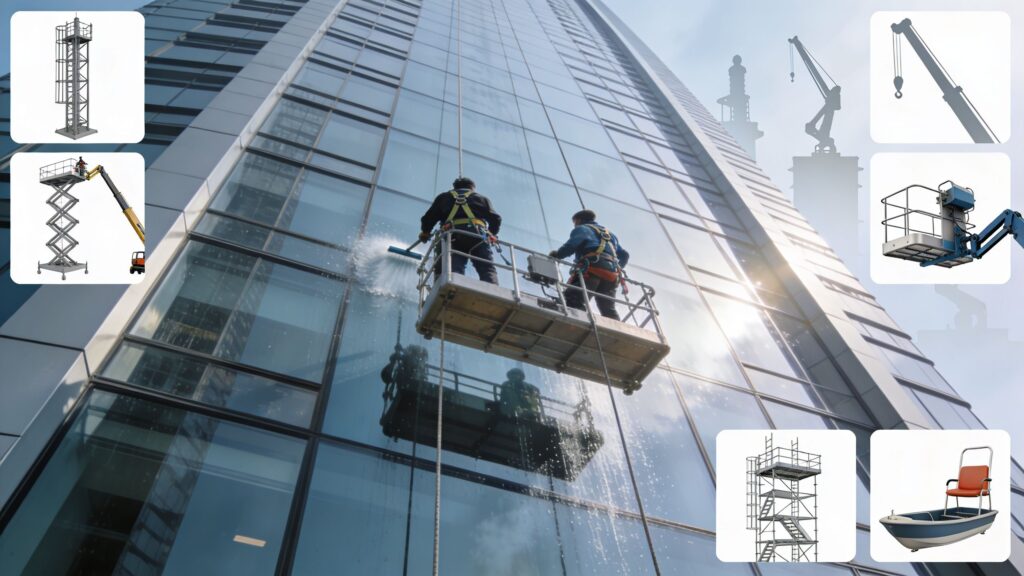
This is the setup many people picture first. A suspended platform, often called a swing stage, hangs from the roof and moves vertically with powered hoists. It's basically a temporary balcony that can travel up and down the face of the building.
For larger commercial facades, suspended systems are a workhorse. Some platforms, such as the ZLP800 configuration, can support up to 800kg and span 7.5m, which allows a multi-person team and tools to work efficiently on tall facades, as shown in the ZLP800 suspended working platform specification.
Best use: long vertical drops on buildings with suitable roof rigging.
Trade-off: excellent reach, but setup and rigging have to be exact.
Davit-supported systems
A davit system uses crane-like arms mounted at the roof edge or in designated bases. Those arms suspend the platform so the crew can clear parapets and descend along the facade. On many buildings, davits are the cleaner and more controlled way to support a suspended platform.
These systems make sense where owners want repeatable access points instead of rebuilding a rigging plan every service cycle. They can also help on buildings where roof-edge conditions complicate direct suspension.
Building maintenance units
A building maintenance unit, or BMU, is the fully integrated version. It's a permanent machine, often on roof tracks, designed into the building. Think of it as a dedicated facade access system rather than rented equipment.
BMUs make the most sense on towers with extensive glass, frequent maintenance needs, or strict access requirements. They cost more upfront than temporary gear, but they bring consistency.
Bosun's chairs and single-person suspended seats
These are compact suspended seats for one worker, sometimes used for narrow access points or detail work. They have a place in the trade, but they are not the answer for every facade.
A single-worker setup can be efficient on tight sections. It is not ideal where the crew needs to carry more tools, handle larger areas, or manage complex rinsing and detailing.
Practical rule: If the facade needs steady movement, multiple tools, and repeatable production, a full suspended platform usually beats a single-person chair.
Aerial work platforms
This category includes boom lifts and scissor lifts. These are ground-based machines that raise the operator to the work. They are often the best option on low-rise and mid-rise properties where the machine can physically reach the glass.
Boom lifts handle outreach better than scissor lifts. Scissor lifts are better when the work is mostly vertical and the ground is suitable. Both can be excellent for atriums, storefronts, and residential projects with enough access. For a closer look at machines used for facade work at height, this guide to high-rise window cleaning equipment gives useful context.
Water-fed pole systems paired with access equipment
This is the type many owners don't think of as a platform strategy, but it often is. A water-fed pole used from the ground or from an aerial lift can solve access problems without putting a worker directly against every pane.
On residential and mixed-use properties, this hybrid approach is often the most practical choice. It reduces repositioning, limits roof traffic, and works well on glass that responds well to purified water cleaning.
Mast climbers and specialized facade access rigs
Mast climbers are less common for routine window cleaning, but they show up on projects where workers need a broad, stable deck along a facade. They are more common in restoration or construction support than regular maintenance cleaning, yet they belong in the conversation because some buildings need that stability.
Window Washing Platform Comparison
| Platform Type | Ideal Use Case | Height Range | Key Pro/Con |
|---|---|---|---|
| Suspended platform | Tall facades with roof rigging access | High-rise | Pro: strong vertical coverage. Con: setup is technical |
| Davit-supported platform | Buildings with parapets and planned roof access points | Mid-rise to high-rise | Pro: controlled roof-edge access. Con: depends on proper bases and structure |
| Building maintenance unit | Towers with regular facade maintenance | High-rise | Pro: integrated system. Con: high capital commitment |
| Bosun's chair | Narrow detail work or limited-access areas | Mid-rise to high-rise | Pro: compact. Con: limited tool capacity and productivity |
| Aerial work platform | Low-rise and mid-rise buildings with ground access | Low-rise to mid-rise | Pro: no roof rigging needed. Con: blocked by landscaping or tight access |
| Water-fed pole with lift support | Homes and low-rise buildings with mixed obstacles | Residential to low-rise | Pro: versatile and gentle on surfaces. Con: not right for every facade shape |
How These Platforms Work and Stay Safe
A platform looks simple from the ground. It isn't. Every safe setup depends on load control, secure suspension, operator restraint, and inspection before the first drop.

What actually holds the platform
Most suspended window washing platforms rely on steel wire ropes, powered hoists, and a roof-level support system. That support may be outriggers, davits, a BMU carriage, or another engineered anchor arrangement. The hoists move the platform vertically in a controlled way, while the suspension system carries the working load.
The operator isn't trusting a single line and a motor. Professional setups include independent safety components, backup lines, and braking systems designed to stop travel if something goes wrong.
A useful way to understand the basics of working at height is to review Safety Space heights safety insights, especially if you're an owner vetting contractors and want a plain-language view of fall protection principles.
The safety features that matter
When a crew uses a suspended platform correctly, they rely on multiple layers of protection:
- Guardrails and enclosed work areas: These reduce the chance of stepping or leaning into open exposure.
- Personal fall-arrest gear: Harnesses and independent lifelines protect the worker if platform travel is interrupted or a misstep occurs.
- Emergency stop functions: Operators need a fast way to halt movement immediately.
- Redundant support components: Safety depends on backups, not just primary lifting parts.
- Pre-use checks: The machine, rigging points, cables, controls, and weather conditions all need review.
A safe platform is never just the platform. It's the machine, the anchors, the training, the inspection, and the rescue plan working together.
Why equipment choice changes safety
A swing stage may be perfect on one building and completely wrong on another. If the roof edge is difficult, a davit may improve control. If the facade is inside an atrium, a lift may be the safer path. That is why experienced crews choose the access method after reviewing the property, not before. For interior glass and enclosed elevations, an atrium lift rental overview shows how different that access planning can be from standard exterior work.
Owners should expect that kind of planning. If a contractor treats every building the same, that is a warning sign.
The Critical Role of Safety Regulations and Insurance
Equipment doesn't protect a property by itself. The company using it has to follow standards, document training, inspect gear, and carry the right insurance. Without that administrative side, even good equipment can become a liability for the owner.

Regulations are part of the job, not paperwork after the fact
In professional window cleaning, OSHA and ANSI compliance shape how crews work at height. That affects equipment selection, fall protection, inspections, load handling, and operator training. Building owners don't need to become code specialists, but they should expect a contractor to speak clearly about how the work will be done safely.
If a bid is vague about anchors, harnesses, access plans, or operator qualifications, the low price may be hiding the true cost. Cheap access work often becomes expensive when something gets damaged, someone gets hurt, or the property owner gets pulled into a claim.
What insurance protects you from
Owners and managers should ask for proof of:
- General liability insurance: Protects against property damage and certain third-party claims tied to the contractor's work.
- Workers' compensation: Covers employee injuries in the course of work and helps prevent those claims from shifting toward the property owner.
- Bonding: Adds another layer of business credibility and consumer protection.
Those documents matter because high-access work has real consequences. A broken pane, damaged roof edge, dropped tool, or worker injury can trigger costs that far exceed the cleaning invoice.
If a contractor says insurance is optional because the job is small, that answer alone tells you the risk is being handled poorly.
Questions worth asking before approving the work
You don't need a long technical interview. A short, direct checklist is enough.
- What access method are you using? The answer should fit the building, not sound generic.
- Who is operating the platform or lift? You want trained people, not day-of improvisation.
- Are you insured for this type of work at height? Ask for certificates, not verbal reassurance.
- How do you protect delicate surfaces? This matters on coated glass, solar panels, and railings.
- What happens if conditions change on site? Professionals pause, adapt, or reschedule. They don't force a bad setup.
For owners who want a clearer view of why documentation matters, this page on insurance for window cleaning business operations gives a useful owner-side perspective.
Choosing the Right Equipment for Your Property
The right access setup depends less on what the machine can do in theory and more on what your building allows in practice. A platform can be perfectly capable on paper and still be the wrong choice because of landscaping, roof design, solar arrays, or fragile architectural details.

What professionals assess first
The first filter is usually access geometry.
- Building height and shape: A flat, open facade is easier than a stepped elevation with offsets and overhangs.
- Ground obstacles: Trees, pool decks, retaining walls, and decorative hardscape can block lift placement.
- Roof conditions: Some buildings invite safe rigging. Others make roof work a poor choice.
- Surface type: Standard window glass is one thing. Glass railings, skylights, and coated panels are another.
A two-story home with tight side yards may be better served by a water-fed pole and selective lift use than by trying to force ladder work. A commercial facade with long uninterrupted drops often favors suspended access.
Solar panels and glass railings need special handling
In high-UV markets like Arizona, dust can reduce solar panel efficiency by 20 to 30 percent annually, and standard window washing platforms alone may not solve the problem because proper cleaning also requires surface-appropriate brushes and techniques to avoid damage on tilted, coated panels, according to Window Hero's discussion of high-rise cleaning and related exterior surfaces.
That same principle applies to glass railings. The access method gets the worker there, but the finish depends on the right pad, brush, water quality, and pressure control. A platform that is excellent for facade glass can still produce poor results if the operator uses tools that leave residue or scratch delicate coatings.
The machine gets you to the surface. The cleaning method determines whether that surface still looks good when you're done.
Matching the tool to the property
For homeowners and managers, the practical takeaway is simple. Ask which setup best protects both access and finish.
A good recommendation often sounds specific:
- For a low-rise commercial frontage: boom lift or scissor lift if the pavement and clearance allow it
- For a narrow residential elevation with upper windows: purified water-fed pole system, possibly paired with selective lift access
- For a tall glass facade: suspended platform or a building-integrated system
- For solar arrays and railings: access equipment paired with non-abrasive, surface-specific tools
A bad recommendation sounds one-size-fits-all. If every property gets the same machine and the same process, the contractor is choosing convenience over fit.
Platform Maintenance for Lasting Safety
The safest platform in the catalog becomes a hazard if maintenance slips. That is why professional operators treat maintenance as part of the job, not a back-office task.
Daily checks matter because suspended and vertical access equipment works under load, weather exposure, and repeated movement. Crews should inspect controls, power systems, wire ropes, guardrails, connection points, and visible wear before use. If something looks off, the machine doesn't go up.
What good maintenance looks like
The process usually includes a few layers:
- Pre-use inspection: Operators check obvious damage, control function, and safety components before each shift.
- Scheduled servicing: Hoists, motors, and mechanical parts need regular attention based on manufacturer guidance and usage.
- Record keeping: Service logs and inspection notes show whether the company is managing equipment professionally.
- Removal from service when needed: Good companies tag out questionable gear instead of trying to finish the job first.
For owners who like operational checklists, a contractor maintenance checklist template is a helpful reference for understanding how disciplined maintenance programs are usually structured.
Why this matters to the person hiring the crew
A property owner isn't expected to maintain the contractor's equipment. But the owner should expect signs of a real system. Clean gear, organized setup, documented inspections, and confident answers all point to a company that takes work at height seriously.
That is one of the clearest differences between a professional service and someone improvising with rented equipment.
Hiring a Pro vs DIY When to Call Sparkle Tech
By the time a job involves upper-story glass, awkward rooflines, solar panels, railings, or limited access, most DIY plans start to break down. The issue isn't just whether you can reach the surface. It's whether you can reach it safely, clean it correctly, and avoid creating a bigger problem.
For complex 2 to 3 story homes with skylights or solar panels, professionals often use a hybrid approach that combines aerial work platforms with water-fed pole systems, because that handles access challenges better than standalone ladders or poles while improving safety and efficiency, according to this overview of methods used for high-rise window cleaning.
That hybrid thinking is what homeowners and property managers should look for. Not bigger equipment for its own sake. Better equipment choices for the exact property.
When hiring a pro makes the most sense
Call a professional when any of these show up:
- The glass is above comfortable ladder range
- The property includes solar panels, skylights, or glass railings
- The ground is uneven or obstructed
- Roof access is limited or risky
- You need proof of insurance and a defined safety process
DIY cleaning still has a place on simple, reachable glass. But once the job needs engineered access, specialty tools, or liability protection, hiring a licensed and insured crew is the safer decision.
Good window cleaning at height doesn't start with a squeegee. It starts with the right access plan.
If your home or property needs safe access for exterior windows, solar panels, or glass railings, Sparkle Tech Window Washing brings the licensed, bonded, and insured approach that high-access work demands. Serving the Phoenix valley and properties across Arizona, the team uses the right combination of professional equipment and surface-specific cleaning methods so you don't have to gamble with ladders, rentals, or uninsured labor.