

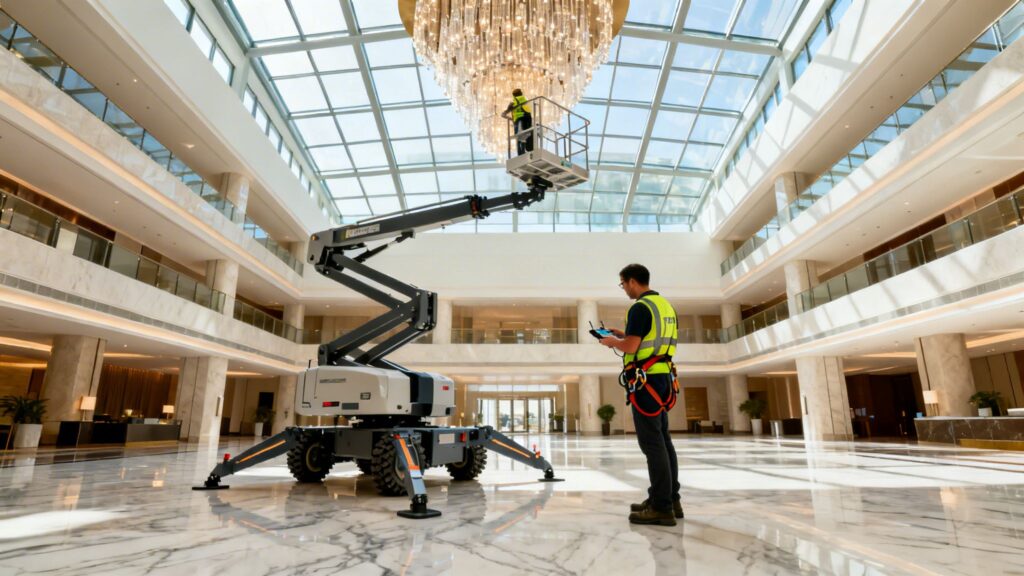
So, you're eyeing an atrium lift rental for a job with some tricky high-reach work. You're on the right track. These specialized machines, often called spider lifts, are absolute game-changers for accessing tight indoor spaces with soaring ceilings. But they're not the answer for every project.
Before you go any further, let's make sure this is truly the right tool for you.
Should You Rent an Atrium Lift for Your Project?

Don't just sign a rental agreement because a spider lift looks impressive. These are highly specialized problem-solvers, and their real value shines when other equipment simply can't get the job done.
It's no surprise that the atrium lift rental market is booming, valued at USD 1.2 billion in 2024 and expected to more than double to USD 2.5 billion by 2034. We’re seeing more complex buildings—hotels, malls, airports, and universities—that require smart solutions for maintenance. You can dig into more about these market trends to see what's driving the demand.
Identifying the Right Job for a Spider Lift
An atrium lift is your best bet when you’re staring down a combination of serious height and tight access. Think of them as the gymnasts of the aerial lift world—they're compact, flexible, and can navigate spaces that would stop a traditional boom lift in its tracks.
A spider lift rental is probably the right call in situations like these:
- Squeezing Through Tight Doors: Their tracks retract, allowing them to pass through standard single or double doorways. A regular boom lift? Not a chance.
- Working on Delicate Flooring: With low ground pressure and non-marking tracks, they can operate on sensitive surfaces like marble, polished tile, or gymnasium floors without leaving a trace.
- Reaching Over and Around Obstacles: The articulating boom is brilliant for getting up and over fixed objects—think church pews, auditorium seating, or that giant fountain in the middle of a lobby.
A classic mistake I see all the time is people focusing only on height. They find a lift that can reach the ceiling but completely forget to measure the path to get it there. A lift is useless if it's stuck outside. Always measure your narrowest point of entry first.
Assessing Your Project Needs
A few minutes of honest evaluation can save you a world of headache (and money) by preventing you from renting the wrong machine. Before you even think about calling a rental company, walk the site and get answers to a few key questions.
What's the actual working height you need to reach? Don’t eyeball it. Grab a laser measure and get an exact number. This will determine the boom length you need.
Next, map out the entire path the lift will travel, from the delivery truck to the final work area. Are there any stairs, narrow gates, steep slopes, or permanent landscaping in the way? Every obstacle matters.
Finally, what are the ground conditions like? Is it a solid concrete slab? A suspended floor over a basement? Or will you be working on soft turf outdoors? The ground has to support not just the lift’s weight, but also the concentrated pressure from its outriggers. Answering these questions will tell you if an atrium lift is your hero or if you need to explore another route.
Here's a quick comparison to see how an atrium lift rental stacks up against scaffolding, ladders, or standard boom lifts for different jobs.
Choosing Your Access Method: Atrium Lift vs. Alternatives
| Access Method | Ideal for | Key Disadvantage |
|---|---|---|
| Atrium Lift | High-reach work in tight, indoor spaces with obstacles. | Higher rental cost; requires a trained operator. |
| Scaffolding | Long-duration projects requiring a large, stable platform. | Time-consuming to set up and dismantle; space-intensive. |
| Ladders | Quick, low-height tasks with no obstacles. | Extremely limited in height and stability; high safety risk. |
| Standard Boom Lift | Outdoor or large indoor spaces with wide access and flat ground. | Too large and heavy for most indoor or delicate surfaces. |
Ultimately, this table shows there's a right tool for every job. For the specific combination of height, tight access, and delicate surfaces, nothing beats a spider lift.
Of course, there’s always another option: skip the rental process altogether and bring in a team that already has the equipment and expertise.
When to Skip the DIY and Hire a Professional
Renting, operating, and insuring an atrium lift is a significant undertaking. If your team lacks the proper training and certification, or if the job site presents major logistical hurdles, the risks can quickly outweigh the rewards.
In these cases, your best move is to hire an insured and experienced professional service. A team like ours at Sparkle Tech Window Washing comes equipped with not just the right atrium lift, but also certified operators who know how to handle it safely and efficiently. We take on the liability, manage the logistics, and get the job done right, saving you the hassle and potential for costly mistakes. You don't have to worry about a thing.
How to Choose the Right Atrium Lift Model
Picking the right atrium lift isn't just about getting a machine that looks like it'll work. I've seen projects get completely derailed because the team rented a lift that was just a few inches too wide or a few feet short on reach. Getting the specs right from the start is the single most important part of the rental process.
Let's walk through what you absolutely need to nail down before you sign any rental agreement.
Match the Height and Reach to Your Task
The first thing I always check is the spec sheet for height and reach. The working height is the number you care about most—it’s the maximum height your hands can reach, not just the height of the basket floor. A good rule of thumb is to add about six feet to your highest touchpoint. That gives you a realistic figure to work with.
But height is only half the battle. Horizontal outreach is where people often get into trouble. This is how far the lift's arm can extend sideways from its base. Think about trying to clean windows over a permanent lobby feature, like a fountain or a wide staircase. You can't just park the lift directly underneath. You need enough outreach to position the basket precisely where the work is, even if the base is 20 or 30 feet away.
A crucial takeaway from my experience is that outreach often decreases as height increases. Always check the lift's "load chart," a diagram showing its full range of motion. This will tell you exactly how far it can reach at a specific height, ensuring no surprise limitations on the job.
Confirm Capacity and Power Source
Every lift has a platform capacity—the total weight the basket can handle. A typical capacity is around 500 lbs, which sounds generous. But remember, that number has to include your operator, a second worker, all their tools, and any materials they need. Overlooking the weight of a bucket of water or a box of light fixtures is an easy mistake that can lead to a dangerous overload.
The power source is another detail that dictates where and when you can operate. You’ll generally see three options:
- Electric Models: These are quiet and have no emissions. For any indoor work in an occupied building—think offices, hospitals, or schools—an electric model is non-negotiable.
- Diesel/Gas Models: With more power to handle rough ground, these are built for outdoor construction sites. The noise and fumes make them completely unsuitable for indoor jobs.
- Hybrid Models: These give you the best of both worlds. You can use the diesel engine to navigate the exterior of a site and then switch to clean electric power once you move inside.
For most indoor atrium projects, you’ll want an electric or hybrid model. Be sure to ask for one with non-marking tracks. These are specifically designed to move across sensitive flooring like marble, tile, or polished wood without leaving scuffs or tire marks.
The demand for this kind of specialized equipment is growing fast. The wider aerial work platform rental market, which includes these atrium lifts, grew from USD 41.4 billion in 2020 and is on track to hit USD 69.0 billion by 2030. You can see more details on the growth of this equipment rental sector.
Finally, and this one is a classic project-killer, you have to verify the stowed dimensions. This is the lift’s size when it’s folded up for transport. Get out your tape measure and check its stowed height, width, and length against every single doorway, hallway, and gate on the path to the work area. If your lift is 32 inches wide and you find a service entrance that’s only 31 inches, your day is over before it even starts.
You can learn more about the different types of lifts and their uses in our detailed guide on the equipment used by high-rise window cleaners.
Nail Your Site Assessment Before You Rent
An atrium lift is a phenomenal piece of equipment, but it's completely worthless if you can't get it to your work area. A smooth atrium lift rental all comes down to the homework you do beforehand. This isn't just a quick glance around; it's a careful investigation to make sure the machine can get into your space, set up, and operate safely.
Your first job is to map out the lift’s path from the curb to the worksite. Get out a tape measure and document the exact width and height of every single doorway, gate, and hallway it needs to pass through. Don't forget to look for tight corners, low-hanging pipes, or any other permanent obstacles that could block the way.
Can Your Floor Take the Weight?
This is, without a doubt, the most critical—and most commonly missed—part of the assessment. While atrium lifts are designed to be lightweight for their reach, they concentrate all their mass onto four small outrigger pads. An average model can tip the scales at over 5,500 lbs, and all that pressure focused on small points can easily crack tiles, dent wood, or even punch right through a floor that wasn't built for it.
Never, ever assume a floor is strong enough. Getting confirmation of the floor's load-bearing capacity is a non-negotiable safety check. If you're working on a suspended slab, an upper floor, or on delicate surfaces like marble or terrazzo, you must consult the building's plans or get sign-off from a structural engineer.
To find out what your floor can handle, you'll likely need to dig up the building’s architectural or structural drawings. These documents will specify the pounds per square foot (PSF) rating for the floor. The rental company can then give you the ground pressure specs for the lift you're considering, so you can make sure the numbers work.
The image below breaks down the key factors you'll be juggling when you select a lift—all of which are directly impacted by the limitations of your site.

As you can see, the height and reach you need are directly tied to the machine's weight and footprint, so it's a balancing act.
Map the Travel Path and Setup Area
Once you've confirmed the lift can physically fit and that the floor can support it, you need to think about the journey itself.
- Is the path clear? Make sure the route is free of debris and other temporary obstacles.
- What about slopes? Atrium lifts are impressive climbers and can often handle gradients up to 18 degrees, but you must check the specs for the specific model you're renting.
- Where will it set up? The final setup location is just as important. For any work outdoors, you need firm, level ground. Setting up on soft dirt or a soggy lawn is a recipe for disaster, as the outriggers can sink and destabilize the entire machine.
To protect sensitive interior floors, using spreader plates (also called outrigger pads) is standard professional practice. These are large steel or composite mats placed under each outrigger foot. They do a fantastic job of distributing the machine’s weight over a much larger surface area, dramatically reducing the point load and preventing costly damage. Your rental company can help you figure out if you need them and can usually supply the right size for your lift and floor type.
Understanding Operator Training and Insurance Needs
Getting the atrium lift to your building is just the beginning. The moment that machine rolls off the truck, a whole new set of responsibilities kicks in. Operating heavy equipment isn't something to take lightly—it comes with serious safety and legal strings attached that can trip you up badly if you ignore them.
Before anyone even thinks about stepping into the basket, you have to sort out their qualifications. OSHA is crystal clear on this point: anyone operating an aerial lift needs to be properly trained and certified on that specific piece of machinery. This isn't a friendly suggestion; it’s a federal rule designed to keep people safe.
Operator Certification Essentials
I can tell you from experience, a reputable rental company will never just toss you the keys. They'll either ask for proof that your operator is currently certified or offer to provide the training themselves. If a company doesn't bring up training at all? That's a massive red flag. Seriously, walk away.
It's absolutely critical that whoever is running that lift knows what they're doing. This means making sure their training meets all the required standards. You'll want to dig into resources on ensuring proper certification and compliance for operators to make sure you're following the letter of the law.
An untrained operator is a massive liability. They not only endanger themselves and others but can also cause thousands of dollars in property damage. In the event of an accident, a lack of certification could void insurance coverage and lead to significant fines.
This intense focus on safety is a big reason why renting is so common. In fact, North America makes up about 45% of the entire global aerial lift rental market, a sector valued at a staggering USD 32.45 billion in 2024. Companies choose to rent because it helps them meet strict safety rules that require certified equipment and trained professionals.
Navigating Insurance Requirements
Insurance is the financial safety net you can't afford to be without, and you need to look at it from two different angles: what you have, and what the rental company has.
First, pull out your own general liability policy. You need to confirm whether it actually covers the operation of rented heavy equipment. Many standard policies specifically exclude this, so don't be surprised if you need to add a special rider to be properly protected.
Just as important is getting a copy of the rental company’s Certificate of Insurance. This is non-negotiable. This document is your proof that they carry enough liability coverage to protect you. Make sure it lists:
- General Liability: This covers bodily injury or property damage.
- Workers' Compensation: This covers their own employees if one of them gets hurt on your property.
Verifying this protects you if their lift malfunctions or their delivery crew accidentally puts a hole in your wall. For a deeper dive into this topic, our guide on what to look for in insurance for a window cleaning business has all the details. Never, ever assume you're covered—get everything in writing before that lift arrives.
When to Hire a Pro Instead of Renting the Lift Yourself

Tackling a big job yourself can feel empowering, and renting an atrium lift might seem like a smart way to cut costs. But before you sign that rental agreement, it's crucial to look beyond the daily rate. That sticker price is really just the beginning.
Once you factor in delivery and pickup fees, fuel surcharges, potential insurance riders, and the time lost to training and logistics, the "deal" on a DIY rental can evaporate quickly. A simple, all-inclusive quote from a professional service often ends up being the more sensible financial decision. Even more importantly, it shifts all the risk from your shoulders to a team that's trained, equipped, and insured for the job.
Know When to Step Aside for the Experts
Some jobs just aren't cut out for a DIY approach. In these cases, you’re not just renting a machine; you’re buying experience, efficiency, and a huge amount of peace of mind.
It’s time to call in a professional crew when you’re facing scenarios like these:
- Extreme Heights and Reach: Any work pushing 60 feet or more, especially if it requires a lot of horizontal outreach, demands an operator who lives and breathes this kind of work. They know the machine’s balance points and limitations instinctively.
- Priceless or Delicate Surroundings: Are you working near historic woodwork, a multi-story glass chandelier, or priceless artwork? Maneuvering a 5,500 lb machine in such a space is nerve-wracking. A tiny miscalculation can lead to damage that’s impossible to repair.
- Tricky Access and Navigation: If getting the lift into position involves crossing manicured lawns, navigating tight public hallways, or scaling steep ramps, the potential for property damage skyrockets. Professional crews are masters at getting equipment into and out of the tightest spots without a scratch.
Here's the part people often forget: liability. If an accident happens with a rented lift on your watch, the financial fallout can be devastating—from property damage claims to catastrophic personal injuries. When you hire a fully insured and bonded professional service like Sparkle Tech, you’re completely insulated from that risk.
What a DIY Rental Really Costs
Before you pull the trigger on a rental, take a moment to do the real math. That professional quote might look higher at first, but it's a fixed number. A DIY project is full of financial wildcards.
Tally up everything you'll actually be paying for:
- The Rental Fee: The base cost per day, week, or month.
- Transport: Delivery and pickup can easily add several hundred dollars to the bill.
- Insurance: Will your current policy cover a piece of heavy machinery? If not, a special rider can be surprisingly expensive.
- Training Time: You can't just hop in and go. Proper certification takes time and money.
- The "What If" Factor: What's the real cost if something goes wrong? A damaged window or a gouged floor can dwarf your rental savings.
When you see all the costs and risks laid out, the straightforward price from an experienced team suddenly seems a lot more attractive. For more insight into this decision-making process, check out our guide on knowing when to call a professional window washing company, which dives deeper into weighing risks and rewards.
Last-Minute Questions About Atrium Lift Rentals
Even with all your research done, renting a piece of specialized equipment like an atrium lift can feel a little daunting. A few key questions almost always come up right before the lift is scheduled to arrive. Getting these details sorted out ahead of time is the secret to a smooth, stress-free project.
Let’s walk through the most common things people ask when they're on the verge of renting one of these machines.
Breaking Down the Real Cost of an Atrium Lift Rental
Everyone’s first question is about the price tag, and the answer is: it depends. You’ll see daily rates anywhere from $500 to $1,500. The bigger the lift and the more reach it has, the closer you'll get to that higher number.
But the daily rate is just the starting point. The final bill will always be higher once you factor in the other necessary costs. Be sure your quote includes line items for:
- Delivery and Pickup: These fees can easily add hundreds of dollars, depending on your distance from the rental yard.
- Mandatory Training: If your operator isn't already certified on that specific model, the rental company will require it.
- Insurance and Damage Waivers: Your own policy might not cover rented heavy equipment, so you may need to purchase supplemental coverage.
Always ask for a fully itemized quote. That’s the only way to avoid sticker shock when the final invoice arrives.
Who Is Actually Allowed to Operate the Lift?
Once you have the budget figured out, the next big question is about who can run the machine. The answer here is firm: only a trained and certified operator. This isn't just a suggestion—it's a legal mandate from OSHA for any type of aerial work platform.
A reputable rental company will handle this one of two ways. They’ll either offer the required training themselves (for a fee, of course) or they will demand to see a valid, current certification for the person you’ve designated as the operator. Don't even think about skipping this step. Operating a lift without certification is a major safety violation that can result in massive fines and will likely void your insurance if an accident happens.
Think of it this way: You wouldn't let an unlicensed driver operate a commercial truck on your property. The same principle applies here. Certification isn't just a piece of paper; it's confirmation that the operator understands the machine's limits, safety features, and emergency procedures.
Will My Floor Hold the Weight of This Thing?
This is probably the most important safety check you'll make. First, ask the rental company for the lift's spec sheet. You're looking for two numbers: the machine's total weight (an average model can be over 5,500 lbs) and its ground pressure, often listed in pounds per square inch (PSI).
Next, you have to verify your floor’s load-bearing capacity. If you're working on a modern, ground-level concrete slab, you're usually in the clear. But for any suspended floors, upper levels, decorative tile, or older buildings, you absolutely must confirm the weight limit. You may need to consult the building's blueprints or even bring in a structural engineer.
Remember, an atrium lift supports its entire weight on four small outrigger pads. This creates an immense amount of focused pressure—known as point load—on those four spots.
What About Setting Up on Uneven Ground or Slopes?
Modern atrium lifts are pretty smart. Most come equipped with self-leveling outriggers that can handle slight grades, usually up to 10-15 degrees, to create a perfectly level base for the machine.
The key word here, though, is slight. The ground itself must be solid and firm. Trying to set up on soft dirt, a soggy lawn after a rainstorm, or a steep hill is a recipe for disaster and one of the primary causes of tip-over accidents. Always check the machine's manual for its specific limitations and listen to the advice of the rental company's experts.
If juggling rental logistics, operator training, and structural engineering sounds like a headache you’d rather avoid, there’s a much simpler path. The professional team at Sparkle Tech Window Washing comes equipped with the right machines and fully certified operators to handle your high-reach work safely and without the hassle. Contact us today for a straightforward, all-inclusive quote.