



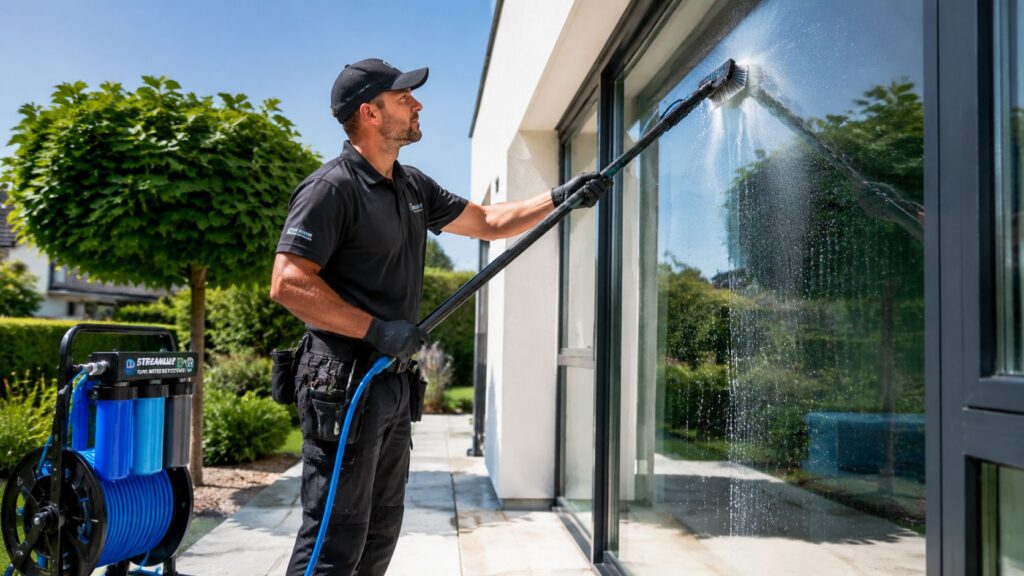
You've got the pole, the brush, the DI tank or filter setup, and a fresh reel in the truck. Then the job starts and the window washing hose becomes the weak link. It kinks at the corner, drips at the fitting, gets hot enough to feel soft in the Arizona sun, and suddenly a simple exterior clean turns into a fight with your own equipment.
That's more common than often acknowledged. New crews usually focus on the expensive gear first. DIYers do the same thing. They'll spend real money on a water-fed pole system, then hook it up with whatever hose happened to be nearby. That shortcut shows up fast on glass. Poor flow, inconsistent rinsing, leaks at the threads, and avoidable seal risk all start there.
A hose isn't just a way to move water. It controls how stable your flow is, how easy the work feels over a long day, and how much trouble you create on the property if you use the wrong pressure or the wrong fittings.
Why Your Window Washing Hose Is a Critical Investment
A lot of people treat the hose like an accessory. In practice, it behaves more like a core system component. If the hose is too small, too stiff, too cheap, or poorly matched to the rest of the setup, the whole job slows down.
That matters whether you're cleaning your own windows or building a real operation. The U.S. window washing industry generated $2.9 billion in revenue in 2024 and is projected to reach $3.2 billion by 2029, according to IBISWorld's window washing industry data. That's a big market, and in a market that size, crews don't stay competitive by wasting time untangling hose coils or chasing leaks across a driveway.
What a bad hose actually costs you
The biggest mistake is thinking the downside is only inconvenience. It isn't.
A poor hose choice can lead to:
- Flow inconsistency that makes rinsing slower and less predictable
- Extra drag around landscaping, corners, and patio furniture
- Heat-related handling issues in hot, arid areas where hose material gets harder or softer than you want
- Leaking connections that waste purified water and leave puddles where customers walk
- Operator fatigue when the hose fights every move
Practical rule: If your hose makes the job harder by noon, it was the wrong hose before breakfast.
In Arizona, the hose takes more abuse than many guides account for. UV exposure is brutal. Surfaces get hot fast. Water evaporates quickly off glass and frames. That means your hose choice has to support controlled rinsing, not just reach.
Professional results start with the boring parts
Most streak problems blamed on brush technique are really setup problems. The hose affects pressure feel, rinsing rhythm, and how easily you can keep moving without stopping to correct equipment issues.
That's why seasoned cleaners get picky about hoses. They're not being fussy. They've learned that the small, boring gear is often what separates a smooth day from a frustrating one.
How to Select the Right Hose for Your Setup
A good hose matches the work. It doesn't need to be flashy. It needs to move the right amount of water, stay manageable on the ground, and hold up in the climate you work in.

Choose diameter before you choose anything else
If you're running pure water, diameter is the first decision. It affects flow stability more than most beginners realize.
For pure water systems, 3/8-inch is the industry standard because it cuts water stagnation by 15% and pressure drops by 20% over long runs compared to 1/2-inch hose. Hoses under 5/16-inch can cause a 35% pressure drop at 50 feet, based on the performance guidance from windowcleaner.com's water-fed hose specifications.
Here's the practical version:
| Hose size | What it feels like on the job | Best use |
|---|---|---|
| Under 5/16-inch | Light, but more likely to choke flow on longer runs | Short, simple setups only |
| 3/8-inch | Balanced flow and manageable handling | Most professional water-fed work |
| 1/2-inch | Bulkier and heavier to drag | Situations where weight matters less than supply |
For most crews and serious DIY users, 3/8-inch is the safe bet. It gives you dependable flow without feeling like you're dragging a heavy garden hose around every bed edge and gate latch.
Material matters more in Arizona
Diameter sets performance. Material sets day-to-day sanity.
In hot, arid climates, I'd rather use a hose that stays flexible enough to handle cleanly when the driveway is hot and the line has been sitting in the sun. A stiff hose fights you around corners. A flimsy hose can twist or kink when it gets warm. You want something that coils well, resists abrasion, and doesn't turn every movement into a tug-of-war.
A simple comparison helps:
- PVC tends to be the budget option. It can work, but it often feels less forgiving.
- Hybrid polymer is a good middle ground when you want flexibility and durability.
- Polyurethane is usually preferred when low weight and easier handling matter most.
If you're still building your kit, it's worth looking at a full water-fed pole window cleaning system as one package, not as separate parts bought at random. Hose, reel, filtration, and pole all affect each other.
The best hose on paper can still be the wrong hose if it doesn't match your reel, fittings, and daily route.
Don't buy more length than you can manage
Longer sounds safer. On real jobs, too much hose creates drag, memory, and clutter.
Pick a length that matches your normal work, then add enough reach for the outlier properties you clean. If the hose spends most of its life piled in loops near the reel, it's too long for your setup. In Arizona heat, excess hose also sits exposed longer, which makes storage discipline more important.
A clean setup feels boring in the best way. The hose feeds smoothly, doesn't snag constantly, and lets you focus on the glass instead of the ground.
Connecting Your System for Leak-Free Operation
You feel connection mistakes fast in Arizona. Water disappears off hot pavement before a small leak gets your attention, and by the time you notice weak flow at the pole, you have already wasted pure water and time.

Use the correct connection sequence
Keep the path simple and consistent:
- Connect the lead hose to the standard tap
- Run that line to the carbon filter inlet
- Connect the DI tank outlet to the hose reel inlet
- Attach the pole tube to the hose reel outlet
That order keeps untreated water on the supply side and purified water on the delivery side. Mix up the sequence and you create avoidable pressure loss, contamination points, and more places for fittings to fail.
On a new rig, I also check every connection type before the water goes on. Garden-hose threads, quick-connects, and push-fit fittings all have their place, but forcing unlike parts together is a rookie mistake that gets expensive. If you are piecing together a setup from different brands, keep your adapters, spare washers, and thread types organized with the rest of your professional window washer supplies.
Hand-tight is usually enough
A lot of leaks start with good intentions. Somebody grabs pliers, crushes a washer, slightly cross-threads a plastic collar, and now the joint leaks under pressure all day.
Hand-thread fittings slowly. Make sure the washer is seated flat. If the fitting binds in the first turn or two, back it off and check the thread type instead of trying to muscle through it.
If a fitting does not spin on cleanly by hand, stop there. Forcing it usually ruins the washer, the threads, or both.
That matters even more on modern windows. Higher pressure does not just stress the hose. It can also push water where it does not belong. Building Science Corporation has documented that water intrusion around window assemblies often starts at weak points in seals, joints, and interface details, especially when water is driven into the assembly under pressure from the wrong direction. A window washing system is not a pressure washer, and treating it like one is a good way to shorten the life of sealants and create callback problems.
A quick visual guide can help if you're setting up a new rig for the first time.
Pressure test before you touch glass
Do a one-minute test at the ground first. It saves ten minutes of stop-and-fix work once the pole is extended.
| Check | What to look for |
|---|---|
| Tap on slowly | No hard kick in the hose, no spray at the first fitting |
| Filter connection | Dry inlet and outlet, steady flow |
| Reel feed | No pulsing, no drips at swivel points |
| Pole tubing | Secure connection, no slipping or weeping at the fitting |
Open the water gradually and watch each joint. Run your hand under the fittings, not over them, so you can feel drips that disappear fast in the heat. If the system surges, pulses, or sounds strained, shut it down and fix the restriction before you start cleaning.
That last step protects more than water production. It protects the windows. Too much pressure at the brush or a blocked line upstream can put extra stress on seals, screens, and poorly maintained frames. Clean flow is the goal. More pressure is not.
Hose Maintenance and Smart Storage
A hose usually dies from neglect before it dies from age. Dirt gets inside. Connectors get abused. The outer jacket cooks in the sun. Then someone blames the brand when the actual issue was storage.

What to do after each job
The end-of-day routine doesn't need to be complicated, but it does need to happen.
- Flush the line if the hose has been sitting or if the water quality changed during the job
- Check the ends for damaged washers, cracked collars, or grit in the threads
- Inspect the jacket for abrasions, soft spots, or sun-baked sections
- Reel it evenly instead of cranking it in with twists locked into every loop
This is also the right time to look over the rest of your kit. If you're maintaining a larger setup, keeping your professional window washer supplies organized in one place makes this routine easier to stick with.
Arizona storage habits that actually help
Phoenix-area heat punishes hoses left on concrete, in truck beds, or piled in direct sun. UV exposure slowly breaks down the outer layer, and repeated heat cycles make some hoses stiffer, chalkier, or more prone to cracking at stress points.
Use a few simple habits:
- Store off the ground when possible, preferably on a reel
- Keep it shaded instead of leaving it stretched across a driveway between jobs
- Avoid hard bends near the fittings, because that's where failure often starts
- Drain before storage so water isn't trapped in a line baking all afternoon
A hose stored badly can still look fine from ten feet away. The damage usually shows up first at the ends, then in pinhole leaks.
Cold-weather Arizona still counts
A lot of people hear “Arizona” and ignore winter prep. That's a mistake if you work higher elevations or colder parts of the state. Freezing can split a water-filled hose or damage fittings even when the line looked fine the day before.
If you're storing gear where winter temperatures drop hard, drain the hose fully and keep it somewhere protected. Freeze damage is one of those failures that feels sudden only because nobody checked before the morning setup.
Troubleshooting Pressure Damage and Flow Issues
Troubleshooting hose problems often begins with one question. “Why is my flow bad?” That's useful, but it's incomplete.
The better question is, “Am I pushing the right amount of water in the right way for this window?” In Arizona, that matters even more because heat, aging seals, and brittle materials can turn a cleaning mistake into a building problem.
High pressure isn't a shortcut
A lot of DIY advice says to use a gentle spray. That's correct, but too vague to protect anybody.
Independent building science studies show that water pressure as low as 30 PSI can force water behind flawed window seals, leading to moisture intrusion in 18% of homes in arid climates over a five-year period, as summarized in this discussion of window washing with a garden hose.
That should change how you think about rinsing. If a seal is already compromised, “more force” can be exactly the wrong move.
If you're weighing more aggressive methods, this guide on cleaning windows with a pressure washer is worth reviewing before you point a stronger stream at aging frames or desert-baked seals.
Signs you have a pressure problem, not a hose problem
Sometimes the hose gets blamed for damage that's really coming from poor spray control.
Watch for these warning signs:
- Water showing up indoors after exterior rinsing
- Staining around the frame that appears after cleaning
- Seal edges that look brittle, cracked, or separated
- Fine mist driving into corners instead of sheeting off the glass
- A strong spray pattern bouncing back off hot glass or frame edges
If the window is old, sun-beaten, or already showing seal wear, treat it like a vulnerable assembly, not a hard surface you can blast clean.
How to correct flow without increasing risk
When the rinse feels weak, don't jump straight to more pressure. Work the problem in order.
- Check for kinks and drag points first.
- Inspect fittings and connections for hidden restriction or leakage.
- Confirm your hose size matches the run and the equipment.
- Adjust your technique by controlling angle and distance rather than forcing output.
On hot glass, controlled rinsing beats aggressive rinsing. Fast evaporation in Arizona makes streaking more likely when water is pushed onto a surface too hard, too wide, or too long. Work smaller sections. Keep the rinse deliberate. Don't let “more spray” become your default fix.
On-Site Safety and Professional Best Practices
Good hose management is part safety, part professionalism. If the hose is lying across walkways, tangled under ladders, or stretched near power sources, the work stops being clean and starts being reckless.
The risk is real. Window cleaning workers in the U.S. face 12.5 incidents per 100 workers annually, and fall-from-height incidents account for 65% of all fatalities in the industry, according to Gitnux window cleaning industry statistics. A hose doesn't cause every accident, but it contributes to plenty of preventable ones.

Hose habits that separate pros from amateurs
The basics aren't glamorous, but customers notice them and crews benefit from them.
- Route with intention so the hose follows edges, not footpaths
- Keep loops tight and visible instead of letting them spread across patios
- Protect entry points where residents, pets, or delivery drivers might step
- Reset as you move rather than dragging a mess from one side of the property to the other
Electrical awareness matters every time
Water work creates complacency fast. Don't let it.
Keep hose streams away from outlets, fixtures, exposed wiring, and any area where electrical components may be vulnerable. Stay alert around overhead lines if you're using poles, especially on uneven ground where pole angle changes quickly.
Clean glass never justifies a rushed setup around electricity.
Reputation comes from execution
A professional job isn't only about spotless windows. It's also about how controlled the site feels while the work is happening. Home service companies that want repeat work usually learn the same lesson. Operations, safety, and presentation feed growth just as much as technical skill. If you're building the business side too, resources on consistent leads for home service companies can help connect strong field execution with steady demand.
Clients may not know hose diameter or TDS targets. They do know when a crew works carefully, protects the property, and leaves the site orderly. That's often what gets you called back.
If you'd rather hand the work to an insured Arizona team that understands window washing hoses, pure water systems, and window screen care in desert conditions, Sparkle Tech Window Washing & window screens is a solid place to start.