


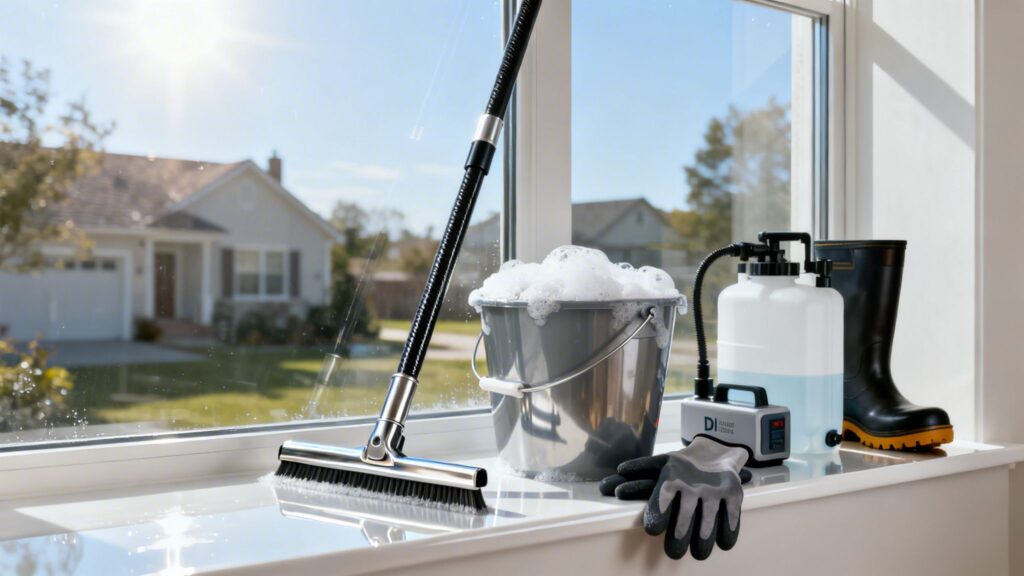
If you're serious about starting a window cleaning business, your first real investment isn't a fancy van wrap—it's the tools you hold in your hands. Putting together the right professional window washer supplies from day one is what separates the pros from the amateurs. With the right gear, you can walk onto any residential or light commercial job and deliver that perfect, streak-free shine that gets you called back.
Building Your Essential Window Cleaning Toolkit
Anyone can buy a squeegee from a hardware store. Building a professional toolkit, however, is about showing up prepared for anything. A well-organized kit tells clients you’re a serious operator, and it lets you work smarter, not harder, justifying your rates and earning their trust.
And it’s a great time to be in the business. The global window cleaning market was valued at a huge USD 4.18 billion in 2024 and is on track to hit USD 6.8 billion by 2033. That steady growth means there's plenty of work to go around, but it also means you need the right setup to compete.
The Foundation of Your Kit
Think of your tool collection as having layers. The first layer is your non-negotiable, everyday gear. This is the stuff you'll be using on every single window, day in and day out.
- Squeegees: You need more than one. A 14-inch squeegee is your workhorse for most standard windows, but you’ll absolutely need a smaller 6-inch one for those tricky French panes or colonial-style grids.
- Scrubbers: Get a 14-inch scrubber (also called a T-bar and sleeve) to match your main squeegee. A good sleeve holds a ton of soapy water, which is key for loosening up all the dirt and grime before your first pull.
- Buckets: Skip the round bucket from the hardware store. A professional rectangular bucket is a must—it’s wide enough to fit your scrubber and squeegee perfectly. Better yet, get a "bucket on a belt" to keep your tools right at your hip while you work.
- Microfiber Towels: You can literally never have too many. Use them for detailing the edges of the glass, wiping down sills, and catching any drips. They absorb way more and leave zero lint, unlike paper towels which just create more work.
For a quick look at the essentials, here's a breakdown of what every pro needs in their starting lineup.
Core Toolkit for Professional Window Washers
| Tool Category | Essential Items | Pro Tip |
|---|---|---|
| Glass Cleaning | Squeegees (14" and 6"), Scrubber (14"), Bucket (Rectangular) | Buy channels and handles separately to mix and match sizes. This is more cost-effective as you grow. |
| Detailing & Wiping | Microfiber Towels (at least a dozen) | Color-code your towels—for example, blue for glass, green for sills—to avoid cross-contamination. |
| Reach & Safety | Extension Pole (8-24 ft) | An extension pole is your best friend for second-story work. It's safer and faster than setting up a ladder for every window. |
| Water & Solutions | Cleaning Solution, Spray Bottle | A simple solution of dish soap and water works great. Add a little "slip" agent like Glass Gleam for smoother squeegee glides. |
This core set of tools will get you through the door and allow you to handle most residential jobs with confidence.
Beyond the Basics
Once you've mastered the fundamentals, you can start adding gear that boosts your efficiency and opens the door to bigger, more complex jobs. This is where an extension pole becomes essential, allowing you to clean second-story windows safely from the ground.
Stocking up on all this gear can feel like a big upfront cost, and it is. For new business owners, looking into options like equipment financing for small businesses can be a smart move. It helps you get high-quality tools from the start without draining your cash flow.
A classic rookie mistake is skimping on tools to save a few bucks. Cheap, consumer-grade equipment just doesn't hold up to daily use. It'll wear out faster, perform poorly, and end up costing you more in replacements and frustration.
Investing in professional-grade supplies from the get-go pays for itself. If you want a closer look at specific brands and models, our guide on the best window cleaning tools breaks down the top recommendations to help you make smart choices. Remember, your tools are a direct reflection of your work.
Choosing Squeegees and Poles That Work for You
Think of your squeegee and pole as the most important extensions of your own arms. Getting the right setup isn't about buying the most expensive gear; it's about matching the tool to the task. The right choice means you work faster, get better results, and feel less exhausted at the end of the day.
It's a great time to be in the business. Since 2020, we've seen a huge jump in demand, with surveys showing 60% of businesses are cleaning more often and relying on pros like us. This demand is even pushing innovation in our tools, with the market for advanced glass cleaning tech expected to grow by 21.5% annually through 2027. What this means for you is better, more efficient tools are hitting the market all the time.
Selecting the Right Squeegee Handle and Channel
Your squeegee is actually two pieces: the handle you grip and the channel that holds the rubber blade. Don't underestimate the handle—its weight and ergonomics make a huge difference over a long day.
- Brass Handles: These are the old-school classics for a reason. They have a satisfying heft that gives you excellent, steady pressure on the glass. Many seasoned pros, myself included, love the balanced feel.
- Stainless Steel Handles: A fantastic middle-ground. They're tough as nails, won't rust on you, and have a good weight that isn't quite as heavy as brass.
- Ergonomic Plastic/Composite Handles: If you're doing high-volume residential work, these are a lifesaver. They are significantly lighter, which really cuts down on hand and wrist fatigue when you're constantly fanning windows.
Next is the channel. The size you choose is all about efficiency. For most residential jobs, a 14-inch or 16-inch channel is your go-to workhorse. But when you’re faced with massive commercial panes, switching to a wider 18-inch or 22-inch channel will let you fly through the job.
This flowchart breaks down the decision-making process based on the kind of work you're doing.

As you can see, the choice really boils down to whether you're tackling smaller, varied residential windows or large, uniform commercial ones.
Choosing an Extension Pole for Reach and Safety
An extension pole is absolutely non-negotiable. It’s your ticket to cleaning second or even third-story windows safely from the ground, which means less time climbing ladders and a huge reduction in risk.
Pro Tip: Whatever pole you buy, make sure it has a sturdy, universal threaded tip. This guarantees it will fit not just your squeegee but also your scrubber, dusters, and other attachments. You don't want to get locked into a single brand's ecosystem.
When choosing a pole, you’re basically weighing cost against weight.
Aluminum Poles are the industry standard and for good reason. They are affordable, rigid, and plenty durable for most ground-level work or jobs needing up to 24 feet of reach. That rigidity is key, as it gives you solid control when scrubbing or squeegeeing from a distance.
Carbon Fiber Poles are the premium choice, and they are worth every penny if you frequently work on multi-story buildings. They are incredibly light compared to aluminum. Trust me, when you're holding a pole fully extended for hours, that weight difference saves your shoulders and back. It's an investment in your own longevity in this business. The most advanced systems, like some of the Tucker water fed poles, rely on carbon fiber for its amazing strength-to-weight ratio.
When to Invest in a Pure Water System

Sooner or later, every growing window cleaning business faces the big question: is it time for a water-fed pole (WFP) system? This is easily one of the biggest investments you'll make, but it’s also the one that can seriously elevate your efficiency, safety, and the quality of your finish.
The magic behind a WFP system is the water itself. It uses a filtration process—either deionization (DI) or reverse osmosis (RO)—to strip tap water of all its minerals and total dissolved solids (TDS). This ultra-pure water is so aggressive at grabbing dirt that when it dries, it leaves absolutely nothing behind. No spots, no streaks, and no need to squeegee.
This isn't just about speed; it's about meeting modern expectations. Today, professional window washer supplies mean more than just a bucket and a squeegee. With residential clients making up 40% of market growth, homeowners expect a flawless, efficient service. As the entire home services industry expands (projected at a 3.1% CAGR through 2029), having the right gear keeps you competitive.
Choosing Your Purification Method
When you're ready to make the leap, your choice comes down to two types of systems: DI-only tanks or multi-stage RO/DI units. The right one for you really depends on the water quality in your service area and the scale of your jobs.
Portable DI Tanks: These are simple, lightweight tanks filled with deionizing resin. They’re fantastic for pros just starting with pure water, especially if you’re mostly doing residential work or live in an area with naturally low TDS (soft water). The upfront cost is much lower, making it an easier first step.
Multi-Stage RO/DI Carts: Think of these as the heavy-duty option. These units first push water through a reverse osmosis membrane, which strips out 90-98% of the impurities. The water then flows through a DI filter for a final polish. This setup is a must-have for large commercial jobs or any area with hard water.
If the tap water in your area has a TDS reading over 150-200 ppm, I'd seriously recommend going straight for an RO/DI cart. You'll spend more upfront, but the RO membrane takes on the bulk of the work, making your expensive DI resin last dramatically longer. It's a classic "pay now or pay more later" scenario.
Breaking Down the Real Costs
The sticker price of a pure water system is just the start. To get a true picture of the investment, you have to look at the long-term running costs.
Your main ongoing expense will be replacing filters and resin. With a DI-only system, you’ll be buying new resin pretty frequently, and that cost adds up fast in hard water zones. An RO/DI system has more components—pre-filters, an RO membrane, and a DI cartridge—but each one lasts much longer. The result is a significantly lower cost-per-gallon to produce pure water.
Ultimately, the math is simple. The investment pays for itself the moment the time you save on jobs is more valuable than what the system costs to operate. For a deeper look at the science and how to use this technology in the field, check out our guide to pure water window cleaning.
Finding the Right Soaps and Solutions
Your squeegee technique is only half the battle. The real secret to a streak-free shine and an effortless glide across the glass is what’s sloshing around in your bucket. The right solution does the heavy lifting by dissolving grime and lubricating your blade, leaving nothing behind but crystal-clear glass.
When you're just starting out, you can't go wrong with the classic, tried-and-true method: a simple mix of water and dish soap. It’s cheap, gets the job done on most residential windows, and you can grab it anywhere.
Of course, not all dish soaps are created equal. Most pros I know swear by Dawn. It’s got incredible grease-cutting ability and gives you that perfect amount of "slip," which is what lets your squeegee move smoothly without skipping or chattering. Just remember, a little goes a long way—a few drops in a gallon of water is all you need.
Beyond Basic Dish Soap
As you start tackling tougher jobs, you’ll quickly discover the limits of plain dish soap. This is the point where you need to look at professional-grade concentrates and additives—these are essential items for any serious professional window washer's supplies list.
These are solutions built specifically for our line of work, and they offer a handful of benefits that soap and water just can't touch.
- Glass Gleam (GG3 or GG4): This is a legendary name in the window cleaning world for a reason. Adding GG3 or GG4 to your bucket dramatically improves slip, reduces squeegee drag, and has water softening agents that fight spotting. It just makes the job easier and the results better.
- Glide Additives: Ever had your solution dry on the glass before you could even make a pass? A few drops of a glide additive in your bucket on a hot, windy day can save you from a streaky nightmare by slowing evaporation.
- Hard Water Stain Removers: For those windows caked with stubborn mineral deposits, you have to bring out the big guns. These are typically acid-based chemicals that require you to be careful and use proper PPE, but they're often the only way to save glass that’s been ruined by hard water stains.
Pro Recipe for a Perfect Everyday Solution: In your bucket, start with three gallons of clean water. Add a small squirt of original blue Dawn dish soap. Then, pour in one capful of a professional additive like Glass Gleam 4. This combo gives you great cleaning power, fantastic slip, and a bit more working time before it starts drying on you.
Specialty Solutions for Unique Jobs
A well-rounded chemical kit also needs to account for those non-standard jobs. Cleaning solar panels, for example, requires a careful approach. While many window cleaning solutions are technically safe, you should always try to use products specifically tested and approved for solar panels to avoid any risk of damaging their anti-reflective coatings.
It's also smart to have an eco-friendly option on hand. More and more clients are asking for it. Stocking a plant-based, biodegradable window cleaning solution shows you’re listening to your customers. These products work great and are perfect for homes with kids, pets, or delicate plants near the windows.
Must-Have Safety Gear and Business Insurance

Let's talk about what really separates the pros from the amateurs. It’s not just about a streak-free finish; it's about running a responsible, sustainable business. Getting this right comes down to two things that are absolutely non-negotiable: your safety gear and your business insurance.
Think of it this way: a fall from a ladder can end your career in an instant. Accidentally damaging a customer’s property can sink your reputation and drain your bank account. Your professional window washer supplies aren’t just squeegees and soaps—they’re the tools and policies that keep you in business.
Essential Personal Protective Equipment
Your personal protective equipment (PPE) is your first line of defense. Never step onto a job site without the right gear to protect yourself. It should be as automatic as grabbing your keys before you leave the house.
Here’s the absolute minimum you should have in your kit:
- Non-Slip Footwear: You’re going to be around water all day long. I’ve seen too many people slip on wet decks or lose their footing on a ladder rung. Get a pair of quality, waterproof boots with aggressive, grippy soles.
- The Right Gloves: A good pair of waterproof gloves is a must. They’ll protect your hands from cleaning solutions and, just as importantly, keep them functional when the temperature drops. Cold, numb fingers can’t safely grip a tool or a ladder.
- Eye Protection: Always wear safety glasses. This is especially true when you're working with chemicals to remove hard water stains or on a windy day when dust and debris can get kicked up into your face.
Once you have the basics covered, it's time to upgrade your ladder game. Using ladder standoffs (often called "horns") is a game-changer. These accessories brace the ladder against the roof instead of the gutters, preventing you from denting or breaking them—a costly mistake. For jobs on sloped or uneven ground, a set of leg levelers is crucial for creating a rock-solid, safe base.
The Shield of Business Insurance
While PPE protects your body, insurance is what protects your entire business. Showing up to a client's home without coverage is like walking a tightrope without a net. It’s an amateur move that carries massive risk.
Proper liability insurance for cleaning companies isn't just a piece of paper; it’s a powerful tool that builds immediate trust and sets you apart from uninsured competitors.
Being insured and bonded isn't just a footnote on your website. It's one of your most effective sales tools. When a potential customer asks if you’re insured, you want to confidently say "Yes, absolutely" and offer to provide proof. That confidence alone can be what lands you the job.
So, what do you need? For a window cleaning business, this table breaks down the essentials.
Safety and Insurance Essentials for Your Business
Here’s a look at the gear and policies that form the foundation of a secure, professional operation.
| Category | Item/Type | Why It's Critical |
|---|---|---|
| Safety Gear | Non-Slip Boots | Prevents slips and falls on wet surfaces, providing stable footing on ladders and ground level. |
| Safety Gear | Waterproof Gloves | Protects hands from chemicals, cuts, and cold weather, ensuring a secure grip on tools. |
| Safety Gear | Safety Glasses | Shields eyes from chemical splashes, dirt, and debris, especially on windy days. |
| Insurance | General Liability | Covers costs if you cause property damage (e.g., break a window) or bodily injury to a third party. |
| Insurance | Bonding | Protects your clients from theft, building trust and giving them peace of mind when you're in their home. |
At the end of the day, these items are your most important professional window washer supplies.
General Liability Insurance is your bedrock. This is what covers you if you drop a pole on a client's car or someone trips over your bucket and gets hurt. It’s the safety net that allows you to work without the constant fear of one accident ruining your business.
Being Bonded works a little differently. It’s a form of protection that guarantees your client against theft. It’s a powerful statement about your integrity and gives homeowners the confidence they need to welcome you into their space.
Investing in safety and insurance is an investment in your future. It’s what allows you to build a reputable company that clients trust and that will last for the long haul.
Common Questions from the Field
As you get more jobs under your belt, you’ll find that certain questions pop up again and again. It doesn’t matter if you’re a seasoned pro trying to dial in your kit or just starting out—getting good answers helps you work smarter, not harder. Let’s tackle some of the most common ones I hear.
What about bad weather? I get this one all the time: "Can you really clean windows in the rain?" The short answer is yes, absolutely. It's a common misconception that rain makes windows dirty. The real culprits are the dirt, dust, and pollen already sitting on the glass, which turn into a streaky mess once they get wet.
If your technique is solid and you're using a quality cleaning solution, a light rain actually helps by giving the glass a final, pure rinse. Plus, an overcast sky is a window cleaner's best friend. It eliminates the glare from direct sunlight, making it much easier to spot any streaks or imperfections you might have missed.
Keeping Your Tools in Fighting Shape
Speaking of your gear, let's talk about making it last. You've invested good money in your tools, and a little bit of care goes a long way in protecting that investment. It's simpler than you think.
Squeegee Rubber is Everything: Your rubber blade is the heart of your squeegee. To keep that edge perfect, never store it where the blade is pressed against a surface. At the end of the day, wipe it clean and feel for any tiny nicks—even a minuscule one will leave a giant, frustrating streak.
Protect Your Poles: For both water-fed and extension poles, keep the clamps free of grit. Dirt in the locking mechanism is the number one reason they start to slip or fail. A quick wipe-down after a job is all it takes to keep them sliding smoothly and locking securely.
Microfiber Towel Care: This is a big one. Never, ever use fabric softener when washing your microfiber towels. It completely clogs the fibers and ruins their ability to absorb water. Wash them in their own load to avoid collecting lint, and if you can, let them air dry.
Building these simple habits ensures your tools are ready to perform every single time you show up to a job.
A well-maintained squeegee with a sharp, clean rubber blade is your best friend. Pro tip: many veterans "end" their blades before a big job by trimming the very corners off at a 45-degree angle. This tiny adjustment prevents those annoying "dog ear" streaks at the edges of the frame.
How to Budget and Source Your Supplies
"Where do you find the best deals on gear?" This is a crucial question for your bottom line. It's tempting to just one-click order everything from a giant online retailer, but building a relationship with a dedicated industry supplier is a much smarter move in the long run.
Specialized window cleaning supply shops do more than just offer bulk pricing on essentials like soap concentrate and replacement rubber. The people who work there have a goldmine of product knowledge. They’re the ones who can recommend the perfect hard water stain remover for a nightmare job or help you troubleshoot a problem with your pure water system.
Here's a general strategy that most pros follow:
- Buy Consumables in Bulk: Things you burn through, like soap and microfiber towels, are always cheaper per unit when you buy a lot at once.
- Invest in Your Core Tools: Don't skimp on your main pole, squeegee handles, or pure water system. These are the tools that make you money, so buy quality that will last.
- Build Supplier Relationships: A good supplier will get to know you. They might tip you off to an upcoming sale or offer a loyalty discount, saving you a surprising amount of money over time.
Thinking strategically about where and how you buy your supplies is just as important as knowing how to use them.
At Sparkle Tech Window Washing, we've built our reputation on using the best tools and techniques in the industry. If you want to see what a professional, streak-free finish looks like on your own property, reach out to us today. Learn more about our services at https://sparkletechwindowwashing.com.