



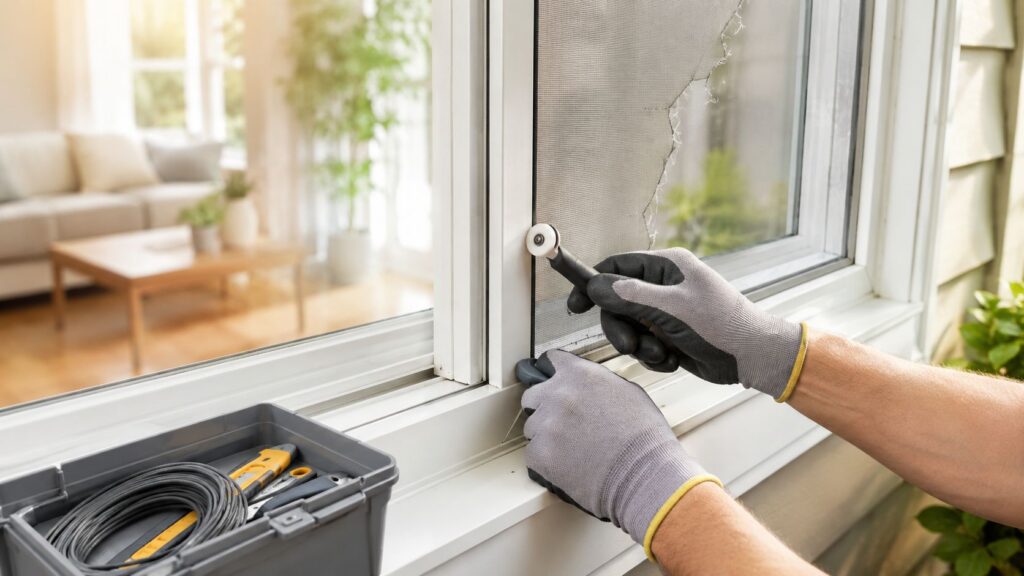
A lot of people search for window and screen repair near me when they're standing in front of the problem. The screen is torn, the window sticks, there's a draft you can feel, or a pane cracked after a storm or a hard shut. At that moment, the main question usually isn't “Who has the best marketing?” It's “Is this a small fix, a bigger repair, or something I shouldn't touch myself?”
That's the right place to start.
Window and screen problems look similar from a distance, but they behave very differently once you inspect them closely. A loose screen can be a quick re-screen. A “simple” draft can point to a failed seal, worn weatherstripping, frame movement, or glass issues. And a screen that only has one visible tear may also have a warped frame or brittle spline that won't hold new mesh properly.
Diagnosing Common Window and Screen Damage
A lot of damage gets misread in the first 30 seconds.
A torn screen looks like a screen problem. A cold draft feels like a bad screen. A window that sticks seems like a dirty track. Sometimes that first guess is right. Often, it is only part of the problem. The goal here is to sort the issue into the right bucket before you spend money or remove parts that were not the actual cause.

Start at arm's length, then get closer. Open the window. Remove the screen if it comes out safely. Run your hand along the frame, corners, mesh, track, and latch points. You are looking for looseness, warping, drag, cracked material, and anything that no longer sits square.
Screen damage that looks small but points to a bigger repair
A small tear does not always mean a small job. In the field, the deciding factors are usually the condition of the frame and whether the old spline still has enough life to hold new mesh securely. If the spline feels dry, hard, or shrunken, the screen may not stay tight after repair, even if the mesh itself is replaced. This screen repair guidance video shows what that failure looks like during a real repair.
Use this quick triage:
- Tiny hole or short split: Check the surrounding mesh with your fingers. If it still feels firm and the frame stays flat on a hard surface, a patch may be enough.
- Long tear or several weak spots: The mesh is usually at the end of its life. Re-screening is often the cleaner fix.
- Loose mesh around the edges: Inspect the spline groove and corners. Old spline can lose grip, and corner damage can keep the mesh from tightening evenly.
- Frame rocks on a flat surface: The frame is bent or twisted. New mesh alone will not correct that.
A simple shop rule helps here. If the screen frame will not sit flat, treat it as a frame issue first and a mesh issue second.
Draft complaints get mixed into screen complaints all the time. Screens do not seal air. They keep bugs out. If you feel airflow around a closed window, start by checking weatherstripping, sash fit, and frame gaps. It also helps to review practical ways to block drafts from windows before assuming the screen needs replacement.
Window problems that need a closer look
Use the window itself as the test. Open it halfway. Close it slowly. Lock it, then release it. Watch the gap lines while it moves.
That quick test tells you a lot.
If one side binds before the other, the sash may be out of alignment. If the latch does not meet cleanly, the frame or meeting rail may have shifted. If you see a crack spreading from an edge or corner, that is usually glass damage, not a hardware problem.
Here's a simple diagnostic table:
| Issue | What to check | Likely concern |
|---|---|---|
| Window won't open smoothly | Tracks, paint buildup, frame alignment | Sticking sash, dirty track, hardware wear |
| Window won't lock cleanly | Meeting rails and latch alignment | Shifted frame or latch issue |
| Cracked pane | Single crack or spreading pattern | Glass damage that usually needs repair |
| Visible fog or haze between panes | Condensation trapped inside unit | Possible seal failure |
| Draft near closed window | Weatherstripping, frame fit, glass seal | Air leakage, seal issue, frame wear |
Fog between panes deserves special attention because it gets mistaken for surface condensation. If the moisture or haze is trapped inside the insulated glass, the seal may have failed. This guide on how to tell if a window seal is broken can help you separate seal failure from a temporary humidity issue.
Fit tells you whether the repair will last
Good screen repair is mostly about fit. A screen can look acceptable on the ground and still fail once it is back in the opening. The common warning signs are easy to spot:
- The frame bows when you press it into place.
- One corner sits high while another drops in loosely.
- The mesh looks tight in the center but slack near the edges.
- The screen shifts or pops loose when the window moves.
Those symptoms usually point to a bent frame, worn corners, bad spline tension, or measurements that are slightly off. That is why diagnosis matters more than people expect. Once you know whether the problem is mesh, frame, hardware, glass, or seal, the repair path gets much clearer.
DIY Repair vs Calling a Professional
A torn screen on a ground-floor window can be a simple Saturday job. A screen that keeps popping out, a window that no longer locks straight, or anything involving broken glass is a different category. The goal is not just to make it look better. The goal is to fix it once and have it stay fixed.

Good DIY jobs
DIY makes sense when the problem is small, easy to reach, and unlikely to create a bigger repair if something goes wrong. Basic screen work is often fine for a careful homeowner, especially on a patio slider or first-floor window where you can work safely and take your time.
Good candidates for DIY include:
- Small mesh patching: Best for minor holes or tears when the frame still fits properly.
- Basic cleaning and track clearing: Packed dirt and debris can make a window drag or keep a screen from seating fully.
- Simple hardware checks: Tightening an exposed screw or checking for an obvious loose latch is reasonable.
- Screen removal and inspection: Fine on accessible windows when the frame is not stuck or bent.
If you want to see what a manageable project involves, this guide to DIY window screen repair walks through the process.
Jobs that usually go better with a pro
Some repairs look simple on the patio table and get complicated fast once the screen goes back into the opening. Full re-screening is a common example. Mesh tension has to be even, the spline has to match the channel, and the frame has to stay square under pressure. If one part is off, the screen may ripple, bow, or slip loose after a few uses.
Call a professional when you're dealing with:
- Warped frames
- Brittle or unknown spline sizes
- Screens on upper-story windows
- Cracked or broken glass
- Rotted wood or frame deterioration
- Windows that bind, rack, or won't lock squarely
Those jobs carry more risk, and not just because they take longer. A bad fit can leave gaps for insects, stress the frame, or hide a larger alignment problem that keeps coming back.
A patch can hide damage. A proper repair restores fit.
The trade-off is time, risk, and whether the fix will hold
DIY usually costs less at the start. Professional repair usually cuts down on repeat work and catches problems that are easy to miss the first time.
I see the same patterns after failed DIY attempts. The mesh is tight on one side and loose on the other. The spline looked close enough but will not stay seated. The frame seemed straight until it was installed and one corner lifted. None of that means the homeowner did something foolish. It means window and screen repair is more exact than it looks.
If the repair affects safety, weather sealing, glass, upper-floor access, or precise fit, book someone who does this routinely. That is usually the cheaper decision once you factor in your time, replacement materials, and the chance of doing the job twice.
Understanding Window and Screen Repair Costs
Repair pricing makes more sense when you stop treating every window problem like the same job. A torn screen, cracked pane, and rotted frame may all start with the same search, but they sit in very different labor and material categories.

What the price range tells you
In Los Angeles, one 2026 cost guide lists the average window repair at $284, with a typical range of $172 to $417. The same guide puts screen repair or replacement at $25 to $100, latch or hardware issues at $25 to $150, cracked or broken glass at $75 to $2,000+, and rotted frames at $250 to $800. Labor is listed at $30 to $90 per hour in that market, according to Angi's Los Angeles window repair cost guide.
That spread matters. It shows why one homeowner gets a quick, low-ticket repair while another gets an estimate that looks more like a major restoration.
What changes the final quote
For screen-specific work, another industry estimate puts average window screen repair at about $310, with a range of $100 to $480, and identifies the main cost drivers as material type, window-screen type, window size, accessibility, and whether the screen frame also needs replacement, according to Angi's screen repair listing.
In plain terms, these are the biggest price movers:
- Mesh-only versus frame rebuild: Replacing mesh is simpler than rebuilding a bent or weak frame.
- Window location: Ground-floor access is easier than a high or awkward opening.
- Repair type: Glass and frame repairs usually involve more labor, more materials, and more risk than screens.
- Window style: Different retention methods and dimensions affect time on site.
- Material choice: Some mesh options and frame parts cost more than standard stock components.
How to read an estimate without guessing
A useful estimate should tell you what's being repaired. Not just “window service,” but whether the charge covers mesh, frame, hardware, glass, labor, or removal and reinstallation.
Here's a clean way to think about scope:
| Repair category | Usually lower complexity | Usually higher complexity |
|---|---|---|
| Screen work | Mesh replacement | Frame rebuild or custom fit |
| Window hardware | Latch or minor mechanism issue | Alignment issue tied to frame movement |
| Glass | Small single-pane repair | Larger or more complex glass replacement |
| Frame | Surface correction | Rot or structural repair |
If you want a closer look at how screen-related pricing is commonly broken out, this page on the cost to repair a window screen gives a practical overview.
The cheapest estimate isn't always the cheapest repair. If it leaves the warped frame, worn spline, or misfit screen in place, you may end up paying twice.
Your Checklist for Hiring a Repair Service
Once you know the problem and have a rough sense of cost, the next step is choosing who gets the job. This part matters more than most homeowners think, because window and screen repair can be mobile, in-shop, same-day, scheduled, or some combination of all four.

Searchers now expect convenience, immediate quoting, and at-home service. In Los Angeles, some Taskrabbit pros advertise window repair at about $54 per hour, while mobile screen businesses emphasize fast on-site work across the region, as noted on Northridge Screen's window repair page. That doesn't mean every job should be mobile. It means you should ask exactly how the service is handled.
Here's a video overview that helps frame the hiring process before you book:
What to ask before you say yes
Use a checklist, not a vibe.
Verify insurance and business status
Ask whether they carry General Liability and Workers' Compensation. If someone gets hurt on your property or damages the home, this matters.Ask how the repair is performed
Is it done on-site, in-shop, or by drop-off? A provider should explain the logistics clearly, especially for screen work.Get the diagnosis in writing
You want more than a price. You want to know whether they're replacing mesh, repairing hardware, rebuilding a frame, or recommending full replacement.Ask about material and fit
This is especially important for screens. If they can't explain how they handle fit, tension, and frame condition, keep looking.Check turnaround expectations
“Fast” means different things to different companies. Ask when they can inspect, when they can complete the repair, and whether parts need to be ordered.
Green flags and red flags
A trustworthy repair company usually does these things:
- Answers direct questions clearly
- Explains what's repairable and what isn't
- Gives a written estimate
- Tells you if the work is done on-site or off-site
- Sets realistic expectations for scheduling and completion
Red flags tend to sound like this:
- “We'll know when we get there” with no scope discussion
- No mention of insurance
- No written quote
- Pressure to replace everything without diagnosis
- Vague answers about who is doing the work
If a company can't explain the repair path in plain language, they probably haven't identified the problem cleanly.
Convenience matters, but clarity matters more
Mobile service is useful. So is same-day availability when you have a torn screen or broken pane. But convenience shouldn't replace basic professionalism.
If you're comparing multiple local options for window and screen repair near me, choose the one that makes the diagnosis, service mode, and estimate easy to understand before the work starts.
Why Arizona Homeowners Choose Sparkle Tech
Homeowners usually want the same few things from a repair company. They want someone local, insured, straightforward, and able to show up ready to solve the actual problem. They also want to know they're not inviting unnecessary risk onto the property.
That's where Sparkle Tech fits the checklist above in a practical way. Sparkle Tech Window Washing LLC is a family-owned company based in the Phoenix Valley, and it services anywhere in Arizona. The company carries full Workers' Compensation, General Liability Insurance, and bonding, and it's registered in Arizona for customer protection.
That matters because window and screen work often overlaps with access, ladders, glass handling, and removal or reinstallation around finished surfaces. Credentials aren't marketing fluff in this trade. They're part of what separates a casual side job from a professional service operation.
What homeowners usually need from one visit
A lot of customers don't have just one issue. They may have a torn bug screen in one room, a sun screen that's worn out on another elevation, and windows that also need cleaning so the full opening, tracks, and glass can be properly inspected.
Sparkle Tech's published service relevance includes new, rescreened, and repaired sun and bug screens. For homeowners who'd rather not juggle separate vendors, that makes it easier to handle adjacent screen and window service needs through one company instead of piecing the job out.
Why this approach works
The strongest repair experiences usually follow a simple pattern:
- The problem gets diagnosed correctly
- The scope is explained in plain English
- The service is performed safely
- The customer understands the next step
That's especially useful in Arizona, where sun exposure, dust, and regular use can leave screens brittle, tracks dirty, and frames tired long before the issue becomes urgent. A neighbor-friendly repair experience doesn't need hard selling. It needs clear answers and reliable follow-through.
If you've been putting off a torn screen, a sticking window, or a repair you're not fully comfortable doing yourself, it's worth getting a real diagnosis instead of guessing from the sidewalk. That's usually the point where the whole thing gets simpler.
If you want a straightforward quote from an insured, bonded, Arizona-based team, contact Sparkle Tech Window Washing to ask about window and screen repair, rescreening, and related service anywhere in Arizona.