



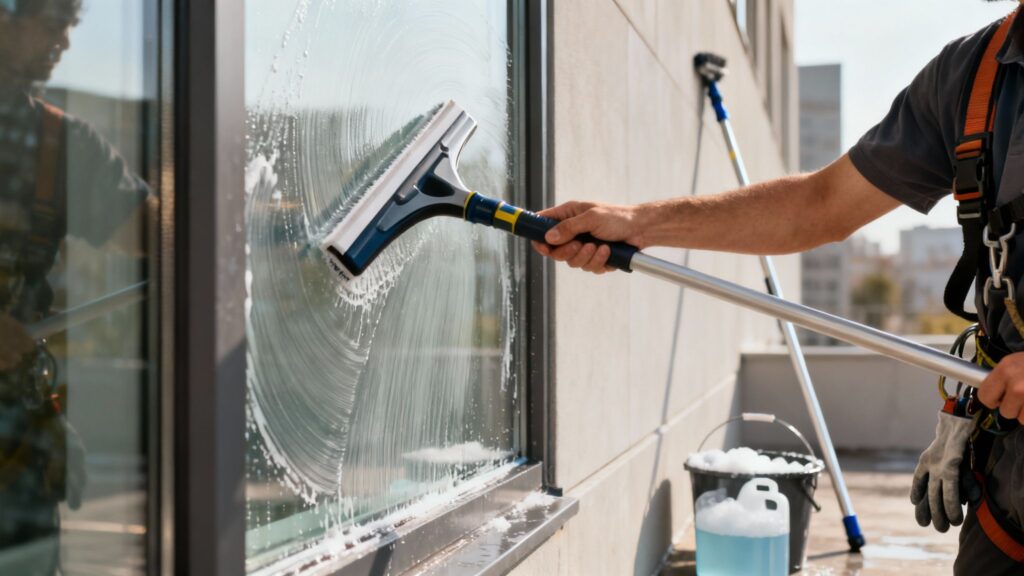
Ever wonder how professional window washers get that perfect, streak-free shine every single time? It's a common question, and the secret isn't some space-age chemical. It's actually a surprisingly simple toolkit built around a professional-grade squeegee, a specialized scrubber, and a basic cleaning solution.
The real magic happens in the synergy between high-quality tools and an expert's technique. This combination is what delivers that flawless finish that most DIY methods just can't seem to replicate.
What's In a Professional Window Washer's Bucket?
When you see a pro at work, you're watching a well-oiled system in action. Each tool has a specific job, and they all work together to lift dirt, control the water, and leave nothing behind but sparkling, clear glass. The goal is to completely sidestep the frustrating streaks and smudges that paper towels and spray bottles almost always leave behind.
It all boils down to a three-step process: apply the solution, scrub away the grime, and then remove every last drop of liquid in a single, smooth pass. This methodical approach is what truly separates an amateur attempt from a professional result.
The Essential Tools of the Trade
At the heart of any window cleaner’s arsenal are a few key pieces of gear. These aren't the flimsy tools you'd find at a grocery store; they're designed for durability, efficiency, and comfort, allowing a pro to work quickly and get it right the first time.
Here’s a look at the absolute must-haves:
-
The Professional Squeegee: This is, without a doubt, the most critical tool. Unlike cheap plastic versions, a pro squeegee has a rigid metal channel holding a replaceable, razor-sharp rubber blade. This creates a perfect seal against the glass, which is vital for a streak-free finish.
-
The Scrubber (or Applicator): You might hear this called a T-bar and sleeve, and it looks a bit like a fluffy paint roller. Its job is to hold a ton of soapy water and scrub the entire window, loosening dirt, dust, and stubborn grime without ever scratching the surface.
-
The Cleaning Solution: Forget harsh chemicals. Most pros use a simple, time-tested mix: water with just a few drops of a specific type of dish soap. This creates the perfect amount of "slip," allowing the squeegee to glide effortlessly across the glass—the key to preventing streaks.
“The art of window cleaning is all in the glide. A quality squeegee and the right amount of soap slip are far more important than any powerful chemical. It’s about removing the dirt and water with precision, not just blasting it away.”
Professionals are trained to adapt their methods for all kinds of surfaces, from historic single-pane glass to modern windows and composite doors, ensuring every type of material is handled with the proper care.
Professional Window Washer's Essential Toolkit At-a-Glance
To give you a clearer picture, here’s a quick summary of the core tools and what they do. This is the foundational kit that allows professionals to achieve consistently perfect results on every job.
| Tool Category | Specific Tools | Primary Function |
|---|---|---|
| Scrubbing & Application | T-Bar & Sleeve (Scrubber) | Holds soapy water and gently scrubs away dirt, grime, and debris without scratching the glass. |
| Water & Debris Removal | Professional Squeegee & Rubber Blade | Removes all water and dissolved dirt from the glass in a single, smooth pass for a streak-free finish. |
| Detailing & Polishing | Scrim or Microfiber Towels | Used for wiping the edges of the window pane (detailing) and polishing away any remaining water drips. |
| Deep Cleaning | Window Scraper (with Blades) | Carefully removes stubborn, stuck-on debris like paint overspray, bug residue, or hard water spots. |
| Cleaning Solution | Bucket, Dish Soap, Water | Creates the necessary "slip" for the squeegee to glide smoothly and helps break down surface grime. |
This simple but effective toolkit is the backbone of the trade. For a deeper dive into specific models and brands, check out our comprehensive guide on the best window cleaning tools the pros rely on every day. When you combine these tools with practiced skill, you have the true answer to how professionals get windows so clean.
Why the Squeegee Is the Heart of Professional Cleaning
If you ask a pro what their single most important tool is, they won't point to some fancy machine or a high-tech chemical. They'll almost certainly hold up their squeegee. To a window washer, this simple tool is what a perfectly balanced knife is to a master chef—it's an extension of their hand and the absolute key to a flawless finish.
A professional-grade squeegee is a world away from the flimsy plastic ones you find at the hardware store. It's engineered for one thing: precision. Every part is designed to work in harmony, leaving nothing behind but crystal-clear, dry glass.
Anatomy of a Professional Squeegee
What makes a pro squeegee so much better? It all comes down to its three core components. Each piece is built for durability and performance, giving the user the control needed to make streaks a thing of the past.
- The Handle: Pro handles are designed ergonomically. After all, washers hold these for hours, so comfort and a solid grip are non-negotiable. Many have quick-release clips, making it easy to snap different-sized channels in and out.
- The Channel: This is the rigid metal track, usually stainless steel or brass, that holds the rubber blade. Its stiffness is critical. It applies perfectly even pressure across the entire blade, which stops the bowing and chattering that cause those ugly streaks.
- The Rubber Blade: This is where the magic happens. The blade is the most critical part, made from high-quality, soft rubber with a perfectly sharp, square edge. This edge acts like a seal, cleanly shearing away every last drop of water and dirt.
This simple workflow shows how these tools come together for a perfect result.
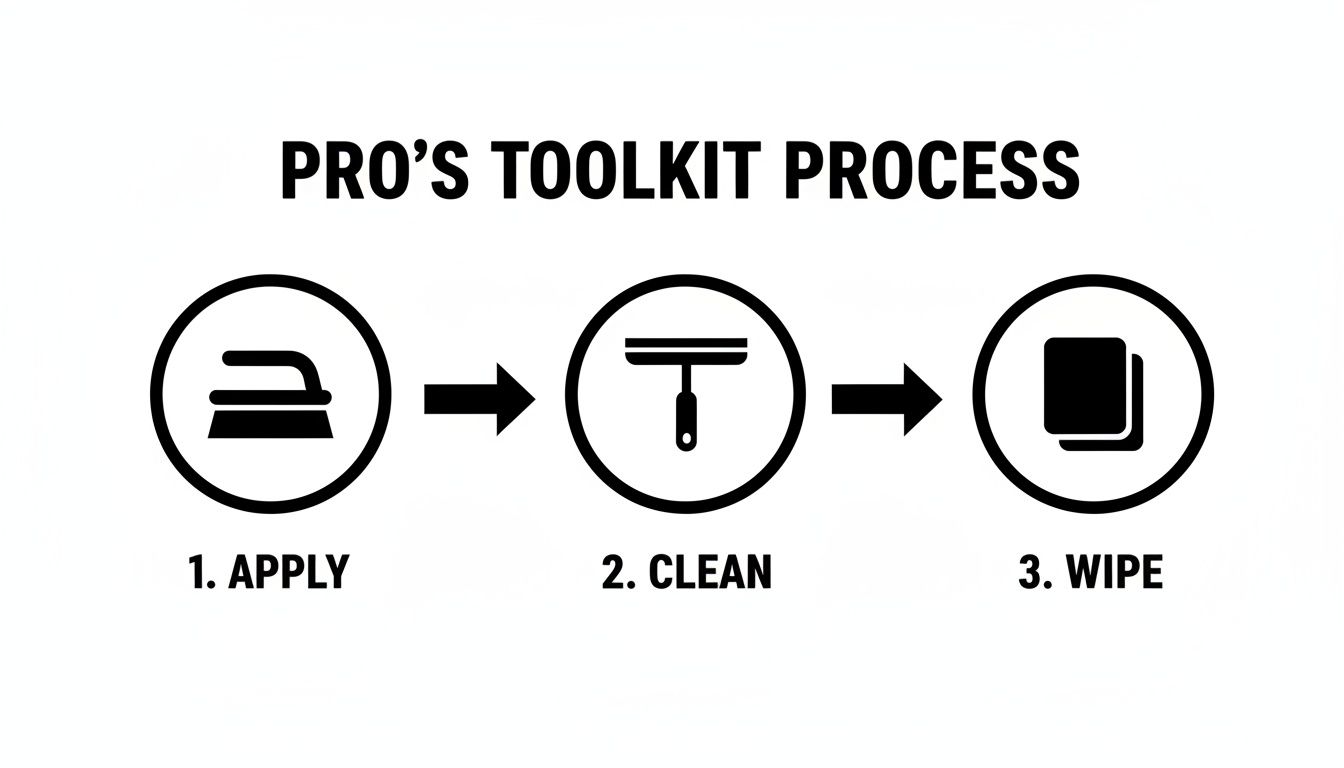
As you can see, the squeegee is the star of the show, handling the heavy lifting of water and dirt removal to get that pristine finish.
Mastering the Art of the Squeegee Stroke
Just having a great squeegee isn't enough; the secret is all in the technique. Amateurs often just drag it straight down the glass, which almost always leaves lines where the strokes meet. The pros, however, have a much more elegant method called the "S-stroke" or fanning.
This technique involves moving the squeegee from top to bottom in one continuous, fluid S-shaped pattern. By keeping the blade in constant motion and slightly angled, the leading edge of the rubber is always cutting into a wet area of the glass. This masterful control is what prevents water from sneaking back under the blade—the number one cause of streaks. It takes a steady hand and a lot of practice, but it's the only way to get that perfect, edge-to-edge clarity on big panes of glass.
A tiny nick or a dull edge on a squeegee blade can ruin an entire window. It’s like trying to draw a perfect line with a broken pencil tip—the flaw will show up in your work every single time. That’s why pros are obsessive about blade maintenance.
In this business, efficiency is everything. Speed and quality have to go hand-in-hand. You'll see pros working out of simple setups, often just an Ettore bucket with their squeegees, washers, and a basic Dawn soap solution. This kit is so effective it allows them to hit a 99% streak-free rate on commercial jobs. You can find more details about the full range of equipment window cleaners use to achieve these results.
The Non-Negotiable Rule of Blade Maintenance
If you take away one thing, let it be this: treat your rubber blade as a consumable. That sharp edge wears down a little with every single pass. Even a tiny, invisible nick can leave a long, frustrating streak down an otherwise perfect window.
Professionals are constantly changing their rubber blades, sometimes even daily, to guarantee a perfect edge for every job. For a DIYer, a good rule of thumb is to swap out the rubber as soon as you see the first sign of streaking or when it no longer feels buttery-smooth on the glass. It’s a cheap habit that makes all the difference in the world.
The Surprisingly Simple Secret in a Pro's Bucket
If you think professional window washers show up with a truck full of top-secret, high-tech chemicals, you're in for a surprise. The truth is, the most trusted and effective cleaning solution in the industry is probably sitting right under your kitchen sink.
For the vast majority of jobs, our go-to mix is stunningly simple: clean water and a few drops of a good-quality dish soap. This isn't about cutting corners. It's about what flat-out works best.
It's All About the "Slip"
The magic of this simple concoction comes down to some basic chemistry. Dish soap is a surfactant. Think of it as a tiny magnet—one end grabs onto water, and the other end grabs onto oil, grease, and grime.
When you wash a window, those soap molecules break up and lift all the gunk off the glass. But its most critical role for a professional is creating "slip." This is the super-thin, slick layer that lets a squeegee blade glide like a hot knife through butter. Without that perfect slip, the blade will skip, jump, and chatter, leaving behind those frustrating streaks everyone hates.
"The perfect window cleaning solution is all about lubrication, not harsh chemicals. The goal is to create a frictionless surface that allows your squeegee to do its job perfectly, removing 100% of the water and dirt with it."
This principle is why you don't see pros spraying windows down with aggressive, foaming cleaners. We rely on a bucket of soapy water and a great squeegee. Even on huge commercial jobs, a simple solution of Dawn dish soap is often the undefeated champ for getting a perfect, cost-effective shine. You can dig into the numbers and industry practices and solutions to see just how prevalent this method is.
While a simple soap-and-water mix is the workhorse, it's not always the right choice for every situation. Let's compare what the pros use to common DIY solutions.
Comparing Professional and DIY Cleaning Solutions
| Solution Type | Primary Ingredients | Pros | Cons |
|---|---|---|---|
| Professional (Standard) | Dish Soap (e.g., Dawn), Water | Excellent slip for squeegees, great at cutting grease, very cost-effective, readily available. | Can leave a residue if not rinsed properly or if too much soap is used. |
| Professional (Hard Water) | Soap, Water, White Vinegar | Acidity effectively dissolves mineral deposits (hard water spots) from sprinklers. | The smell can be strong; not ideal for every surface or sealed window. |
| Household (Blue Spray) | Ammonia, Solvents, Water | Convenient for quick spot cleaning, evaporates quickly. | Poor slip for squeegees, can create static that attracts dust, often leaves streaks. |
| Household (DIY Vinegar) | Vinegar, Water | Inexpensive, good for light mineral spots. | Very little slip, can damage stone sills (marble, travertine), strong odor. |
As you can see, the professional's choice is all about creating the right conditions for their tools to work flawlessly. DIY solutions might seem convenient, but they often work against the very techniques needed for a streak-free finish.
When You Need a Little Extra Kick
While a simple soap solution handles over 90% of residential jobs, sometimes you run into problems that require a specialist. A pro knows when to add a little something extra to the bucket without causing damage.
These aren't all-purpose cleaners; they are precision tools for specific problems:
- White Vinegar: Got hard water spots? A splash of white vinegar is the answer. Its mild acidity is fantastic for breaking down the chalky mineral deposits left behind by sprinklers.
- Ammonia: This one is used a lot less these days, but it still has its place. Ammonia is a beast when it comes to cutting through heavy grease, like the film on a kitchen window or years of smoky buildup. It’s powerful, so you absolutely need good ventilation.
- Specialized Soaps: While Dawn is great, some pros swear by soaps designed specifically for window cleaning. They're formulated for maximum slip and minimal suds, making the job a bit smoother. To see what the options are, take a look at our guide to the essential chemicals for window cleaners.
In the end, the professional philosophy is "less is more." We always start with the mildest, safest solution that can get the job done right. This protects your window seals, your painted frames, and the garden below, all while delivering that perfect, invisible-glass look. The real secret isn't what's in the bucket—it's knowing how to use it.
How Water-Fed Poles Changed the Window Cleaning Game
For windows you can reach from the ground, the classic squeegee and bucket combo is still king. But the moment you need to go vertical, everything changes. Cleaning windows several stories up used to mean ladders, lifts, or even ropes—all of which come with risks. This is where the Water-Fed Pole (WFP) system comes in, and it's been a total game-changer for safety, speed, and the quality of the final shine.
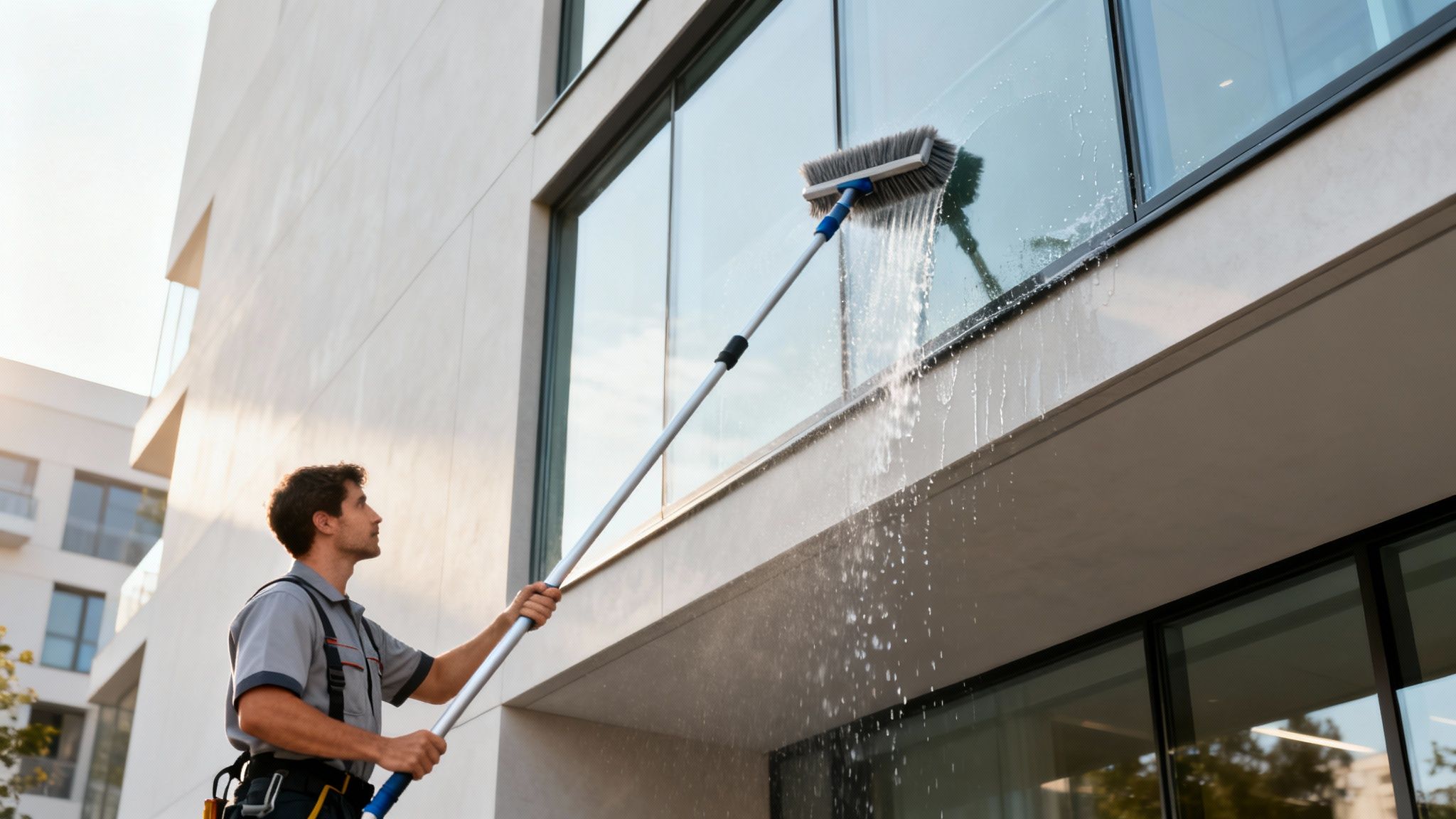
Picture a super-light, telescoping pole, usually crafted from carbon fiber, that can stretch up to reach windows five or six stories high. At the very top, there's a soft-bristled brush. A thin tube runs up the entire length of the pole, feeding a steady stream of highly purified water right onto the glass. This simple but brilliant setup lets a window cleaner do a perfect job from the safety of the ground.
The Magic is in the Water
The real secret to the WFP system isn't the pole—it's the water. We're not talking about regular tap water here. This is ultra-pure water, which has been meticulously filtered to remove every last mineral and dissolved solid. Tap water is full of microscopic minerals, like calcium and magnesium, which are the culprits behind those chalky white spots you see after a car wash.
Professionals use one of two filtration methods to get this perfectly pure water:
- Reverse Osmosis (RO): This system forces water through an incredibly fine membrane, which acts like a sieve, trapping nearly all the impurities.
- Deionization (DI): This process uses special resin beads that work like tiny magnets, grabbing mineral ions from the water and swapping them out for harmless ones.
Once all the minerals are stripped away, the water becomes hungry. It's so pure that it actively wants to bond with anything it touches.
When this pure water hits a dirty window, it naturally grabs onto dirt, dust, and grime, lifting them off the glass and holding them in suspension. It’s like a magnet for dirt, all without a drop of soap.
This natural cleaning power is so effective that detergents are rarely needed. The pro just scrubs the window with the brush to loosen all the gunk, then gives it a final rinse with the pure water. Because there are no minerals left in the water, it dries completely clear. No spots, no streaks, no need for a squeegee.
The Big Wins of Using a WFP System
Switching to a water-fed pole is about more than just a spot-free finish; it fundamentally improves the entire job. This approach offers huge advantages over climbing ladders, making it the go-to method for most exterior cleaning projects. If you want to see the gear up close, you can explore a full water-fed pole window cleaning system and how it all fits together.
Here are the main reasons why pros love this tool:
- Unmatched Safety: This is the big one. Keeping workers on the ground instead of on a ladder dramatically cuts the risk of falls, the single biggest danger in the industry.
- Serious Efficiency: A skilled pro with a WFP can clean windows much faster than someone who has to constantly move, secure, and climb a ladder. More speed means the job gets done quicker without cutting corners.
- It’s Eco-Friendly: The system’s reliance on pure water means no harsh chemicals or soaps are needed. That means no chemical runoff into your garden or the local water supply, making it a much greener way to clean.
- A Deeper Clean: The brush doesn't just clean the glass. It scrubs the window frames, sills, and ledges at the same time, giving you a far more thorough cleaning than you'd get with just a squeegee.
The Non-Negotiable Safety Gear Pros Always Use
While fancy tools create that perfect, streak-free shine, they’re not the most important thing in a professional’s toolkit. Far from it. What truly separates a seasoned pro from a risky DIY attempt is an unwavering commitment to safety.
For any job that involves working off the ground, what professional window washers use to clean is completely overshadowed by what they use to stay safe.

This isn't just about avoiding a fall; it’s a whole system designed to manage risk at every single step. From the moment we arrive on-site, safety is the first and last thing on our minds.
Foundational Safety for Every Job
Even on a single-story home, we take precautions that amateurs often skip. The foundation of a safe job starts before a foot ever leaves the ground, with equipment designed to make the entire workspace stable and secure.
This baseline gear includes:
- Proper Footwear: Slip-resistant boots with a solid grip are an absolute must. They keep you stable on ladders and protect your feet from dropped equipment.
- Ladder Stabilizers: Think of these as "arms" that attach to the top of a ladder. They rest against the wall or roof, creating a much wider, more stable base and preventing the ladder from kicking out sideways.
- Leg Levelers: Working on uneven ground? These attachments let you adjust the length of each ladder leg independently. This ensures the ladder is perfectly vertical and won't wobble.
- Tool Belts and Holsters: Trying to climb a ladder while holding tools is a recipe for disaster. A good holster keeps your squeegees and scrapers secure, leaving your hands free for a safe climb.
For hand protection, many pros rely on durable cut-resistant gloves to guard against sharp window frames or the rare piece of broken glass.
Advanced Systems for High-Rise Work
When you’re cleaning a skyscraper, the safety gear gets far more complex and demands serious, specialized training. This is where you see the high-tech equipment that allows cleaners to safely descend the face of a building, hundreds of feet in the air.
Safety is paramount in this line of work. OSHA data shows just how serious the risks are, especially on commercial high-rise jobs. Over a 15-year period, there were 88 window cleaning accidents, including 62 fatalities. This is exactly why you trust certified professionals who invest in the right gear and training.
The systems used for this kind of work are highly specialized, and you can’t just buy them and go—they require rigorous certification to use.
Core Components of Rope Descent Systems
This is the gear that allows a window washer to access a building's exterior from the roof. It’s a multi-part system where every single component is load-rated and inspected before every single use. No exceptions.
A typical high-rise setup includes:
- Safety Harness: A full-body harness is the worker's connection to the safety lines. It’s designed to distribute the force of a fall across the strongest parts of the body to prevent catastrophic injury.
- Rope Descent System (RDS): This is the main "working line" the cleaner uses to control their descent. It runs through a friction device, allowing for a smooth, controlled rappel down the building.
- Fall Arrest System: This is a completely separate backup line. It connects to the harness with a "rope grab" that automatically locks onto the rope if the main line fails, arresting the fall. It's the ultimate safety net.
- Bosun's Chair: It’s basically a rigid seat that lets the cleaner work comfortably while suspended for hours. It provides far more support and stability than a harness alone ever could.
Ultimately, this equipment, combined with extensive training, is what makes a professional. It’s a constant reminder that the most important part of the job isn't cleaning the glass—it's getting home safely at the end of the day.
Deciding Between DIY and Hiring a Professional
Knowing what the pros use is one thing, but figuring out whether to do the job yourself or call in an expert is a whole other ball game. There's no single right answer—it really comes down to your specific home, balancing the cost of good equipment against the value of your time and, most importantly, your safety.
A DIY approach can be really satisfying, not to mention budget-friendly, especially for a single-story home where you can reach every window with your feet firmly on the ground. But the moment you start talking about second stories, extension ladders, or stubborn, baked-on grime, the scale usually tips in favor of hiring a pro. The cost of buying quality gear and the time it takes to learn how to use it without leaving a streaky mess can add up faster than you think.
Ultimately, you have to be honest with yourself about the job's complexity, the risks involved, and the kind of results you're after.
When to Consider a DIY Approach
Going the DIY route makes a ton of sense if your home checks a few key boxes. If you're the kind of person who enjoys a good weekend project and your windows are mostly on the ground floor, cleaning them yourself is a perfectly manageable task.
You should definitely consider tackling the job yourself if:
- Your home is a single story. This immediately removes the biggest safety hazard in window cleaning: working high up on a ladder.
- You have standard, easy-to-reach windows. Think casement, sliding, or double-hung windows you can easily get to from the ground or with a sturdy step stool. These are prime DIY candidates.
- The grime is just everyday dust and dirt. If you're not up against tough hard water stains, specks of paint, or stubborn artillery fungus, a simple soap-and-water solution with a good squeegee will make your glass sparkle.
Pro Tip: For a basic but seriously effective DIY starter kit, grab a 10-14 inch professional squeegee, a scrubber (often called a T-bar and sleeve), a bucket, and a quality dish soap like Dawn. This small investment will give you results that paper towels and a spray bottle can't even touch.
When to Call a Professional Service
Sometimes, hiring an insured professional isn't just a matter of convenience; it's a smart move for your safety and the quality of the final result. Pros come equipped with the right gear, proper insurance, and the training to handle tricky situations that are just too risky for the average homeowner.
It’s probably time to pick up the phone when:
- Your home has more than one story. The risk of a fall from a ladder is no joke. Professionals are trained in ladder safety and often use water-fed poles to clean upper-story windows safely from the ground.
- You have hard-to-reach windows. We're talking about skylights, windows set high up in a vaulted ceiling, or massive picture windows that are impossible to clean without specialized equipment.
- You're dealing with stubborn residue. Pros have the right tools and know-how to remove things like hard water stains, paint overspray, or post-construction gunk without accidentally scratching the glass.
- You value your free time. Let's be real. A professional crew can knock out all the windows in a typical home in just a few hours—a job that could easily eat up your entire weekend.
Got Questions About Professional Window Cleaning?
After diving into the tools and techniques of the pros, you probably have a few practical questions. It’s one thing to know what a squeegee is, but it’s another to know why a pro uses it instead of, say, a pressure washer. Let’s tackle some of the most common questions that pop up.
Getting these details right is what separates a DIY job from a truly professional result.
Why Can't I Just Use a Power Washer?
This is a big one, and the answer is a hard no from any professional. A power washer is a tool for concrete, not glass. The sheer force of that water jet can do serious, expensive damage in seconds.
For starters, it can easily shatter the glass. More often, it blows out the window's seals. Once a seal is broken, moisture seeps between the panes, creating that permanent foggy look. The only fix for that is a full window replacement.
But the damage doesn't stop there. The high pressure can also:
- Shred your window screens
- Blast paint right off your siding and window frames
- Force water behind the siding and into your wall cavities, setting the stage for mold and wood rot
It's a high-risk, zero-reward approach. You might spend a few hundred dollars on a cleaning, but a pressure washer mistake could easily cost you thousands.
The professional's secret isn't power—it's precision. A gentle scrub and a perfect squeegee pull get the job done right, protecting your windows and delivering a flawless shine without the risk.
How Do Pros Deal With Filthy Tracks and Screens?
A truly clean window isn't just about the glass. The surrounding components matter just as much, and pros have a specific process for them.
For Window Tracks: They start by getting all the loose stuff out. A stiff brush works great for breaking up caked-on gunk, which is then sucked out with a powerful shop vac. For anything left behind, a quick wipe with a damp microfiber cloth leaves the track looking brand new.
For Screens: Screens are delicate, so they get their own special treatment. Pros carefully pop them out and wash them by hand using a soft-bristled brush and mild, soapy water. After a thorough rinse, they're set aside to air dry completely before being put back. This simple step prevents water spots on the glass and keeps moisture from getting trapped.
How Often Should I Get My Windows Cleaned?
For most homes, the sweet spot is twice a year. This is usually enough to keep dirt, pollen, and mineral deposits from building up and potentially etching the glass over time. Think of it as spring and fall cleaning for your windows.
Of course, your environment makes a difference. If you live near a busy street, a construction zone, or by the coast where salt spray is a constant, you’ll probably want to bump that up to a quarterly service.
On the other hand, commercial properties like storefronts have a much higher standard to maintain. To keep looking sharp and welcoming for customers, they often need cleanings every month or even every week.
Ready to see what a real professional clean looks like? The team at Sparkle Tech Window Washing has the right gear and the expert technique to give your windows a long-lasting, streak-free shine. Pop over to our site for a free, no-pressure quote and let us bring the view back to life: https://sparkletechwindowwashing.com.