



You notice it when you crack the window open for fresh air. The screen has a tear in one corner, the frame looks a little bent, or the mesh has gone chalky and loose from the Arizona sun. Now bugs get in, dust rides the breeze, and that quick search for screen repair near me window suddenly becomes urgent.
Most homeowners want the same answers right away. Can this be patched, or is it too far gone? Is this a simple DIY job, or am I about to waste a Saturday fighting with spline and wrinkled mesh? And if I hire someone, what's a fair price and what should I expect from the service?
Arizona makes those questions more important. Heat and sun change how long a repair lasts. A patch that might hold up well in a milder climate can turn into a short-term fix on an older, brittle screen here. The right choice usually comes down to three things: the condition of the frame, the age of the mesh, and whether the material still has enough strength to hold tension.
That Annoying Tear in Your Window Screen
It usually starts small. A pet pushes into the mesh. A branch rubs the screen during a windy day. Someone removes the screen for cleaning and tweaks the frame on the way back in. At first, it looks minor enough to ignore.
Then the practical problems show up. Mosquitoes find the gap. The screen rattles because a corner isn't sitting right. You stop opening that window because the damage has made the whole thing feel unreliable.
Practical rule: If the damage changes how the screen fits in the opening, treat it as more than a cosmetic issue.
In Arizona homes, I see a common pattern. Homeowners focus on the tear because that's the obvious damage, but the bigger issue is often the condition of the mesh around it. Sun-baked material loses flexibility. Once that happens, patching one spot doesn't always solve the problem because another weak point can fail next.
The questions that matter first
Before anyone grabs a repair kit or books a service call, check these basics:
- Look at the mesh texture. If it feels brittle, stiff, or faded, the damage probably isn't isolated.
- Check the frame corners. A screen can have good mesh and still fail because the frame is loose or out of square.
- Test the fit. If the screen doesn't sit snugly, even a neat-looking repair won't perform well.
- Think about age. Older screens often need a broader fix than the visible tear suggests.
That's why a good repair decision starts with diagnosis, not guesswork.
What Window Screen Damage Can Be Repaired
Some screen problems are straightforward. Others look simple until you remove the screen and see that the frame, spline, and mesh are all part of the issue. A homeowner who knows the difference usually makes a better call on repair versus replacement.

Damage that usually can be repaired
Small punctures and short tears are often fixable if the surrounding mesh still has strength. A localized patch can work when the rest of the screen is stable and the frame is still square.
A loose or worn spline is also a repairable issue in many cases. If the mesh is coming out of the groove at one side or corner, replacing the spline and resetting the mesh can restore tension without replacing the whole unit.
Minor frame issues can sometimes be corrected too. A slightly bent aluminum frame may be straightened if it hasn't creased sharply or pulled the corners out of alignment.
Damage that usually points to replacement
Large rips are one clear sign. The other is material degradation. If the mesh is sun-damaged and brittle, patching one opening often leaves you with a screen that fails in another spot soon after.
Severely warped frames are another cutoff point. Once the frame no longer sits properly in the window opening, it becomes hard to get a reliable result from repair alone.
A screen is only as good as its weakest part. If the frame is sound, re-screening often makes sense. If the frame is failing too, partial fixes usually turn into repeat work.
Why material choice matters
The most important technical choice is often the mesh material, not the frame. CHC Glass explains fiberglass is the residential standard because it's flexible, while stiffer aluminum mesh is better for large openings, and the spline diameter has to match the frame groove to prevent puckering or the mesh pulling out under wind load.
That's where many DIY jobs go sideways. The wrong spline size can leave loose corners, waves in the screen, or a mesh edge that won't stay seated.
For homeowners comparing local help, some providers handle on-site adjustment, re-screening, and frame-related fixes in one visit or service flow. Sparkle Tech's window screen repair service is one example of that type of offering in Arizona.
DIY Screen Repair vs Hiring a Professional
A lot of screen work looks easy from a distance. Remove old spline, lay in new mesh, roll it in, trim the edge, reinstall. On a clean workbench with a perfect frame, that can be manageable. In practice, most trouble starts when the frame is slightly off, the mesh has become brittle, or the installer uses the wrong amount of tension.
When DIY makes sense
DIY is reasonable when the damage is small and isolated, and when the frame still fits correctly. If you're patching a minor hole or replacing mesh on a single, standard screen frame in good shape, the job is mostly about patience and setup.
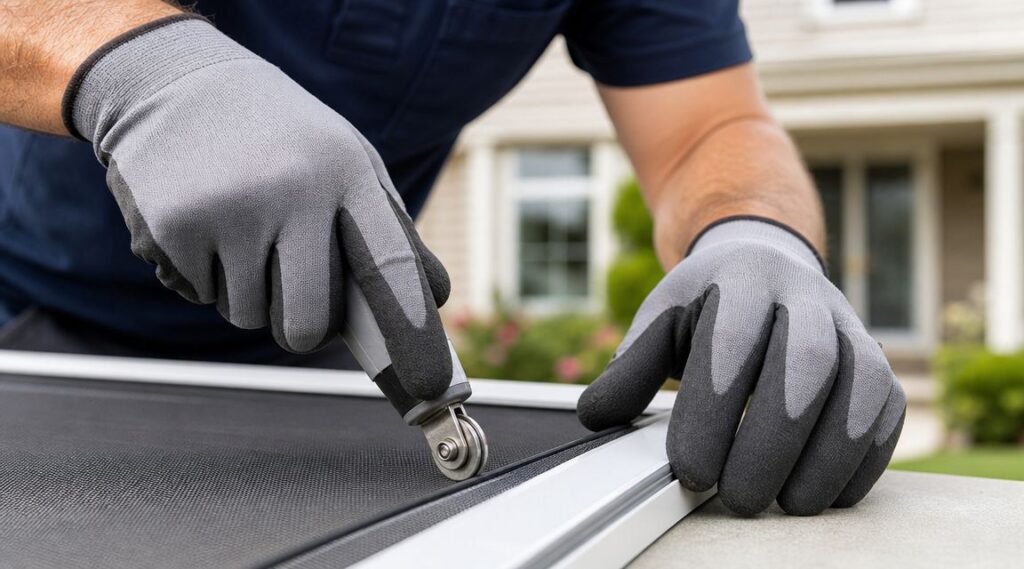
You'll need the basics: replacement mesh, spline, a spline roller, a utility knife or scissors, and a flat work surface. The difficult part isn't owning the tools. It's keeping the material straight, applying even tension, and not overworking the frame.
When a pro is the better call
Arizona changes the equation. Peninsula Mobile Screens notes that repair versus replacement is often an economic decision, and in a hot climate like Arizona, accelerated UV degradation means patching old, brittle mesh is often only a temporary fix.
That matters because the screen that looks repairable at a glance may already be past the point where a patch is worth doing. A professional usually spots that faster. They can also tell whether the problem is the mesh, the spline, the frame geometry, or some combination of all three.
If the screen is fighting you during installation, stop and reassess. Good screens don't need brute force to fit right.
DIY vs Professional Screen Repair At a Glance
| Factor | DIY Repair | Professional Service |
|---|---|---|
| Best use case | Small, isolated damage on a sound frame | Aging mesh, loose fit, frame issues, multiple screens |
| Tools needed | Spline roller, mesh, spline, cutting tools, work surface | Technician brings tools and matching materials |
| Time commitment | Your own time for setup, repair, cleanup, and reinstall | Usually less homeowner effort beyond scheduling |
| Finish quality | Depends on skill and tension control | Typically more consistent, especially on re-screening |
| Risk of redo | Higher if spline size or tension is wrong | Lower when diagnosis is correct from the start |
| Good fit for Arizona sun damage | Limited when mesh is brittle or heavily UV-worn | Better for deciding whether repair is even worth attempting |
The hidden cost of a bad DIY fix
The biggest mistake isn't spending money on materials. It's spending time on the wrong solution. A patch on failing mesh can look acceptable for a short while, then split again during the next hot stretch or windy day.
That's usually the point where hiring a pro becomes cheaper in practice, because you're no longer paying twice in time and materials. If you're unsure where that threshold is, this guide on knowing when to call a professional window washing company lays out the broader logic behind when specialized service saves hassle and rework.
Understanding Professional Screen Repair Costs and Timelines
The number homeowners usually want first is price. Fair enough. Professional screen work can vary because labor, screen size, access, material, and frame condition all affect the final invoice.
Angi reports the average cost for professional window screen repair is about $310, with a broad range of $100 to $480, and notes that replacement often becomes more cost-effective when screens are more than 10 years old because age-related deterioration is usually the underlying problem.

What changes the price
A basic re-screen on a standard frame is one thing. A larger opening, damaged frame corners, or difficult access is another. Material matters too. Fiberglass and aluminum don't handle the same way during installation, and some jobs need more frame correction before the new mesh can go in cleanly.
Age plays into cost in a less obvious way. Once screens are past that older threshold, technicians often find multiple points of wear at the same time. That makes repeated small repairs less sensible than a more complete fix.
What to expect on timing
Timelines depend on the service model. Mobile and on-site providers may be able to handle adjustment, re-screening, and reinstall work without taking the screens away, while some shops prefer off-site repair after you drop the screen off or after pickup.
The key is to ask one direct question: will this be handled as a patch, a full re-screen, or a replacement recommendation if the frame or mesh fails inspection? That answer tells you more about likely timing than a vague estimate does.
For a more detailed breakdown of what affects pricing, this window screen repair cost guide is a useful reference point.
How to Choose a Reliable Local Screen Repair Service
You call one company and get a flat price in 30 seconds. You call another and they ask what kind of mesh you have, whether the frame still sits square, and how much sun that side of the house gets. In Arizona, the second call is usually the better sign.

A reliable screen repair service should do more than swap mesh. It should help you decide whether repair is still a good use of money in our heat. Sun exposure in Arizona changes the equation. Mesh gets brittle, corners loosen up, and a frame that might be worth saving in a milder climate may not hold up long after a quick fix here.
What to verify before you book
Start by checking whether the company is set up like a real service business and not just advertising like one.
- Insurance should include Workers' Compensation and General Liability.
- Bonding and registration matter if someone is working on your home and handling removals, reinstallations, or ladder access.
- Repair scope should be specific. Some companies only replace torn mesh. Others can also straighten frames, replace spline, rebuild corners, and fit new screens if the old frame is done.
- Arizona material knowledge matters. A good provider should be able to explain why one mesh holds up better than another in intense sun, not just quote the cheapest option.
That last point matters more than many homeowners expect. If a company cannot explain the trade-off between lower-cost fiberglass, aluminum, pet-resistant mesh, and sun-control products, they are probably selling what they stock, not what fits your window and exposure.
What a useful estimate sounds like
A useful estimate usually starts with condition, not price. The company should ask what failed, how old the screen is, whether the frame is bent or loose at the corners, and whether this is a shaded opening or full west-facing sun.
That tells you how they think.
If they skip straight to a one-size-fits-all quote, be careful. A small tear is one job. A brittle sun-cooked screen in an aging frame is another. Ask whether they'll tell you if replacement makes more sense than repair. A contractor who says yes to every repair request is often setting you up to pay twice.
What a credible local company looks like
Sparkle Tech Window Washing is one example of the kind of details worth checking. The company identifies itself as a family-owned Arizona business, states that it services the state, and says it carries full Workers Compensation and General Liability Insurance, is bonded, and is registered as an LLC and in the Arizona trades office. Those are concrete things to verify with any provider, regardless of who you hire.
Online visibility is not proof of workmanship, but it does explain why some legitimate home service companies show up more consistently in local search. If you want context on that side of the business, VIP TECH CONSULTING for home service SEO explains how established service companies improve local search presence.
Common Questions About Window Screen Repair
Can a bent window screen frame be fixed, or does it need replacement
A slight bend can often be corrected. A severely warped or creased frame usually isn't worth fighting. The deciding factor is whether it can sit square and snug in the opening again.
What is the best screen material if I have pets
For pet-related damage, the main issue is resistance to claws and pressure. Ask the installer which mesh options fit your frame and use case. The right answer depends on the opening size and how the screen is used.
How long does an on-site repair visit typically take
Simple jobs can be handled quickly, while re-screening or frame-related work takes longer. The primary variable is condition, not just screen size. A technician should tell you whether the work is likely to be done on-site or handled through a shop workflow.
Do you need to be home for the repair
Usually, yes, at least for access and approval if the technician finds the screen needs more than a patch. For exterior-accessible screens, some companies can work with limited homeowner involvement once the scope is confirmed.
If your screens are torn, sagging, sun-damaged, or no longer fitting right, Sparkle Tech Window Washing handles window and screen repair service in Arizona, including repaired, rescreened, and new bug and sun screens. Reach out if you want a straightforward assessment of whether your screen should be patched, re-screened, or replaced.