


At its heart, purified water window cleaning is a game-changer. It's an advanced approach that uses nothing but 100% mineral-free water to get a perfect, streak-free shine on your windows, all without a drop of chemical soap.
This method completely flips the script on how we think about cleaning glass. It all comes down to the unique properties of water once it's been rigorously filtered.
A Smarter Way to Get Spotless Windows
You’re probably familiar with the old soap-and-squeegee routine. It gets the job done, but it almost always leaves behind a microscopic film of soap residue. That film is sticky, and it becomes a magnet for new dust and dirt.
Purified water cleaning operates on a completely different scientific principle. Think of your regular tap water as a sponge that's already partially full. It's loaded with invisible dissolved minerals like calcium and magnesium. When that water evaporates on your window, it leaves those minerals behind as spots and streaks.
Now, imagine a sponge that’s totally empty and dry. That's purified water. We strip out all those minerals using a process like reverse osmosis, and the water becomes hungry. It actively wants to bond with and pull away any dirt, pollen, and grime it touches on your windows.
The water itself becomes the cleaning agent. The process is simple yet incredibly effective:
- Scrubbing: We gently agitate the glass with a special soft-bristled brush, which is fed a constant stream of pure water through a lightweight pole.
- Rinsing: The loosened dirt and grime are then simply washed away by the continuous flow of that same pure water.
- Drying: Here's the magic part. We just let the windows air dry. Since there are no minerals left in the water, there’s nothing to leave behind—just a flawless, transparent finish.
This is a quick look at how the two methods stack up:
Traditional Cleaning vs Purified Water Cleaning
| Feature | Traditional Method (Soap & Squeegee) | Purified Water Method |
|---|---|---|
| Cleaning Agent | Chemical soaps and detergents | 100% pure, de-mineralized water |
| Residue | Leaves a sticky soap film that attracts dirt | Leaves absolutely no residue |
| Finish | Prone to streaks and spots if not perfect | Dries naturally to a spot-free finish |
| Environmental Impact | Uses chemicals that run off into the ground | Completely eco-friendly and chemical-free |
| Reach | Limited by ladder height and safety risks | Safely reaches up to 5 stories from the ground |
| Longevity | Windows get dirty again faster | Windows stay cleaner for longer |
Ultimately, the pure water method delivers a deeper, longer-lasting clean that traditional techniques just can't match.
It’s no surprise this method has become the new industry standard. The window cleaning market in North America is on a clear upward trend, projected to grow by 13% between 2020 and 2028. This boom is largely fueled by the efficiency and green credentials of pure water systems.
Naturally, this also means more demand for skilled professionals, with employment in the field expected to climb by 10% in that same timeframe. You can find more industry growth insights about window cleaning at NT Property Care. The result is a safer, more effective solution that delivers a superior clean for any home or business.
The Science Behind a Spotless Shine
https://www.youtube.com/embed/O7Mu7Pu0jH8
Ever wonder why cleaning with regular tap water can leave those annoying white spots behind? The secret to a perfect, streak-free finish isn't about adding harsh chemicals—it's about taking something out of the water itself.
It all comes down to a concept called Total Dissolved Solids (TDS). This is just a way of measuring all the invisible minerals—calcium, magnesium, salt, and other impurities—that are naturally found in tap water. When these minerals are left behind to dry on your windows, they create spots and streaks.
Think of it this way: tap water is like a dirty sponge that can't absorb much more mess. But when we purify water, we strip away all those minerals until its TDS level hits zero parts per million (PPM). Suddenly, that water becomes incredibly "hungry." It’s now a clean, thirsty sponge, ready to absorb everything in its path.
This is why pure water is such an amazing cleaning agent. It actively pulls dirt, dust, and pollen right off the glass, dissolving them completely. There’s no need for soap or detergents that leave a sticky film, which only attracts more dirt later.
How We Create Pure Water
So, how do we get water to that ultra-pure state? We run it through a pretty sophisticated multi-stage filtration process right in our service vehicles. While there are various methods, including things like whole house reverse osmosis systems, professional window cleaners rely on two main workhorses.
-
Reverse Osmosis (RO): This is the heavy lifter. We use a high-pressure pump to force tap water through a special, ultra-fine membrane. This membrane is so tight that it traps almost all the minerals and contaminants, allowing only pure water molecules to squeeze through.
-
Deionization (DI): This is the final polishing stage. After the RO system does its job, the water flows through a tank filled with special resin beads. These beads act like tiny magnets, grabbing any last remaining mineral ions and swapping them out, leaving nothing but pure H₂O.
This infographic gives a great visual breakdown of why this approach works so well.
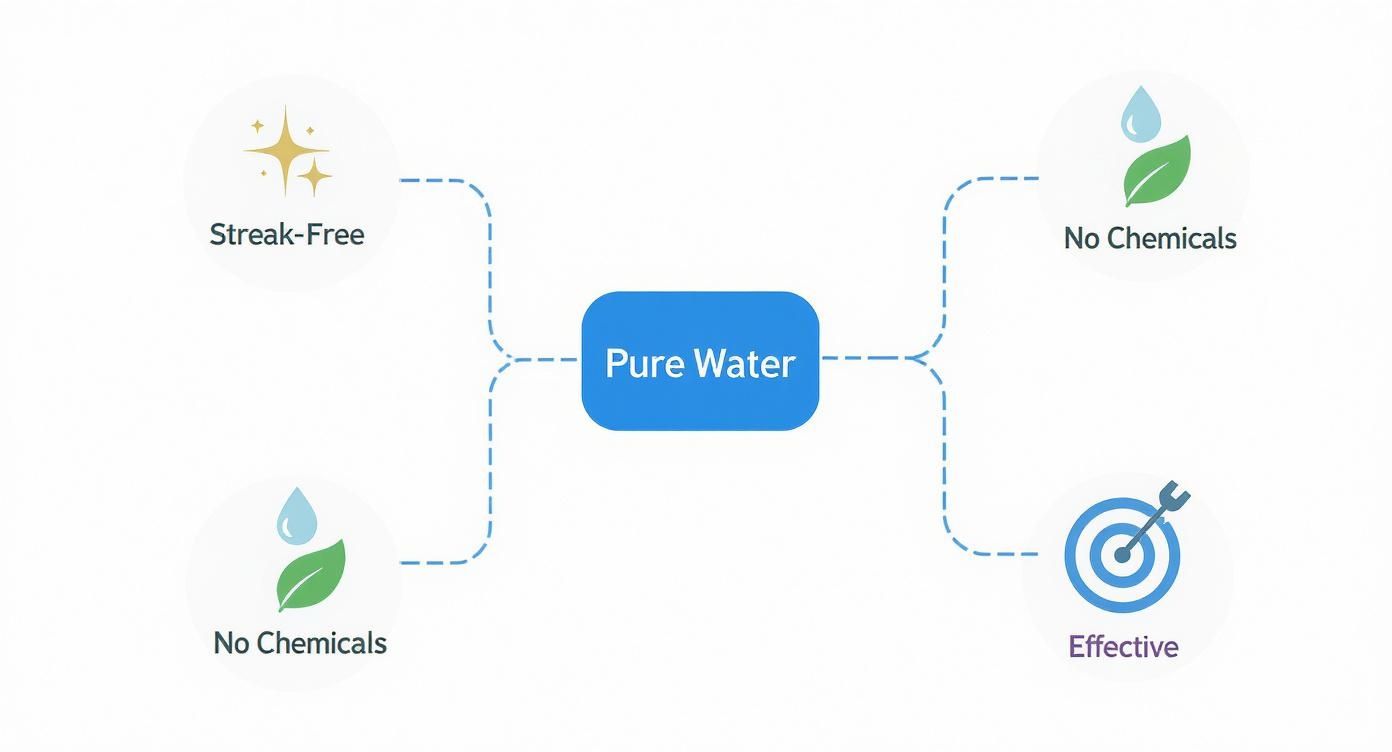
As you can see, the benefits all stem from the water's natural properties. The way pure water interacts with dirt is also affected by the glass itself. If you're curious to learn more, we have an entire article explaining the difference between hydrophilic and hydrophobic glass.
By removing virtually all dissolved solids, the water's natural solvency is unlocked. It's not about adding chemicals to clean; it's about removing impurities from the water so it can do the cleaning itself.
This scientific principle is what makes our "wash, rinse, and walk away" method possible. Because there are zero impurities in the water, it simply evaporates off the glass, leaving absolutely nothing behind. No spots, no streaks, just a flawless shine that actually stays cleaner, longer.
So, What Are the Real Benefits of Using Purified Water?
When you switch to a modern window cleaning method like purified water, the advantages are immediately obvious. We're talking about more than just a better-looking window; the benefits touch on everything from safety and environmental impact to the long-term value you get for your money.
The first thing you'll notice is the flawless, streak-free finish. Think about it: traditional soap and squeegee methods always leave a sticky, invisible film behind. That residue is a magnet for new dirt and grime, meaning your windows don't stay clean for very long.

Purified water, on the other hand, leaves absolutely nothing behind. It's so pure that it evaporates completely, leaving a crystal-clear surface that naturally repels dust. Your windows stay cleaner, for longer. Simple as that.
A Much Safer Way to Work
This is a big one. The old way of cleaning windows often involved technicians perched on ladders or operating costly aerial lifts, especially for multi-story buildings. It was a risky business, plain and simple.
The purified water method completely changes the game.
- Feet Firmly on the Ground: Our water-fed poles can easily reach windows up to five or six stories high, all while the technician stays safely on the ground.
- Less Worry for You: For property owners, this practically eliminates the liability and anxiety that comes with having someone climb ladders on your property.
- No Heavy Machinery: We don't need to bring in bulky lifts that can tear up your landscaping or block your driveway. The whole process is far less intrusive.
This shift toward a safer work environment is a major reason why so many professionals in the industry are making the switch.
An Eco-Friendly Clean You Can Feel Good About
Another huge plus is how gentle this method is on the environment. The entire process is 100% chemical-free. Because the ultra-pure water is the cleaning agent, there’s absolutely no need for soaps, detergents, or harsh solvents.
This means zero chemical runoff. The water we use is completely safe for your lawn, your garden, your pets, and the local ecosystem. It’s a clean you can feel good about.
This commitment to green practices is more important than ever. Homeowners and businesses are actively seeking out sustainable services, and purified water cleaning fits the bill perfectly. It's no surprise that the window cleaning market is growing—from an estimated $2.68 billion in 2023 to a projected $5.34 billion by 2031—with chemical-free methods leading the charge. You can read more about the window cleaning market's expansion at Verified Market Research.
Better Results, Less Hassle
At the end of the day, this method is just more efficient. A skilled technician with a water-fed pole system can clean windows much faster than someone juggling a ladder and squeegee.
This efficiency isn't just about saving us time; it translates directly into better value for you. You get a higher-quality, longer-lasting clean with less disruption to your day. It’s simply a smarter, safer, and more effective way to get that perfect shine.
The Essential Tools for the Job
Getting that perfect, streak-free shine with purified water isn't just about the water itself. It’s about a whole system of specialized gear working in harmony. Once you see what goes into a professional setup, you'll understand the expertise and investment behind a genuinely flawless result.
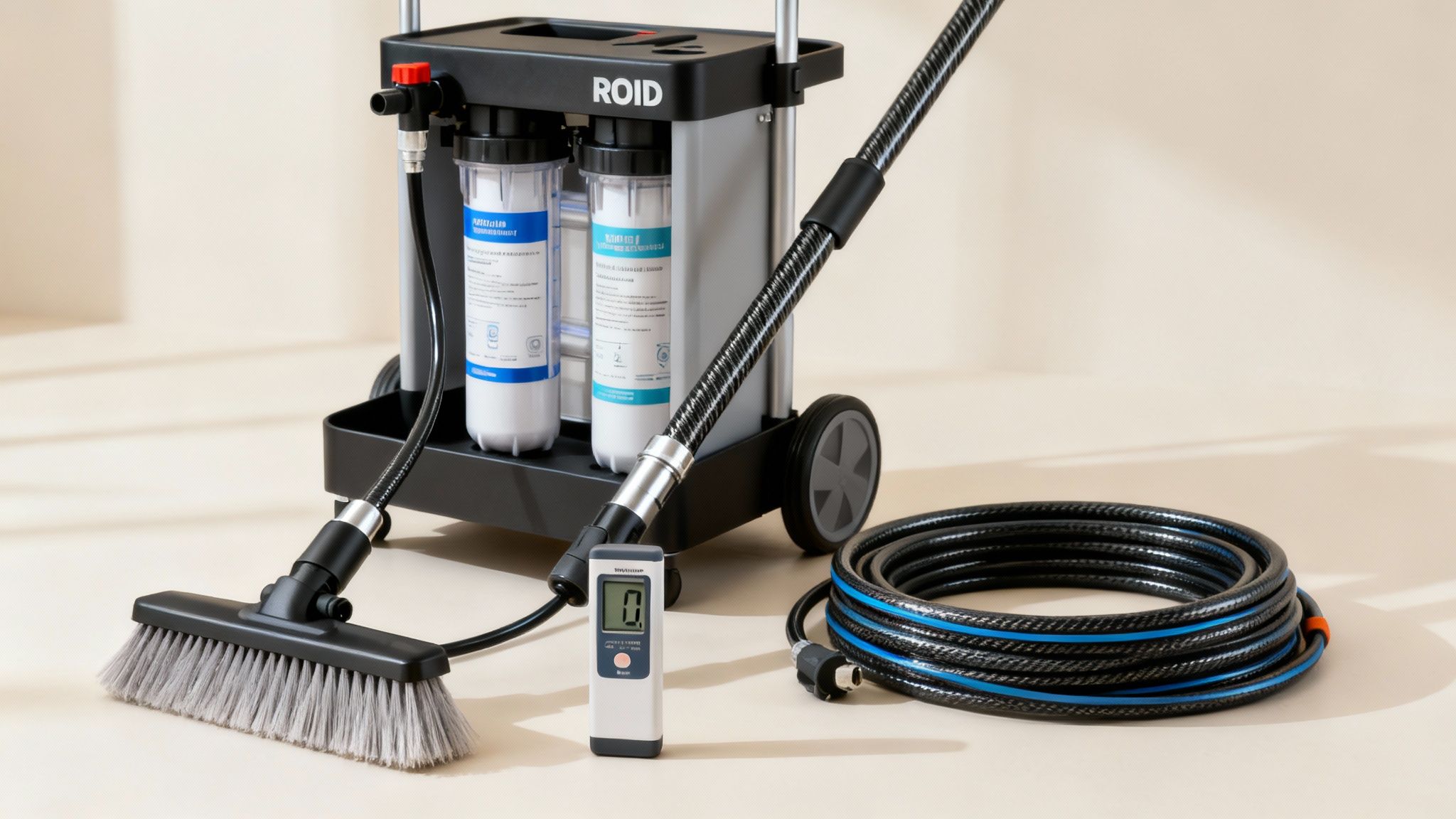
The entire operation starts with the purification system. This is the heart of the whole process, a multi-stage filter unit that takes regular tap water and meticulously removes every last mineral and impurity. It typically uses a powerful one-two punch of Reverse Osmosis (RO) and Deionization (DI) to get the water’s Total Dissolved Solids (TDS) reading down to zero.
Once the water is perfectly pure, it's sent up to where the real work happens: the pole.
The Water-Fed Pole and Brush
The water-fed pole is probably the piece of equipment most people notice first. These are a far cry from a simple extension pole; they're high-tech tools. Made from lightweight materials like carbon fiber or fiberglass, they're telescopic, rigid, and allow a technician to clean windows several stories high, all while standing safely on the ground. You can get a closer look at this technology in our guide to the water-fed pole window cleaning system.
At the very top of that pole, you'll find a couple of key components:
- The Brush Head: Forget harsh, scratchy bristles. These brushes are incredibly soft, designed to gently scrub away dirt, dust, and pollen from the glass, sills, and frames without leaving a single mark.
- Integrated Jets: Tiny jets are built right into the brush head, spraying a steady, low-pressure stream of pure water onto the glass. This means the technician is scrubbing and rinsing all in one smooth motion.
This combination of gentle scrubbing and a constant flow of pure water is what makes the system so effective at lifting and washing away grime.
You can think of it like a high-tech dental cleaning. The purification system is the hygienist making sure the water is pristine, the pole is the precision tool for reaching every spot, and the soft brush gently polishes the surface clean without causing any damage.
The whole system is connected with professional-grade hoses and reels to guarantee a consistent flow of water and an efficient workflow. It’s a significant investment, but this equipment is non-negotiable for achieving the kind of high-quality, consistent results that have become the standard in modern window cleaning.
Breaking Down the Pure Water Window Cleaning Process
So, how do we get that perfectly clear, streak-free finish every time? It might look like magic, but it’s actually a straightforward process rooted in science. Each step is deliberate and plays a critical role in delivering that flawless shine you expect.
It all starts with the water itself. Before a brush even gets near your glass, we perform a crucial quality check. We use a handheld Total Dissolved Solids (TDS) meter to test the water. The goal? A perfect reading of 000 parts per million (PPM). This is a non-negotiable first step. It confirms the water is 100% pure and ready to do its job, which is to attract and wash away dirt without leaving anything behind.
The Three Stages of a Flawless Clean
Once we've verified the water purity, the real work begins. The entire cleaning system boils down to three core actions that work in perfect harmony to leave your windows spotless.
-
Agitation: This is where the elbow grease comes in. Using a water-fed pole equipped with a soft-bristled brush, we methodically scrub the entire window. This includes the frames and sills, not just the glass. This gentle but thorough scrubbing physically breaks the bond between the grime and the surface, lifting away all the built-up dirt, dust, and pollen.
-
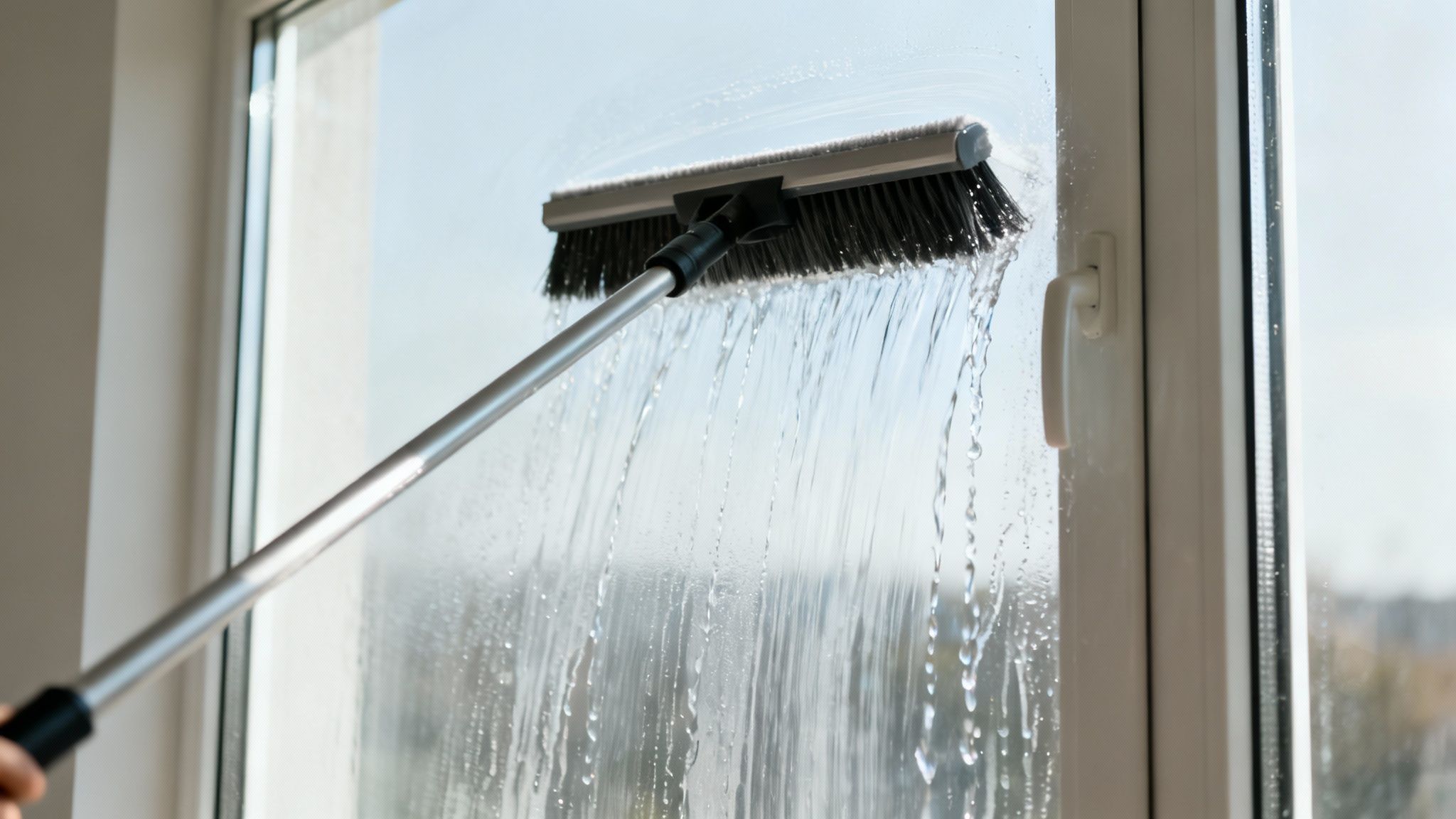
Rinsing: This is the most important part of the process. After scrubbing, we lift the brush just off the glass and let a steady stream of pure water cascade down from the top. This creates a "sheeting" effect. As the water flows over the surface, its natural properties act like a magnet, pulling all that loosened debris with it and washing it completely away.
-
Air Drying: And for the final step? We do nothing at all. We simply let the window air dry naturally. There’s no squeegee, no cloth, no chamois.
Why does this work? Because the water is 100% pure, it contains absolutely no minerals or solids. When it evaporates, it leaves nothing—and I mean nothing—behind. The result is just a crystal-clear, spotless surface.
That’s it. This simple, three-part system is the secret behind every professional pure water window cleaning job.
Purified Water Cleaning Process Checklist
To guarantee a perfect result every single time, our technicians stick to a disciplined checklist. This systematic approach ensures no detail is overlooked and lets the science of pure water work its magic.
Here's a quick look at the essential steps and why they matter.
| Step | Action | Key Tip |
|---|---|---|
| 1. Water Test | Confirm TDS is 000 PPM | This initial check is the key to preventing spots before they can even form. |
| 2. Scrub Frames | Agitate window frames and sills first | Always clean from the top down. This ensures dirty water doesn't drip onto already clean glass. |
| 3. Scrub Glass | Use methodical, overlapping strokes | This guarantees complete coverage and loosens every bit of surface grime. |
| 4. Final Rinse | Rinse thoroughly from top to bottom | A comprehensive rinse is crucial for washing away all the suspended dirt particles. |
| 5. Air Dry | Let the window dry on its own | Resist the urge to touch the glass! Let the pure water evaporate completely for a perfect finish. |
By meticulously following these steps, the purified water window cleaning process delivers a superior, longer-lasting clean that's simply impossible to replicate with traditional methods. It's a system built on science, precision, and the right professional touch.
When Is Purified Water Cleaning the Best Choice?
While purified water window cleaning is incredibly versatile, it's not a one-size-fits-all solution. Think of it like a specialized tool in a pro's toolkit. It truly comes into its own in specific situations where safety, a spotless finish, and environmental care are non-negotiable.
This method is the undisputed champion for cleaning multi-story homes and commercial buildings. Our water-fed poles are long and surprisingly lightweight, letting us reach windows up to five or even six stories high. The best part? Our feet stay planted safely on the ground. This completely sidesteps the risks that come with ladders, scaffolding, or bulky aerial lifts.
Ideal Properties and Situations
Some properties are practically made for this chemical-free approach. If you’ve invested time and money into beautiful landscaping around your home or business, this method is a no-brainer.
- Eco-Sensitive Areas: Because we're not using any soaps or detergents, there's absolutely zero chemical runoff. That means no risk to your delicate plants, your soil, or your pets.
- Large Glass Facades: Think about car dealerships, modern offices, or retail storefronts with huge panes of glass. Purified water cleaning is fast, efficient, and leaves a finish that helps those properties stay looking sharp for longer.
- Hard-to-Reach Windows: Got windows over a steep slope, an intricate garden bed, or other tricky obstacles? This is where the pole system shines, letting us clean them perfectly without disturbing a single thing on your property.
The real game-changer is the ability to access difficult windows safely. It turns what would be a high-risk, complicated job into a straightforward, ground-based operation that delivers even better results.
For regular maintenance and seasonal cleanings, this system is perfect for maintaining that flawless look. It leaves behind a surface that naturally repels dirt, meaning your windows actually stay cleaner for longer.
When a Different Approach Is Needed
The purified water system is fantastic for well over 95% of the jobs we handle, but it’s important to be honest about its limits. If windows have been seriously neglected for years, they might have stubborn grime or mineral deposits that are essentially baked on.
In those cases, a little extra prep work is needed.
For instance, severe hard-water stains often need a special treatment before the purified water system can work its magic. If you're wrestling with that problem, our guide on how to remove hard water stains from windows dives deep into the process. Likewise, post-construction messes like paint overspray or silicone residue have to be carefully scraped and removed with traditional tools first.
Of course. Here is the rewritten section, designed to sound completely human-written and natural, as if from an experienced professional.
Questions We Hear All the Time
Even after seeing how it works, people usually have a few questions about using purified water for window cleaning. It’s a bit different from the old soap-and-squeegee method, so that’s perfectly normal. Let's tackle some of the most common ones we get from our clients.
What About Really Filthy Windows?
You bet. This is where the system really shines. The combination of a gentle scrub from the brush and the sheer cleaning power of pure water is more than a match for even heavy, caked-on layers of grime. For your typical seasonal clean-up, it’s all you’ll ever need to get things sparkling again.
The secret is in the water itself. Once we strip out all the minerals, the water becomes "hungry." It naturally wants to grab onto and dissolve dirt, pulling it right off the glass without any need for chemical soaps.
Can You Still Clean in Bad Weather?
It’s a surprisingly robust system. We can actually keep working in a light drizzle because rainwater is naturally soft and won't leave new spots on the glass we've just cleaned.
That said, safety always comes first. We'll always reschedule if we're dealing with:
- High Winds: Trying to manage a long, water-fed pole in gusty conditions just isn't safe.
- Freezing Temperatures: The last thing anyone wants is a sheet of ice forming on the glass or walkways.
Does This Fancy System Cost More?
It's a common assumption, but the service is very competitively priced. While the equipment we use is definitely a serious investment on our end, the water-fed pole system lets us work much more efficiently than traditional methods. We can often get a job done faster, which helps keep the cost reasonable for you.
When you factor in that the windows stay clean for longer, you're actually getting fantastic value. You might find you don't need to call us out quite as often.
Ready to see what pure water can do for your windows? Let Sparkle Tech Window Washing give your property a clean that’s safer, more effective, and lasts longer. Get your free estimate today!