



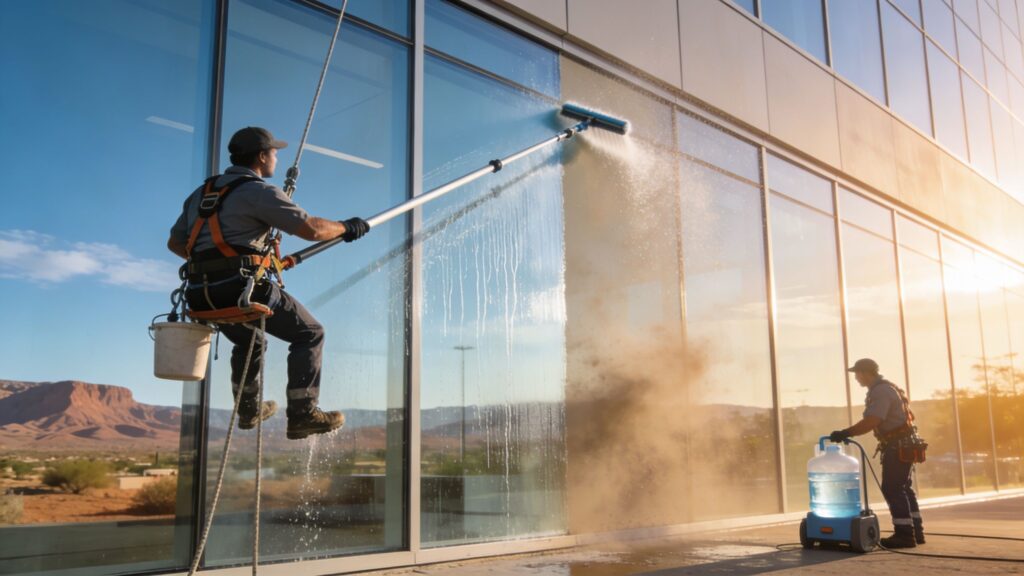
You’re probably dealing with one of two situations right now. The glass on your office looks dull enough that employees notice it from inside, or you’re comparing vendors and realizing most quotes don’t tell you much beyond “window cleaning” and a price.
That’s where problems start in Phoenix. Dust settles fast, hard water leaves mineral residue, and bright sun makes every missed edge, drip mark, and interior fingerprint stand out. Office window cleaning isn’t just a cosmetic task here. It affects how your property looks to tenants, visitors, and staff, and it affects how safely the work gets done.
The U.S. window cleaning industry generated $2.9 billion in revenue in 2024, and regular office cleaning every 1 to 2 months is recommended to improve natural lighting, reduce energy costs, and maintain a professional appearance, especially in higher-pollution environments, according to GetJobber’s window cleaning industry statistics. That recommendation makes practical sense in Arizona, where dust, traffic film, and mineral spotting can build quickly.
What True Professional Office Window Cleaning Covers
A lot of people assume office window cleaning means someone sprays the glass, pulls a squeegee across it, and leaves. That’s only part of the job. A professional commercial service should address the full window system, not just the most visible square inches of glass.
The biggest issue I see is one-sided cleaning. Exterior-only work can make a building look better from the parking lot, but it often leaves the office still looking dirty from the inside. Light coming through the glass exaggerates smudges, dust, and film on the interior side. Unger notes that a window only appears clean when both interior and exterior sides are addressed, because otherwise you get the “half-clean” effect that still makes the space look unkempt from inside the building, as explained in their guidance on commercial window cleaning done right.

The glass is only one part of the job
If a crew skips the surrounding components, dirt comes back onto the glass fast. Tracks hold grit. Frames collect dust and runoff. Sills trap debris and, in some offices, dead insects or moisture residue. When those areas are ignored, the finished result never looks complete.
A proper scope usually includes:
- Interior and exterior glass so the building looks clean from both viewpoints.
- Frames and edges because dirty borders make clean panes look unfinished.
- Sills and tracks where dust, sand, and debris collect.
- Spot treatment for mineral residue, adhesive marks, or buildup that won’t come off in a routine pass.
- Screen service when present including removal, cleaning, and basic repair assessment if the property uses screens on operable windows.
What facilities managers should ask for
Many commercial quotes are vague on purpose. “Windows cleaned” sounds complete, but it may exclude interiors, detail work, screen handling, or debris removal. That’s where misunderstandings happen.
Use this checklist when reviewing a proposal:
- Ask which sides are included. Exterior only and full interior-exterior service are not the same product.
- Ask whether frames, sills, and tracks are wiped or detailed. If they aren’t, expect dust transfer back onto the glass.
- Ask how they handle screens. Some companies remove and clean them. Others avoid them entirely.
- Ask what counts as restorative work. Hard water staining and post-construction residue often need separate treatment.
- Ask how they protect interior floors and furnishings. Interior office glass needs runoff control and clean detailing tools.
Practical rule: If a quote doesn’t define the scope, assume the vendor is cleaning less than you expect.
The standard should be higher than “looks better”
In a Phoenix office, quality isn’t just about shine. It’s about clarity in direct sun, clean lines around frames, and no obvious residue when someone sits near a window all day. It’s also about consistency from one visit to the next.
Good office window cleaning should leave you with a clear answer to a simple question: if a client walks from the parking lot into the lobby and then into a conference room, does every pane look finished from every angle? If the answer is no, the service wasn’t complete.
Matching the Cleaning Method to Your Building
The right method depends on the building, not the cleaner’s preference. Office window cleaning works the same way as any other trade. The tool should fit the surface, height, access conditions, and risk level.
A storefront entry, a two-story office, and a mid-rise medical building shouldn’t all be cleaned the same way. Some glass needs hand detailing. Some elevations are better handled from the ground with purified water. Some structures need lift access because the architecture makes pole work or hand work impractical.

Traditional squeegee work
For interiors and lower exterior glass, traditional squeegee cleaning is still hard to beat. Done well, it gives tight control over edges, corners, and detailing. It’s especially useful on lobby glass, conference room partitions, entrance doors, and ground-level exterior panes where clients and staff will notice any small miss.
The method matters. Professional cleaners use a scrubber or mop to apply cleaning solution, then remove it with controlled squeegee passes and detail the edges with microfiber. Skill is demonstrated in these specific actions. An untrained cleaner often leaves lines at the blade edge, excess water at the bottom gasket, or drag marks across the pane.
According to Professional Window Cleaning’s overview of the best washing techniques, the traditional squeegee method remains the precision standard for interior office windows and ground-level exteriors, with high streak-free performance when handled correctly. In practical terms, that’s why it remains the go-to method for executive offices, entry glass, and any interior pane where runoff control and detail quality matter most.
Water-fed pole systems
Once you move beyond easy hand access, a pure water-fed pole system often becomes the better option. This method uses deionized water with under 10 ppm of dissolved solids, which allows the water to dry without leaving mineral deposits. It can reduce labor by up to 50%, reach up to 65 feet from the ground, and cut fall risks by over 80% compared to ladders, based on Midway Cleaning’s explanation of traditional versus modern methods.
That matters in Arizona. Ground-based cleaning reduces ladder use, and purified water helps avoid the residue issues that standard tap water can leave behind. On mid-rise office buildings, water-fed poles are often the most sensible balance of safety, speed, and finish quality.
If you want a plain-language breakdown of the equipment and when it’s appropriate, this page on the water-fed pole window cleaning system is a useful reference.
Purified water works because it doesn’t leave minerals behind when it evaporates. That’s the advantage, not a gimmick.
Where each method fits best
Here’s the practical comparison:
| Building condition | Method that usually fits | Why it works |
|---|---|---|
| Interior office glass | Traditional squeegee | Better edge control, less runoff, tighter detailing |
| Ground-floor exterior | Traditional squeegee | Good for touch-up work, heavy fingerprints, and visible entry glass |
| Mid-rise exterior glass | Water-fed pole | Safer ground-based access and efficient coverage |
| Awkward architectural sections | Lift access or specialty setup | Needed when angles, setbacks, or obstacles block normal access |
What doesn’t work well
The wrong method creates predictable problems.
- Using ladders where a pole can do the job adds risk without improving results.
- Using pure water indoors usually creates unnecessary mess and slower detail work.
- Treating all glass the same ignores tint, coatings, access limits, and surrounding surfaces.
- Rushing edge detailing leaves the exact streaks occupants notice first.
High-rise and specialty access
Some office properties exceed pole reach or have features that make standard access impossible. That’s where rope access, boom lifts, or aerial platforms come into play. Those methods aren’t for every suburban office, but they’re necessary on taller or more complex structures.
The point isn’t that one method is superior across the board. The point is that a competent commercial provider should be able to explain why a method fits your building, what trade-offs come with it, and how that choice affects safety, production, and final appearance.
Planning Your Cleaning Schedule and Budget
A Phoenix office can look sharp on Monday and dusty by Friday if it sits near traffic, open lots, or active irrigation. That is why window cleaning schedules should be set by exposure, tenant use, and visibility, not by a generic calendar.
Waiting until the glass looks bad usually raises the bill. Dust bonds to the surface, sprinkler minerals bake onto lower panes, and first impressions slip in the meantime. In Arizona, the sun also makes film, spots, and streaks show sooner than many owners expect, especially on entry glass and west-facing elevations.
What changes your schedule
Two office buildings with the same square footage can need very different service intervals. A law office with street frontage and daily client traffic has a higher appearance standard than a back-office building in a quiet industrial park. A property with irrigation overspray may need frequent touch-ups at the ground level even if the upper glass holds up well.
The factors that matter most are:
- Dust and traffic exposure. Buildings near arterial roads, construction, or open desert collect exterior soil faster.
- Sun and orientation. Direct Arizona sun makes residue easier to see and can bake mineral spotting onto the glass.
- How the building is used. Lobby glass, conference rooms, and tenant-facing entries usually need tighter maintenance than private office areas.
- Landscaping and sprinkler patterns. Hard water on lower panes creates repeat spotting and can turn simple maintenance into stain removal.
- Current glass condition. A property that has been skipped for months often needs a catch-up visit before it can move to a stable schedule.
One schedule rarely fits the whole property. Many offices do better with more frequent exterior service on the front elevation and entry doors, while interior glass runs on a longer cycle.
Budgeting without guesswork
Window cleaning cost comes down to labor hours, access, glass count, condition, and how much detail the scope includes. A simple one-story office with clean access is a different operation from a multi-tenant building with tall entry glass, interior partitions, and old hard water staining.
The cleanest way to budget is to separate maintenance from correction.
| Type of service | What it usually involves | Budget effect |
|---|---|---|
| Routine maintenance | Scheduled cleaning before buildup gets heavy | More predictable pricing and fewer surprises |
| Restorative or catch-up work | Mineral spotting, heavy soil, neglected glass, first-time detail work | Higher labor cost and more variable pricing |
If you want a clearer picture of how scope affects pricing, this guide to commercial window cleaning cost helps break down the variables before you request bids.
Regular service usually costs less than recovering neglected glass.
A practical way to set frequency
Start with the windows people notice. Main entries, lobby glass, and street-facing offices carry more weight than side elevations behind service areas. Then look at what is causing the buildup. Road dust, irrigation, monsoon residue, and tenant traffic each leave a different maintenance pattern.
A simple planning process works well:
- Walk the site by elevation. Identify which sides of the building collect the most dust, spotting, and handprints.
- Rank glass by visibility. Entry doors, lobby panels, and front-facing conference rooms should be cleaned to a higher standard and often on a shorter cycle.
- Split interior and exterior frequencies. Exterior glass in Phoenix often needs attention sooner than interior office glass.
- Review after the first service cycle. Once you see how fast the site soils, you can tighten or extend the interval with confidence.
Lowest price is rarely the same as lowest operating cost. A thin scope, light detail work, or an interval that is too long can make the property look inconsistent and create avoidable restoration charges later. The better plan is a schedule your site can hold, with a scope that keeps the glass presentable between visits and the budget predictable through the year.
The Critical Role of Safety Insurance and Compliance
A low bid can get expensive fast if the company on your property isn’t properly insured or doesn’t follow safe access procedures. Office window cleaning involves ladders, poles, rooflines, walkways, parking areas, and sometimes high-up glass near public entrances. If a contractor takes shortcuts, the risk doesn’t stay with them alone. It can land on the property owner or manager too.

For suburban Arizona office buildings, mid-rise access is where this becomes very practical. On buildings of 4 to 6 stories, the choice between ground-based poles and riskier ladder methods matters. Advanced carbon fiber poles reaching over 40 feet can reduce ladder use by 60%, which is important as insurance costs rise and OSHA compliance remains a real concern, based on Spotless Window Cleaning’s discussion of structural access challenges.
Insurance isn’t paperwork. It’s risk control.
Facilities managers should ask for proof of coverage before work starts. Not after a quote is accepted. Not after an incident. Before access is granted.
The basics to verify are:
- General liability insurance for property damage and third-party claims.
- Workers’ compensation coverage in case a worker is injured on your property.
- Bonded status for another layer of accountability.
- Business registration so you know you’re hiring an established company rather than an informal operator.
If you want a window-cleaning-specific explanation of why this matters, review this page on liability insurance for window cleaners.
Safety method is part of service quality
A cleaner who relies on ladders for everything isn’t just using an older approach. They may be creating exposure your company doesn’t need. Ground-based pole work, controlled access zones, proper footwear, hose management, and pre-job site checks all affect how safely the work gets done.
That also affects operations. Safer crews tend to work in a more controlled way around walkways, employee vehicles, and entry points. They’re less likely to improvise.
Here’s a useful visual on the kind of safety mindset commercial work demands:
What to ask before approving a vendor
Don’t settle for “yes, we’re insured.” Ask direct questions.
- Can you send certificates of insurance? The answer should be immediate.
- How do you access mid-rise glass? Listen for method, not vague reassurance.
- Do you use ladders, poles, lifts, or rope access on buildings like ours? The choice should sound intentional.
- How do you control pedestrian areas? Entryways and sidewalks matter.
- Who supervises safety on site? Someone should own that responsibility.
A professional window cleaning company should be able to explain its safety process as clearly as its cleaning process.
Sparkle Tech Window Washing LLC states that it carries full Workers Compensation, General Liability Insurance, and is bonded, while also being registered in Arizona. For a facilities manager, that isn’t a marketing detail. It’s the baseline you should expect from anyone working on your property.
How to Choose the Right Partner in Arizona
Choosing a vendor gets easier when you stop comparing only price and start comparing fit. In Arizona, the right office window cleaning partner needs to understand desert dust, hard water spotting, bright-sun visibility, and the access realities of everything from single-story offices to mid-rise suburban buildings.

Start with a vendor checklist
When you review proposals, look for specifics. A good commercial provider should answer these without hesitation:
Scope clarity
Are both interior and exterior panes included? Are frames, sills, and tracks part of the service or excluded?Method selection
Can they explain when they’ll use hand detailing, water-fed poles, or specialty access?Insurance documents
Can they provide proof of general liability, workers’ compensation, and bonded status?Site coordination
Will they work around office traffic, tenant schedules, and access restrictions?Problem-solving ability
Do they understand mineral spotting, dusty exposures, and irrigation overspray common in Phoenix?
Arizona problems need Arizona answers
The state creates very specific window issues. Fine dust settles on exterior glass quickly, especially near roads, open lots, and active construction. Hard water from sprinklers can leave mineral stains that a routine wipe won’t fix. Strong sun makes residue show up sharply from the interior, especially in conference rooms and perimeter offices.
That means the right partner won’t just say “we clean windows.” They’ll ask where your irrigation hits, which elevations get the most sun, which windows tenants complain about, and whether the building has glass railings, clerestory panes, or solar panels that need coordinated service.
A few practical signs of local experience:
| Arizona issue | What a capable vendor should discuss |
|---|---|
| Dust accumulation | More frequent exterior service or targeted elevations |
| Hard water spotting | Separate treatment approach, not just routine cleaning |
| Intense sunlight | Interior detailing quality and edge control |
| Solar panel buildup | Safe cleaning methods that don’t leave residue |
Don’t overlook insurance literacy
Some business owners compare bids without understanding the difference between policy types. That’s risky. If you want a clear primer on how coverage categories differ, this overview of professional vs general liability Florida from Professional Insurance Advisors, LLC helps clarify the distinction. It isn’t window-cleaning-specific, but it’s useful for understanding why “insured” can mean different things.
Ask how they handle solar panels and specialty glass
In Arizona, many office properties have solar installations, glass railings, or decorative exterior glass. Those surfaces need careful handling. The wrong brush, dirty water, or careless chemistry can create visible problems instead of solving them.
That’s where it helps to hire a company whose service mix includes those surfaces. Sparkle Tech Window Washing, for example, offers window cleaning along with solar panel cleaning, glass railing cleaning, screen service, and repair in Arizona. For a facilities manager, that matters because one vendor can often service connected glass surfaces under the same site plan instead of treating them as unrelated jobs.
Local expertise shows up in the questions a vendor asks before they ever touch the glass.
The best choice is usually the clearest one
A dependable commercial partner should make your decision easier, not harder. Their proposal should define scope. Their access plan should sound safe. Their schedule should match your property’s exposure. Their insurance documentation should be current and easy to verify.
If you get vague answers on any of those points, keep looking. In office window cleaning, confusion at the proposal stage usually turns into disappointment on site.
Frequently Asked Questions and Your Next Steps
A crew shows up at 6:00 a.m., the lobby is opening at 7:00, and tenants are already asking whether entrances will stay open. Those are the questions that matter once the quote is in hand. Facilities managers usually want clear answers on access, disruption, cleanup, and whether the work plan fits the building they operate.
Do our employees need to prepare anything before service?
Usually, very little.
For interior work, the main requirement is safe access to the glass. Desks, chairs, cords, and display items should not block the technician’s path. If there are awards, plants, or electronics on window ledges, move them before the appointment. That saves time and reduces the chance of accidental contact.
For exterior service, the crew may need a few parking spaces, sections of sidewalk, or a side gate kept clear for part of the visit. On Phoenix properties, that often matters most at front entries and along narrow service corridors where hoses, poles, or ladder access need room.
A simple prep list helps:
- Clear access to the glass inside and out
- Remove fragile items from sills and reception areas
- Let staff know about interior scheduling for private offices and conference rooms
- Point out problem areas ahead of time such as hard water buildup, stuck locks, irrigation overspray, or delicate flooring
Are the cleaning methods safe for landscaping and surrounding areas?
They should be, if the company is using the right method for the site.
Many commercial exteriors in Arizona are cleaned with purified water systems, which limit the need for heavier chemicals and leave less residue behind on glass and frames. Interior work should use controlled amounts of solution and detail tools that keep water off carpet, millwork, and finished floors. The actual difference is not the sales language. It is whether the crew has a clear process for runoff control, equipment placement, and protecting surfaces around the work area.
Ask how they protect entry mats, stone, painted trim, and planting beds. A qualified contractor should answer that without hesitation.
Can office window cleaning be done outside business hours?
Yes, and for many buildings it should be.
Medical offices, law firms, financial offices, and busy corporate lobbies often prefer early morning, evening, or weekend scheduling. Exterior-only service is usually easier to place around business activity. Interior glass can also be handled after hours if access is coordinated in advance and the scope is clear room by room.
The best schedule is based on how your property operates in real life. A route that works for the vendor but interrupts tenants, visitors, or staff is not a good commercial plan.
How do we know if we need routine cleaning or restorative cleaning?
Check the glass in direct sunlight. Phoenix sun makes defects obvious.
If the glass shows dust, fingerprints, and normal environmental film, routine cleaning is usually enough. If you see mineral deposits, oxidation staining, adhesive residue, or sprinkler spotting that remains after standard cleaning, the property may need restoration or specialty treatment before it settles into a maintenance cycle.
That distinction affects price, labor time, and expectations. It is one reason the first on-site visit matters more than a quick phone quote.
What should we expect from a professional estimate?
A useful estimate should spell out scope, frequency, access method, service timing, and exclusions. It should tell you whether interior glass is included, how upper panes will be reached, whether hard water removal is separate, and what site conditions could change the price.
If those details are vague, expect confusion on service day.
Good estimates also reflect Arizona conditions. Dust exposure, irrigation overspray, sun-baked residue, and access restrictions all change the work. A low number without that context often turns into a change order, a rushed job, or both.
Clean office glass should support the way your building is seen and used every day, not become another maintenance issue that keeps coming back.
For Phoenix businesses, office window cleaning affects appearance, operations, and liability at the same time. Clear glass improves curb appeal, but the bigger value is consistency. The work gets done on schedule, access is handled safely, and the contractor carries the insurance and job planning needed for a commercial property.
If you are reviewing vendors now, focus on four things. Defined scope. A method that fits your building. Proof of insurance. A schedule that works with your tenants and staff.
If you want a no-pressure estimate for your office, Sparkle Tech Window Washing serves the Phoenix valley and properties across Arizona with commercial window cleaning, solar panel cleaning, glass railing cleaning, screen service, and insured, bonded service.