



Think of liability insurance for window cleaners as your financial safety net. It’s a specialized business insurance designed to protect you from the financial fallout if an accident happens on your watch.
Specifically, it covers the costs if you accidentally cause third-party property damage or bodily injury while on a job.
Why Window Cleaner Insurance Is Non-Negotiable

Picture a high-rise cleaner suspended hundreds of feet in the air. Their safety harness isn't just a good idea; it's the one piece of gear that prevents a disaster. For your window cleaning business, liability insurance works the same way. It's your financial safety harness, catching you before a simple mishap spirals into a business-ending crisis.
Let's be real—accidents happen, even to the most meticulous pros. A dropped squeegee can crack an expensive pane of custom glass. A ladder leg might sink into a soft lawn, damaging a client’s prized landscaping. Even a spilled bucket of soapy water can warp a pristine hardwood floor.
Without insurance, you're on the hook for every penny of those repairs. A single mistake could easily wipe out your profits for the month, or worse, put you out of business entirely.
From Small Jobs to Major Risks
The inherent risks of the job make liability insurance a must-have, especially when it comes to landing bigger contracts. A routine $50 window cleaning can explode into a claim exceeding $27,000 if a tool falls and shatters a car's windshield below.
This is exactly why most commercial clients and owners of high-end homes won't even talk to you without seeing a certificate of insurance first. It's a non-starter. They need to know you're a professional who takes responsibility seriously.
Liability insurance isn't just an expense; it's a powerful tool for growth. It unlocks access to larger, more lucrative contracts and builds immediate trust with clients who value professionalism and security.
This coverage is your first line of defense, protecting both your bank account and your hard-earned reputation. It’s an absolute cornerstone for any serious tradesperson, which is why it’s considered essential business insurance for contractors. At the end of the day, it gives you the peace of mind to focus on what you do best: making windows sparkle.
What Your General Liability Policy Actually Covers
Let's be honest, insurance policies can feel like they're written in a different language. But when you boil it all down, your general liability policy is really just a financial backstop for when things go wrong on a job. It’s your business’s first line of defense.
Think of it as having three main shields, each protecting you from a different kind of disaster.
Shield #1: Third-Party Property Damage
This is the big one for window cleaners. Third-Party Property Damage is the part of your policy that kicks in when you or your gear accidentally breaks something that isn't yours. It happens to the best of us.
Imagine this: you're carrying a ladder through a client's living room and—CRACK—you swing it a bit too wide and put a nasty gash in their brand-new 70-inch TV. Or maybe a squeegee slips from your hand and shatters an expensive vase on the windowsill below. Your general liability insurance is what pays to repair or replace that damaged property, so you don't have to.
Shield #2: Bodily Injury
Next up is Bodily Injury coverage. This protects you if someone who isn't on your payroll gets hurt because of your work. Think clients, their kids, or even just a random person walking by.
Let's say you’ve got a hose running across the sidewalk from your truck. A jogger comes around the corner, doesn't see it, and takes a nasty fall, fracturing their ankle. The medical bills and potential legal fallout from that one accident could be financially devastating. This is precisely what your bodily injury coverage is for—it handles the medical costs and legal fees, keeping your business afloat.
Your liability policy isn't just about paying claims. It's about survival. It lets your business take a hit from an unexpected accident without wiping out your savings or ruining the reputation you’ve worked so hard to build.
Shield #3: Completed Operations Coverage
The final piece of the puzzle is one that many people forget about: Completed Operations Coverage. Your responsibility doesn't always end the second you drive away from a job site. This coverage protects you from claims that pop up after you've already packed up and left.
For example, you install a new pane of glass on a second-story window. A week later, it turns out the seal wasn't perfect, and a heavy rainstorm causes a leak that damages the client's custom-painted wall and antique wooden desk below. Because the damage was a direct result of work you already finished, your completed operations coverage would handle the claim.
This is what makes liability insurance for window cleaners so essential. It protects you before, during, and long after the job is done.
How Much Does Window Cleaner Insurance Cost?
Trying to pin down a single price for window cleaner insurance is a bit like trying to give a quote for a job sight unseen. It just doesn't work that way. The final cost depends entirely on your specific business, because every operation carries a different level of risk.
Think about it: a solo cleaner who only does ground-floor residential homes is in a completely different risk category than a three-person crew that regularly works on mid-rise commercial buildings. Insurance companies look at your unique setup to figure out the right premium, much like you assess a building before deciding on your price.
This image breaks down some of the core components that go into calculating your insurance costs, from basic coverage to overall financial protection.
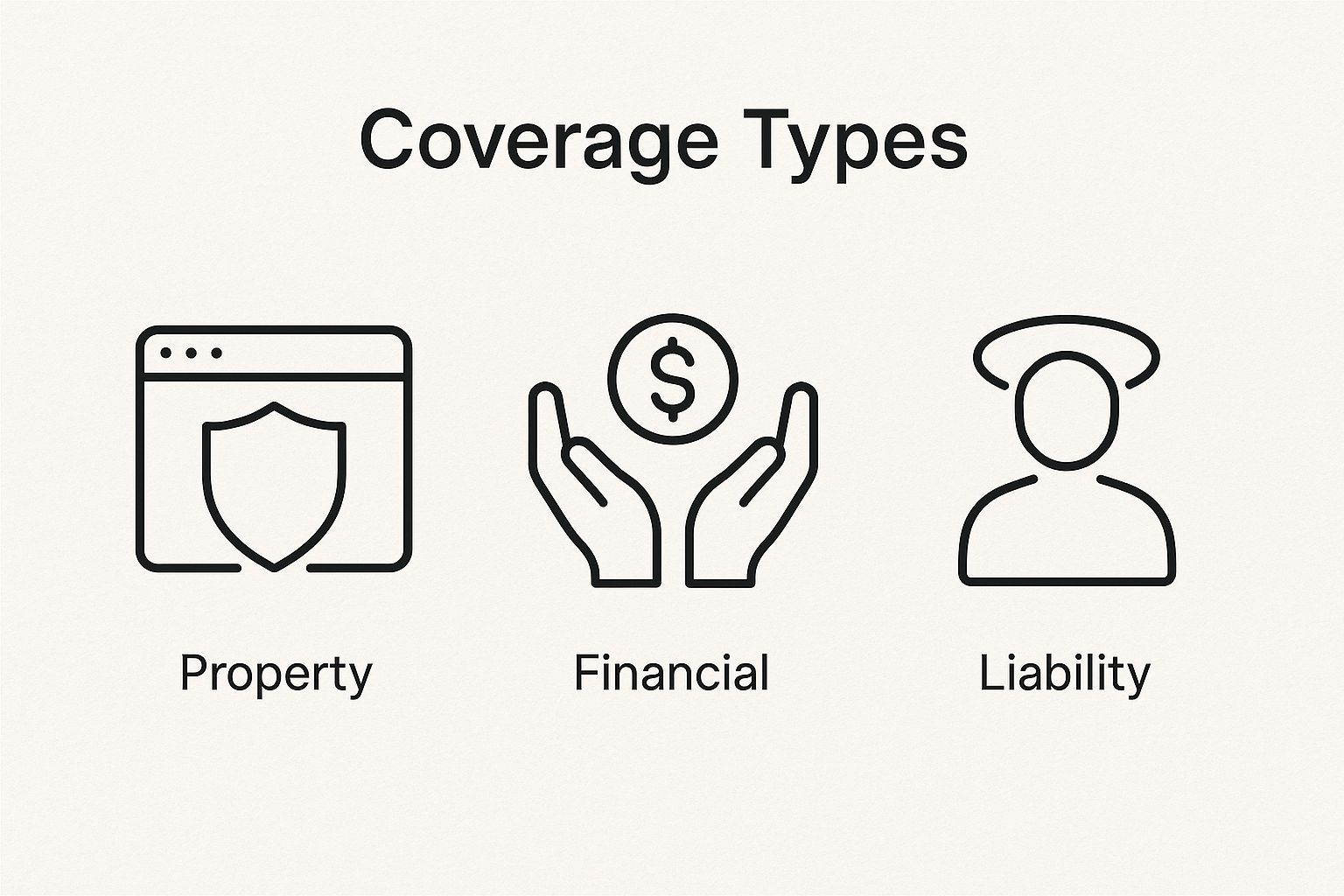
As you can see, what you pay is directly tied to the coverage you choose, the financial footprint of your business, and how much personal protection you need.
Key Factors That Influence Your Premium
A handful of key factors really drive the cost of your insurance policy. Getting a handle on these will help you understand your quote and see where you might have some control over your expenses.
- Business Size and Revenue: It's a simple numbers game. The more people you employ and the more money you bring in, the higher your risk. A bigger business doing more jobs just has more opportunities for something to go wrong.
- Services You Offer: This one's a biggie. If you're doing high-rise work with specialized equipment, your premiums will naturally be higher than if you stick to single-story houses. The danger involved is a major factor in your rate.
- Your Location: Where you work matters. Insurance rates can change from state to state, and even from one city to the next, thanks to local laws and what it typically costs to settle claims in that area.
- Claims History: A spotless record is your best friend here. If you have no history of claims, insurers see you as a safe, low-risk business, and that almost always leads to better rates.
What Can You Realistically Expect to Pay?
So, let's talk real numbers. We've compiled some industry data to give you a clearer picture of what you might expect to pay each month.
Estimated Monthly Insurance Costs For Window Cleaners
This table shows estimated monthly premiums based on business size and policy type, helping cleaners budget for their insurance needs.
| Business Profile | Policy Type | Estimated Monthly Cost |
|---|---|---|
| Sole Proprietor (No employees) | General Liability Insurance | $45 – $75 |
| Small Business (1-3 employees) | General Liability Insurance | $60 – $120 |
| Small Business (1-3 employees) | Business Owner's Policy | $150 – $250 |
| High-Risk Specialist (e.g., high-rise cleaning) | Specialized Liability | $300+ |
These numbers are a solid starting point. A typical small window cleaning business with a couple of employees and around $300,000 in revenue might pay anywhere from $60 per month for a basic liability plan to over $234 per month for a more comprehensive business owner's policy. Most of these plans offer $1 million per-occurrence and $2 million aggregate limits, which is pretty standard for our industry.
Of course, your insurance premium is just one piece of your financial puzzle. Smart money management is key to running a healthy business, so be sure to check out these essential small business accounting tips. Ultimately, the price of your policy is a reflection of how your business operates, including details like https://sparkletechwindowwashing.com/how-much-do-window-cleaners-charge/, which helps define your company's overall size and scope.
Smart Add-Ons to Complete Your Coverage
Think of your general liability policy as the foundation of your business's protection. It's the must-have, covering the big, common risks. But a foundation alone isn't a complete house. To truly protect your window cleaning business from top to bottom, you need to consider some specialized add-ons.
These extra coverages, often called endorsements or riders, aren't just upsells from an insurance agent. They're smart, targeted solutions that plug specific holes in a standard policy. By understanding what they do, you can build a safety net that lets you work with real peace of mind, no matter what the job throws at you.
Professional Liability for Workmanship Errors
General liability is great for "oops" moments—like accidentally breaking a window or a client tripping over your hose. But what happens if the issue is with the quality of your work? That's where Professional Liability Insurance, also known as Errors and Omissions (E&O), steps in.
Imagine you try a new cleaning solution that leaves permanent streaks on expensive, custom-tinted glass. Or maybe you don't seal a window properly after cleaning, and the next rainstorm causes water damage inside. A standard liability policy won't touch these claims. E&O insurance is designed specifically for these exact scenarios, covering legal fees and settlements when a client sues you over the quality of your service.
Commercial Auto Insurance for Your Work Vehicle
This is a big one that trips up a lot of new business owners. If you use any vehicle—a dedicated work van, a truck, or even just your personal car—to get to job sites and haul equipment, your personal auto policy probably won't cover you if you get in an accident while working.
Insurers draw a hard line between personal and business use. A simple fender bender on your way to a client’s house could be flat-out denied by your personal provider, leaving you on the hook for every penny. A Commercial Auto Insurance policy is non-negotiable. It ensures your most critical business asset, your transportation, is actually protected when you're on the clock.
A complete insurance strategy addresses every angle of your operation. It’s not just about covering on-site accidents but also protecting your professional reputation, your vehicles, and your essential business property from unexpected loss.
The All-in-One Business Owner’s Policy
For many small businesses, bundling just makes sense. A Business Owner’s Policy (BOP) is a package deal that typically combines general liability and commercial property insurance into a single, more affordable policy.
This is a fantastic option if you have a small office, rent a storage unit for your gear, or just want to protect your valuable squeegees, poles, and other equipment from theft or damage. Many window cleaners also add professional liability to their BOP. On average, this kind of bundled coverage costs around $61 per month. You can find more details about how a BOP can provide cost-effective protection for your window cleaning business insurance needs on techinsurance.com.
How to Get the Right Insurance Policy

Alright, let's get you covered. Finding the right liability insurance for your window cleaning business isn't as complicated as it might seem. Think of it less like navigating a maze and more like following a clear roadmap. If you follow a few simple steps, you can land a policy that fits your business like a glove—giving you solid protection without draining your bank account.
The very first thing you need to do is get real about your risks. Take a hard look at your day-to-day operations. Are you a one-person show handling single-story homes, or do you have a team scaling commercial high-rises? It's simple: the higher you go and the bigger the jobs, the more risk you're taking on.
This is just like your pre-job inspection. You'd never start squeegeeing without checking your gear and the state of the windows. In the same way, you shouldn't even think about shopping for insurance until you know exactly what you need to protect.
Prepare for Your Quotes
Before you even think about calling an agent, get your paperwork in order. A little prep work here will make the whole quoting process a hundred times smoother.
You'll need a few key details handy:
- Business Name and Structure: Are you operating as an LLC or a sole proprietor?
- Annual Revenue: A good estimate of your gross income for the year.
- Number of Employees: This is a huge factor for insurers when calculating risk.
- Services Offered: Be specific. List everything from standard residential window washing to pressure washing or high-rise work.
Once you've got your info together, it's time to shop around. Whatever you do, don't just take the first offer that comes your way. Make it a rule to get quotes from at least three different providers. This is the only way to get a true feel for the market and what a fair price actually looks like for a business like yours.
Compare Policies Beyond Price
With a few quotes in hand, the temptation is to grab the cheapest one and call it a day. That's a mistake. The lowest price tag often hides high deductibles or weak coverage. You need to dig into the details and make sure you're comparing apples to apples.
Here’s what to zero in on:
- Coverage Limits: Check the per-occurrence and aggregate limits. A $1 million / $2 million limit is pretty standard in our industry and should be your baseline.
- Deductibles: This is what you'll pay out of your own pocket before the insurance company steps in. A low monthly premium might look great until you see it's tied to a deductible you can't afford.
- Exclusions: This is crucial. Read the fine print and see what isn't covered. Some basic policies won't cover high-rise work, for example, unless you add a specific endorsement.
Once you’ve laid everything out, you can confidently pick the policy that gives you the best bang for your buck—strong coverage at a price that makes sense. For a more detailed breakdown of what to look for, take a look at this complete guide on the right insurance for your window cleaning business.
After you've made your choice, just finalize the paperwork. Soon enough, you'll have a Certificate of Insurance in hand, ready to give you peace of mind and help you land those bigger, more lucrative jobs.
Using Your Certificate of Insurance to Win Jobs
Getting the right liability insurance is a huge step, but learning how to use it to land more work? That's what really separates the pros from the pack.
Think of your Certificate of Insurance (COI) as your golden ticket. It's a simple, one-page document that instantly tells potential clients you're a serious, legitimate business owner. It’s your proof that you’ve done your homework and are prepared for the risks of the job.
This single piece of paper can open doors to lucrative commercial contracts and give discerning homeowners the peace of mind they need to hire you. When a client sees you’re insured, a major hesitation just vanishes.
Turning Proof of Insurance Into a Sales Tool
Your COI isn't just bureaucratic paperwork; it's one of the most powerful sales tools you have. Getting a copy is easy. Just call or email your insurance provider and ask for it. They can usually send over a PDF in minutes, ready for you to share.
Make your insured status a cornerstone of how you present your business:
- On Your Website: Slap a "Licensed & Insured" badge right on your homepage where no one can miss it.
- In Your Quotes: Don't just mention it—attach a copy of your COI to every single estimate you send out. Let the proof speak for itself.
- On Social Media: Add "Fully Insured" to your business profiles on Facebook, Instagram, or anywhere else you connect with customers.
Proper insurance does more than just protect you; it actively builds the trust you need to grow. For a comprehensive guide to marketing for contractors, you'll find that proving your professionalism is a recurring theme in winning bigger and better projects.
What Is an Additional Insured Request?
Sooner or later, a larger commercial client is going to ask to be listed as an "additional insured" on your policy. Don't sweat it. This sounds complicated, but it's a completely standard request for commercial jobs.
An "additional insured" endorsement simply extends your liability coverage to include the client—like the property management firm or building owner—protecting them from claims that might come up because of your work.
Basically, if an accident happens while you're on their property and someone tries to sue them for it, your policy steps in to cover them too.
Fulfilling this request is usually as simple as a quick call to your insurance agent. Agreeing to it shows you’re experienced with commercial work and makes you a far more appealing choice for those big, high-paying contracts.
Common Questions About Window Cleaner Insurance
Even after you get a handle on the basics of insurance, a few specific questions always seem to come up. It's completely normal. Let's walk through some of the most common things window cleaners ask, so you can feel confident you've got the right coverage.
"Do I Really Need Insurance for Small Residential Jobs?"
I hear this one all the time, especially from guys just starting out. The answer is a loud and clear yes. The risks don't just disappear on smaller jobs.
Imagine this: you're working inside a home and your ladder leg accidentally punches a hole in a brand-new hardwood floor. Or you're outside and a simple slip causes you to drop a tool that cracks an expensive custom paver on the patio. These small accidents can quickly turn into big, expensive claims, just like they would on a huge commercial site.
"Can I Just Get Insurance for a Single Big Job?"
Sometimes a one-off project might seem like it needs its own special, short-term policy. While those do exist, they're rarely the smart financial move.
An annual policy is almost always more cost-effective. More importantly, it gives you constant, gap-free protection. You never have to worry about whether you're covered, and you can jump on new job opportunities without having to scramble for insurance every single time.
What Happens When You File a Claim?
The idea of filing a claim sounds like a massive headache, but it’s usually more straightforward than you’d think. It's not an instant courtroom drama.
Here’s the typical flow:
- Document Everything: The moment something happens, stop and take pictures. Get photos of the damage from every angle and collect names and phone numbers of anyone involved.
- Call Your Insurer: Report the incident to your insurance company right away. They'll get the ball rolling and assign a claims adjuster to your case.
- The Investigation: The adjuster's job is to figure out what happened. They’ll talk to you, the other party, and review your documentation to determine liability.
- The Resolution: If the claim is covered under your policy, your insurance company takes over. They’ll handle the negotiations and pay for the necessary repairs or medical costs, up to your policy's limit.
"Are My Tools Covered if They're Stolen?"
This is a huge point of confusion, so it's essential to get this right. Liability insurance for window cleaners protects you from damage you do to other people's stuff, not your own.
Think of your general liability policy as a shield that protects your clients and their property from you and your work. It's not designed to protect your own gear.
So, if your expensive water-fed pole system gets stolen from your truck or damaged in a garage fire, your liability policy won't cover it. For that, you need commercial property insurance. This is what protects your business assets. Many cleaners bundle it with their general liability in what's called a Business Owner's Policy (BOP) to get complete protection.
We dive into more of these topics in our guide covering the common questions about window cleaning that pop up for professionals and homeowners alike.
At Sparkle Tech Window Washing, we see being fully insured as a non-negotiable part of being a professional. It's about protecting our clients, our crew, and the reputation we've worked hard to build. To see what a difference hiring a fully licensed, bonded, and insured team makes, visit us at https://sparkletechwindowwashing.com.