

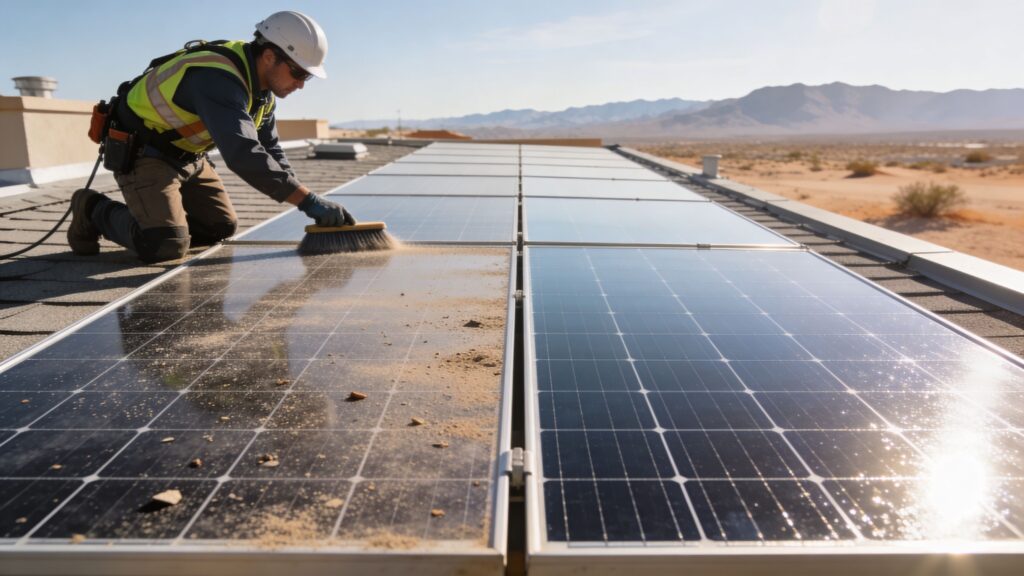
You installed solar to cut your APS or SRP bill, not to watch it creep back up while your roof keeps doing the same job every day. That’s the moment a lot of Phoenix homeowners call someone like us. The system looks fine from the driveway. The inverter is on. The panels are still shiny enough from a distance. But the production graph has flattened, or the savings don’t line up with the investment anymore.
That confusion is common in Arizona because our panels don’t fail dramatically most of the time. They get slowly buried in the kind of buildup this valley produces better than almost anywhere: dust after a dry stretch, residue after a haboob, pollen in the wrong season, and bird mess that bakes on fast under hard sun. People assume rain handled it. Usually, here, it didn’t.
Local owners also get mixed advice. One installer says solar is “low maintenance.” A neighbor says hose it off once in a while. Someone online says never touch it. Another says clean every month. None of that helps unless the advice is built around Phoenix conditions.
That’s what this guide is for. It answers how often should solar panels be serviced if you live in the Valley, and it answers it in practical terms. Not generic national advice. Arizona advice.
If you want a broad companion resource on system care beyond cleaning alone, these expert solar power system maintenance tips from Connect VPP are worth reviewing alongside local service guidance. Then bring that information back to the reality of desert roofs, monsoon dust, and long dry periods.
Your Solar Panels Are Working Hard Are They Working Smart
A typical Phoenix homeowner notices the problem backward. Not by staring at the roof, but by opening the utility bill and thinking, “Why is this higher than it should be?” The panels are still there. The sun certainly hasn’t gone anywhere. Yet the system isn’t delivering like it did.
That’s usually the first clue that your solar array is working hard, but not working smart. In Arizona, panels get punished by conditions that don’t show up in softer climates. Fine dust settles in layers. Wind pushes grit into corners and along lower edges. Bird droppings harden quickly in the heat and can leave stubborn spots that a casual rinse won’t fix.
A lot of owners expect obvious warning signs. Cracked glass. A dead inverter. An alarm. Sometimes that happens. More often, output fades gradually enough that people blame the season, the utility rate plan, or simple bad luck.
In Phoenix, “looks clean enough” from the ground is one of the most expensive assumptions a solar owner can make.
The other issue is that service gets treated like an all-or-nothing decision. Either people ignore the system entirely, or they assume any maintenance means a major service call. Most arrays need something in the middle: regular observation, basic safe upkeep, and timely professional work when the signs point there.
Why Arizona owners need a different answer
Advice written for rainy climates breaks down fast here. In places with frequent rain, a homeowner can get away with a lighter touch. In the Phoenix Valley, rain is unreliable as a cleaning plan, and dust arrives year-round from multiple directions.
Local conditions change the schedule:
- Desert dust stays put: Without regular rainfall, buildup doesn’t wash away on its own.
- Monsoon season adds a twist: Wind can load panels with dirt even when a storm barely drops any water.
- Urban growth matters: New construction, traffic corridors, and open lots all add airborne grime.
- Extreme heat bakes residue on: What lands lightly can become difficult to remove if it sits too long.
That’s why the right answer isn’t a single calendar date. It’s a service rhythm built around Arizona’s environment and your system’s actual performance.
The Low Maintenance Myth and Its High Cost
A Phoenix solar array can look fine from the driveway and still underperform for months.
That is the trap behind the “low maintenance” label. Solar equipment is built to last, but long life and peak production are not the same thing. In the Valley, panels sit through dry stretches, windblown dust, bird activity, and hard summer heat that bakes grime onto the glass. If nobody checks the system, small losses stack up into a bigger power bill.
The cost usually does not show up as one dramatic failure. It shows up as a slow drop in production that many homeowners miss. I see this a lot after monsoon dust events. The array still turns on. The inverter still appears normal. But the glass has a film on it, the lower edges are packed with grime, and a few droppings are creating dense shaded spots. The system keeps working, just not at the level the owner paid for.

What soiling loss actually looks like in Phoenix
Soiling loss is simple. Dirt blocks sunlight. Less sunlight reaches the cells, so production drops.
In Arizona, that dirt is rarely just one thing. It is usually a mix, and each type behaves differently on the panel surface:
- Fine desert dust: The everyday problem. It settles lightly, then builds in layers during dry periods.
- Pollen: Sticky enough to hold onto other debris and harder to rinse clean.
- Bird droppings: Small area, outsized effect. One dense spot of shade can drag down performance more than owners expect.
- Traffic film: More common near busy roads and intersections, especially in parts of Phoenix with heavy vehicle flow.
- Roof and tree debris: Grit, leaves, seed pods, and granules collect along edges and near the bottom frame.
That last part matters. Dirt does not spread evenly. On many roofs, the heaviest buildup forms near the lower edge of the panel where runoff slows and residue collects. From the ground, the array can still look “pretty clean.” Up close, the worst buildup is often exactly where homeowners cannot see it.
The real trade-off
Skipping service saves money only if the system keeps producing as expected. In Phoenix, that is not a safe assumption for long.
Routine attention costs less than extended underperformance, and it reduces the chance that minor issues go unnoticed. A dirty panel is one problem. Dirty panels plus a loose connection, nesting birds, or a hotspot risk is a more expensive one. That is why I tell Arizona owners to stop thinking in terms of “Do I need maintenance or not?” The better question is, “How much production am I willing to give up before I act?”
What helps, and what causes trouble
Some habits protect performance. Others create damage or safety problems.
What helps
- Watch your monitoring trends: A gradual production dip often shows up in the app before it is obvious on the roof.
- Inspect from the ground: Binoculars or a phone zoom can reveal debris, droppings, or heavy dust without climbing.
- Clean only in cool conditions: Early morning is safer and reduces the chance of stressing hot glass with water.
What causes trouble
- Counting on rain: Phoenix rain is inconsistent, and light rain often leaves mud spots or residue behind.
- Using abrasive brushes or dirty tools: Scratching the surface costs more than a proper cleaning ever would.
- Getting on the roof without the right setup: The fall risk is real, especially on tile roofs in summer heat.
- Waiting for the inverter to alarm: By that point, you may have accepted reduced output for weeks or months.
For Arizona solar owners, low maintenance means less frequent work than many home systems. It does not mean hands-off ownership.
Key Factors That Change Your Service Frequency
How often should solar panels be serviced in Phoenix? The honest answer is that the roof, location, and surrounding environment decide a lot of it.
Two houses in the same ZIP code can need very different schedules. One may stay relatively manageable for long stretches. Another gets hammered by dust, pollen, bird activity, or roadside grime. Generic advice misses that.
Arizona weather changes everything
Phoenix doesn’t clean panels the way wetter climates do. Long dry periods let fine dust accumulate in layers, and our storms often bring dirt first, water second. If a storm drops plenty of wind and very little rain, the roof can look worse the next day than it did before.
Heat adds another trade-off. It doesn’t just make rooftop work uncomfortable. It also bakes residue onto the glass faster, especially bird droppings and grime that settle near the lower frame. The longer that sits, the harder it is to remove without proper technique.
Your roof design matters more than most owners think
Roof pitch affects whether debris slides off or hangs around. A steeper pitch usually helps loose material move. A flatter layout can hold dust longer, especially at the bottom edge of panels where runoff slows and grime collects.
Panel layout matters too. Tight spacing, valleys in the roofline, and nearby parapet walls can create pockets where dirt settles. Arrays installed near chimneys, vents, or overhangs often need closer observation because those features interrupt wind and water flow.
A few structural details that often change service needs:
- Low-slope roofs: More likely to keep residue in place.
- Complex rooflines: More spots for debris to gather.
- Hard-to-reach sections: Owners delay care because access is difficult.
- Panels near trees or bird perches: More organic buildup and droppings.
What’s around your home can speed up buildup
The neighborhood matters. Homes near freeways often collect more airborne grime. Properties near open desert lots get more windblown dust. New construction nearby can coat a roof faster than owners expect. Agricultural edges bring their own mix of dirt and pollen.
Bird pressure is highly local too. Some houses barely deal with it. Others become regular landing zones because of nearby utility lines, roof peaks, or shaded ledges. Once birds adopt a roofline, the cleanup pattern usually changes.
Warranties are part of the schedule
Owners often think of servicing as only an efficiency issue. It’s also a documentation and care issue. If a manufacturer expects the system to be maintained and a problem appears later, neglect can complicate that claim.
That doesn’t mean every owner needs the same paperwork routine, but it does mean you should read the panel, inverter, and battery requirements closely. The service schedule should support performance and protect coverage.
Some of the most expensive solar problems start as simple maintenance decisions. Dirt gets ignored. Performance slips. A fault gets noticed late. Then the repair conversation gets harder than it needed to be.
A practical way to set your interval
Instead of picking a random frequency, look at your situation through four questions:
How dirty does the roof get between storms?
If buildup is visible from the ground, your schedule probably needs tightening.What does your monitoring app show?
Stable production suggests your current routine may be fine. Unexplained dips suggest otherwise.How exposed is the property?
Freeways, open desert, construction, and heavy bird traffic all increase service needs.Can you safely inspect it yourself?
If roof access is poor or visibility is limited, professional inspection becomes more important.
That's the practical Arizona answer. Service frequency is driven by local conditions, not just manufacturer brochures.
Routine Cleaning vs Professional Inspection
Homeowners often use “cleaning” and “servicing” as if they mean the same thing. They don’t.
Cleaning deals with what’s on the panel surface. Professional inspection deals with what dirt may be hiding, what heat may be damaging, and what your system may be doing wrong even when the glass looks fine from the yard.

Professional inspections are commonly recommended every 1-5 years, and in Arizona conditions they matter because technicians can identify issues such as micro-cracks or PID (Potential Induced Degradation). Guidance from Upvolt also notes that in extreme heat, uncleaned dust can contribute to hotspot formation, where localized overheating degrades cells at 2-3x the normal rate, and thermal imaging can reveal anomalies tied to yield losses of 15% or more if left alone, as described in this article on whether solar panels are high maintenance.
DIY cleaning has a place
A homeowner can absolutely do some useful maintenance, provided the setup is safely accessible and the task stays basic. Ground-level checks, monitoring reviews, and light cleaning on reachable arrays can all help.
If you want a step-by-step overview of safe methods, this guide on how to clean solar panels is a useful reference for the cleaning side of the job.
DIY is appropriate when the goal is simple upkeep. It is not the right choice when there are electrical concerns, visible damage, stubborn deposits, or steep roof conditions.
What each approach is actually for
| Task | DIY Approach | Professional Service |
|---|---|---|
| Light dust removal | Rinse or gently clean safely accessible panels during cool conditions | Uses solar-safe tools and methods across the full array |
| Visual check for debris | Look from the ground for leaves, bird droppings, or obvious grime | Confirms buildup patterns and checks hidden edges and hard-to-see sections |
| Performance review | Check app data for unusual drops | Compares output behavior with system condition and tests for deeper faults |
| Damage detection | Spot only what’s visible, such as major cracks or obvious discoloration | Identifies micro-cracks, hotspots, and degradation that aren’t visible to the naked eye |
| Electrical safety | Should not be attempted by homeowners | Inspects wiring, inverter behavior, and related system issues |
| Warranty support | Limited value unless your manufacturer accepts owner records | Better aligned with documented maintenance and condition checks |
What professionals catch that owners usually can’t
Some of the most costly solar issues don’t announce themselves clearly. A panel can be underperforming without obvious visual damage. A hotspot can develop in one area while the whole array still appears intact from below. An inverter issue can show up first as a subtle production mismatch.
That’s where diagnostic work matters. A proper service visit isn’t just “more cleaning.” It’s a condition check of an electrical asset exposed to years of heat, dust, and weather.
A trained crew may look for:
- Micro-cracks: Often invisible without closer assessment.
- Hotspots: Localized overheating tied to dirt, cell stress, or shading.
- PID-related symptoms: A degradation issue homeowners won’t diagnose from the driveway.
- Mounting concerns: Loose components or wear around the array.
- Inverter irregularities: Warning signs behind reduced production.
If output drops and the panels still look decent, don’t assume it’s just a dirt problem. Arizona heat can hide a deeper fault behind an ordinary-looking roof.
Where the line should be drawn
Here’s the practical boundary. If your panels are easy to observe, lightly dusty, and your app data is stable, owner upkeep may be enough between service visits. If the roof is steep, the buildup is stubborn, the array sits high, or performance has changed without a clear reason, professional help is the safer call.
That’s also the point where a local service option like Sparkle Tech Window Washing becomes relevant. Not as a substitute for electrical repair, but as one way to handle proper solar panel cleaning and visual maintenance support on Arizona roofs where access and buildup make DIY unrealistic.
Warning Signs Your Solar Panels Need Service Now
A common Phoenix call goes like this. The homeowner opens the app after a dusty week, sees production running low by lunchtime, and assumes the summer heat is the whole story. Sometimes it is. Sometimes the system is asking for attention before a small problem turns into a costly one.
The first warning usually shows up in performance, not appearance.

Production drops that do not match the weather
In Phoenix, output naturally shifts with season, temperature, and daylight hours. What should get your attention is a drop that does not line up with those patterns. If the sky is clear and the system suddenly produces less than it usually does for similar days, treat that as a service flag.
Watch for signs like these:
- A sudden production dip on clear days
- One string or panel group lagging behind the rest
- Low output that continues days after a dust storm
- A pattern of weaker afternoon production that was not there before
A short dip after a haboob is normal. A system that stays down after the dust settles needs a closer look. For Arizona owners, that often means dirt buildup, debris lodged along the lower edge of the array, or a developing equipment issue that cleaning alone will not fix.
If you want a simple way to track what to check after storms, this solar panel maintenance checklist for Arizona homeowners gives you a practical baseline.
Visible trouble from the ground
You do not need to get on the roof to spot many service issues. In fact, on tile roofs and steep pitches around the Valley, staying on the ground is usually the right call.
Look for:
- Heavy dust bands or muddy residue near the bottom frame
- Bird droppings that keep building up in the same area
- Leaves, palm debris, or nesting material caught under or around the array
- Cracked glass, browning, or obvious burn marks
- A panel that looks different from the rest in color or reflectivity
In Arizona, a panel does not have to look filthy to lose output. Fine desert dust can form a light, even film that cuts performance without creating dramatic visual buildup from the street.
Inverter warnings mean more than "check later"
Homeowners sometimes ignore inverter alerts because the system comes back on by itself. That is a mistake if the warning repeats. A one-time communication hiccup can happen. Repeated fault codes, warning lights, or disconnects usually point to a real problem.
Pay attention if you notice:
- Recurring inverter alerts in the app
- Communication errors paired with weak production
- An inverter shutting down during hot afternoons
- Buzzing, clicking, or other unusual sounds
- Burn marks, melted plastic, or a hot electrical smell
Those are service-now signs. In Phoenix, long heat exposure is hard on electrical components, and small inverter issues can drag production for weeks before the owner realizes how much energy has been lost.
When to stop troubleshooting and call a pro
A ground check and app review are reasonable. Roof walking, opening electrical equipment, or trying to diagnose fault codes by guesswork are not.
Call for service promptly if you see physical damage, repeat inverter faults, loose mounting hardware, or a sustained production drop with no obvious weather cause. That is the line between routine owner awareness and professional solar service.
This short video is a useful visual primer if you want to see the kinds of solar issues owners should take seriously before they spread.
Your Arizona Solar Maintenance Schedule and Checklist
A Phoenix solar schedule should be built around dust, heat, and storm season. Homeowners here do not get much help from rain, and one dirty month can stretch into a whole season if nobody is watching production.
For many Valley homes, a practical plan is simple. Check the system lightly every month from the ground. Recheck it after dust storms and monsoon activity. Clean it as conditions and output justify, not by copying advice written for cooler, wetter states.

A workable Phoenix Valley service rhythm
This schedule fits how panels get dirty in the Phoenix area:
Monthly from the ground
Open the monitoring app and compare current production to recent weather. Look for new grime, bird droppings, or debris lines along the lower edge of the array. Check for tree growth or new shade that was not there last season.After a haboob or high-wind event
Inspect the array from the ground once conditions are safe. Dust storms in Phoenix can leave a visible film in a single afternoon, especially on low-slope roofs and homes near open lots, construction, or desert edges.Spring
Fine dust and pollen often build a light haze that owners miss until production starts slipping. This is a good time to schedule cleaning if the panels look dull or the app shows a sustained dip.Late summer or post-monsoon
Monsoon season often leaves behind mud spotting, runoff marks, and trapped debris. In my experience, this is one of the best times to reset the array before cooler weather improves production.Once a year for professional review
Even if the panels still look decent from the yard, an annual service visit is a smart maintenance baseline in Arizona. Owners who like structured upkeep can also borrow the logic from an electrical preventive maintenance schedule template and apply it to seasonal solar checkups.
A homeowner checklist that actually gets used
Long maintenance lists usually get ignored. A short repeatable routine works better.
Use this kind of checklist, or keep a saved solar panel maintenance checklist for Arizona homeowners so you can track what was checked, what changed, and when service was done.
Monthly from the ground
- Review the monitoring app: Watch for a drop that does not match cloud cover, season, or normal heat-related swings.
- Scan the panel faces: Look for dust film, bird mess, leaf buildup, or dirty streaks near the frame.
- Check the area around the array: New shade and overhanging branches can cut output and add more debris.
After storms
- Look for fresh soiling: Haboobs can coat panels fast, and monsoon rain often dries dirty instead of rinsing clean.
- Check for trapped debris: Twigs, leaves, and trash can collect along panel edges or under the array.
- Confirm production recovery: If output stays weak after the weather clears, it is time for a closer look.
During owner cleaning
- Only clean what you can reach safely: Ground-mounted panels and easy-access setups are one thing. Steep roofs, second-story arrays, and slick tile roofs are another.
- Work early: Panels are safer to clean in the morning before the glass gets hot.
- Use gentle methods: Soft brushes, clean water, and non-abrasive tools protect the glass and frame.
What usually belongs on the homeowner side versus the pro side
The line is straightforward. Owners monitor, inspect from the ground, and handle low-risk cleaning. Professionals take the roof risk, check the harder-to-see trouble spots, and confirm the system is performing the way it should.
| Maintenance need | What the homeowner can do | What a professional should handle |
|---|---|---|
| Routine monitoring | Check app trends and compare seasonal output | Diagnose underperformance and rule out system issues |
| Light visual inspection | Spot obvious grime, shade, or debris from the ground | Inspect array condition up close and identify wear points |
| Basic cleaning | Clean reachable panels in safe conditions | Clean roof-mounted arrays safely and thoroughly |
| Bird and debris issues | Notice nesting or repeated buildup | Remove problem buildup and assess prevention options |
| Annual service review | Track service dates and observations | Inspect mounting, panel condition, and overall service needs |
A calendar reminder helps, but Arizona owners get better results by tying service to weather patterns and output history. That is how local solar maintenance stays practical instead of becoming guesswork.
The simplest answer for most local owners
For many homes in Phoenix, panels need attention several times a year and professional service at least annually. Some systems can get by with fewer cleanings. Others, especially near busy roads, new construction, open desert, or heavy bird activity, need more frequent care.
That is the Arizona version of a maintenance schedule. It follows the climate, not the brochure.
The Cost and Benefit of Professional Solar Service
In Phoenix, I see the same pattern every summer. A homeowner assumes the panels still look good from the ground, keeps putting off service, then calls after a utility bill jumps or the monitoring app starts showing a drop that does not match the weather. By that point, the job is rarely just a basic rinse.
Professional solar service is a maintenance cost, but it is also a performance decision. In Arizona, that trade-off matters more because dust hangs around, rain is light, and roof surfaces get brutally hot. Panels here take more abuse than the average national article accounts for.
What are you paying for?
You are paying for safe roof access, the right cleaning method for the panel type, and an inspection by someone who knows what early trouble looks like in desert conditions. That can mean spotting baked-on dust that water alone will not remove, catching bird activity before it spreads under the array, or noticing a mounting issue before monsoon winds make it worse.
The return usually shows up in a few practical ways:
- Better energy production from cleaner panel surfaces
- Earlier detection of issues that are easy to miss from the ground
- Less avoidable wear from grime, debris, and long service delays
- Safer maintenance than climbing onto a steep, hot roof yourself
Neglect usually gets expensive in small steps, not one dramatic failure. Output slips. Dirt hardens onto the glass. Bird mess sits too long. A minor issue becomes a service call with more labor attached to it. Arizona owners feel that pattern faster because our weather does not do much free cleaning for us.
Homeowners who want to budget realistically can compare typical solar panel cleaning service cost with the value of keeping production closer to where it should be. The exact price depends on roof height, access, panel count, and how much buildup is on the system. A simple one-story cleaning is one thing. A two-story tile roof with heavy debris is another.
The planning mindset is the same one contractors use for other electrical equipment. An electrical preventive maintenance schedule template is a useful example of how scheduled care prevents bigger service problems later. Solar is no different. Regular maintenance keeps small problems small.
For many Phoenix-area systems, professional service makes financial sense when it does one or more of these jobs:
- Keeps annual savings from slipping due to preventable production loss
- Finds wear, debris, or damage before repairs become more involved
- Creates a service record that supports warranty or resale questions
- Removes the safety risk of DIY roof work in extreme heat
That is the key cost-benefit calculation in the Valley. Service is not just about cleaning dirt off glass. It is about protecting output, reducing roof risk, and avoiding the kind of deferred maintenance that gets expensive in Arizona heat.
If your solar panels are in the Phoenix Valley and you want a realistic maintenance plan, Sparkle Tech Window Washing provides solar panel cleaning and exterior cleaning services across Arizona. If you’ve noticed dirt buildup, storm residue, bird mess, or a production drop that doesn’t make sense, it’s a good time to schedule a professional review and get your system back on track.