

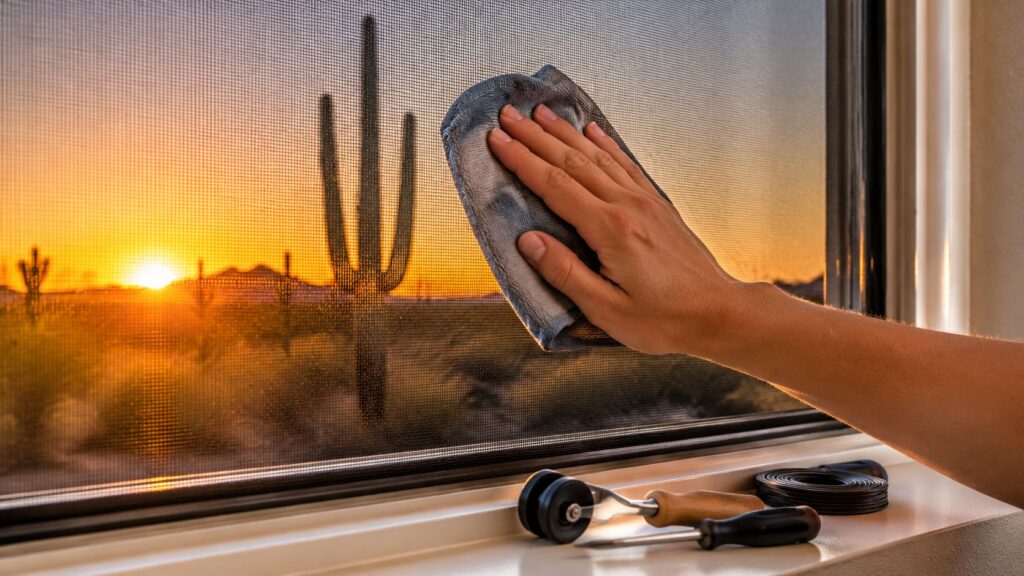
An Arizona evening can make you want to throw every window open. The sun drops, the air finally loosens up, and for a little while the house could cool naturally if you could just let that breeze move through.
Then the trade-offs show up fast. Mosquitoes find the porch light. Tiny flying insects drift in through a loose corner. Dust from a recent windstorm sits on the mesh and cuts the airflow you were counting on. A screen that looked “fine” last month suddenly seems like the weak point in the whole room.
That's why bug screens matter more than most homeowners think. They aren't just accessories clipped into a frame. They're part of how your home breathes, how comfortable your evenings feel, and how much confidence you have opening up the house when the weather gives you a chance.
If insects are already part of the problem outside, it also helps to think beyond the screen itself. Homeowners dealing with biting and nuisance pests may also want broader prevention advice like Protecting your home from flies and fleas, especially when bugs are gathering around doors, pet areas, and exterior lights.
A good bug screen setup comes down to a few practical things. The right mesh for the pests you have. A frame that fits tightly. Routine cleaning that doesn't ruin the material. And knowing when a quick repair will solve the problem versus when the whole screen is done.
Enjoying the Breeze Without the Bugs
Most homeowners don't start shopping for bug screens because they're excited about mesh. They start because something isn't working.
Maybe it's the bedroom window you stopped opening because bugs keep showing up on the sill by morning. Maybe it's the patio slider where the screen drags, leaves a gap, and lets in just enough flying pests to make dinner near the back door annoying. In Arizona, it's often both comfort and cleanup. You want fresh air, but you don't want dust and insects tagging along.
What homeowners usually want
The request is usually simple. Keep the bugs out, keep the airflow moving, and don't make the house feel closed in.
That sounds basic, but the details matter. A screen can look intact and still fail if it's loose in the frame or not seated tightly at the edges. Another can block insects well but make the room feel stuffy because the mesh is too tight for the location. The right answer depends on the opening, the exposure, and what's happening around the home.
Open windows only feel worth it when the screen gives you confidence. If you're second-guessing every opening at dusk, the screen system isn't doing its job.
What works in real homes
For most houses, bug screens work best when you treat them like a system instead of a single product. That system includes:
- The mesh itself that handles the insect pressure in your area
- The frame and corners that hold shape over time
- The spline and retention that keep the mesh taut
- The fit against the window or door so insects can't slip through the perimeter
- The maintenance routine that keeps airflow and visibility from dropping off
Homeowners who get the best results usually keep things simple. They clean screens before dust buildup gets heavy, check corners and spline when they wash them, and replace worn parts before summer pest pressure ramps up.
What Exactly Are Bug Screens
Bug screens are a physical barrier that lets air pass while stopping insects at the opening. That sounds obvious, but it helps to think of them as the gatekeeper for comfort. They sit between the outside air you want and the pests, debris, and nuisance entry points you don't.
They also have a long history in American homes. Early references to woven wire window screening appeared in the 1830s, and bug screens became commercially successful during the Civil War era. In 1861, a wire cloth company repurposed surplus wire mesh used for food sieves, painted it, and sold it as window screening, and the idea quickly caught on, as noted in this history of the window screen.

More than bug control
A screen does more than block insects. It affects how a room feels every time you crack a window.
A clean, properly fitted bug screen supports ventilation, helps keep flying pests from settling indoors, and gives you a usable opening instead of one you avoid. In a porch, window, or patio setting, that can be the difference between using the space and keeping it shut most of the season.
The term that matters most
The first technical term homeowners should know is mesh count. Mesh count tells you how tight the weave is. Tighter weave means smaller openings. Smaller openings mean better exclusion of tiny insects, but also less airflow and sometimes a slightly more muted view.
That trade-off is at the center of almost every screen decision. If you only think about “keeping bugs out,” you can choose a screen that feels too closed off. If you only think about visibility and breeze, you can end up with a screen that doesn't stop the insects bothering you in the first place.
Practical rule: Don't judge bug screens by appearance alone. Two screens can look similar from a few feet away and perform very differently once tiny insects and airflow come into play.
Why not all bug screens are equal
Homeowners often assume the material is the whole story. It isn't.
A bug screen's real-world performance comes from a combination of factors:
- Mesh density that matches the pest pressure
- Material choice based on sun, wear, and use
- Frame condition so the screen sits square
- Installation quality so the screen stays taut and sealed
That's why one screen can last and perform well while another causes constant frustration, even when both seem “new enough.”
Choosing Your Perfect Bug Screen
Choosing bug screens gets easier once you stop looking for a universal option. There isn't one. The right screen for a shaded bathroom window isn't always the right screen for a sun-beaten Arizona patio door or a window next to a pet's favorite lookout spot.
Start with pest pressure and airflow
Screen performance comes down first to mesh count. According to Phifer's bug protection guidance, standard 17×14 mesh blocks most mosquitoes, while smaller insects like no-see-ums require a tighter 20×20 weave. The trade-off is reduced airflow and visibility. That's the kind of trade-off homeowners should decide on intentionally, not after installation.
If you're dealing with larger common flying insects, standard insect screening usually makes sense. If tiny pests are your main concern, a tighter weave is the smarter technical choice, especially on openings you use at dusk.
Material matters too
Once mesh is sorted out, material becomes the next practical decision. Here's how the common options compare in practice.
| Material Type | Key Benefit | Best For | Durability | Cost |
|---|---|---|---|---|
| Fiberglass | Flexible and easy to work with | Standard residential window screens | Good for routine use | Lower |
| Aluminum | Crisp look and firmer feel | Homeowners who want a more rigid screen material | Good, but can crease | Moderate |
| Pet-resistant screen | Handles clawing and pushing better than standard mesh | Homes with dogs or cats that press against screens | Higher than standard mesh | Higher |
| Solar screen | Helps manage harsh sun and glare while still screening openings | Arizona homes with strong sun exposure | Good for sun-focused applications | Higher |
What each type is really good at
Fiberglass bug screens
Fiberglass is common for a reason. It's forgiving during installation, widely used, and practical for everyday window screens.
For DIY homeowners, it's often the easiest material to rescreen with because it seats well and doesn't fight you as much when you're learning. It's a strong choice when the frame is still in good shape and the opening doesn't take abuse.
Aluminum bug screens
Aluminum has a more rigid feel and a clean appearance. Some homeowners prefer how it looks from the curb and how it sits in the frame.
The downside is handling. Bend it the wrong way and it tends to show that damage. If you're removing and reinstalling screens often, or if you have kids and pets around the openings, aluminum may demand a little more care.
Pet-resistant screens
These make sense when the issue isn't insects alone. It's impact.
If a dog jumps at the lower half of a patio slider or a cat uses the screen frame as a perch, standard mesh may not last. Pet-resistant material gives you a tougher barrier in those high-contact areas. It's not the answer for every opening, but it's often worth it on one or two screens that constantly get hit.
Solar screens
Arizona homeowners should take solar screens seriously where afternoon sun is brutal. They aren't just about insect control. They also help with glare and sun load on the opening.
For west-facing and south-facing exposures, this can be a practical upgrade if heat and harsh light are as annoying as bugs.
A simple way to choose
If you want a fast decision path, use this:
- Choose standard insect screening if the main goal is everyday bug control and decent airflow.
- Choose tighter mesh if tiny insects are getting through the openings you use most.
- Choose pet-resistant mesh where animals regularly press on the screen.
- Choose solar screens where Arizona sun is beating up the opening and making rooms harder to live in.
What doesn't work is guessing based on price alone. A cheaper screen that doesn't match the opening or the pest problem usually gets replaced sooner, or ignored entirely because the window stops being useful.
Your Guide to Cleaning and Maintenance
Arizona screens don't just collect a little dust. They catch fine grit, pollen, windblown debris, and the film that settles in after a dusty stretch of weather. If you let that sit, airflow drops, visibility gets dull, and the screen starts working harder while performing worse.
That's why cleaning bug screens should be gentle and regular instead of aggressive and occasional.

A more detailed walkthrough on how to clean window screens can help if you want a full process before you start.
The safe cleaning routine
For most homes, this method is enough:
- Remove loose dust first. Use a soft brush, microfiber cloth, or a vacuum with a brush attachment. Don't start with water if the screen is carrying gritty dust. You'll just make mud and grind debris into the mesh.
- Wash with mild soap and water. A bucket of water with a small amount of mild dish soap works well. Use a soft sponge or soft-bristle brush.
- Scrub lightly. Work in sections and support the screen if it's out of the frame. Pressing too hard can stretch the mesh or stress older corners.
- Rinse gently. A soft spray is enough. High pressure can loosen spline, bow the mesh, or force water into frame corners.
- Let it dry fully. Reinstalling a damp screen can trap moisture and grime.
What to look for while cleaning
Cleaning is also inspection time. Don't just wash and move on.
Check these trouble spots:
- Corners loosening up where the frame no longer sits square
- Spline lifting or shrinking so the mesh no longer stays tight
- Wrinkles and slack areas that signal the screen has lost tension
- Small edge gaps that are easy to miss when the screen is dirty
- Tears near the lower section where pets, shoes, or tools make contact
A screen doesn't have to be torn to fail. If the perimeter is loose, insects will use the opening you left for them.
Arizona timing matters
In Arizona, it makes sense to clean bug screens before the hottest stretch of the year and again after dusty weather hits hard. Haboob dust is fine, abrasive, and persistent. It settles into mesh quickly and can make a screen look older than it is.
For homeowners who keep windows closed much of the summer, a pre-fall cleaning often pays off most. That's when people want to open the house again, and it's when dirty screens become obvious.
Repair or Replace A Homeowners Decision Guide
Most screen problems aren't dramatic. They're a small tear in one corner, a screen that rattles, a frame that doesn't sit flat anymore, or a slider that looks closed but still leaves a sliver of space.
That's where homeowners get stuck. Is this a quick fix, or is it time to replace the whole thing?

A practical starting point is to learn the basic repair process. This guide on how to repair window screens walks through the core steps and tools.
Repair usually makes sense when
Small, localized problems are often worth fixing if the frame is still sound.
Repair is usually the better choice when you have:
- A small tear or puncture in otherwise healthy mesh
- Loose spline that can be removed and reset properly
- Minor wrinkles caused by tension issues rather than major frame damage
- A usable frame with corners that still hold shape
If the screen fits the opening well and the frame isn't bent or warped, rescreening can restore performance without replacing the whole unit.
Replacement is usually smarter when
Some screens are technically repairable but not practically worth it.
Full replacement is often the better call when:
- The frame is warped and won't sit tight in the opening
- Corners are failing and the screen no longer stays square
- The mesh is brittle or badly worn across the full panel
- The screen has repeated fit problems even after basic adjustments
- The opening is custom-shaped or oversized and prior DIY work hasn't solved it
The biggest missed issue is fit. Many homeowners assume bugs are getting in through the mesh when the actual issue lies with the perimeter. Product guidance from Tisch points in that direction. Homeowners often deal with insect entry because of poor fit, loose splines, or warped frames that create gaps, and a screen needs to be fully retained and taut to do its job, as discussed on this bug screen support angle product page.
A fast decision test
Ask these questions before you spend time on a repair:
| Problem | Likely Best Move | Why |
|---|---|---|
| Small hole in center of mesh | Repair or rescreen | Damage is isolated |
| Loose screen material | Re-seat spline if frame is good | Tension may be the only issue |
| Bent or twisted frame | Replace | Fit and seal will stay unreliable |
| Bugs entering around edges | Check fit before replacing mesh | Perimeter failure is often the real cause |
| Older screen with multiple issues | Replace | Stacked problems usually waste repair time |
If the frame can't hold tension and sit flush, new mesh alone won't solve much.
What DIY often misses
DIY repairs fail most often for three reasons. The mesh gets over-stretched, the spline isn't the right size, or the frame itself is the problem and nobody catches it until after the new material is installed.
That's why some repairs feel frustrating. The homeowner did the visible part correctly, but the hidden issue was the opening, not the screen cloth.
Bug Screen Care for the Arizona Climate
Arizona is hard on bug screens in a way milder climates aren't. The sun is stronger, the dust is finer, and the weather can go from calm to abrasive quickly. A screen that works well elsewhere may age faster here because the conditions are tougher day after day.

Sun changes the material choice
On exposed Arizona elevations, screen material doesn't just need to block insects. It needs to tolerate harsh UV and keep doing that through long hot stretches.
That's one reason many homeowners here move beyond the most basic option on every opening. Standard mesh can still work well in the right spot, but sun-heavy windows often benefit from a more purpose-matched choice, especially where glare and heat are part of the problem too.
Dust changes the maintenance routine
Haboob dust isn't regular dirt. It's fine, clingy, and abrasive.
If you scrub hard while that dust is still on the mesh, you can wear the screen faster and push grit into corners and spline channels. Arizona homeowners do better with a dry dust-off first, then a gentle wash. That applies to bug screens on windows, patios, porches, and doors.
A seasonal exterior routine helps. This broader seasonal home maintenance checklist is useful if you want to line screen care up with the rest of your Arizona home upkeep.
Local pest pressure changes where to invest
Not every opening needs the same solution. If tiny flying insects gather near one side of the home at dusk, that may be the opening where tighter insect control matters most. If another side gets harsh afternoon sun and very little pest activity, comfort and solar performance may be the smarter priority there.
That's the practical Arizona approach. Don't overspend on every screen equally. Upgrade the openings that create problems.
For homeowners who want help with screen cleaning, rescreening, or replacement in Arizona conditions, Sparkle Tech Window Washing offers service for sun and bug screens as part of its window screen work.
When to Call a Professional for Your Screens
Some bug screen jobs are good DIY projects. Others turn into half-day frustrations, ladder risks, and repeated trips to the hardware store.
Professional help makes sense when the opening is hard to reach, the fit needs to be precise, or the problem clearly goes beyond a torn mesh panel.
The situations that justify a pro
Call a professional when you're dealing with:
- Second-story or hard-access windows where removal and reinstalling creates a safety issue
- Custom or unusual frames that need exact measuring and clean fabrication
- Warped openings or persistent gaps that aren't solved by replacing the mesh
- Large sliding screen panels that need better alignment and smoother travel
- Multiple damaged screens at once where batching the work saves time and hassle
Large commercial-style openings often use tracked sliding systems rather than simple fixed inserts because bigger spans need guided movement, structural support, and better stability. Chase Doors describes systems with heavy-duty 11 oz PVC-coated mesh, a 16-gauge roller track, and configurations for openings up to 10 ft wide by 10 ft high, with different setups for larger spans, as shown on its sliding bug screen product page. Most homeowners won't need that exact hardware, but the lesson carries over. As screens get larger, alignment and support matter more.
Why pros often solve the right problem faster
A professional doesn't just swap material. They can identify whether the issue is the screen, the frame, the track, or the opening itself.
That matters when homeowners are also battling exterior insect pressure. If mosquitoes are consistently active around the yard, screen work helps at the opening, but source control outdoors matters too. In that case, it can also be useful to learn how to get rid of mosquitoes in your property so you're reducing pressure outside as well as tightening the barrier at the house.
Good screen service starts with diagnosis. Replacing mesh on a bad frame is neat work, but it's still the wrong fix.
For homeowners in the Phoenix valley and across Arizona, professional screen service is often the smart call when you want a tight fit, safe installation, and less trial and error.
Frequently Asked Questions About Bug Screens
Can I paint my bug screens
You can, but it's usually not the first fix to reach for. Paint can clog openings in the mesh, affect airflow, and create an uneven finish if it's applied too heavily. If the screen looks tired because it's dirty, loose, or worn, cleaning or rescreening is usually the better move.
How do I measure for a replacement screen
Measure the frame opening carefully in more than one place. Width and height should be checked at the points where the screen seats, not just the visible edge of the window. If the frame is bent or the opening seems out of square, write that down before ordering anything.
Are retractable bug screens a good option
They can be, especially on openings where you don't always want a visible screen. The catch is fit and retention. Moving screen systems need good alignment and a clean seal at the edges, or they lose much of their value.
Why are bugs getting in if the mesh isn't torn
This usually points to fit problems. Loose corners, poor frame retention, worn spline, or slight warping can leave enough space for insects to get through even when the mesh looks intact.
How often should I clean bug screens in Arizona
There isn't one perfect schedule for every home. Homes near construction, open desert, or high-wind exposure usually need attention more often than sheltered properties. In practice, clean them before heavy use seasons and after major dust events.
What's the easiest DIY screen repair
Replacing spline and rescreening a standard frame is often the most approachable repair if the frame is still square. It's a manageable project with the right roller tool, screen material, and patience. Bent frames and persistent fit issues are where DIY becomes less efficient.
Do all windows in my home need the same type of bug screen
No. Matching every opening to one material is simple, but it's not always smart. Use the screen that fits the job. High-sun exposures, pet-contact areas, and windows with tiny-insect pressure may each call for a different choice.
If your screens are loose, dusty, damaged, or not keeping Arizona bugs where they belong, Sparkle Tech Window Washing can help with practical screen service for homes across the Phoenix valley and throughout Arizona. Whether you need cleaning, rescreening, repair, or replacement, it's worth getting the fit, tension, and material right so you can open your windows with confidence again.