



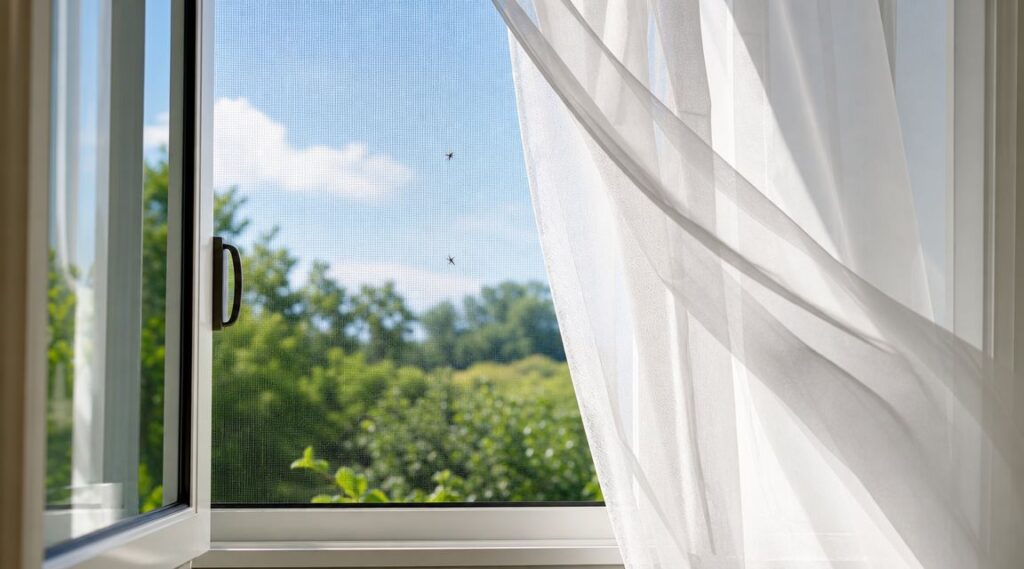
You open the window after sunset because the air finally feels good. Then the trade-off shows up fast. A few mosquitoes drift in, a tiny gnat makes it past the frame, and the breeze that was supposed to make the room more comfortable turns into a reminder that a bad screen is worse than no screen at all.
In Arizona, bug screens for windows do more than keep insects out. They sit in direct sun for long stretches, collect dust, and get tested by dry air, wind, and regular use. A screen that looks fine in a store can sag, fade, clog, or tear sooner than expected once it's on the house.
Most homeowners don't need a long list of screen products. They need a practical answer. Which screen gives you good airflow in hot weather, which one holds up better in hard sun, which mesh blocks the specific bugs you have, and when is a premium screen worth the extra cost.
Enjoying the Breeze Without the Bugs
A lot of Arizona homeowners call about screens for the same reason. They want to crack the bedroom windows early in the morning or open the living room up in the evening without inviting half the insect population inside. That's a normal goal, but the result depends on whether the screen fits the climate and the pest pressure around the home.
If you're near irrigation, standing water, dense landscaping, or a shaded yard, mosquitoes can become part of the problem even in a dry climate. Good screens help, but they work best as one layer of protection. If mosquitoes are a recurring issue around your property, it also helps to understand broader pest control for mosquitoes so you're not relying on the window screen alone.
The mistake I see most often is treating every screen like a generic replacement part. Homeowners ask for “new screens,” but what they usually mean is one of three things:
- Keep bugs out better: The current mesh lets in tiny insects or has small tears at the corners.
- Let more air through: The room feels stuffy when the windows are open.
- Clean up the view: The old screen looks faded, dusty, or warped and makes the glass seem dirty even when it isn't.
Practical rule: The right bug screen has to do three jobs at once. Exclude pests, hold up in sun, and still make the room feel open.
That's why material, mesh, and screen style all matter. A basic fiberglass screen may be perfectly fine on one window and the wrong choice on another. A tighter mesh may solve a gnat problem but feel too restrictive in a room that already runs warm. And a premium low-visibility screen may look great on a view window but be unnecessary on a laundry room window.
Good screen decisions are rarely about the catalog description. They're about where the window sits, what bugs show up there, and how much maintenance you're willing to deal with.
Comparing Window Screen Materials
A screen that looks fine in the store can fail fast on an Arizona window. West-facing sun cooks the mesh all summer, dust sticks to it year-round, and any weak material starts showing age long before the frame breaks.

Fiberglass, aluminum, polyester, and stainless steel
Fiberglass is still the standard residential choice because it is affordable, easy to replace, and gives decent visibility and airflow. It also has some flex, which helps it avoid the permanent creases you see in metal mesh. The downside is service life. On windows that get removed for cleaning, pushed on by kids, or exposed to hard afternoon sun, fiberglass usually shows wear sooner than tougher materials.
Aluminum feels sturdier the day it goes in. It stays taut well and gives the screen a firmer, cleaner look, which some homeowners prefer. In practice, I recommend it selectively. Aluminum dents easily, and once the mesh gets bent or creased, the damage is visible from inside and outside.
Polyester is a smart middle option for households that are rough on screens. It stands up better to pets, repeated handling, and everyday abuse than basic fiberglass, so it often earns its higher price in busy parts of the house. The trade-off is that not every polyester product gives the same open view or light feel, so it helps to compare the actual mesh rather than buying by label alone.
Stainless steel is the premium choice when strength, cleaner sightlines, and longer-term durability matter more than lowest cost. It handles harsh conditions well and resists corrosion, which is one reason higher-end screen systems use it. Some micro-fine stainless products are also designed to improve outward visibility and airflow, as Andersen notes on its TruScene insect screen product page. I would not put that upgrade on every window, but it can make sense on main living areas where the view and ventilation are worth paying for.
The best material is rarely the strongest one on the shelf. It is the one that fits the window's exposure, how often the screen gets handled, and what you want to spend replacing it later.
What works better in Arizona conditions
Heat and UV exposure change the math. A lower-cost mesh may be perfectly reasonable on a shaded bathroom window that stays closed most of the year. The same mesh on a south or west elevation can fade, dry out, and lose its crisp appearance much sooner.
Dust is the other factor homeowners underestimate. Fine desert dust collects on every screen, but tighter or more textured mesh tends to show buildup faster. That matters because a dusty screen cuts into visibility and airflow, even when the material itself is still intact. If you like to open windows on cooler mornings, a screen that is easy to rinse and brush clean usually stays more usable over time.
For a closer look at how common options compare in real homes, this guide to window screen material types gives a helpful side-by-side breakdown.
Window Screen Material Comparison
| Material | Durability | Visibility | Cost | Best For |
|---|---|---|---|---|
| Fiberglass | Moderate | Good | Lower | Standard residential windows, lower replacement cost |
| Aluminum | Moderate to high, but prone to dents | Fair to good | Moderate | Windows where homeowners want a firmer mesh |
| Polyester | High | Good | Moderate to higher | High-use areas, homes with pets, frequent handling |
| Stainless steel | High | Very good to excellent, depending on mesh type | Higher | View windows, sun-exposed openings, premium upgrades |
A practical approach works best. Use fiberglass where easy replacement and lower cost matter most. Step up to polyester where screens take abuse. Reserve stainless steel for windows that earn the upgrade, especially on openings where sun exposure, visibility, and long-term appearance matter more than saving a little on the initial install.
Fixed Retractable and Other Screen Styles
Screen style matters just as much as mesh. Some homeowners focus on material first, then end up disappointed because they chose the wrong kind of screen for the way the window is used.

Fixed screens for everyday windows
For most bedroom, bathroom, kitchen, and living room windows, a fixed frame screen is still the practical winner. It's simple, easy to inspect, and usually the easiest style to repair or rescreen when the mesh wears out. If your main goal is dependable insect control, fixed screens usually give you the least trouble.
That's especially true in dusty parts of Arizona. Fewer moving parts means fewer places for grit to collect and fewer things to go out of alignment. A standard fixed screen also tends to be the most sensible choice when you have multiple similar windows and want consistency across the house.
Retractable and gliding systems
Retractable and gliding screens appeal to homeowners who care a lot about aesthetics, large openings, or preserving an unobstructed view when the screen isn't in use. They can make sense on patios, wide openings, or areas where a fixed screen would feel visually heavy.
The catch is maintenance. Retractable and gliding systems can be more vulnerable to debris, track issues, and misalignment than standard fixed screens, while fixed screens often remain the most cost-effective and durable option for most standard windows (retractable screen considerations).
Field note: If the opening is standard and used often, fixed usually wins. If the opening is oversized or design-driven, retractable starts to make sense.
Matching style to the room
Different rooms ask different things from a screen:
- Bedrooms: Quiet function matters most. Fixed screens are usually the better fit because they seal easily and don't ask much from the homeowner.
- Kitchen windows: Grease, dust, and frequent opening can make easy-clean designs more appealing than specialty systems.
- Patio-facing openings: Retractable or gliding styles have a stronger case here, especially if the goal is to protect views.
- Hard-to-reach windows: Simpler is better. Anything that needs regular track attention becomes annoying fast.
A retractable screen isn't a bad product. It's just easy to overspend on one where a fixed screen would have done the job better and with less upkeep. For most standard windows, reliability beats novelty.
How to Choose the Right Screen for Your Home
Most screen decisions get easier once you start with the bugs, not the product brochure. The mesh that feels perfect in one neighborhood may be the wrong choice a few miles away if your home deals with smaller insects, more blowing dust, or hotter afternoon exposure.

Start with mesh count
Mesh count is the main engineering variable in insect screening because it controls the size and number of openings. A 20-mesh screen has 20 openings per linear inch in each direction, which creates 400 openings per square inch, and standard 18 to 20 mesh products are widely used because they block most common flying insects such as flies and mosquitoes while still allowing usable ventilation and sightlines (mesh size explanation).
For many homes, that standard range is the right balance. It keeps out the common pests without making the room feel unnecessarily closed off.
When the target is much smaller insects, the answer changes. Standard 18×16 mesh blocks most mosquitoes and flies, while a tighter 20×20 no-see-um mesh is specifically engineered to block smaller insects like gnats and sand flies. That's a real trade-off in hot climates because finer mesh improves exclusion but can slightly reduce airflow (no-see-um screen guidance).
Use this decision framework
If you're trying to choose bug screens for windows in Arizona, work through the opening one question at a time.
- What bugs are getting in? If you're only fighting flies and mosquitoes, standard mesh is often enough. If tiny biting insects or gnats are the issue, a tighter screen becomes more reasonable.
- How important is airflow in that room? On a shaded bedroom window, a finer mesh may be worth it. On a west-facing room that already runs warm, too much restriction can be frustrating.
- How much dust does that side of the house collect? Tighter mesh can trap more fine debris, so heavily exposed windows may need more frequent cleaning.
- Do you care more about view or toughness? A main living area may justify better clarity. A utility room may not.
Good choices for common Arizona situations
To put it in simple terms:
| Situation | Screen choice that usually makes sense |
|---|---|
| Standard neighborhood bug pressure | Standard fiberglass or similar screen in a common residential mesh |
| Tiny insects near washes, landscaping, or damp areas | Tighter no-see-um mesh where needed |
| Big view windows | Higher-clarity premium mesh if the view matters enough |
| Dusty side yard or utility area | Durable, easy-to-clean option over the finest possible weave |
One thing many homeowners miss is that you don't have to use one screen spec everywhere. A whole-house approach sounds tidy, but it's often smarter to tailor the screen to the window. The kitchen, master bedroom, and patio-side office may each deserve a different answer.
DIY Measurement and Installation Basics
Bad measurements create most screen headaches. If the frame is even slightly off, the screen may rattle, bow, bind, or leave small gaps at the edge. Those gaps are where all the confidence in a “new screen” disappears.

Measuring before you order
Start with a tape measure, notepad, and a way to label each opening. If your home has several similar windows, don't assume they're identical. Measure each one.
A helpful habit is to use the same care people use when learning how to measure windows for blinds. The principle is similar. Measure the actual opening carefully, check for variation, and write down which window each set of numbers belongs to.
For replacement screens, you also want to look at the frame details. Note the corner style, existing tabs or pull hardware, and how the current screen sits in the track or channel. A screen that is the right size but the wrong frame style still won't fit correctly.
What to check before installation
Use this checklist before you buy or build anything:
- Width and height at more than one point: Openings aren't always perfectly square.
- Frame depth: Some windows need a specific frame profile to seat correctly.
- Retainer style: Springs, tabs, plungers, and lip details all matter.
- Screen condition around the opening: Bent channels or damaged window tracks can make a good screen fit badly.
If you want a more screen-specific measuring reference, this guide on how to measure window screen size covers the basic dimensions and fit details homeowners often miss.
What's realistic to install yourself
Installing a standard fixed screen is manageable for many homeowners if the measurements are right and the window is easy to reach. Re-screening an existing frame can also be straightforward if the frame is still square and the spline channel is in decent shape.
Retractable systems are different. Alignment matters more, hardware is less forgiving, and installation mistakes show up fast in daily use.
Here's a useful visual walkthrough if you want to see the basics in action before deciding whether to tackle it yourself:
A good DIY line is this. If you're replacing mesh in a sound fixed frame, you can probably handle it. If the frame is bent, the opening is unusual, or the screen style has moving parts, professional help often saves time and wasted materials.
Screen Maintenance Repair and When to Call a Pro
In Arizona, screen maintenance is mostly about dust, sun, and catching small failures before they become replacement jobs. A screen rarely fails all at once. It starts with loose spline, a corner pull, a tiny puncture, or a frame that no longer sits tight.
Simple maintenance that helps
Routine care doesn't need to be complicated:
- Brush or rinse off dust gently: Fine debris builds up on mesh and cuts down airflow.
- Check the corners and spline: If the mesh is loosening, fixing it early is easier.
- Inspect the frame when you remove screens: Small bends and twists are easier to correct before they worsen.
- Clean the window track too: A good screen can still fit badly in a dirty or damaged channel.
A screen that looks dirty also makes the glass look dirtier. Homeowners often think the window needs cleaning first, when the screen is doing half the visual damage.
Small mesh tears and worn spline are usually repairable. If the frame is still sound, a re-screen often makes more sense than a full replacement. Homeowners who want to understand that process better can review common repair scenarios in this guide on how to repair window screens.
When DIY stops making sense
Call a pro when the problem is structural, repeated, or tied to a specialty system. Bent frames, multiple torn sections, poor fit across several windows, and retractable screens with tracking or alignment issues usually need more than a quick patch.
This is also the point where service can save frustration. Sparkle Tech Window Washing provides window screen cleaning, repair, rescreening, and new bug screen service in Arizona, which is useful when the issue isn't just dirt or one small hole but a set of screens that need proper fitting and rebuild work.
If your windows need new bug screens, rescreening, or repair work that goes beyond a simple DIY fix, Sparkle Tech Window Washing is one Arizona-based option for inspecting the frames, matching the right mesh to the opening, and getting the screens working properly again.