



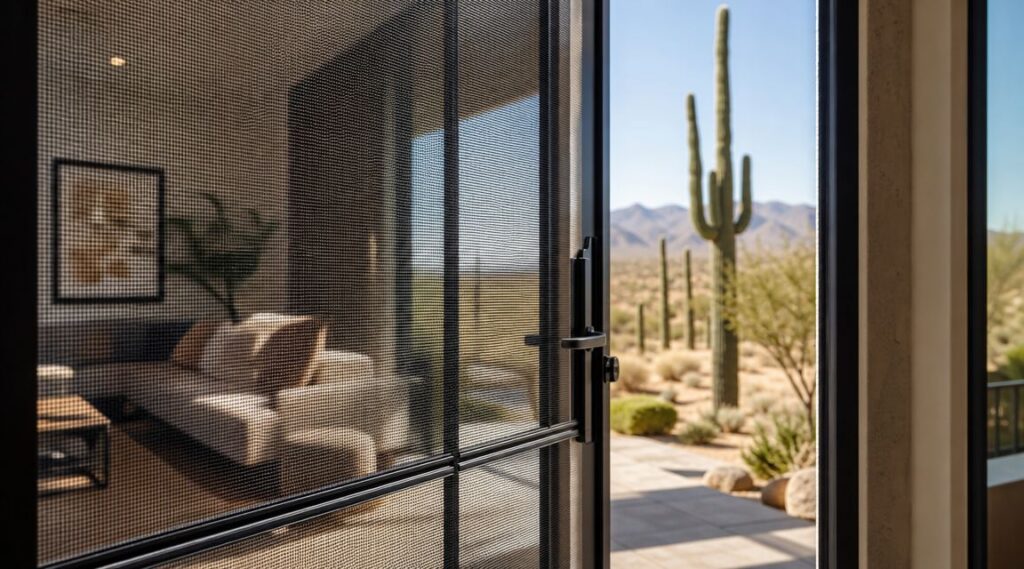
You open the door after sunset because the air finally feels decent. Within minutes, the breeze is nice, but so are the mosquitoes, drifting dust, and every flying insect that found the porch light before you did. That's the moment most Arizona homeowners start thinking seriously about bug door screens.
In a hot, sunny climate, a screen door isn't just a bug blocker. It's part ventilation tool, part comfort upgrade, and part maintenance item. The right one lets you use cooler morning and evening air. The wrong one turns into a dusty, faded, dragging panel that nobody wants to touch.
A lot of screen advice online skips the part that matters most in Arizona. Every screen is a trade-off. More airflow usually means less filtering. Darker solar mesh can cut glare, but it changes visibility. Stronger materials can last longer, but they don't all slide or retract the same way. If you're buying for a Phoenix-area home, those details matter more than the showroom pitch.
What Are Bug Door Screens
A bug door screen is a mesh barrier installed at a doorway so you can let in air and light while keeping out insects, birds, and airborne debris. That sounds simple, but the reason they've remained common for so long is practical. They solve a daily problem without much complexity. You get ventilation without opening the door to everything outside.
For most homes, bug door screens show up in one of three places: front entries, back patio doors, and side garage or service doors. Their job is straightforward. They create a breathable opening that still feels usable during bug season, dusty evenings, and shoulder months when you'd rather not run the AC nonstop.
Why they matter in Arizona
In dry, sunny areas, homeowners usually want a screen for one of two reasons:
- Better airflow during cooler hours so the house doesn't feel sealed up all day
- A usable doorway that doesn't invite in mosquitoes, flies, or drifting debris
That second point gets overlooked. A screen only works if the fit is tight, the mesh is intact, and the frame stays aligned. A torn corner or loose track defeats the whole purpose.
Practical rule: If light shows around the edges, bugs will find it before you do.
Bug door screens also fit into a broader outdoor-living setup. If you're comparing a single screened opening with a larger enclosure, this guide to what is a screened porch helps clarify when it makes sense to screen one door versus creating a bigger screened living area.
A proven home feature, not a new trend
Screens have been around far longer than commonly thought. Historical sources place the earliest true insect screens in America in the 1820s, and Gilbert and Bennett reportedly adapted wire cloth used for sieves into window screening by 1861 according to this history of early insect screens. That matters because it shows how established the idea is. Homeowners were solving this same comfort problem long before modern retractable systems and specialty mesh options existed.
What changed over time wasn't the basic need. It was the materials and the refinement. Older homes relied on cruder barriers. Modern bug door screens are lighter, more consistent, and easier to fit to everyday door openings.
What a good screen actually does
A good screen door should do four things at once:
| Function | What it means in real use |
|---|---|
| Block pests | Stops common flying insects from coming straight indoors |
| Allow ventilation | Lets you use natural airflow when outdoor conditions are favorable |
| Hold visibility | Preserves the view instead of making the doorway feel closed off |
| Stay serviceable | Can be cleaned, adjusted, or re-screened without replacing everything |
That last point is important in Arizona. Sun, wind, and grit wear on moving parts and mesh alike. A screen isn't a one-time purchase you forget forever. It's a working part of the opening.
Comparing Bug Screen Types and Materials
Not all bug door screens are built for the same doorway or the same household. The frame style affects how the screen behaves. The mesh material affects how it looks, wears, and performs. If you only compare price tags, you'll usually end up replacing the wrong screen sooner than you expected.
Screen door styles
The main door styles each solve a different problem.
Sliding screen doors make the most sense on patio sliders. They're familiar, simple to use, and easy to service when the frame is still in decent shape. The downside is that rollers and tracks collect dust fast, and cheap panels tend to wobble or jump the track.
Swinging screen doors work well at front or side entries where you want a traditional hinged opening. They're straightforward and durable when the frame is solid. The weak point is impact. If kids, pets, or guests push through them hard, the closer, latch, or frame can get out of alignment.
Retractable screen doors fit homes where you don't want to look at a permanent panel all year. They're useful for French doors and clean-looking entryways because the mesh disappears when not in use. But they're more sensitive to installation quality. If the housing, guides, or tension aren't set correctly, they can drift, wrinkle, or fail to seal well at the edges.

Mesh materials and what changes with each one
Screen mesh has evolved a long way from late-1800s metals like copper. Today, common materials include aluminum, fiberglass, nylon, and polyester, and some modern fiberglass screening is reported to provide over 75% UV protection in this overview of screen material history.
That sounds technical, but the homeowner decision usually comes down to a few practical choices.
| Material | Where it works well | What to watch for |
|---|---|---|
| Fiberglass | Standard residential doors, good visibility, flexible handling | Less resistant to abuse than heavier-duty specialty mesh |
| Aluminum | Durable everyday use, stronger feel, common on many fly screen doors | Can show bends or dents more readily if hit |
| Solar screen | Hot, sunny exposures where glare and sun load matter | Darker appearance changes outward and inward visibility |
| Pet-resistant screen | Homes with dogs or cats that press, claw, or jump at the mesh | Heavier mesh can feel less open than standard screen |
What works versus what doesn't
If your priority is a cleaner view and a common patio opening, fiberglass is often the easy answer. If your screen gets hit, leaned on, or pushed by pets, standard fiberglass usually doesn't stay pretty for long.
Aluminum holds up well in many situations, especially where you want a more durable insect screen and don't mind a slightly more rigid look. Solar screen is the right call when the opening gets hammered by sun. It changes the feel of the doorway, but that's often the point.
For a more detailed side-by-side material breakdown, this guide on fiberglass vs aluminum window screen is useful when you're narrowing down the mesh rather than the frame style.
A strong frame with the wrong mesh still disappoints. Most screen complaints start with a mismatch between household use and mesh choice.
The Unexpected Benefits for Arizona Homes
Shoppers often acquire bug door screens to keep insects out. That's valid, but it's only part of the value. In Arizona homes, a well-chosen screen can also help manage sunlight, reduce the amount of airborne junk that drifts inside, and make your doorway more comfortable to use during the parts of the day when outdoor air is pleasant.

Better airflow without leaving the opening exposed
The simple benefit is still the one homeowners use most. You can open the house during early mornings, evenings, or after a storm passes without turning the doorway into an open invitation. That changes how often people use their exterior doors for ventilation.
In practice, homes with functional screen doors tend to use natural airflow more often because the opening feels usable. A bare doorway doesn't.
Sun control matters more than many buyers expect
In hot climates, some bug screen products act as environmental controls, not just insect barriers. Some mesh fabrics offer a shade factor of about 65%, which helps reduce solar heat gain and heat buildup from direct sun while still allowing ventilation, as described in this article on bug screen doors in hot environments.
That matters on west-facing and south-facing openings where sunlight turns the threshold into a heat source. The mesh doesn't replace insulation or glass upgrades, but it can make the opening feel less harsh and cut some glare at the same time.
Less dust and a more usable doorway
Arizona homeowners also notice something less obvious. A screen changes what blows into the house. It won't stop fine dust entirely, but it can reduce the amount of larger debris, leaves, insects, and airborne particles that move straight through an open door.
That's why the “most open” screen isn't always the best choice. If the opening faces a dusty yard, a busy street, or afternoon wind, a little more filtering can make the door more usable day to day.
A helpful local read on that broader comfort issue is how updating your screens can help beat the Phoenix heat. The main point is simple. A screen isn't only about what it keeps out. It also changes whether you want the door open in the first place.
Small comfort gains add up
Here's where homeowners usually notice the difference:
- Morning routines feel easier because you can air out the kitchen or living room without dealing with flies
- Evening airflow becomes practical instead of something you avoid because bugs show up immediately
- Sun-heavy openings feel softer when a darker mesh cuts some direct glare
- Seasonal use improves because the door becomes part of comfort control, not just an access point
The best screen is the one you actually use. If a door sticks, rattles, or lets in too much sun, homeowners stop opening it.
A Practical Guide to Selecting Your Screen
Most bad screen purchases happen because the buyer focuses on one feature and ignores the opening as a system. They choose maximum airflow, then hate the bugs that still get through. Or they choose the toughest mesh available, then wonder why the doorway feels darker and less breezy.
The better approach is to match the screen to the opening, the exposure, and the way your household uses the door.
Start with the opening, not the brochure
Measure the doorway carefully and check it in more than one place. Openings aren't always perfectly square, especially on older patio doors and high-use service entries. If the width or height shifts across the frame, that affects how well the finished screen seals and moves.
Before choosing material, look at these conditions:
- Sun exposure. West-facing and south-facing doors take more punishment.
- Traffic level. A back patio door used all day needs different hardware than a front entry opened occasionally.
- Pet activity. Dogs pressing at the bottom of the mesh change the material choice immediately.
- Dust and wind. Openings near bare ground or high airflow need tighter fit and easier cleaning access.

Understand mesh count before you buy
The biggest technical trade-off in bug door screens is mesh openness versus particle exclusion. Common screen meshes such as 18×16 and 20×20 are designated by openings per square inch, and tighter mesh blocks smaller insects while also reducing ventilation and daylight transmission, as explained in this mesh size guide.
That's the part many homeowners never get told clearly.
| Mesh approach | What you gain | What you give up |
|---|---|---|
| More open mesh | Better airflow, brighter feel, less visual obstruction | Less effective against smaller pests and finer airborne material |
| Tighter mesh | Better exclusion of smaller insects and more filtering | Reduced breeze, reduced daylight, slightly more restrictive feel |
If your main goal is catching cooler evening air, going too tight can backfire. If tiny insects are the main complaint, very open mesh may not solve the problem well enough.
Match the screen to the problem
A simple way to decide is to rank your top priority.
Airflow first
Choose a more open standard insect screen if the opening is mainly for breeze and common flying insects are your issue.Smaller pest control first
Move toward a tighter mesh, knowing the opening will feel less open.Sun and glare first
Look at darker solar-oriented mesh on harsh exposures.Durability first
Choose a stronger mesh and sturdier frame setup for pets, kids, or heavy daily use.
What works well in Arizona homes
For many Phoenix-area homes, the sweet spot is balance. Homeowners usually want enough openness to feel the breeze, enough screening to stop the obvious pests, and enough durability that the door still works after a dusty season.
A few practical checks help before ordering:
- Run your hand along the frame edges. Rough or uneven surfaces can keep seals from sitting properly.
- Inspect the threshold and track. A perfect new screen won't glide well on a dirty or bent base.
- Think about cleaning access. If the mesh clogs with dust easily, make sure you can reach and wash it.
- Don't overspec the mesh for a low-use opening. A heavy-duty screen on a lightly used side door can be unnecessary.
One local option for this kind of work is Sparkle Tech Window Washing screen services, which include bug screens, sun screens, rescreening, and repair sliders. The value in any provider is simple: proper measuring, material matching, and a tight fit that doesn't leave gaps.
If you can't explain why you picked a certain mesh, you probably let the color or price decide for you.
Maintaining and Repairing Your Bug Screens
Most bug door screens don't fail all at once. They get gritty. The track gets rough. The mesh loosens a little. A corner starts to separate. Then the door drags, pops, or sags enough that nobody wants to use it. In Arizona, sun, wind, and airborne grit speed up that cycle.
Industry guidance on screen systems notes that exposure to UV, wind, and airborne grit affects longevity, while many sellers don't clearly address service intervals for tracks, rollers, and seals in this discussion of insect screen maintenance and lifecycle concerns. That lines up with what homeowners experience. The hardware often becomes the problem before the frame itself does.

What homeowners can handle
Routine maintenance is simple if you stay ahead of it.
- Brush or vacuum loose dust off the mesh gently so airflow doesn't get choked by buildup.
- Wipe tracks and thresholds before grit starts grinding rollers and corners.
- Check the spline and edge tension on framed screens if the mesh starts looking loose.
- Rinse carefully when the screen is dirty, then let it dry fully before closing up a retractable system.
If you want a basic walkthrough for common fixes, this guide on how to repair window screens covers the usual homeowner-level issues.
When it stops being a DIY job
Small tears and basic cleaning are manageable. Re-tensioning a retractable screen, dealing with bent frames, or re-screening a large panel without creating sagging is different. That's where many DIY repairs go sideways. The mesh ends up wavy, the frame goes out of square, or the screen never seals tightly again.
Watch for these signs:
| Problem | DIY or pro |
|---|---|
| Dusty mesh and dirty track | Usually DIY |
| Small isolated tear | DIY if the frame is still true |
| Screen dragging or jumping track | Often needs closer inspection |
| Loose, sagging mesh across a full panel | Better handled professionally |
| Retractable screen not closing straight | Professional adjustment is usually safer |
A similar principle applies across exterior maintenance. Homeowners can spot symptoms, but not every issue should be self-repaired. That's why guides like these expert tips for roof hail damage are useful. They help you know what to inspect, what to document, and when to bring in someone with the right tools.
After you've seen the common mistakes, this quick video gives a useful visual reference for the repair process:
The real lifecycle cost
The cheapest screen is rarely the cheapest screen to own. If the mesh tears early, the frame warps, or the rollers grind down because the track was never cleaned, you pay through repeated fixes and frustration. A better-built screen with regular maintenance usually costs less trouble over time, even if the upfront choice wasn't the lowest bid.
Why Trust Sparkle Tech for Your Screen Needs
Arizona is hard on exterior screens. Intense sun, windblown dust, daily use, and big temperature swings expose weak materials and sloppy installs fast. A screen that looks fine on day one can start showing problems much sooner if the frame isn't fitted correctly, the mesh wasn't matched to the opening, or the track was never prepared properly.
That's why professional screen work isn't just about replacing mesh. It's about getting the opening to function as a system. The frame has to sit right. The screen has to seal. The material has to suit the exposure. If any one of those is off, the homeowner ends up with the same complaints again.
What professional service changes
A qualified screen technician looks past the obvious tear or worn panel. They check whether the frame is square, whether the rollers still track properly, whether the threshold is contributing to drag, and whether the chosen mesh makes sense for the sun and traffic that opening gets.
That matters in a Phoenix-area home because durability problems are rarely random. Usually the failure points are predictable:
- High-UV exposure breaks down weaker screen materials faster
- Dust-heavy tracks wear moving parts and make doors feel rough
- Loose edge fit allows pests and debris through even when the mesh is intact
- Incorrect mesh choice leaves the homeowner unhappy with airflow, glare, or visibility
Why local qualifications matter
Homeowners should care about more than whether someone says they “do screens.” You want a company that works in Arizona conditions and handles homes with proper business protections in place.
Sparkle Tech Window Washing LLC is a family-owned Phoenix valley company that services Arizona. According to the company's published information, it carries Workers Compensation, General Liability Insurance, and Bonding, and is registered in Arizona for customer protection. For homeowners, that matters because it reduces risk when work is being done on and around exterior openings, glass, tracks, and screens.
A better long-term decision
Handyman-level screen work can look fine from the driveway. The difference shows up later. The panel starts rubbing. The retractable edge doesn't meet cleanly. The mesh loosens. Dust builds where the install never addressed the track.
A proper screen job should leave you with a door you'll use. It should open smoothly, seal well, and fit the way your household lives. That's the whole point. In Arizona, bug door screens aren't decorative extras. They're working components that need to hold up under heat, sun, and grit.
If you're replacing or repairing a screen, the smartest move is to treat it like a functional upgrade, not a quick patch. That usually means better measurement, better material selection, and better installation than a rushed DIY or bargain repair delivers.
If your screens are torn, dragging, sun-damaged, or just not doing the job anymore, Sparkle Tech Window Washing can help with bug screens, sun screens, rescreening, and screen repair throughout Arizona. Reach out if you want a practical assessment of what should be cleaned, repaired, or replaced so your doors work the way they should.