



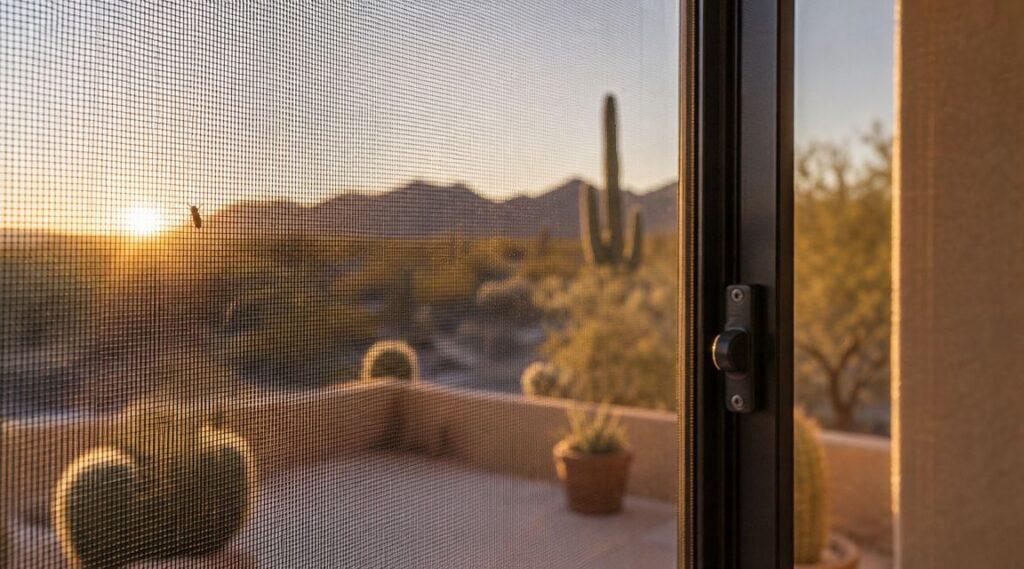
On a Phoenix evening, there's a short window when the air finally feels usable. You want the patio door open, the kitchen to breathe, and the house to lose that sealed-up feeling from a long hot day. What you don't want is mosquitoes, flying pests, dust, and a loose screen that rattles every time the air moves.
That's where bug door screens earn their place. A good one isn't just a mesh panel. It's a selective filter for the home. It lets the things you want in, like airflow and light, while keeping out the things that make an open door a mistake. In Arizona, that filter has to do more than stop bugs. It has to hold up under sun, heat, grit, and daily use.
Modern bug door screens didn't start as a luxury add-on. Their roots go back to the late 19th century, and 1887 is commonly cited as the milestone when Hannah Harger of Iowa is credited with inventing the modern screen door, according to this history of screen doors and window screens. That long history matters because screens were solving ventilation problems before air conditioning became standard.
Today, the choices are broader, and the trade-offs are more specific. Some screens give you better visibility. Some handle pets better. Some help with sun. Some are easy to live with for years. Others look fine on day one and become a maintenance problem in desert conditions. For Phoenix homeowners, that difference matters more than most generic buying guides admit.
Introduction
A bug door screen sounds simple until you live with the wrong one.
The wrong mesh cuts airflow more than you expected. The wrong frame loosens in the opening. The wrong installation leaves a small gap at one corner, and that's all insects need. In Phoenix, the wrong screen also becomes a dust collector fast, especially on doors that get opened often or face wind.
Think of it as a home filter
The easiest way to understand bug door screens is to stop thinking of them as just a barrier. Think of them the way you'd think about a good coffee filter. It should let the useful stuff pass through while keeping out what doesn't belong.
For a home, the useful stuff is airflow, outside light, and that feeling of connection to the yard or patio. The stuff you want blocked is insects, larger debris, and some of the irritation that comes with leaving a doorway open.
That filtering job is always a balancing act. A tighter screen can block smaller pests better, but it can also reduce airflow. A stronger screen can last longer, but it may look heavier from inside the house. A solar-oriented screen can make a west-facing opening more comfortable, but it changes the view and light level.
Practical rule: The best bug door screen isn't the strongest one or the most invisible one. It's the one that matches how you actually use the door.
Why Arizona changes the decision
In milder climates, homeowners can get away with picking by appearance alone. In Phoenix, the environment makes the decision more technical. UV exposure wears materials down. Dust builds up in mesh openings. Heat makes weak installations show their flaws sooner.
That's why local advice matters. A front entry that only opens occasionally has different needs than a patio slider you use every day. A shaded north-facing door can get by with one setup. A sun-beaten west-facing opening usually needs another.
The goal isn't to buy the fanciest option. It's to choose a screen you'll still want to use after a full season of heat, wind, and cleaning.
Understanding Bug Door Screen Fundamentals
A bug door screen only works when the whole assembly works together. In Phoenix, that matters more than many homeowners expect. Strong sun hardens cheap vinyl parts, dust settles into tracks and corners, and heat exposes small alignment problems fast. A screen can have good mesh and still perform poorly if the frame twists, the latch does not pull it in tight, or gaps open at the edges.

The three main door styles
Phoenix homes usually end up with one of three screen door setups: hinged, sliding, or retractable.
Hinged screen doors fit front entries, side doors, and older openings that were built for a second swinging door. They feel solid and are easy to understand at a glance. The trade-off is clearance. If the stoop is tight or the furniture layout crowds the doorway, a hinged screen can become annoying to use.
Sliding screen doors are the standard choice for patio openings. They save space and suit daily traffic well, especially where kids or pets move in and out all day. Their weak point in Arizona is the track. Fine dust and blown grit build up quickly, and once that happens the rollers wear faster and the door starts dragging.
Retractable screens appeal to homeowners who want airflow without looking at a fixed panel all year. They can be a good fit on view-oriented openings facing a yard, pool, or wash. They also ask more from the installation. If the side rails are even slightly out of plumb, the screen will show it in operation.
If you are planning a larger entry update, the door itself affects which screen options make sense. This guide to exterior doors for renovations is useful for seeing how the main door system and the screen should be chosen together.
Mesh choice affects daily comfort
Mesh controls four things homeowners notice right away: airflow, visibility, durability, and insect control. The common options include fiberglass, aluminum, polyester, bronze, and stainless steel, with tighter weaves available for smaller insects, as explained by Phantom Screens in its overview of screen mesh options.
That does not mean the tightest mesh is automatically the right pick. In practice, denser mesh cuts airflow and holds more dust. On a breezy spring day that may not matter much. In late summer, when you are trying to vent out heat in the evening, it can make the opening feel less useful.
For most homeowners, the smarter move is matching the mesh to the door's job. A lightly used front entry can prioritize appearance. A patio door that stays active every day usually benefits from a mesh and frame combination that is easier to clean and less fussy over time. If you want a closer look at the strengths and weaknesses of each option, this breakdown of window screen material types is a good reference.
What makes a screen effective in real use
Good performance comes from fit and operation as much as material. I see more failures from poor sizing, loose handles, worn rollers, and warped frames than from the mesh itself.
A bug door screen should:
- Close tightly so insects cannot bypass the mesh at the edges
- Move smoothly without scraping, jumping, or binding
- Hold tension so the mesh stays flat instead of sagging in the middle
- Match traffic level at that doorway, whether it is occasional use or constant in-and-out use
That foundation matters in Arizona. A screen that is only adequate in a mild climate often becomes frustrating after a season of UV, dust, and heavy use.
Comparing Screen Door Types and Materials
Choosing bug door screens for a Phoenix home usually comes down to a simple question. What matters most at this specific opening: airflow, durability, view, pet resistance, or sun control? You usually can't maximize all five at once, so the smart choice is the one that fits the door's job.

Picking the right door type
Here's how the main door styles stack up in real use:
| Screen type | Where it works well | Main advantage | Main drawback |
|---|---|---|---|
| Hinged | Front entries, side doors | Solid feel, simple operation | Needs swing space |
| Sliding | Patio doors, backyard access | Space-efficient, familiar | Tracks collect dust and grit |
| Retractable | View-focused openings, modern patios | Out of sight when closed | More dependent on precise installation |
If you already have a major door renovation planned, it helps to think about the whole entry system, not just the screen. Templeton Built has a useful guide to exterior doors for renovations that shows how door material and door style affect the screen options that make sense later.
Comparing common mesh materials
Material choice matters more in Arizona than many homeowners expect. Heat and UV don't treat all mesh the same, and neither do pets or heavy use.
Fiberglass is common because it's flexible and affordable. It works well for many standard patio doors, and it usually provides a comfortable balance of visibility and airflow. The downside is that it's not the toughest option if people, pets, or furniture regularly bump the door.
Aluminum feels crisper and more rigid. It tends to hold shape well and gives a more defined appearance in the frame. Some homeowners like the cleaner look, but aluminum can show dents or creases if it gets hit.
Pet-resistant mesh is worth considering in homes where dogs or cats push against the screen. It's built for abuse, not elegance. You usually give up some openness in the view for extra toughness, which is often a fair trade on a frequently used patio slider.
Solar screen mesh deserves more attention in Phoenix. Homeowners often think of bug screens and sun control as separate categories, but at some doors they overlap in a useful way. If the opening gets hard afternoon exposure, a screen that reduces glare and heat can make the room more usable.
For homeowners comparing options in more detail, Sparkle Tech has a practical breakdown of window screen material types that helps clarify how different meshes behave in daily use.
What works in Phoenix and what usually doesn't
Some combinations make more sense in desert conditions.
- For a busy patio door: Sliding or retractable systems usually fit the way people move in and out. The wrong choice is often a light frame with mesh that can't handle repeated contact.
- For a sun-heavy opening: Solar-oriented mesh is often worth serious consideration. Standard insect mesh may solve the bug problem while doing nothing for glare or heat.
- For pet households: Standard mesh often becomes a repeat repair item. Pet-resistant mesh is rarely the prettiest choice, but it can be the one that lasts.
- For view-focused rooms: High-visibility materials matter. If the screen makes the opening feel closed off, homeowners stop using it.
The mistake I see most often is choosing by showroom impression. In Phoenix, the better test is this: will the screen still operate well, look decent, and feel worth opening after months of dust, sun, and regular traffic?
The Surprising Benefits of Modern Screens
At a Phoenix patio door, a screen often has to solve three problems at once. It needs to block insects, hold up under hard sun, and stay usable after dust starts settling into the frame and mesh. That is why newer screen options can make a bigger difference than homeowners expect.

Comfort goes beyond bug control
Good screens help a door earn its keep. On cooler mornings, evenings, and parts of the year when outside air is pleasant, a well-chosen screen lets you use that opening more often without inviting in every flying insect in the neighborhood.
In Phoenix, sun exposure changes the equation. Some modern meshes are built to cut glare and reduce some solar load while still allowing airflow. Phifer notes that its SunTex solar screen fabric is designed to absorb and dissipate heat while allowing outward visibility and air circulation, which is the kind of dual-purpose performance that matters on west-facing and south-facing doors in Arizona homes: Phifer SunTex solar screen fabric.
That benefit comes with trade-offs. Meshes that block more sun usually darken the view a bit and can reduce airflow compared with a lighter insect screen. For some doors, that trade is worth it. For others, especially shaded openings where view matters most, a lighter high-visibility mesh is the better fit.
Better visibility changes how the room feels
Homeowners notice this after installation, not usually during shopping.
A heavy-looking screen can make a bright doorway feel muted. A cleaner, more open-looking mesh keeps the visual connection to the patio, yard, or pool area. People are more likely to leave the door in regular use when the screen does not make the room feel boxed in.
I tell Phoenix homeowners to judge a screen by daily livability, not just by the sample in hand. If the mesh looks acceptable in a showroom but feels too dark at home during late afternoon light, you will notice that every day.
A good screen should fade into the background. You should notice the airflow and the view before you notice the mesh.
Modern screens reward realistic upkeep
The better the screen matches the opening, the more likely you are to keep using it. The maintenance side matters too, especially here, where dust buildup is not occasional. It is routine.
Before ordering, it helps to review how to measure window screen size accurately so the screen is matched to the opening from the start. Even a quality product feels disappointing if it binds, rattles, or leaves small gaps.
For ongoing care, keep the routine simple:
- Brush or rinse off dust before it cakes into the mesh
- Wipe tracks and frame edges so grit does not wear down operation
- Look at corners, spline, and attachment points after windy weeks
- Check the latch and slide path on frequently used patio doors
A screen door should be added to your regular home care routine, right alongside filters, seals, and exterior checks. A broader seasonal plan like this ultimate annual home maintenance checklist helps homeowners stay ahead of the small issues that turn into replacements.
Modern screens improve comfort, airflow, and everyday use of a door. In Arizona, they do that best when the material fits the sun exposure, the frame is built for dust and traffic, and the homeowner is realistic about maintenance.
Proper Sizing and Essential Maintenance Tips
Most bug door screen problems start with one of two things. The screen was sized incorrectly, or it stopped getting attention after installation. In Arizona, both show up fast because dust exposes weak operation and intense sun punishes cheap materials.

Why close enough is not good enough
A bug screen has to fit snugly. Even small gaps reduce effectiveness. That's not theory. It's basic real-world performance, and it's highlighted in this commercial bug screen reference, which also notes that some micro-fine stainless steel meshes offer 50% more clarity than standard aluminum screens.
The fit issue is where DIY screen projects often go sideways. A door opening may look square and still be slightly off. Tracks may be worn. Frames may be just out enough that the screen seems fine until dusk, when insects start finding the corners.
A better way to measure
If you're measuring before replacement, don't rely on a single width and height.
Use this approach:
- Measure width at the top, middle, and bottom
- Measure height at the left, center, and right
- Check whether the opening is square by comparing the frame visually and watching for uneven gaps
- Inspect the threshold or track because the best mesh won't fix a bad base
If you want a more detailed walkthrough before ordering or scheduling service, this step-by-step guide on how to measure window screen size is useful for understanding how precise measurements prevent fit problems.
Field note: If one corner looks slightly off now, it usually looks much worse after the new screen is under tension.
Maintenance in a dusty climate
Phoenix maintenance is less about deep cleaning and more about staying ahead of buildup. A neglected screen doesn't fail all at once. It gets harder to slide, dirtier to look through, and less pleasant to use.
A practical routine looks like this:
- Remove loose dust first. Use a soft brush or gentle rinse before wiping. Grinding dust into the mesh shortens its life.
- Clean the frame separately. Dust gathers in frame channels and corners, not just on the mesh.
- Watch moving hardware. Sliding and retractable units need clean contact points to operate smoothly.
- Repair small damage early. Tiny tears often spread because the mesh stays under tension.
For homeowners who like bundling seasonal upkeep, a broader ultimate annual home maintenance checklist can help you work screen inspection into the rest of your home routine.
When to patch and when to replace
Not every flaw means full replacement. A tiny, isolated puncture in otherwise healthy mesh may be repairable. That's especially true if the frame is square and the screen still moves correctly.
Replacement becomes the better choice when:
- The mesh is brittle from sun exposure
- The frame no longer sits flush
- The screen repeatedly slips, drags, or pops out
- There are multiple tears or stretched areas
- Dust and wear have turned cleaning into a constant fight
Professional service ensures accurate sizing, proper tension, and the right material choice, which prevent repeat repairs. In Arizona, that usually matters more than squeezing one more season out of a screen that already isn't doing its job well.
Why Professional Installation Matters in Arizona
Arizona is hard on bug door screens. Heat, UV, and dust don't just age the mesh. They expose poor fit, weak hardware choices, and sloppy installation details. That's why the question often isn't just which product to buy. It's whether the screen system is worth installing at all for that opening and that household.
A good professional helps sort out those trade-offs. NanaWall puts it plainly in its discussion of insect screens for hot climates: in places like Arizona, the issue is not just which screen to choose, but whether the screen meaningfully improves ventilation without creating too much airflow reduction and maintenance burden, especially with heavy dust, as explained in this guide to insect screen trade-offs.
Quick answers homeowners usually want
Is DIY installation always a mistake?
No. But if the opening is out of square, heavily used, exposed to strong afternoon sun, or part of a retractable setup, DIY errors show up quickly.
What usually goes wrong with DIY work?
Gaps at edges, poor tension, rough sliding action, and material choices that looked fine online but don't suit the opening.
Why hire a local company instead of ordering a generic replacement?
Because desert conditions change what lasts. Local installers see the same failure patterns over and over and can recommend mesh and frame options based on actual Arizona use.
Does it help to compare installers in different markets?
Yes, especially to understand how climate changes the recommendation. For example, this overview of door replacement options in Winnipeg reflects concerns that are very different from Phoenix, which is exactly why local judgment matters.
If you need repair, rescreening, or full replacement, Sparkle Tech offers window screen repair and replacement as one practical option for Arizona homeowners who want the screen fitted correctly and built for local conditions. Since the company is family owned, bonded, insured, and serves the Phoenix valley and beyond, the value is straightforward: fewer guesswork decisions, cleaner installation, and a better chance the screen still performs after real desert use.
If your patio door, front entry, or side door screen is torn, loose, hard to slide, or unsuitable for the way you use your home, Sparkle Tech Window Washing can help you sort out the right bug door screen for Arizona conditions. Whether you need rescreening, a new sun and bug screen, or a full replacement, the goal is simple: a clean fit, smooth operation, and a screen you'll want to use.