

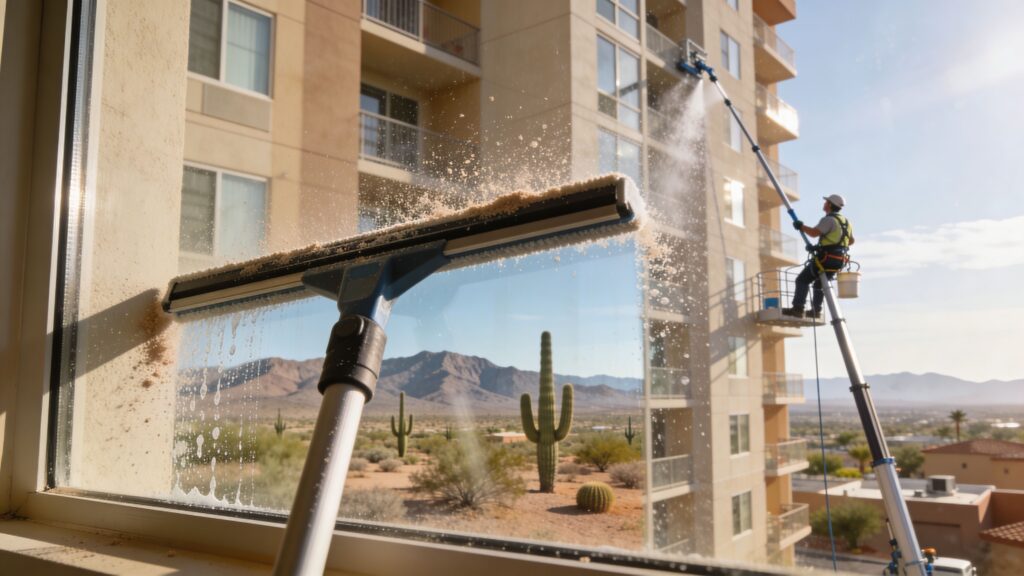
The sun is up, the view should be sharp, and instead your apartment windows look like they’re wearing a film of desert dust. In Phoenix, that happens fast. A clean pane can go dull after a windy week, a dusty parking lot, or one hard-water sprinkler hit near the first floor.
Renters notice it from the couch. Property managers notice it from the curb. Pros notice it in the glass itself, because dirt, mineral spotting, and baked-on grime don’t just block light. Left alone, they become harder to remove and more likely to leave lasting marks. That’s one reason apartment window cleaning has become such a steady part of building maintenance. The U.S. window washing industry is projected to reach $2.9 billion in 2024, and industry standards recommend professional cleaning for apartment buildings at least twice per year to control grime and pollution that can damage glass, especially in dusty places like Phoenix (IBISWorld window washing industry data).
If you’re a renter getting ready to move, window condition often gets lumped into the final cleaning scramble along with baseboards, appliances, and patching wall scuffs. A practical move-out cleaning checklist can help you separate what you can handle yourself from what needs approval or a pro visit.
For Phoenix renters and managers who want local help, window cleaning in Phoenix usually comes down to three questions. Can you legally access the glass, can you do it safely, and is a DIY result good enough for the property standard?
Your Guide to Crystal-Clear Apartment Views
Apartment window cleaning sounds simple until apartment living gets involved. The window may be yours to look through, but the exterior side often isn’t yours to access however you want. That’s where people get tripped up.
A renter on a ground-floor patio has one set of options. A tenant on the fourth floor with sliding windows and a strict lease has a completely different reality. A property manager dealing with dozens of units, tenant turnover, dust storms, and curb appeal has another set of decisions altogether.
What Phoenix changes
Phoenix is tough on glass. Dust settles quickly, monsoon season can paste grime onto windows, and mineral-rich water can leave marks that don’t wipe off with a paper towel. On apartment properties, that means window care isn’t just cosmetic. It’s part of how a place presents, leases, and holds up over time.
Practical rule: If dirt has been sitting through multiple seasons, expect more than a quick spray-and-wipe fix.
Who this is for
This guide is for two people most generic articles ignore:
- Renters who want cleaner windows but don’t want to violate a lease or take a bad fall trying.
- Property managers who need standards that make sense across garden-style, mid-rise, and premium buildings.
You don’t need a complicated system. You need to know which windows are fair DIY territory, which ones aren’t, what a professional service includes, and how to budget for the work without wasting money on the wrong approach.
The Two Paths to Clean Apartment Windows
Most apartment window cleaning decisions come down to two paths. You either clean what you can reach and are allowed to access, or you hire a company equipped to handle the exterior safely and compliantly.
Neither path is automatically right for everyone. The mistake is assuming apartment windows work like single-family house windows.

When DIY makes sense
DIY works best when the job is small, legal, and fully reachable from a safe position inside the apartment or from stable ground on a private patio. That usually means interior glass, screens you can remove from indoors, and exterior panes at ground level where the building rules allow tenant access.
Good DIY candidates often include:
- Interior-only cleaning: Living room sliders, bedroom windows, and balcony doors where all work happens from inside.
- Ground-floor accessible glass: Patio doors and exterior windows you can reach without climbing or leaning.
- Touch-up cleaning: Fingerprints, pet nose marks, kitchen film, and dust that builds up between scheduled professional cleanings.
When professional service is the real option
Apartment buildings add rules that generic DIY articles usually skip. Many leases and HOA rules prohibit residents from accessing exterior windows, and that creates liability issues. In multi-story buildings, professional service is often the only compliant and safe option (guidance on unreachable exterior apartment windows).
That matters more than people think. Even if a tenant owns a squeegee, they may still not have permission to use a ladder on a balcony, remove certain screens, or lean out to reach the exterior pane. Property managers know why those rules exist. One bad slip, one dropped tool, or one damaged screen frame becomes a building problem.
Side-by-side trade-offs
| Path | Works well for | Main upside | Main limitation |
|---|---|---|---|
| DIY | Interior glass and safe, reachable exterior panes | Lower direct out-of-pocket cost | Your time, your risk, your lease responsibility |
| Professional | Multi-story exteriors, difficult access, full-property service | Better access, better finish, less tenant risk | Higher upfront cost |
| Hybrid | Tenants do interiors, management schedules exteriors | Balanced cost and appearance | Needs clear coordination |
The cleanest plan is often mixed. Renters handle inside glass. Property management handles the outside on a schedule.
A quick decision test
Before you buy supplies, ask four questions:
- Can I reach the window without leaning, climbing, or stretching from a risky position?
- Does my lease or HOA allow me to clean the exterior side?
- Will I be able to remove and reinstall the screen without damaging it?
- If I make a mistake, who pays for the glass, frame, screen, or any injury?
If any answer is unclear, slow down. In apartment window cleaning, uncertainty usually means the job shouldn’t be DIY.
Your DIY Window Cleaning Toolkit and Method
If your windows are reachable, allowed under your lease, and safe to clean from inside or from the ground, DIY can work well. The key is to keep the process simple and to stop before the job becomes a ladder project.

The basic kit that actually helps
You don’t need a garage full of gear. A solid starter setup usually includes:
- A real squeegee: A basic handheld squeegee gives a cleaner finish than paper towels and glass wipes.
- Microfiber towels: Use one for detailing edges and one dry towel for frames and sills.
- Bucket with mild soapy water: Keep it light. Too much soap leaves residue.
- A scrubber or microfiber applicator: This loosens dirt before you pull water off with the squeegee.
- A soft brush or vacuum attachment: Good for tracks, corners, and dry debris before water touches anything.
- A screen-safe cloth or soft brush: Screens tear more easily than people expect.
If your unit has insect screening, it helps to know what style you’re removing and replacing. This guide to different types of fly screens for windows is useful for identifying common screen setups before you pry on a frame that doesn’t want to move.
For renters comparing hand tools before they start, a short list of best window cleaning tools can help you avoid the usual low-quality squeegees and lint-heavy cloths.
The method pros use in small spaces
DIY window cleaning goes better when you work dry first, wet second.
- Clear the area first. Move furniture, plants, and blinds out of the splash zone.
- Dust the frame and track. If you skip this, dirt turns into muddy paste the second water hits it.
- Apply your cleaning solution with a scrubber. Don’t flood the glass. Wet it evenly.
- Pull the squeegee across the glass. Start at the top and overlap each pass.
- Detail the edges. Use a dry microfiber towel around the perimeter and bottom edge.
- Finish the sill and track. That’s where drips collect and where a job still looks unfinished if you stop early.
The squeegee technique that works
Wiping instead of extracting often leads to difficulties. The squeegee should remove the dirty water, not just push it around.
A simple approach:
- Start at the top edge so dirty water moves downward.
- Use light, even pressure instead of pressing hard.
- Overlap each pass so you don’t leave narrow wet lines.
- Wipe the blade often with a clean cloth.
Clean the rubber blade more often than you think. One speck of grit can drag a line across the whole pane.
Here’s a visual walkthrough of the basic motion and setup:
What not to do
Here, apartment window cleaning shifts from practical to dangerous.
- Don’t lean out of a window to reach the exterior corner.
- Don’t stand on balcony railings, patio furniture, or stacked stools.
- Don’t use ladders on uneven patio pavers or small balconies.
- Don’t remove screens forcefully if you’re not sure how they’re retained.
- Don’t use abrasive pads or razor blades unless you know the glass condition and coating situation.
Realistic DIY expectations
DIY is best for interiors, routine touch-ups, and limited ground-floor exteriors. It’s not the right answer for oxidized frames, hard water buildup that’s been baking for months, or upper-floor exterior panes.
If the glass still looks cloudy after careful cleaning, that doesn’t always mean you did it wrong. Sometimes the issue is mineral staining, screen shadowing, or exterior contamination you can’t reach safely from where you stand.
What a Professional Service Includes
A solid apartment window cleaning service should leave the whole window looking cared for, not just the center of the glass. In Phoenix, that matters more than people expect. Dust storms load up screens and tracks fast, hard water can leave spotting, and many renters are only allowed to handle the inside glass under their lease or HOA rules.

What gets cleaned besides the glass
A proper visit usually covers the parts that make a window still look dirty after a quick wipe-down:
- Glass surfaces: Interior, exterior, or both, depending on access and building rules.
- Frames and sills: Fine dust and runoff collect here and show up right away in Arizona light.
- Tracks: Sliding window and door tracks often hold the heaviest buildup.
- Screens: Cleaned separately so loose dust does not blow back onto the glass.
That fuller scope is what renters notice when they step back and look at the window as a whole.
Why pros use different equipment
The method should match the building. Ground-floor patio doors often clean up best with a scrubber and squeegee. Mid-rise exterior glass is often better handled with pure-water systems and water-fed poles, as explained in this pure-water and water-fed pole overview.
In Phoenix, water quality affects the result. Tap water can dry with mineral spots, especially on hot glass. Purified water helps avoid that. It also lets crews clean many upper exterior panes from the ground instead of setting ladders around walkways, balconies, parked cars, and irrigation lines.
That is not just an efficiency issue. It is a liability issue for property managers.
What a good crew checks before starting
In apartment work, access rules matter almost as much as technique. A good company confirms who is responsible for interior access, whether balcony gates need to be opened, how screens are removed without damage, and whether the lease, HOA, or building policy limits what can be cleaned from outside.
For renters, that avoids a common problem. Someone hires help for exterior panes, then learns the building does not allow certain access methods or requires management approval first. For managers, clear planning prevents missed units, complaints, and damage claims tied to screen tabs, wet entryways, or restricted areas.
What works well, and what usually disappoints
| Situation | Usually works well | Usually works poorly |
|---|---|---|
| Ground-floor patio glass | Hand cleaning with scrubber and squeegee | Quick spray-and-wipe shortcuts |
| Mid-level exterior windows | Water-fed pole systems | Repeated ladder repositioning |
| Dusty screens and tracks | Separate cleaning and detailing | Glass-only service |
| Common-area glass with steady traffic | Scheduled maintenance visits | Waiting for complaints |
Clean glass still looks neglected when the tracks are packed with grit and the screens are coated in dust.
A good service visit should feel organized
The best crews are clear about scope. They explain what is included, what is excluded, who provides access, and what happens if a screen is brittle, a track is damaged, or an exterior pane cannot be reached within building rules.
That kind of clarity saves time for everyone. Renters know what they are paying for. Property managers get consistent results across units, fewer surprises on service day, and a cleaner record if safety or access questions come up later.
Budgeting for Apartment Window Cleaning
Apartment window cleaning costs make more sense when you separate one-time cleanup from maintenance. A unit that hasn’t been touched in a long time usually needs more work than a unit on a regular schedule, and the same is true at the property level.

The starting range most people ask about
For a small apartment or home, professional window cleaning typically ranges from $150 to $300. Industry guidance for multi-family properties recommends biannual service, while urban or high-end apartments in places like Phoenix may need quarterly cleaning to stay ahead of dust and pollution and reduce long-term glass damage (apartment window cleaning frequency and cost guidance).
That range is a useful starting point, not a universal quote. Apartment jobs vary a lot based on layout and access.
What changes the price
A renter usually pays based on the unit itself. A property manager usually budgets based on building conditions and service scope across multiple units.
Common cost drivers include:
- Number of windows and sliders: More glass means more labor.
- Interior only or inside and outside: Exterior access changes the job.
- Screen and track cleaning: These add time, especially if they’re heavily soiled.
- Accessibility: Ground-level patio doors are simpler than awkward upper-story panes.
- Condition of the glass: Light dust is different from baked-on mineral spotting or neglected grime.
A better way for managers to think about value
Property managers often get stuck comparing line-item price without considering what irregular cleaning creates elsewhere. Dirty windows affect first impressions on tours, move-in readiness, and how well a property photographs. They also lead to tougher cleanup later.
A workable budgeting approach often looks like this:
| Property type | Practical cadence | Budget mindset |
|---|---|---|
| Garden-style or standard multi-family | Biannual | Treat as routine exterior maintenance |
| Luxury or high-visibility properties | Quarterly | Protect appearance and leasing presentation |
| Turnover-heavy units | As needed plus scheduled common-area work | Combine curb appeal with unit prep |
If a property is already fighting dust, postponing service usually doesn’t save money. It just shifts the work into a heavier cleanup later.
Why insured and bonded matters
This is where cheap pricing can get expensive. Apartment window cleaning involves glass, screens, tenant property, common-area access, and sometimes work above walkways or parking. If something is scratched, dropped, bent, or broken, you want clear responsibility.
For renters, that means asking whether the company is insured before someone starts handling windows attached to a leased unit. For managers, it means verifying coverage and scope before approving vendor access on site.
For renters deciding whether it’s worth paying
If your issue is one interior slider and a bedroom window, DIY may be enough. If your unit has multiple large panes, dusty screens, and exterior glass you can’t safely reach, professional service starts to look less like a luxury and more like the efficient option.
The same logic applies to move-outs. A professional cleaning bill can be easier to justify when the alternative is spending a full day fighting tracks, screens, and exterior film with household supplies that weren’t built for the job.
Navigating Safety and Building Access Rules
When apartment window cleaning moves beyond the first floor, safety stops being a preference issue. It becomes a compliance issue.
A lot of renters assume they only need permission. Property managers sometimes assume a general maintenance person can handle it. On low, easy-access glass, maybe. On taller buildings, that assumption creates risk fast.
What changes on taller buildings
For buildings over 6 stories, OSHA requires Rope Descent Systems, and those systems rely on roof anchors certified to hold 5,000 lbs. Building owners are responsible for annual anchor inspections, and compliant systems reduce injury risk by 85% (OSHA-related high-rise anchor and RDS guidance).
That tells you something important. High-rise window cleaning isn’t just “a harder version” of standard cleaning. It’s specialized access work with equipment, inspections, and responsibilities tied to the building itself.
What renters should do before touching the exterior
If you live in an apartment, condo, or managed community, check these before doing anything outside the glass:
- Read the lease or community rules: Exterior access may be restricted outright.
- Ask management in writing: That avoids confusion later if a screen gets damaged or a neighbor complains.
- Confirm who owns the responsibility: In many communities, exterior window care belongs to management or the HOA.
- Skip improvised access methods: A balcony chair, extension pole, or step stool doesn’t change the liability.
What property managers should verify
Managers don’t need to become rope-access experts, but they do need to know what to ask.
A short checklist helps:
- Does the building height require specialized access?
- Are roof anchors inspected and documented where applicable?
- Is the contractor insured for the work being performed?
- What areas of access need tenant notice or scheduling coordination?
- How will the crew protect walkways, landscaping, and resident property?
For lower buildings, outside glass may still be better handled by trained technicians using safer access methods. For common problem situations on taller homes and similar setups, practical guidance on how to clean second story windows helps show why even “not that high” can still be a bad DIY bet.
The moment a job requires leaning, climbing, hanging, or reaching from a compromised position, it’s no longer a cleaning question. It’s a safety question.
The rule that saves the most trouble
If there’s any doubt about access rights or safe positioning, stop and ask before the work starts. That protects renters from lease trouble and managers from preventable liability.
In apartment window cleaning, the safest decision is often the cheapest one in the long run. Not because the service invoice is lower, but because the avoidable mistake never happens.
Phoenix Apartment Window Cleaning FAQs
A Phoenix apartment window can look fine at noon and filthy by 7 a.m. The low sun catches every dust streak, screen stain, and hard water spot. That’s usually when renters start scrubbing with paper towels, or managers start hearing that a unit “still feels dirty” after turn prep.
How often should apartment windows be cleaned in Phoenix
Twice a year works for many apartment properties. It is a solid baseline for buildings that do not sit right on a busy road or open desert edge.
Some properties need more attention. Dust storms, nearby construction, pool splash, irrigation overspray, and heavy traffic all dirty glass faster in Phoenix. Managers also need to factor in leasing standards. A luxury property, model unit, or high-turnover building usually benefits from a tighter schedule than a small garden-style complex with lower visibility.
For renters, the simplest test is what the glass looks like in direct morning light. If the view looks dull, the screens look chalky, or the lower corners show spotting, it is time.
What’s the best time of year to schedule service
Late spring and late fall are usually the easiest scheduling windows. Those seasons help reset the glass after heavier dust periods and before the next round of summer buildup.
Operational timing matters too. Many managers get better value by pairing window cleaning with unit turns, seasonal maintenance, or pre-leasing prep. Renters should also check lease language before booking interior or exterior service, especially in condos or HOA-controlled communities where access rules can be stricter than expected.
Why do my windows still look dirty after I wipe them
Usually, the glass is only part of the problem.
Four trouble spots show up all the time:
- Dust-loaded screens: Phoenix screens hold a lot of fine dust. Sunlight pushes that haze right back into view.
- Dirty tracks and sills: Loose dirt in the frame area gets picked up again the next time the window moves.
- Exterior grime left in place: Cleaning the inside pane does nothing for dust, rain residue, or baked-on film outside.
- Mineral spotting: Hard water residue does not wipe off like normal dust. It often needs a different process.
I see this a lot after monsoon season. Someone cleans the inside carefully, but the screen and exterior glass are still carrying the visual problem.
Are hard water spots a big issue in Phoenix apartments
Yes, especially on lower-level units near sprinklers, pool decks, or planters with misting and irrigation. Phoenix water and heat are a rough combination for glass. Once mineral deposits bake in, a basic spray bottle and towel usually will not remove them fully.
Prevention matters more than cleanup. Keep irrigation off the windows if possible. Report overspray to management early. If spots sit for months, removal gets harder and the result can be less predictable.
Can tenants clean exterior apartment windows themselves
Sometimes, but permission comes first.
A renter should check the lease, property rules, and any HOA restrictions before doing exterior window work. Some communities do not allow residents to lean out, use ladders on balconies, or perform visible exterior maintenance at all. Even if a window looks reachable, the rule may still be no.
Ground-floor glass is usually the only reasonable DIY case, and only when it can be reached from a stable position. Upper-floor windows, fixed panes, and anything that requires stretching past the frame should be left alone. At that point, the cleaning question turns into a liability question for both the resident and the property.
What should property managers ask before hiring a service
Start with scope and access, then move to logistics.
- What is included? Glass only, or screens, tracks, and sills too?
- How will the crew access this specific building type?
- Is the company insured for apartment and multi-unit work?
- Will tenant notice or unit entry coordination be required?
- Are there HOA, condo association, or site-specific rules that affect scheduling or exterior access?
- How should the service frequency change for this location and exposure?
Those questions prevent a lot of friction. They also help managers compare bids that may look similar on price but cover very different work.
Do screens matter that much
Yes.
In Phoenix, a dusty screen can make clean glass look dirty. It also cuts down the crisp look renters expect when they open blinds or photograph a unit for a listing. If the apartment still feels dim after the glass was cleaned, the screens are often the reason.
Is apartment window cleaning worth it before a move-out or new lease-up
Usually, yes. Clean windows help a unit show better, photograph better, and feel brighter right away. That matters during tours, turnover walks, and final resident touch-ups.
For renters, it can also help avoid leaving behind obvious grime in tracks, sills, and glass that catches light immediately. For managers, it is one of the simpler ways to improve how a vacant unit presents without starting a larger make-ready project.
If you need help sorting out what is safe to DIY and what should be handled professionally, Sparkle Tech Window Washing is a practical local option for Phoenix renters and property managers. They handle apartment-relevant window cleaning work in Arizona and can help you figure out the right approach for your building, access limits, and cleaning schedule.