



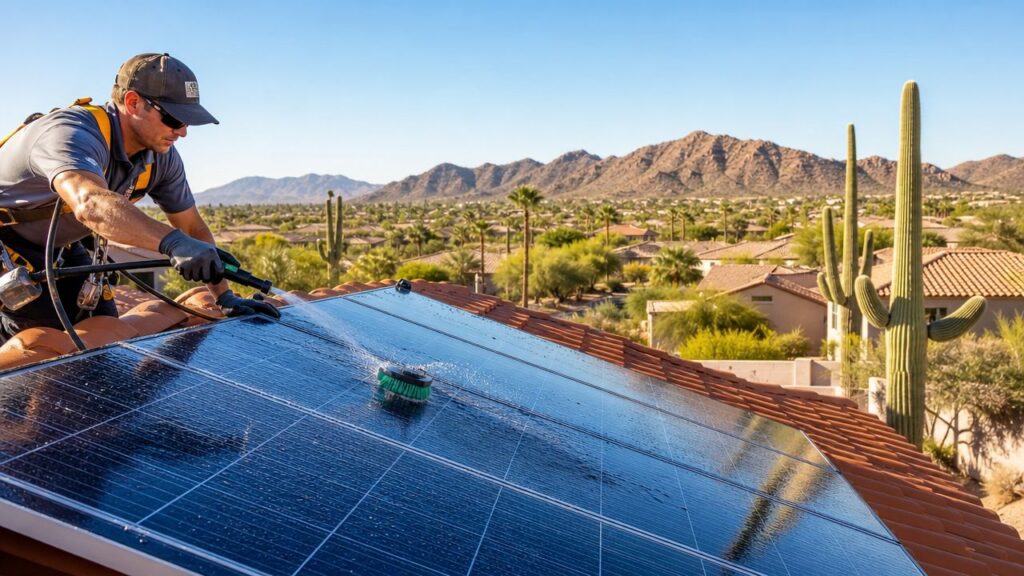
You're probably looking at your roof right now after a windy Phoenix week and seeing a dull film on your panels. Not mud. Not obvious debris. Just that familiar desert dust that gets on everything. The question isn't whether the panels are dirty. The question is whether cleaning them will pay off.
That's where most advice falls apart. Generic articles tell you to clean solar panels “once or twice a year” and move on. That might be fine in a milder, wetter place. It's weak advice for the Valley, where haboobs, construction dust, pollen, freeway grime, and long dry stretches all change the math.
I'll give you the straight answer. Solar panel cleaning frequency in Phoenix should be based on economics, not appearances alone. Some homes can wait. Many can't. If you're in a dusty corridor, near active building, near agriculture, or you just got hit by monsoon dust, waiting too long costs real production.
If you want a broader view of lowering utility costs in a very different climate, this breakdown of expert advice for Florida homeowners is useful because it shows how local weather changes energy strategy. For Phoenix-specific upkeep, this guide on how to improve solar panel efficiency is a practical companion.
Why Your Solar Panel Cleaning Frequency Matters
A Phoenix homeowner can go from clean panels to a measurable dust layer in one bad week. A haboob rolls through, monsoon winds kick up loose soil, nearby construction starts moving dirt, and your system keeps running while production slips. If you wait for rain to fix it, you can wait a long time in the Valley.
Cleaning frequency matters because solar panels make money only when sunlight gets through the glass efficiently. In Phoenix, dust is not just an eyesore. It directly affects output, and the local pattern is harsher than the generic national advice assumes. If you want the broader maintenance side of improving solar panel efficiency in Phoenix, start there. For this decision, focus on return.
The question is simple. Will a cleaning recover enough power to justify the cost?
That answer changes fast by neighborhood. A home near open desert in Buckeye deals with different soiling than a roof near freeway traffic in central Phoenix or a house near active development in Queen Creek. Canal corridors, pollen-heavy landscaping, bird activity, and long dry stretches all change how quickly loss builds up. Phoenix homeowners who use a fixed calendar and ignore those conditions usually either overpay for cleanings or leave production on the table.
Use this practical framework:
- Low-soiling property with decent roof pitch, limited nearby dust, and stable production. Clean based on performance trends, not because the panels look dull.
- Typical Phoenix suburban home with seasonal dust, dry weather, and occasional storm buildup. Put the system on a recurring schedule and adjust after major wind events.
- High-soiling property near construction, agriculture, busy roads, desert edges, or frequent bird mess. Clean more often because the recovered output usually justifies it.
This is the part generic blogs miss. In Phoenix, cleaning frequency is a local maintenance decision tied to weather, location, and power recovery. It is not a copy-paste national recommendation.
If you want a contrast in how local climate changes home energy strategy, this breakdown of expert advice for Florida homeowners is useful. Florida and Phoenix have completely different soiling patterns, which is exactly why local guidance matters. For Valley homeowners, the smart move is to decide based on site conditions first, then choose whether the job makes sense as DIY work or whether a local pro such as Sparkle Tech should handle it.
The Baseline for Solar Panel Cleaning Schedules
Most baseline advice says to clean solar panels every six months. That's not crazy. It's just incomplete.
In some places, biannual cleaning is enough because the climate does part of the work. A study by engineers at the University of California, San Diego found that solar panels left uncleaned for 145 days during a summer drought in California lost only 7.4% of overall efficiency, with an average daily efficiency loss of about 0.05%, as reported by UC San Diego.

That finding matters because it kills the lazy assumption that every dirty-looking panel needs immediate washing. It doesn't. In many residential settings, the return from frequent cleaning is limited. The same UC San Diego report also noted a small financial gain from mid-drought washing on a typical residential system and advised against routine washing for most homeowners unless they're in exceptionally dusty locations.
Why Phoenix is not a normal baseline
Phoenix is one of those exceptionally dusty locations in practical terms. Not the Sahara, obviously. But dusty enough that standard national advice often undershoots what local roofs need.
Here's the right way to think about the baseline.
| Situation | Good starting schedule |
|---|---|
| Mild climate with regular rain | Biannual or seasonal |
| Typical Phoenix residential setting | More frequent than biannual |
| High-dust, high-pollen, or debris-heavy property | Quarterly or tighter review |
That table isn't about fear. It's about break-even logic. In dry, dusty markets, recovered efficiency can justify more frequent cleaning. In wetter regions, it often can't.
Start with the roof, then adjust
A baseline is still useful if you use it as a starting point instead of a rule.
- If your system is easy to access and your monitoring looks steady, biannual may be enough.
- If your output slips after long dry stretches or dust events, your schedule is too loose.
- If your roof gets repeated grime from local sources, biannual is usually too conservative.
For a practical maintenance workflow, use a simple solar panel maintenance checklist instead of guessing from memory.
A sensible schedule starts with climate, but it should end with site conditions and production data.
Five Factors That Determine Your Cleaning Frequency
Phoenix homeowners need a sharper framework than “clean them when they look dirty.” Five variables decide how often your panels should be washed.

Location inside the Valley
Not all Phoenix dirt is the same. A home near dense urban streets collects a different mix than a home on the edge of desert development. Buckeye, Queen Creek, Maricopa, and other growth corridors often deal with more airborne soil, open-lot dust, and construction residue. Homes near freeways pick up darker grime that can cling harder than ordinary dust.
A useful comparison comes from outside Arizona. This local soiling example notes that agricultural zones may need cleaning every 6–8 weeks while urban zones can wait 10–12 weeks. The key point isn't the Bay Area itself. It's that localized soiling risks create vastly different optimal frequencies.
Panel tilt and runoff
Roof angle matters more than people think. A steeper panel sheds water and loose dust better than a flatter one. A lower-tilt array tends to hold grime longer, especially after light rain that leaves residue behind.
If your panels are flatter, don't assume monsoon moisture did the job. Often it just rearranged the dirt.
Seasonal events in Phoenix
Phoenix has dirty seasons.
Spring can coat panels with pollen. Summer brings haboobs and monsoon dust. Fall can leave stubborn grime if storms splatter dirt rather than fully rinse it. If you live under trees, winter can add leaves and bird droppings to the mix.
The practical point is simple. Your cleaning interval doesn't need to be evenly spaced if your roof gets hit hardest in predictable windows.
Here's a useful visual on maintenance considerations:
Nearby debris sources
This is the factor generic guides miss most often.
- Construction nearby means fine dust, repeated deposition, and faster buildup.
- Agricultural activity throws dry soil and plant matter into the air.
- Bird perches or nesting patterns create concentrated fouling that can't be ignored.
- Busy roads add grime that may stick more than loose desert dust.
If hard water spots are already an issue on exterior glass around your home, review these hard water stain prevention tips because mineral residue and dust often show up together in Arizona maintenance work.
Panel age and surface condition
Older panels or panels with worn surfaces can hold dirt differently than newer ones. That doesn't mean you need an automatic shorter interval. It means you should pay closer attention to whether grime is washing off naturally or building up into a more stubborn layer.
Field note: The dirtiest-looking roof isn't always the highest-loss roof. The roof with repeated sticky residue, droppings, and poor runoff is usually the one that needs faster action.
Reading the Signs Your Panels Are Dirty
You walk outside the morning after a Phoenix dust storm, look up, and the array has that dull tan haze instead of clean glass. That is the moment to stop guessing and check whether dirt is starting to cost you money.
In the Valley, dirty panels usually show up in two places first: on the roof and in your production data. Use both. A quick ground-level look tells you what kind of buildup you are dealing with. Your monitoring app tells you whether it is worth acting on now.
What to look for on the roof
A thin, even film of desert dust is common here. It does not always justify immediate cleaning. What does justify action is buildup that sticks, cakes, or blocks part of the panel harder than the rest.
Focus on the types of grime that tend to hang around on Phoenix roofs:
- Dust packed along the bottom frame or lower edge. That usually means runoff is not clearing the panel well.
- Blotchy patches or streaks. These often come from muddy monsoon residue, roof splash, or hard water minerals.
- Bird droppings. Small mess, big problem. Droppings block light in concentrated spots and should not sit there.
- Pollen clumps or sticky debris. Loose dust may blow off. Sticky residue usually stays put.
- A hazy film that is still visible a day or two after a haboob. If it did not clear on its own, it is probably not going to.
One dirty corner is not the same as a roof-wide cleaning issue. A broad film across multiple panels is.
How to use your solar app like an adult, not a gambler
Your app matters more than the “looks dirty” test. Panels can look rough and still produce fine. They can also look only mildly dusty and be underperforming because the grime is concentrated in the wrong places.
Check production with some discipline:
- Pull a recent stretch of production data from your inverter or monitoring app.
- Compare it to a cleaner period from the same season or similar weather pattern.
- Look for a sustained drop, not one weak afternoon.
- Match that drop to a real cause like a haboob, a long dry spell, droppings, or visible residue.
Do not compare April to July and call it evidence. Compare like with like.
If output falls after a dust event and the panels still look hazy, schedule a cleaning. If output is holding steady and you are only seeing a light desert film, wait and keep watching. That is the economic way to do it.
Signs that call for action now
Some conditions are clear enough that waiting makes no sense.
| Sign | What it usually means |
|---|---|
| Thick dust layer after a haboob | Broad soiling is likely cutting production |
| Bird droppings or sticky spots | Localized blockage that should be cleaned soon |
| Production stays down for several days | Check soiling before assuming equipment trouble |
| Muddy streaks or mineral spotting after rain | The storm made the panels dirtier, not cleaner |
A simple rule works well in Phoenix. If the roof looks dirty and the app shows a real dip, clean the panels. If the roof looks dusty but production is still strong, keep your money for now and reassess after the next dust event.
Your Solar Panel Cleaning Plan for Phoenix
A Phoenix roof can go from fine to worth-cleaning fast. One haboob, a few weeks of dry wind, then a light monsoon rain that turns dust into streaks, and your panels are no longer on a normal schedule. They are on a Phoenix schedule.
For most Phoenix-area homes, quarterly cleaning is the right starting point. That is the practical middle ground between wasting money on unnecessary washes and letting desert buildup drag down production long enough to matter.

A practical Phoenix schedule
Use the calendar as a baseline, then adjust for what lands on your roof.
A solid Phoenix plan usually looks like this:
- Late spring, after pollen and fine debris build up
- After major summer dust storms, especially haboobs that leave a visible film
- After monsoon stretches, when rain leaves mud spots or mineral residue instead of rinsing the glass
- In fall, if your system went through a long dry period and you want clean panels heading into cooler sunny months
Some homes can stay on a twice-a-year routine. Many cannot. If you live near open desert, active construction, farmland, busy roads, or an area that catches windblown dust, quarterly is usually the floor, not the ceiling.
DIY versus hiring a pro
Keep this decision simple. DIY works only when the roof is easy, the access is safe, and the cleaning is straightforward.
DIY makes sense when
- Your roof is single-story and easy to reach
- You can clean the panels without stepping on them
- You have the right tools, including soft non-abrasive equipment and low-pressure water
- You know how to shut the system down properly
- You can clean early enough in the day to avoid spraying hot panels
If you need to improvise with ladders, awkward reach tools, or bad footing, stop there. The savings are too small to justify a fall or broken panel hardware.
Hire a pro when
- The roof is steep, high, or awkward
- The panels have caked dust, droppings, sticky residue, or hard-water spotting
- You want to avoid damage from poor technique
- You already need other exterior cleaning done
A local pro like Sparkle Tech handles residential exterior cleaning in Arizona, and that matters here. Phoenix soiling patterns are not generic. Haboobs, monsoon residue, and neighborhood-specific dust exposure change how often a system really needs attention.
My recommendation: If your system is on a two-story home, your roof pitch is uncomfortable, or the grime is more than light surface dust, hire it out. In Phoenix, the wrong DIY job gets expensive fast.
The simplest decision framework
Use this and move on.
| Your situation | Recommendation |
|---|---|
| Light dust, stable output, protected neighborhood | Wait and monitor |
| Typical Valley dust and long dry weather | Clean quarterly |
| Near desert edge, construction, freeway grime, or frequent pollen | Check monthly and expect to clean more often |
| Steep, tall, or awkward roof | Hire a professional |
The right solar panel cleaning frequency in Phoenix is the one that protects production and still makes financial sense. For a lot of homeowners here, that means starting at quarterly, then tightening up after dirty storm periods and easing off only if the roof and production data support it.
Protecting Your Solar Investment in Arizona
Solar isn't a cheap add-on. It's a long-term home asset. Treat it that way.
Most homeowners don't need obsessive cleaning. They need smart cleaning. That means watching for local soiling patterns, checking production, and using a schedule that matches Phoenix conditions instead of copying advice written for rainy climates.

The short version
If your home is in a normal low-soiling environment, you can afford to be conservative. If your roof gets hit by Valley dust, pollen, traffic grime, or repeated storm residue, waiting too long costs more than people think.
That's why I'd keep it simple:
- Use quarterly as the default Phoenix starting point
- Adjust based on roof conditions and monitoring
- Do it yourself only when access and safety are straightforward
- Bring in a professional when the roof, residue, or risk level says so
Professional cleaning isn't just about convenience. It's a way to avoid falls, avoid panel damage, and protect the output you paid for when you installed the system.
Clean on purpose, not on impulse. In Phoenix, the goal isn't spotless glass. It's protecting production and making the maintenance math work.
If your panels, windows, and screens all need attention after another dusty stretch, Sparkle Tech Window Washing & window screens is a practical local option for Arizona homeowners who want safe exterior cleaning and a straightforward assessment of what needs service.