



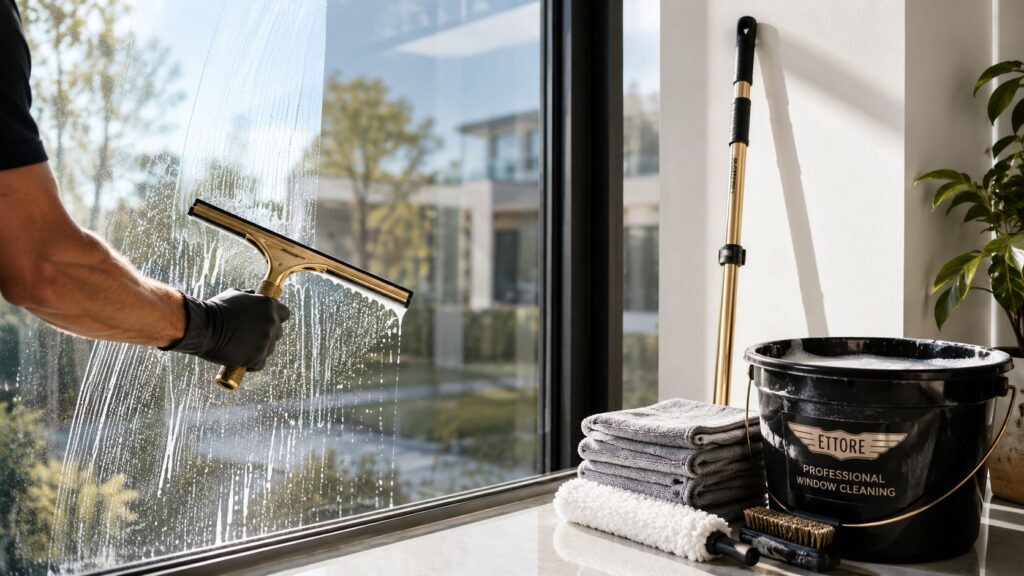
You're probably here because you've already tried one of two things. Either you bought a spray bottle and paper towels, cleaned half a window, and watched the streaks dry right back in. Or you looked at professional gear online and got buried in a pile of channels, rubbers, sleeves, poles, holsters, soaps, and gadgets that all claim to be necessary.
Individuals often don't need more products; they need a working system.
Good residential window cleaning supplies aren't a random shopping list. They're a set of tools that each do one job well, in the right order. When that system is dialed in, cleaning glass gets faster, easier, and much less frustrating. When it isn't, even expensive tools feel clumsy.
The Essential Toolkit for Streak-Free Windows
The foundation of almost every solid setup is still the same manual kit that window cleaners have relied on for years: squeegee, scrubber or T-bar, extension pole, bucket, scraper, and microfiber towels. Grainger's equipment guide still describes the T-bar as the standard tool for applying solution and the squeegee as essential for fast drying, which tells you something important. The basics have held up because they work. Grainger's guide to must-have window cleaning supplies and tools lays out that core toolkit clearly.

The squeegee does the finishing work
If one tool makes the biggest difference, it's the squeegee. Cheap plastic squeegees usually flex too much, don't hold even pressure, and often come with rubber that chatters across the glass. That's where streaks start.
A better squeegee has a rigid channel, a comfortable handle, and replaceable rubber. Brass, stainless, and aluminum all show up in real-world kits. What matters most is control. A straight channel and clean rubber edge let you remove water in one controlled pass instead of fighting drips with towels afterward.
If you want to understand how pros choose and use them, this guide on squeegee window cleaners is worth reviewing.
The scrubber loosens dirt before the squeegee ever touches glass
Beginners often underestimate the scrubber, sometimes called a T-bar. That's a mistake. The scrubber isn't there to “get it kind of wet.” It's there to carry solution, spread it evenly, and break loose pollen, dust, bug residue, and film before you pull a blade over the pane.
A good sleeve holds water without dripping everywhere. A poor one either dumps solution too fast or barely wets the glass, which forces you to scrub harder and re-dip constantly.
What works well:
- Dense sleeve fabric: Holds enough solution to keep the window wet while you work.
- Solid handle fit: A wobbly T-bar feels sloppy, especially on larger panes.
- Washable sleeve: You'll want to rinse and reuse it, not treat it like a throwaway.
Practical rule: If the glass dries before you can squeegee it, the problem often isn't your technique. It's usually weak solution, too little water on the glass, or a scrubber sleeve that doesn't carry enough moisture.
The bucket is about workflow, not glamour
You don't need a fancy bucket. You do need one that fits your tools and keeps the process moving. A bucket that's too small makes you fold scrubbers awkwardly and splash solution. One that's stable and easy to carry saves hassle all day.
For homeowners, it's smart to save money in this area. A basic bucket works fine if it's wide enough for your washer and easy to rinse out.
Microfiber towels handle the detail work
Microfiber towels aren't there to clean the whole pane after the fact. If you're doing that, the system is off. Their real jobs are edge detailing, wiping the sill, drying corners, and catching the occasional line of water at the frame.
Keep separate towels for different tasks:
- Glass detailing towel: For edges and touch-ups only
- Frame and sill towel: For dirtier work
- Dry backup towel: For final polishing if needed
That separation matters more than people think. One towel contaminated with frame dirt can smear a clean pane fast.
A homeowner kit and a pro kit aren't the same thing
A homeowner's good-enough kit should feel simple, light, and easy to store. A professional efficiency kit is built to reduce wasted motion. Same system, different standard.
The homeowner version says, “I can clean my windows well.”
The pro version says, “I can clean a whole house without stopping every few minutes.”
Choosing Your Window Cleaning Solution
The soap question trips people up because window cleaning solution sounds more technical than it is. In practice, you need a mix that helps the scrubber break dirt loose and gives the squeegee enough slip to glide cleanly across the glass.
Slip matters. If the blade drags, skips, or grabs, your passes get rough and uneven. That usually leads to lines, chatter, and repeat work.
Dish soap is the common starting point
For everyday residential glass, mild dish soap in water can work well. It's easy to find, inexpensive, and familiar. A small amount helps the washer move smoothly and gives the squeegee that controlled glide most beginners are missing when they use plain water.
The upside is obvious. It's accessible and forgiving.
The downside is also real. Some dish soaps leave more residue than you want, especially if you mix them too strong. When the mix gets heavy, the glass can feel gummy instead of slick, and edges may need extra detailing.
A simple rule helps: use enough soap to create slip, not enough to create foam.
Professional concentrates clean differently
Professional window cleaning concentrates are built for consistency. They tend to rinse cleaner, behave more predictably in different conditions, and make it easier to keep your solution the same from one job to the next. That matters when you're working on sun-warmed glass or windows that have built up a stubborn film.
For a homeowner, concentrate makes sense when:
- You clean often: Consistency becomes more valuable over time.
- Your windows get heavily soiled: Dust, pollen, and bug residue need more dependable performance.
- You want repeatable results: A proper concentrate removes guesswork.
For occasional cleaning, dish soap is usually fine. For regular exterior work, concentrate starts to earn its place.
How to choose between the two
Here's the practical comparison:
| Option | Works well for | Main drawback |
|---|---|---|
| Dish soap mix | Casual home use, interior glass, light soil | Easy to overmix and leave residue |
| Professional concentrate | Repeat cleaning, larger homes, tougher exterior glass | Higher upfront cost and more product choices to sort through |
If you've struggled with haze, residue, or overly perfumed cleaners, resources that solve glass cleaning frustrations can help you think more clearly about ingredient choices and what tends to leave glass cleaner versus what tends to smear.
For a closer look at what cleaners do on the glass, this guide on soap for window cleaning gives useful context.
Too much soap doesn't make windows cleaner. It usually makes them slower to detail.
What doesn't work well
A few things cause problems over and over:
- Heavy foaming mixes: Suds look active but often make squeegee control worse.
- Random household sprays: Many are designed for spot cleaning, not for scrub-and-squeegee work.
- Dirty solution: Once your bucket turns gray with grit, you're washing with the same debris you just removed.
Fresh solution beats fancy solution almost every time.
Advanced Supplies for Tough Jobs and High Windows
Some windows don't become difficult because of the glass. They become difficult because of the reach, the angle, or the debris stuck to them. That's when basic supplies stop being enough and targeted upgrades start to matter.

For higher windows, poles come first
For residential work, the first upgrade should usually be an extension pole. It lets you keep your feet on the ground for many second-story panes and awkward transoms. That's a major step up in both efficiency and safety.
Aluminum poles are common and durable. Carbon fiber feels lighter in use, especially over time, but it's more of an investment. For occasional home use, aluminum is often enough. For frequent work, a lighter pole reduces fatigue and gives you better control at full extension.
A pole is only useful if the head stays stable. If the tool wobbles, your squeegee angle changes and your scrubber pressure gets uneven.
For exterior work that goes beyond traditional hand tools, a water-fed pole window cleaning system is another category entirely. It uses pole-fed brushing and rinsing rather than a bucket-on-the-ground setup, which can be useful on certain residential exteriors.
Ladders are a last resort, not a starting point
Many homeowners treat a ladder as the default. Experienced cleaners usually treat it as the tool they'd rather avoid if a pole can do the job well.
Use a ladder only when the window design requires it and the setup is stable. Uneven ground, decorative rock, wet concrete, and planting beds all make ladder work less forgiving. If the angle is awkward or you have to lean sideways to reach the glass, stop and rethink the plan.
The safest window cleaning tool is often the one that keeps you off the ladder in the first place.
For stuck-on debris, the scraper has one job
A scraper is not for routine washing. It's for bonded debris like paint specks, tape residue, bug spots, or construction mess that won't release with normal scrubbing.
One essential rule: the glass must stay wet while scraping. Dry scraping raises the risk of scratching. Use a sharp blade, light pressure, and short controlled motions. The scraper should do the lifting. You shouldn't be forcing it.
Use a scraper carefully on known safe glass and stop if you're unsure about coatings, damage, or debris type.
Here's a simple visual walkthrough of pole-based exterior work and setup considerations:
Small accessories can change your pace
Efficiency tools sound minor until you work without them.
- Holster: Keeps the squeegee close instead of on the ground or balanced on a sill
- Tool belt: Helps carry towels, scraper, and washer without repeated trips
- Pole tip adapters: Make it easier to switch between tools
- Extra rubber: Saves a job when a blade edge gets nicked
These upgrades don't make a beginner look professional. They remove friction from the workflow.
Where to Buy and What to Budget for Your Kit
Buying residential window cleaning supplies gets easier when you stop treating every tool the same. Some items need quality. Some just need to be functional. That distinction keeps you from overspending in the wrong places.
This is also a mature category, not some passing trend. The U.S. window cleaning services industry generated $2.8 billion in revenue in 2023 and employed about 45,200 workers, while global industry summaries place the market at about $45.2 billion in 2022. Those figures help explain why the same core tools stay widely available to both service companies and homeowners. These window cleaning industry statistics provide that market context.

Big-box stores versus specialty suppliers
Where you buy depends on what stage you're in.
| Seller type | Best use | Watch out for |
|---|---|---|
| Big-box hardware store | Fast replacement of basic items, simple starter kits | Limited professional-grade selection |
| Specialty online retailer | Better squeegees, channels, sleeves, replacement rubber, niche accessories | More choices can confuse first-time buyers |
Big-box stores are fine for buckets, basic microfiber, and general-purpose cleaning odds and ends. Specialty suppliers are usually better when you want a better handle, a dependable channel, quality rubber, or sleeves that hold water the way they should.
Spend on the tools that touch the glass
Some purchases matter far more than others.
Spend more carefully on:
- Squeegee and rubber quality: This affects the finish directly.
- Scrubber sleeve: A weak sleeve makes the whole process harder.
- Pole if you need height: Cheap poles often twist and flex.
Save money on:
- Bucket: Functional beats fancy.
- Basic carry tote or belt: Start simple unless you clean often.
- General microfiber stock: Buy enough, then sort by task.
Two practical kit paths
A homeowner doesn't need the same kit as someone considering weekend jobs.
Enthusiast homeowner kit
This setup is about clean results without clutter:
- Quality squeegee
- One scrubber and sleeve
- Bucket
- Microfiber towels
- Small scraper for isolated debris
- Basic extension pole if you have high exterior panes
This kind of kit can stay compact and still handle most home window work well.
New pro starter kit
A side-hustle or entry-level professional setup needs redundancy and speed:
- More than one squeegee size
- Extra rubber
- At least one dependable extension pole
- Multiple towels separated by task
- Scraper and spare blades
- Holster or belt
- Professional cleaning concentrate
- Backup sleeve or washer
That second kit isn't just more gear. It protects your workflow when a tool gets dirty, dropped, or worn mid-job.
A practical buying mindset
Don't buy gimmicks first. Buy friction reducers.
That means smoother rubber, a better sleeve, a stable pole, and enough towels to keep clean glass separate from dirty frame work. If you're also maintaining insect screens, Sparkle Tech Window Washing & window screens offers screen-related services in addition to window washing, which can matter when the project includes both glass and screen upkeep.
Pro Tips for Tool Care and On-the-Job Safety
Well-maintained tools clean better, last longer, and save money. Neglected tools create drag, streaks, lint, and unnecessary replacement costs. The gap between a frustrating day and a smooth one often comes down to maintenance habits that take only a few minutes.
Protect your squeegee rubber
Rubber fails at the edge first. A tiny nick, flat spot, or dried residue line can leave marks across a whole pane.

After each session:
- Wipe the blade clean: Dirt left on the edge hardens and affects the next use.
- Store it straight: Don't crush the rubber at the bottom of a crowded bucket.
- Check the corners: Wear often shows there first.
A lot of cleaners replace the whole rubber too soon. If one edge is worn and the other is still clean, you may be able to reverse or reposition it depending on the channel style.
Shop habit: Clean the blade before you put the tool away, not when you pull it out next time. Dry residue is harder to deal with and easier to forget.
Wash microfiber the right way
Microfiber works because it grabs residue and moisture well. It stops working when it's loaded with dirt, fabric softener, or oily cleaner residue.
Keep your towel system simple:
- Glass towels stay with glass towels
- Frame towels stay separate
- Heavily soiled towels get isolated from cleaner ones
If you wash all your towels together without sorting, the cleaner detailing towels pick up the grime from the dirtiest ones. Then you wonder why your final wipe smears.
Don't ignore frames, tracks, and nearby fabric
Window work rarely ends at the glass. Sills, tracks, and shades collect dust and transfer it back to the cleaned area if you skip them. If your project includes window treatments, these tips for maintaining Roman shades are useful because dirty fabric shades can drop dust and affect the finish around freshly cleaned windows.
Safety habits that aren't optional
Most avoidable accidents happen during setup, not while making a squeegee pass.
Use these rules every time:
- Look up before raising a pole. Stay well clear of overhead power lines.
- Test your footing. Wet patios, gravel, and decorative rock can shift under you.
- Don't overreach on ladders. Move the ladder instead of leaning your body outside the rails.
- Keep glass wet when using a scraper. Friction on dry glass is asking for trouble.
- Stop when conditions are wrong. Wind, unstable soil, or bad angles don't improve with optimism.
Replace small parts before they cause big problems
A worn sleeve, bent channel, loose handle, or contaminated towel can drag down the whole result. New cleaners often try to squeeze too much life out of tired gear. That usually costs more in time than the replacement would have.
Good maintenance isn't about babying tools. It's about keeping the system predictable.
Putting It All Together Your Window Cleaning Workflow
A clean result comes from sequence. When the tools are used in the right order, each one makes the next step easier.
Step one is prep
Lay out your towels, bucket, scrubber, and squeegee before you start. Mix your solution, check the rubber edge, and decide how you'll handle high panes before the glass is wet. If screens are coming off, give them a place to rest without picking up dirt again.
That simple setup avoids the stop-and-start routine that makes small jobs feel longer than they are.
Step two is apply and scrub
Load the scrubber well enough to wet the pane evenly. Work the soil loose instead of just brushing over the surface. Pay attention to corners, edges, bug spots, and any film that needs a second pass.
If debris is bonded to the glass, handle that selectively and carefully before moving on.
Step three is remove the water cleanly
The squeegee earns its place through careful application. Make controlled pulls with even pressure and keep the blade edge clean. If a pass leaves a line, don't panic and flood the whole pane again. Check the edge, wipe the rubber, and correct the issue with intention.
Good technique feels calm. Rushed technique creates drips and cleanup.
Step four is detail the edges
Use microfiber for the edges, sill, and any remaining droplets. This shouldn't be a rescue operation. It should be light finishing work. If the towel is doing too much, go back and look at the earlier steps.
The system is what gives you repeatable results:
- Prep well
- Scrub thoroughly
- Squeegee with control
- Detail lightly
That's the difference between “clean enough” and glass that looks clear from across the room.
If you'd rather hand the job off, or you need help with both glass and screens, Sparkle Tech Window Washing & window screens provides residential window washing and window screen services in Arizona. That's a practical option when the windows are hard to reach, the screens need repair, or you want the whole system handled in one visit.