

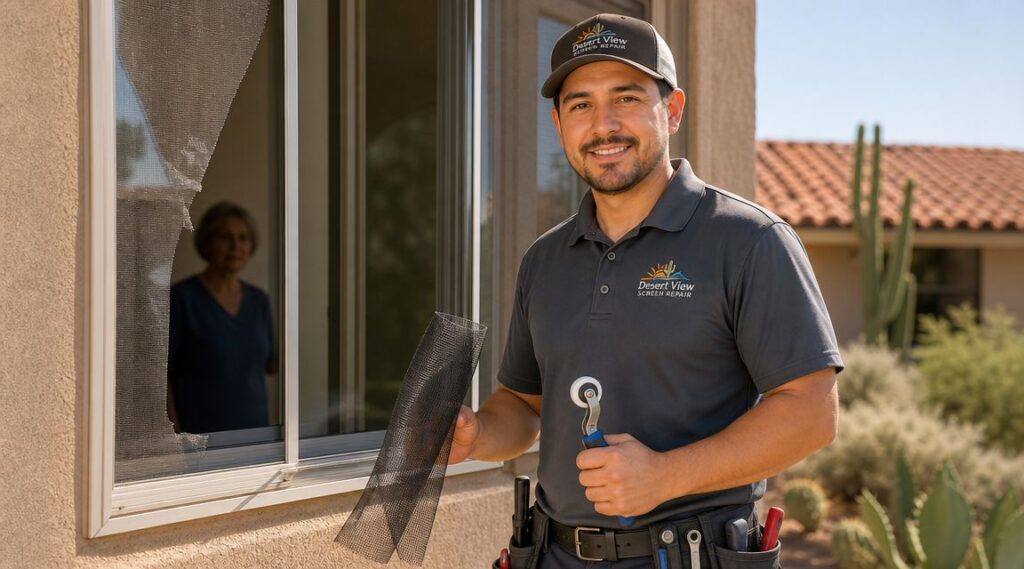
You open the window to get some Arizona air moving through the house, then you see it. The screen is ripped, the frame is tweaked, or the window itself sticks and fights you every time you try to slide it. That's usually when screen and window repair near me is sought, and a straight answer is wanted fast.
Fair enough. Most homeowners don't need another directory full of vague listings. You need to know what's wrong, whether it's worth repairing, what a fair process looks like, and how to avoid hiring someone who talks big but gets sloppy once they're on site.
In Arizona, these issues show up at exactly the wrong time. When the weather turns and you want airflow, damaged screens and tired windows stop being a minor annoyance. They affect comfort, bug control, day-to-day use, and how well the house handles heat.
Your Guide to Local Screen and Window Repair
A lot of homeowners wait too long because a torn screen or stubborn window doesn't feel urgent. Then the first stretch of good weather hits, windows go up, and suddenly every little problem gets your attention.
That timing isn't random. Window screen repair demand is highly seasonal, with hardware stores like Weaver's Ace Hardware describing it as a popular service especially during the spring and summer when people open windows more often and find torn mesh, bent frames, or worn parts in the process. You can see that seasonal pattern in their window screen repair service page.

Arizona homeowners usually need one of three things:
- A simple screen fix when the mesh is torn but the frame still fits well
- A better diagnosis when the problem looks like “the screen” but is really the frame, track, latch, or window
- A practical local service that can tell you whether they handle on-site work, shop work, or both
Practical rule: If you're searching “screen and window repair near me,” you're usually not buying a product. You're hiring judgment, labor, and convenience.
That's why local repair matters. This isn't like ordering a replacement part online and calling it done. Screens have to fit. Windows have to operate smoothly. And the person helping you should be able to explain, in plain language, what can be repaired, what should be replaced, and why.
Telltale Signs Your Windows and Screens Need Service
Most homeowners notice the obvious stuff first. A hole in the mesh. A crack in the glass. A window that suddenly drags. The trouble is that the visible damage isn't always the actual problem.
Start by looking at the screen and the window as two separate systems. One keeps bugs and debris out while letting air move through. The other handles glass, seals, movement, and security. When either system starts failing, the symptoms are usually easy to spot if you know what to watch for.

Signs the screen needs attention
A bad screen doesn't always mean “replace the mesh and move on.” Sometimes that works. Sometimes it doesn't.
Here are the common red flags:
- Tears or holes in the mesh that let bugs in and keep spreading
- Sagging or loose screen material that flutters when air moves through it
- Bent corners or a bowed frame that won't sit square in the opening
- Spline problems where the material starts pulling away from the edge
- Broken tabs or latches that make removal and reinstalling a pain
One technical point matters more than most homeowners realize. A durable screen repair depends on frame integrity. If the aluminum frame is bowed or the spline channel is worn, new mesh won't maintain tension, leading to fluttering, edge pullout, and premature tearing, as described by Silverton Hardware on its window and screen service page.
That means a nice-looking remesh can still fail if the frame itself is shot.
A short visual walkthrough helps if you want to compare what you're seeing at home:
Signs the window itself needs service
Window problems usually show up through operation, airflow, or glass condition.
Watch for these:
- Drafts around a closed window
- Condensation between panes
- Difficulty opening or closing
- Visible chips or cracks in the glass
- Locks or latches that don't line up right
If the screen looks rough but the window also sticks, rattles, or won't seal, don't treat it like a screen-only job.
A homeowner will often call about one issue and find out there are two. That's normal. A damaged screen may be obvious, but a worn track, misaligned sash, or failed glass unit is often what's been making the whole opening feel “off” for months.
Should You Repair or Replace the Whole Thing
Repair decisions often lead to two extreme approaches. These involve either trying to save everything, even when the part is clearly done, or assuming every problem means full replacement. Both mistakes cost money.
The internet hasn't helped much. A major gap in online advice is the lack of guidance on when to repair versus replace, which leaves homeowners guessing whether a small fix is enough or whether replacement makes more sense over time. That gap is clear in the way many service pages talk around the issue instead of answering it directly, as noted on Gem Glass and Mirror's screen repair page.
When repair makes sense
Repair is the right call when the main structure is still sound.
Good repair candidates usually include:
- Torn mesh with a square frame
- Loose spline with an otherwise solid channel
- Minor hardware issues like tabs, latches, rollers, or track cleaning
- Glass problems limited to one component rather than the full window assembly
If the screen frame still sits correctly and the corners are solid, remeshing is usually sensible. If the window frame is in good shape and the issue is isolated to hardware or glass, targeted repair is often the smarter move.
When replacement is the better answer
Replacement makes more sense when repair keeps turning into patchwork.
That usually means:
- The screen frame is warped, cracked, or won't sit tight
- The spline channel is too worn to hold tension reliably
- The window component has repeated failure
- The repair would leave you with a weak result you'll be paying for again soon
Here's the plain-English version. If the job can be repaired cleanly and hold up, repair it. If the repair still leaves the assembly crooked, loose, or unreliable, replace that component and stop throwing labor at a bad base.
Homeowners save money when they replace only the failed part, not the entire unit by default.
That's especially true with windows. A foggy insulated glass section doesn't automatically mean you need a whole new window frame. On the screen side, though, a badly distorted frame often means a full screen replacement is more sensible than trying to stretch new material over bad geometry.
If you want a more hands-on breakdown of those decision points, this guide to repairing damaged window screens is worth reading before you schedule work.
DIY vs Hiring a Professional Screen Repair Service
DIY screen repair can work. I'm not against it. But homeowners should be honest about what kind of job they have.
If you've got one simple screen, a flat work surface, a spline roller, new spline, fresh mesh, and enough patience to keep tension even, you might be fine. If the frame is bent, the fit is odd, the opening is high up, or you need several screens to match, hiring a pro usually saves aggravation.
The real tradeoff
DIY saves labor, but it shifts all the measuring, tool handling, troubleshooting, and quality control onto you.
Professional repair costs more upfront, but it usually buys you:
- Cleaner fit and tension
- Faster turnaround
- A better read on frame condition
- Less risk of doing the job twice
For homeowners thinking beyond the immediate out-of-pocket cost, I like the same basic logic people use when comparing repair settlements and replacement decisions on larger property claims. The discussion on actual cash value versus replacement cost from For The Public Adjusters is useful because it pushes you to ask a smart question: are you paying for a temporary compromise or for a durable result?
DIY vs Professional Screen Repair at a Glance
| Factor | DIY Repair | Professional Service |
|---|---|---|
| Cost | Lower material cost, but you buy tools and absorb mistakes | Higher service cost, but labor and fit are handled for you |
| Time | Can eat up a weekend if you're learning as you go | Usually faster once scheduled |
| Skill level | Best for basic remeshing on a good frame | Better for warped frames, tricky fits, and multiple units |
| Finish quality | Depends on your tension, trimming, and measuring | Usually more consistent and cleaner |
| Risk | Easy to end up with wrinkles, loose spline, or a bad fit | Lower risk if the technician knows screens well |
| Best use case | One straightforward screen and a patient homeowner | Homes with several damaged screens or mixed issues |
My recommendation
Do it yourself when the job is simple and you don't mind trial and error.
Hire help when any of these are true:
- You suspect the frame is the primary issue
- The screen is on an upper level
- You need multiple screens repaired together
- You also have a window operation problem
- You want it handled once and done right
If you're still weighing whether your project is a good DIY candidate, this walkthrough on DIY window screen repair basics can help you judge the difficulty before you buy materials.
Understanding Average Costs and Timelines in Arizona
You call for a torn screen on Monday because dust is blowing in through the kitchen window. By Wednesday, you want to know two things. What will this cost, and how long will the house stay half-open to the desert.
A fair starting point comes from the Homewyse screen repair cost page, which estimated basic window screen repair at $142 to $175 per screen in January 2026. Use that as a reality check, not a promise. Arizona pricing swings fast once a company adds travel, minimum service charges, upper-story access, pet-resistant mesh, or a frame that is bent instead of torn.
Price usually follows scope.
A single, standard window screen with a good frame is the low-friction job. A sliding screen door, sun-damaged corners, custom sizing, or a window that also sticks or will not latch pushes the ticket up because the technician is solving more than one problem. If you want a local benchmark before you start calling, Sparkle Tech's guide on the cost to repair a window screen gives you a practical budget range to compare against quotes.
Here's what changes the number in Arizona:
- How many units need work
- Standard window screens versus patio or door screens
- Whether the frame can be reused
- On-site service versus shop fabrication
- Mesh type and custom sizing
- Whether hardware or window operation also needs repair
Timelines work the same way. Straightforward rescreening can move quickly if the company has the material on hand and the frame is still square. Jobs slow down when parts need to be ordered, multiple screens have to be fabricated, or the provider batches work through a shop instead of handling it during the visit.
Homeowners make bad comparisons. One company quotes a low per-screen number but expects drop-off. Another charges more and finishes on site. Those are not equal offers.
Ask three direct questions before you book: Do you repair on site, do you take screens back to the shop, and what changes the turnaround time? If a company cannot answer those cleanly, keep looking. Arizona homeowners do better with providers who explain the process up front, because the best value is not the cheapest line item. It is the repair that fits your schedule and solves the problem in one trip.
If you manage a rental, short-term stay, or hospitality property, speed matters even more because every extra day affects guest comfort and maintenance coordination. The service mindset outlined by Renue Systems Four Points for Arizona is a useful reminder that response time and job flow matter almost as much as the repair itself.
Your Checklist for Hiring a Reputable Repair Pro
You call a company because a patio screen is hanging loose, they quote a low price over the phone, and then the job changes the second they arrive. Now the frame is bent, the corners are weak, and nobody can tell you whether they can finish today. That is how Arizona homeowners end up with a cheap quote and a frustrating repair.
The fix is simple. Hire based on process, paperwork, and judgment. Price matters, but it should be the last filter, not the first.

What to verify before anyone starts
Check the business before you hand over the job. If a company gets vague here, move on.
- Licensing and registration. Confirm the company is properly registered for the work it offers.
- General liability insurance. If a technician damages a frame, glass panel, wall, or flooring, you want coverage in place.
- Workers' compensation coverage. If someone gets hurt on your property, this can protect you from a much bigger problem.
- Bonding. Bonding does not guarantee perfect work, but it shows the company operates like a real business.
- Clear written scope. You should know exactly what they plan to repair, replace, remove, reinstall, and charge for.
If you want a plain-English explanation of why this paperwork matters, insurance solutions for Florida contractors offers a useful overview of the coverage serious service companies carry.
One Arizona option homeowners may come across is Sparkle Tech Window Washing. The company states that it is a family-owned Arizona LLC and carries workers' compensation, general liability insurance, and bonding while offering window screen services.
Questions that separate pros from guessers
A good repair pro should answer these clearly, without dancing around them:
- What do you inspect before you quote the final repair?
- If the frame is bent or the corners are failing, do you still recommend remeshing it?
- Do you handle both window screens and sliding screen doors?
- What changes the price after you see the screen in person?
- What material are you installing, and why is it the right fit for Arizona sun and dust?
- If you remove the screen and find extra damage, what happens next?
- Do you warranty the labor, the materials, or both?
Pay attention to how they answer, not just what they say.
A pro explains the decision. A guesser repeats a price.
My no-nonsense hiring standard
Use a simple filter. Hire the company that can inspect the problem, explain whether repair still makes sense, and back up the work with real business credentials.
That means the company should:
- Show up ready to assess the actual condition of the frame and screen
- Explain when a repair is smart and when replacement is the better call
- Put the scope and pricing in writing
- Carry the insurance and business documentation you asked for
- Answer direct questions without getting defensive
- Give you a realistic plan instead of a vague promise
Arizona homeowners do best with companies that make the decision easier, not murkier. Your goal is not to find somebody willing to swap mesh. Your goal is to hire somebody who can tell you, on the spot, whether the repair is worth doing at all.
Frequently Asked Questions About Screen and Window Repair
Can a torn screen be patched instead of fully remeshed
Sometimes, yes. If the damage is very limited, a patch can buy time. But if the mesh is brittle, loose, or damaged in more than one area, patching usually turns into a temporary fix that looks rough and fails early.
Why does my new screen still look loose
Because the problem may not be the mesh. If the frame is bowed or the edge channel doesn't hold spline properly, the material won't stay evenly tensioned. That's why a clean remesh on a bad frame often disappoints.
Should I call a screen company or a window repair company
Call based on the actual symptom. If the issue is torn mesh, frame fit, or a damaged sliding screen door, a screen-focused service is the better first stop. If the glass is cracked, the window won't seal, or the sash and hardware are failing, you want a company that handles window repair, not just screens.
If you want help sorting out whether you need a simple rescreen, a full screen replacement, or a closer look at the window itself, Sparkle Tech Window Washing is one Arizona option to contact. Ask for a clear description of the repair process, whether the work is handled on-site or off-site, and what they recommend based on the actual condition of the frame and window.