



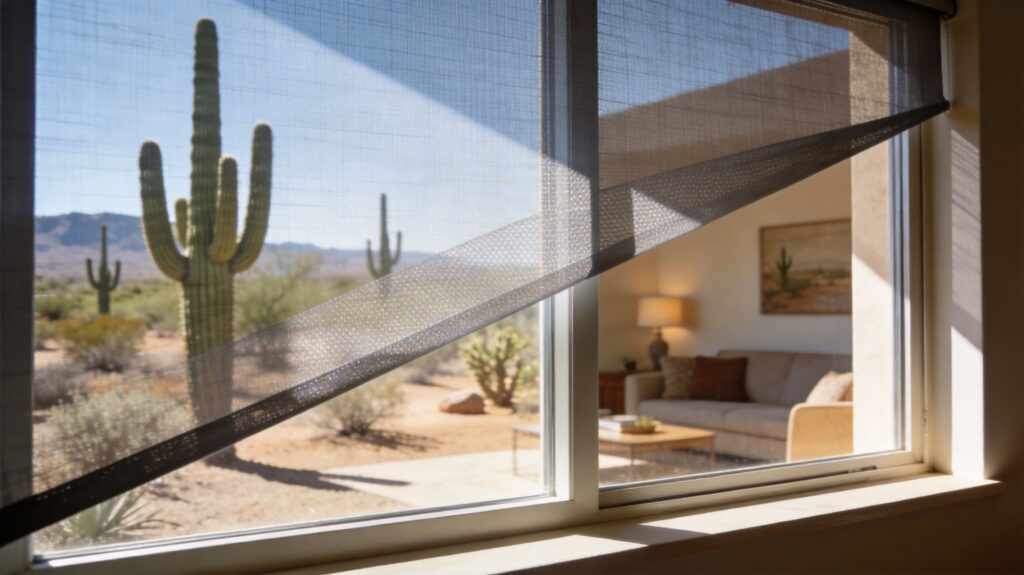
By late spring in Arizona, you can feel which windows are causing trouble before you even touch the thermostat. The west-facing rooms turn harsh in the afternoon. The TV gets washed out by glare. Floors near the glass feel hotter. Then the power bill lands, and it confirms what the house has been telling you for weeks.
That's usually when homeowners start looking at window sun screens. Not because they want a fancy upgrade, but because they want the house to stop fighting the air conditioner all day. In Arizona, that's a practical decision, not a cosmetic one.
A good screen setup can make a room more usable, cut glare, protect interiors from UV exposure, and reduce how much solar heat gets into the house in the first place. If you're also working through broader ways to reduce your Arizona cooling costs, sun screens belong on the short list with attic insulation, HVAC tune-ups, and sealing obvious leaks.
The catch is that not all screens perform the same, and Arizona exposes bad choices fast. Dust builds up. Cheap mesh weakens. Older homes often have odd frames that don't accept off-the-shelf solutions cleanly. Some products block heat well but make rooms too dark. Others preserve view but don't do enough on aggressive sun exposures.
That's where homeowners need straight answers. Material matters. Openness matters. Installation quality matters. Maintenance matters more than is commonly realized.
Escaping the Arizona Glare and High Energy Bills
A lot of Arizona homes have one or two problem sides. East-facing windows blast the breakfast area early. West-facing glass turns the living room into an oven by late afternoon. South-facing rooms stay bright all day and punish you through the hottest months.
Window sun screens are built for exactly that problem. They sit on the exterior side of the window and intercept sunlight before the glass absorbs it. That's the practical advantage. You're not trying to manage the heat after it has already come inside. You're trying to stop a big share of it at the window line.
Homeowners usually come in with one of three complaints:
- The AC never seems to catch up: The system runs, but rooms on the sunny side still feel uneven.
- The glare is making the room unusable: Home offices, TVs, and kitchen counters get hammered by direct light.
- The view is fine, but the comfort isn't: People don't want to close heavy drapes all day just to make a room tolerable.
A room can look bright and still be uncomfortable. Glare and heat are related, but they aren't the same problem.
That distinction matters. Some people only need glare control in a single room. Others need broad solar control on the hottest exposures. Others are dealing with an older home where the original windows let in far more heat than they should.
Arizona also adds a maintenance layer that homeowners often underestimate. Dust storms, pollen, hard water residue, and plain desert grime all affect how well exterior screens perform over time. A screen that worked well when it was new won't keep doing its job if it's clogged, sagging, or mounted poorly.
That's why choosing window sun screens isn't just about buying a darker mesh. It's about matching the fabric, openness, frame fit, and maintenance plan to the side of the house that's taking the hit.
What Are Window Sun Screens and How Do They Work
Think of window sun screens as sunglasses for your house. They filter solar energy outside the glass instead of relying on interior blinds or curtains to deal with the problem after the window has already heated up.

That outside placement is the whole game. In the cooling season, about 76% of sunlight falling on standard double-pane windows enters homes and becomes heat, according to Arrowhead Solar Screen. The same source notes that high-quality solar screens can block up to 90% of the sun's heat-producing rays, and some homes have documented interior temperature drops of as much as 15 degrees.
What the screen is actually doing
A proper solar screen doesn't act like solid blackout material. It uses woven mesh to intercept, reflect, and dissipate sunlight while still allowing some light and visibility through the opening in the fabric. That's why you can often stand inside and still see out.
Three things affect performance most:
- Mesh density: Tighter weaves generally provide more protection from solar heat gain and glare.
- Color: Darker and lighter fabrics behave differently in terms of view, glare, and reflected light.
- Sun angle: Screens do their best work when direct sun is hitting the window.
If you're comparing products and need a practical starting point, this roundup on choosing solar screens gives a helpful overview of the common options homeowners sort through.
What openness factor means
You'll hear installers talk about openness factor. That's the amount of open area in the fabric. The range commonly runs from less than 1% to 15%, based on the Arrowhead explanation linked above.
Lower openness gives you more solar protection and stronger glare control, but you give up some outward clarity and interior brightness. Higher openness gives a clearer view and more daylight, but less heat rejection.
Practical rule: If a room gets punished by direct afternoon sun, most homeowners are happier leaning toward stronger solar control instead of chasing maximum visibility.
That doesn't mean every window should get the same mesh. A west-facing family room and a shaded north-facing bedroom rarely need the same setup.
A short demonstration helps if you want to see the concept in action before comparing fabrics and frame styles:
Why exterior screens beat interior fixes on heat
Interior blinds and curtains can reduce glare. They can help with privacy. But once sunlight has passed through the glass, the window has already started acting like a heat source. Exterior window sun screens attack the problem earlier in the chain.
That's why they're often the first upgrade I'd look at for an Arizona home that has good windows structurally but poor solar control on one or two exposures.
Choosing Your Screen Types and Materials
The biggest mistake homeowners make is shopping by darkness alone. They look at one sample, then another, and assume the darker one must block more heat. Sometimes that's true. Sometimes it isn't. The fabric construction, openness, and durability matter more than the quick look in your hand.

Polyester versus lighter-duty screen material
For Arizona conditions, vinyl-coated polyester is usually where serious sun control starts. A good example is Phifer SunTex 80/90, which is made from durable vinyl-coated polyester and is designed to block 80% to 90% of solar heat according to Phifer's product page. That same source notes the fabric is pet, mildew, and fade resistant, which matters in dusty, high-UV environments where weaker material doesn't age well.
Standard insect screen has its place. It keeps bugs out. It lets air through. But it isn't built to do the same level of solar work. If the goal is comfort on a sun-exposed window, bug screen and solar screen are not interchangeable.
For homeowners comparing fabric options in more detail, this guide to window screen material types is useful because it breaks down where each material fits instead of treating all screens like they do the same job.
What 80 and 90 really mean in practice
The easiest way to understand these labels is this. Higher blockage numbers generally mean more help with heat and glare, but also a stronger effect on daylight and view.
A practical breakdown looks like this:
- Around 80% solar block: Good when you want a balance of comfort and visibility.
- Around 90% solar block: Better for brutal west and south exposures where afternoon heat is a major problem.
- Very high-performance specialty fabrics: Better suited for windows that take severe direct sun and where comfort matters more than maximum transparency.
With Phifer SunTex 80/90, the openness factor sits in the 10% to 15% range on the referenced product line, which is part of why homeowners often see a decent balance between outward visibility and protection on residential installs.
On a hot Arizona exposure, the wrong screen doesn't fail all at once. It fails slowly. More glare than you expected, more room heat than you expected, and a view that still isn't as clear as you hoped.
When specialty fabrics make sense
For harder-hit windows, specialty fabrics can outperform standard solar mesh. SilverScreen is the clearest example in this category. According to the SilverScreen technical sheet, the fabric uses a PVC-coated fiberglass yarn with an aluminum backing and a 4% openness factor. That combination gives it 77% to 78% solar reflectance, cuts solar transmission to 6%, and blocks about 96% of UV rays.
That construction matters because it reflects solar energy away from the window before the glass soaks it up. The same technical sheet says this setup can cut air conditioning loads by up to 30% to 50% under direct sun exposure.
Material choices that work better in Arizona
Arizona homeowners usually do best when they choose based on the exposure, not the brochure.
| Screen need | Better fit |
|---|---|
| Main goal is insect control | Standard bug screen |
| Main goal is heat and glare reduction | Solar screen fabric |
| Strong west-facing exposure | Higher-block solar mesh or specialty reflective fabric |
| Need durability around pets and weather | Vinyl-coated polyester products like SunTex 80/90 |
A few buying realities matter more than brand names:
- Frame fit matters as much as fabric quality. A premium mesh won't perform well if the screen bows or leaves gaps.
- West-facing windows deserve the strongest attention. Those usually produce the complaints first.
- Don't overspec every window. Some rooms need maximum solar control. Others need a lighter touch.
If a seller can't explain why they recommend one openness level over another for your specific exposures, keep asking questions.
Sun Screens vs Alternatives A Head-to-Head Comparison
A lot of Arizona homeowners don't start by searching for window sun screens. They start by thinking about blinds, curtains, or tint because those are more familiar. That makes sense. The problem is that these options solve different parts of the same comfort issue.

Where each option wins and loses
Interior blinds are good at light control and privacy. They're easy to live with, and they can reduce visual discomfort. But they don't stop exterior solar energy before it hits the glass.
Curtains can help with room darkening and softness. Heavy drapes can improve comfort, but many homeowners don't want to keep rooms closed up all day just to block heat.
Window film is cleaner-looking and doesn't require a bulky interior treatment. It can be a good fit where exterior screens aren't practical. But film still works on the glass itself, not out in front of it like an exterior screen.
Window sun screens usually make the most sense when heat reduction is the top goal and you still want usable daytime visibility.
Exterior solar control usually beats interior solar control on windows that take hard direct sun. The reason is simple. The earlier you interrupt the sunlight, the less heat the glass picks up.
Why specialized screen fabrics stand out
Some products push this advantage further than others. SilverScreen, for example, has an aluminum backing that helps it reach 77% to 78% solar reflectance, according to the technical sheet from Insolroll. The same source states that under direct sun exposure it can cut air conditioning loads by up to 30% to 50% because it reflects heat before the window absorbs it.
That's the core difference in a head-to-head comparison. A curtain can hide the sun from your eyes. A screen can reduce how much of that heat turns the window into a radiator.
For homeowners looking at motorized or interior options for large openings, Home AV Pros automated shade installations are worth reviewing because they show what automated interior shading can and can't replace. In many homes, automated shades are about convenience and glare management. Exterior sun screens are more about raw solar control.
Window Treatment Comparison
| Feature | Window Sun Screens | Window Tint/Film | Blinds/Curtains |
|---|---|---|---|
| Solar heat blocking | Strong, because the screen sits outside the glass | Moderate, because the film works on the glass | Lower for heat control, better for glare and privacy |
| Outward view clarity | Usually good in daylight, depends on openness factor | Usually good, depends on film type | Often reduced when closed |
| Glare reduction | Strong on direct-sun windows | Moderate to strong | Strong when shut |
| Durability | Good when fabric and frame are matched to climate | Depends on film quality and installation | Depends on fabric, hardware, and sun exposure |
| Maintenance needs | Exterior cleaning matters in dusty climates | Lower routine cleaning burden | Interior dusting and fabric care |
The practical choice
If you hate glare but love your view, film or shades might be enough.
If the room is too hot, exterior window sun screens are usually the more direct fix.
If you want both appearance and convenience inside, use interior treatments for light control and privacy, but don't expect them to perform like an exterior heat shield on the worst Arizona exposures.
Installation Cost and Return on Investment
The first cost question homeowners ask is straightforward. How expensive is this compared to doing nothing, or compared to replacing windows? The better question is whether the install solves the actual problem on the windows that are driving your cooling load.
Cost varies with screen fabric, frame type, window size, and whether the home has standard openings or awkward ones. Arched windows, deep stucco returns, older metal frames, and mismatched existing screens all complicate the job. That's why flat online pricing rarely reveals the full picture.
Where the value usually comes from
A well-chosen solar screen can lower cooling strain by reducing solar gain on the hardest-hit windows. In practical terms, that means the AC isn't fighting as much direct sun in the afternoon. It also means rooms become usable without keeping blinds shut all day.
The broader market data also points in the same direction. The global window coverings market was estimated at USD 34.50 billion in 2023 and is projected to reach USD 60.16 billion by 2030, with blinds and shades accounting for 40% of global revenue in 2023, according to Grand View Research. That same report says tightly installed cellular shades and solar screens can reduce heat loss through windows by about 40% in heating seasons, equating to roughly 10% heating energy savings. Arizona homeowners care more about cooling than heating, but the bigger point is clear. Window attachments have become a serious efficiency category, not an afterthought.
Older Arizona homes deserve a different strategy
A lot of Phoenix-area homes were built long before energy efficiency became a selling point. For those houses, retrofitting often makes more sense than chasing expensive full-window replacement right away.
According to the retrofit guidance cited by Insolroll, 60% of Arizona housing stock was built before 1980, and retrofitting sun screens onto existing windows can deliver a 15% to 20% better ROI than full replacements. The same source notes the important catch. Older homes need professional assessment so poor seals don't create heat-gain leaks that undercut performance.
If the frame fit is sloppy, the homeowner pays for premium screen fabric and gets bargain-bin results.
That's why older ranch homes, stucco homes with changed trim details, and houses with non-standard replacement windows need measurement and fit checked carefully.
If you're pricing the project, this breakdown of window screen replacement cost is a practical reference point because it helps separate material issues from labor and custom-fit issues.
DIY or professional installation
DIY works when the openings are simple, the measurements are consistent, and the homeowner understands how critical a snug fit is. Professional installation usually makes more sense when:
- The home has older or irregular frames
- The windows are on hard sun exposures where performance matters most
- Existing screens are damaged, bowed, or missing
- You're mixing materials or openness levels across different sides of the home
For many Arizona homes, the return comes from solving targeted comfort problems with a retrofit instead of overspending on broader replacements that the house may not need yet.
Keeping Your Sun Screens Clean and Effective
The part most homeowners skip is the part that protects the investment. Arizona dust doesn't just make screens look dirty. It interferes with how they perform.

Content about sun screens often focuses on installation and barely touches upkeep, but in arid regions like Phoenix, accumulated dust can reduce a screen's heat-blocking performance by 20% to 30%, according to Screenmobile's solar screen page. The same source notes that professional cleaning restores full efficacy and the related energy savings.
What homeowners should do themselves
Routine care doesn't need to be complicated.
- Start with dry dust removal: Use a soft brush or gentle vacuum attachment to remove loose dirt.
- Wash with mild soap and water: That's the safest approach for most solar screen fabrics.
- Rinse gently: You want debris off the mesh without stressing the weave or frame.
- Let the screen dry fully: Reinstalling a damp screen can trap grime and encourage wear.
This step-by-step guide on how to clean window screens is a good reference if you want a safe process that won't beat up the mesh.
What not to do
The fastest way to shorten screen life is aggressive cleaning.
- Don't pressure wash them. High pressure can tear mesh, loosen spline, or warp frames.
- Don't scrub with abrasive pads. That can damage coatings and rough up the surface.
- Don't ignore sagging or loose corners. A dirty screen is one problem. A dirty screen that no longer sits correctly is two problems.
Mild soap, water, and patience beat aggressive cleaning every time on solar screen fabric.
For homeowners who don't want to remove screens, wash them, dry them, and inspect the frames, Sparkle Tech Window Washing offers window and screen cleaning, plus sun and bug screen repair and rescreening. That's useful when the screens need more than a rinse and you want the fabric condition and frame fit checked at the same time.
In Arizona, clean screens aren't just cosmetic. They're part of keeping the house cooler.
Frequently Asked Questions About Arizona Window Sun Screens
Can you still open the windows with sun screens installed
Usually, yes. Most exterior sun screens are mounted so the window itself can still operate. The exact clearance depends on the frame style and how the screen is attached.
Will sun screens make the house too dark
That depends on the openness factor and where the window faces. On harsh west-facing windows, many homeowners are happy to trade some brightness for better comfort and lower glare. On softer exposures, an overly dense screen can feel unnecessary.
Do they help with UV and fading
Yes. Solar screens are used in part for UV protection, along with heat and glare control. The exact level depends on the fabric.
Are they strong enough for Arizona weather
Good solar screen materials are built for outdoor exposure, but durability still depends on the fabric, frame, and installation quality. Monsoon winds expose weak corners, loose fit, and old spline fast.
Are they better than replacing all the windows
Sometimes yes, especially on older Arizona homes where only a few exposures are creating most of the comfort problem. A targeted retrofit can be a smarter move than replacing every window at once.
Do darker screens always work better
Not automatically. Fabric construction and openness matter. A screen should be selected for the window's sun exposure, not just because it looks darker in a sample book.
How often should they be cleaned in Arizona
They need regular attention because desert dust builds up faster than many homeowners expect. If the screens look dull, the view is getting hazy, or the hottest rooms start feeling worse again, it's time to clean them.
If your windows are taking a beating from Arizona sun, Sparkle Tech Window Washing can help with screen cleaning, repair, rescreening, and new sun or bug screens so your existing setup keeps doing the job it was installed to do.