

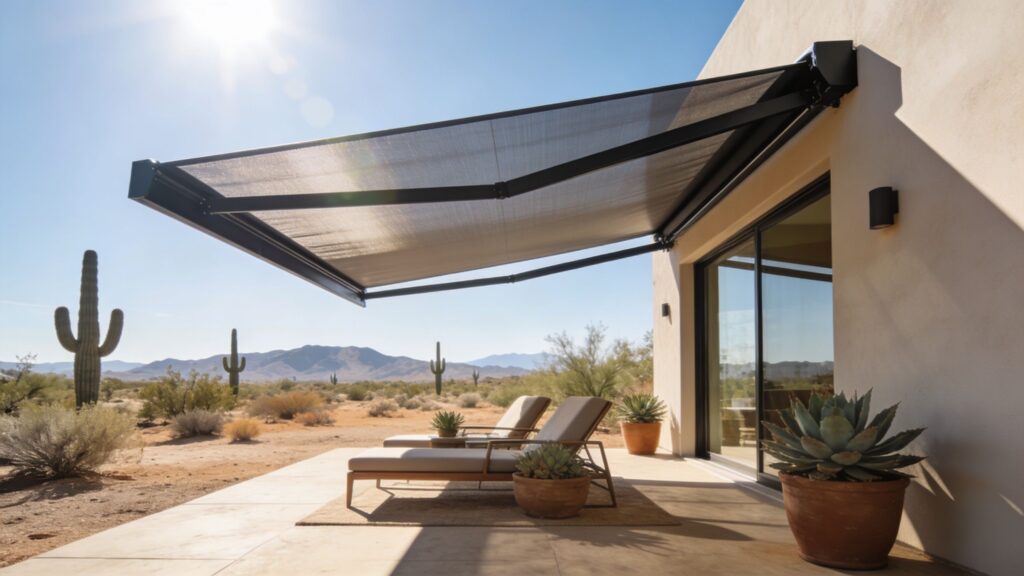
By late afternoon in Phoenix, you can feel which side of the house lost the battle with the sun. The west-facing bedrooms stay bright long after you want them cooler. The family room TV catches glare. The patio furniture gets hot enough that nobody wants to sit outside until after dark.
That's usually when homeowners start looking at outdoor sun shade screens.
Done right, they're not just a shade product. They change how a house feels in summer. The big difference is placement. These screens stop sunlight before it hits the glass, which matters a lot more in Arizona than people think. If the sun never bakes the window, the room behind it has a fighting chance.
I've seen people focus on the wrong things first. They compare color swatches, ask whether they'll still have a view, or assume every screen works about the same. In the desert, that approach costs comfort. Heat load, mesh density, wind exposure, dust buildup, and how the screen gets mounted all matter more than a brochure makes it sound.
A good setup can make a harsh room usable again. It can also make a patio feel like part of the house instead of a space you avoid half the year. The catch is that Arizona is hard on everything outside. The same sun that makes these screens valuable also tests the fabric, the fasteners, the tracks, and the maintenance schedule.
Reclaiming Your Home from the Arizona Sun
A lot of Arizona homes have the same weak spots. West-facing windows that cook a bedroom in the evening. South-facing patio openings that turn outdoor dinners into a short, sweaty experiment. Sliding glass doors that dump glare across the floor every afternoon.
Outdoor sun shade screens solve those problems in a very direct way. They block and filter solar exposure before it reaches the glass or the people sitting behind it. That's why they feel different from indoor blinds. Indoor products can darken a room, but they still let the glass heat up first. Outside screens interrupt that process earlier.
Where they help the most
The biggest improvement usually shows up in places with one or more of these conditions:
- West-facing windows: Afternoon sun in Phoenix is the punishing one.
- Large patio openings: Pergolas, covered patios, and outdoor seating areas need more than overhead shade.
- Rooms with electronics or TVs: Glare control becomes just as important as temperature.
- Spaces with fading concerns: Flooring, furniture, and rugs take a beating from strong sun.
Most homeowners don't call these screens life-changing until the first really hot week after installation. Then they notice which room stopped feeling angry by 4 p.m.
Why Arizona changes the conversation
In milder climates, outdoor shade products can be treated as comfort upgrades. In Arizona, they're closer to heat-management equipment. The sun is intense, the exposure lasts for months, and fine dust gets into every mesh opening and track.
That means the best outdoor sun shade screens for desert homes aren't always the ones that look best in a showroom. They're the ones that hold tension, block serious sun, tolerate dust, and still function after repeated exposure to heat and wind. If a product can't handle those conditions, it won't stay impressive for long.
The Four Core Benefits of Sun Shade Screens
The value of outdoor sun shade screens comes down to four things homeowners notice. Lower heat, less UV exposure, less glare, and better daytime privacy. If a screen doesn't improve those, it's decorative more than practical.
Better cooling performance
The strongest case for exterior shading is simple. It works where the heat starts.
The U.S. Department of Energy recognizes exterior shades as the most effective window treatment for reducing solar heat gain. Research shows they are 8% to 10% more effective than interior shades and can cut air-conditioning use by over 20% compared to homes with no window coverings because they block heat before it ever touches the glass, as noted in this solar shade openness comparison guide.

That's the main advantage of exterior placement. The glass doesn't become the first collector of heat. In Phoenix, that matters most on south- and west-facing exposures where the sun hits hard and stays hard.
UV protection that actually matters
A good screen acts like sunscreen for the house. It helps protect flooring, furniture, rugs, and wood finishes from constant exposure. That's especially useful in rooms with large windows and in patios where people want usable shade without fully enclosing the space.
For homeowners also thinking about privacy outdoors, some of the same design ideas used for DIY homeowners deck privacy can help frame where a shade screen makes sense and where a wall, planting, or panel might work better.
Glare control without shutting the room down
This is the benefit people often underestimate. A room can be air-conditioned and still feel miserable because of glare. Screens cut the harsh brightness that makes you close the curtains in the middle of the day. TVs are easier to watch. Laptops are easier to use. You stop squinting.
Practical rule: If you keep closing blinds every afternoon but still feel heat coming through the window area, you likely need an exterior solution, not another interior covering.
Daytime privacy with a usable view
Privacy is where trade-offs get real. Tighter screens give more privacy and stronger sun control, but they also reduce visibility more. Looser screens preserve the view better but don't hide as much.
That doesn't make one better than the other. It means you should choose based on the opening. A street-facing front room usually needs a different screen than a backyard patio overlooking a pool.
Understanding Materials and Mesh Densities
Shopping for outdoor sun shade screens gets confusing fast because manufacturers throw a lot of terms at you. Polyester. Fiberglass. openness factor. privacy weave. solar mesh. Once you strip out the marketing, two things matter most: what the screen is made of, and how open the weave is.
What the material changes
Some common exterior screens use vinyl-coated polyester mesh. SunTex 80/90 is one example, and it's widely used because it's built for exterior sun control rather than basic bug screening. Other heavy-duty systems use PVC-coated fiberglass or polyester fabrics in cassette or track-mounted assemblies.
Here's the practical version of that choice:
| Material type | What it's good at | Where it fits best |
|---|---|---|
| Standard polyester | Everyday exterior shading | Basic residential window applications |
| PVC-coated fiberglass | Strength in harsh heat | Larger openings and tougher exposures |
| High-density mesh | Strong sun and privacy control | West-facing windows and intense patio sun |

If you want a deeper primer on comparing window screen mesh types, that resource is useful for understanding how weave and material choices affect performance in general. For a local look at common residential options, this guide to window screen material types is also worth reviewing before you buy.
Openness factor works like sunglasses for your house
Openness factor tells you how tightly the fabric is woven. Standard solar shade fabrics typically range from 1% to 14% openness, and the lower the number, the tighter the weave, according to this solar shade openness comparison.
The easiest way to think about it is sunglasses:
- 1% openness: Very dark sunglasses. Strong privacy and strong blocking. A 1% screen blocks 99% of UV rays.
- 5% openness: The everyday choice for many homes. A 5% screen blocks 95% of UV rays and still keeps a usable view.
- 10% openness: Lighter sunglasses. Better outward visibility. A 10% screen blocks 90% of UV rays.
What works and what doesn't
Darker fabrics usually give a better outward view and stronger glare control than lighter fabrics. That surprises people. They assume a lighter screen feels less closed in, but from inside the house a darker mesh often looks cleaner and easier to see through.
What doesn't work is choosing based on visibility alone. In Phoenix, a screen that preserves the view but doesn't control afternoon heat well enough becomes a compromise you'll keep noticing every day.
How to Choose the Right Sun Shade Screen
The right screen depends less on the catalog and more on the opening. A patio opening has different priorities than a bedroom window. A front room facing the street has different privacy needs than a backyard slider.

Start with the exposure
Before you choose color, controls, or frame style, answer these questions:
- Which direction does it face? West-facing glass usually needs the most aggressive sun control.
- Is privacy important? Street-facing and neighbor-facing openings often need a tighter screen.
- Do you want to preserve the view? Patios and backyard openings often benefit from a more view-friendly mesh.
- Will the area stay fixed or need flexibility? Some people want permanent coverage. Others want the option to raise the screen.
A west-facing bedroom usually benefits from a tighter, darker mesh. A covered patio may do better with a screen that balances glare reduction and view-through. If the opening catches strong wind, the mounting system matters just as much as the fabric.
Choose the mounting style honestly
There's no perfect mounting option for every house. There's only the one that matches how you'll use it.
Fixed panels
Fixed screens are straightforward. They stay in place, need fewer moving parts, and work well on windows where you want constant protection. They're a solid choice when you care more about heat control than flexibility.
The downside is obvious. You don't retract them when you want an open view.
Roll-up shades
Manual and motorized roll-up shades make more sense for patios, large openings, and outdoor living spaces. They let you change the amount of shade depending on time of day, season, or whether people are using the area.
This video gives a good visual sense of how exterior shade systems function in real installations.
Track and cable-guided systems
For bigger or wind-exposed areas, guided systems hold the fabric more securely than a loose drop shade. They're often the better call for wide patio spans or openings where the wind tends to push and flap standard shades.
If a patio shade moves too much in the wind, homeowners usually blame the fabric first. More often, the problem is the wrong hardware for the opening.
Measure like the installer will
Good measurements are boring until they're wrong. Then they're expensive.
Take width in multiple places, not just one. Check height on both sides. Look for stucco irregularities, trim, handles, lights, hose bibs, and anything else that changes mounting clearance. On patios, confirm where the top mount can fasten into solid structure.
A clean, square opening gives you more options. An uneven one narrows them fast.
DIY Installation vs Hiring a Professional
Some outdoor sun shade screens are reasonable DIY projects. Others shouldn't be. The dividing line usually isn't confidence. It's project complexity.
When DIY makes sense
A basic fixed panel on a ground-floor window is manageable for a skilled homeowner with patience. If the opening is simple and accessible, the work is mostly about careful measuring, level mounting, and making sure the screen sits cleanly without twist or bow.
DIY usually fits best when the project looks like this:
- Small and reachable: Standard windows, not tall patio spans.
- Simple hardware: Fixed frame or straightforward manual setup.
- Low consequence if imperfect: A minor fit issue won't affect a major living area.
The main mistakes are predictable. People mismeasure. They mount into weak material. They leave the screen out of square. Or they under-tension a shade so it looks loose and wears badly.
When hiring a pro is the better move
Large retractable systems, second-story installs, motorized shades, and track-guided patio screens are where professional installation earns its keep. Heavy-duty exterior cassette and track systems can span over 20 feet and require precise tensioning to withstand high winds. Professional installation also matters for achieving the projected 25-35% cooling cost reductions and maximizing the product's 10-15 year lifespan, according to this guide on stock roll-up solar shades.
That's not just about labor. It's about alignment, anchoring, safe access, and getting the system to operate the way it was designed to.
A side-by-side reality check
| Installation route | Best for | Common downside |
|---|---|---|
| DIY | Small, simple, ground-level jobs | Fit and tension errors |
| Professional install | Large, motorized, wind-exposed, or elevated jobs | Higher upfront cost |
| Hybrid approach | Homeowner measures and learns first, then hires out | Requires honest self-assessment |
A clean install looks easy only after someone has solved the hard parts. On exterior shades, those hard parts are usually tension, anchoring, and alignment.
If you're unsure, ask one question. If this shade fails in wind, binds in the track, or sits crooked, are you willing to redo the whole thing?
Protecting Your Investment in the Arizona Climate
A lot of homeowners hear “low maintenance” and translate it as “ignore it.” That's the fastest way to shorten the useful life of outdoor sun shade screens in Phoenix.
Dust is the issue people overlook. Fine desert dust doesn't just sit on the surface. It works into the mesh, settles in tracks, and changes how the screen breathes and filters light. In arid regions like Phoenix, fine dust can rapidly clog screen mesh, reducing UV protection and airflow efficiency. Industry studies show that screens uncleaned for six months can lose up to 30% of their heat-blocking performance, making quarterly professional cleaning essential, according to this exterior sun control maintenance reference.

What homeowners can do themselves
Routine care doesn't need to be complicated. It needs to be gentle and consistent.
- Rinse off loose dust: Start with light water flow, not aggressive blasting.
- Use mild soap: A small amount in water is enough for most buildup.
- Brush softly: A soft brush lifts dirt without stressing the weave.
- Clean the frame and track too: Dirt in the hardware causes its own problems.
If you want a practical homeowner walkthrough, this guide on how to clean window screens covers safe basics that also apply to many exterior screen setups.
When professional cleaning matters
Patio systems, large roll-down shades, and heavily dust-loaded screens need more care than a quick hose-off. Deep cleaning has to remove embedded dust without damaging the mesh, the coating, or the tensioned assembly. That's where technique matters.
A good professional service also checks the surrounding system. Tracks, bottom bars, attachment points, and frame corners all need attention. If you're comparing local service expectations, this overview of sun screen cleaning Phoenix Arizona is a useful benchmark for what homeowners typically ask for.
Clean screens don't just look better. They perform closer to the way you paid for them to perform.
The maintenance mistake that costs the most
The biggest problem isn't dramatic failure. It's gradual underperformance. The room starts feeling hotter again. Visibility gets duller. Airflow seems worse. Homeowners blame the product when the issue is buildup.
That's why maintenance belongs in the buying decision from day one. In Arizona, an exterior screen that can't be cleaned safely and regularly becomes harder to justify over time.
Top Screen Choices and Cost for Arizona Homes
For Arizona heat, start with products designed for exterior solar control, not ordinary bug screening dressed up as a sun solution. SunTex 80/90 remains a strong benchmark for residential use. It blocks 80-90% of solar heat, has shown interior surface temperature reductions of up to 15-20°F, and can lower AC-related energy costs by 20-30% in residential settings, based on this SunTex 80/90 product reference.
Good fits for common Arizona situations
Here's the practical breakdown:
- West-facing windows: SunTex 80 or 90 style exterior screens are often the first place to look.
- Large covered patios: Heavy-duty roll-down or guided systems make more sense than lightweight loose shades.
- Homes with strong view priorities: A more open mesh may be worth it on the backyard side, even if the front gets a tighter weave.
- Dust-heavy locations: Pick systems that can be cleaned without fighting the design.
About cost
Price is where a lot of articles get careless, and on this point, homeowners require honest expectations. The actual cost depends on opening size, material, operation type, hardware quality, and how difficult the install is. Fixed window screens are usually the simpler and less expensive route. Motorized patio systems, cassette housings, and guided tracks cost more because the hardware and installation are more involved.
For budgeting, the most useful approach is to compare categories rather than chase generic national averages. This local guide to window screen replacement cost is a better starting point than broad numbers that may not match Arizona conditions.
What I'd prioritize first
If budget is limited, don't spread it thin across every opening. Start where the sun hurts the most. Usually that means west-facing glass, then the main patio opening, then any room where glare or fading has become a daily annoyance.
That order tends to produce the fastest improvement in comfort. And in Arizona, comfort is what tells you whether the screen was worth it.
If you're in the Phoenix area and want help keeping screens, glass, and exterior openings in working shape, Sparkle Tech Window Washing handles window cleaning, screen service, and maintenance with the kind of desert-specific care these systems need.