

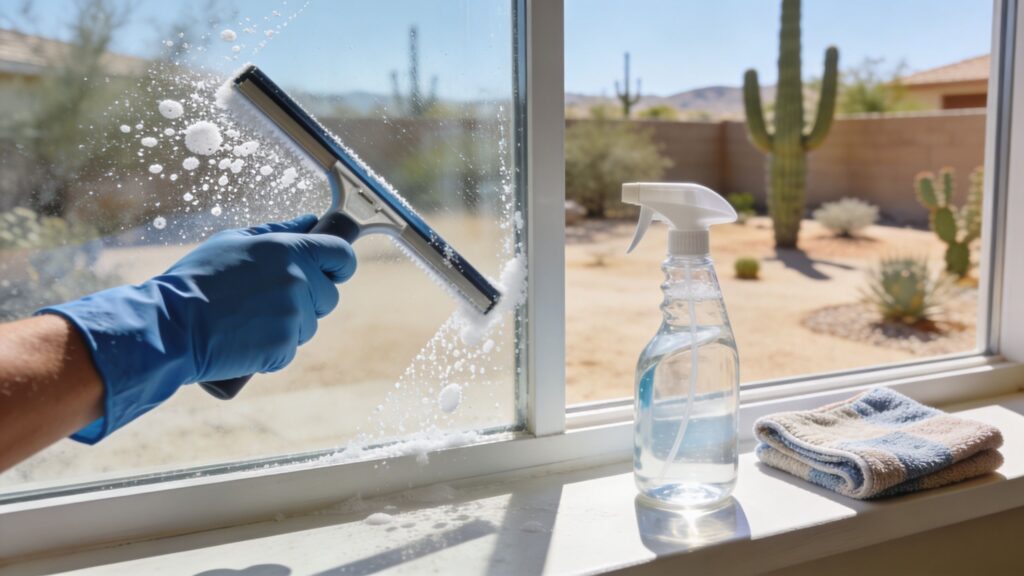
You wash the window. It looks clean while it’s wet. Then the sun hits it, and every chalky ring, white dot, and cloudy patch shows up again. That’s the moment most homeowners start searching for a glass cleaner for water spots and realize regular glass spray isn’t built for this job.
In Phoenix and across Arizona, this problem shows up on house windows, shower glass, patio glass, solar panels, and railings. Some spots are fresh mineral deposits and come off with the right cleaner. Others have already changed the glass itself. If you don’t know which one you’re dealing with, it’s easy to waste time scrubbing, buy the wrong product, or scratch the surface trying to fix what cleaner alone can’t fix.
Understanding Why Your Glass Has Water Spots
Those white marks aren’t random dirt. They’re usually mineral deposits left behind after water evaporates. In hard-water areas, the water carries calcium, magnesium, and other dissolved minerals. When the water dries, the minerals stay on the glass.

What hard water means on glass
Hard water is measured in grains per gallon, or gpg. Water at 0 to 3 gpg is soft. 5 to 7 gpg is moderate. Over 7.5 gpg is considered hard, and that’s where mineral buildup becomes a serious issue. Over 85% of U.S. households experience some degree of hard water, with Arizona averaging 10 to 15 gpg according to USGS data. Water over 7.5 gpg is considered hard and is a primary cause of mineral deposits on glass, which can lead to permanent etching if not properly addressed (Unger hard water overview).
That local piece matters. In the Phoenix valley, sprinklers, hose rinses, monsoon residue, and tap-water washing all leave mineral traces behind fast. Then the heat bakes those deposits onto the surface.
Why they get worse over time
Fresh spots sit on top of the glass. Older spots don’t always stay there. Minerals can settle into the microscopic pores of the surface. Once that happens, you stop dealing with a simple cleaning issue and start dealing with damage.
Practical rule: If water spots keep coming back in the same place after normal cleaning, the issue usually isn’t the spray bottle. It’s the water source, the drying pattern, or damage already forming in the glass.
This same basic chemistry shows up on vehicles too. If you want a parallel example outside home glass, The Mobile Buff has useful detailing advice for car owners that explains why mineral-heavy water leaves visible spotting on smooth surfaces.
Some glass also behaves differently depending on how water spreads or beads on it. If you want to understand that side of the equation, this breakdown of hydrophilic and hydrophobic glass helps explain why some panes sheet water and others hold droplets that dry into spots.
Your First Line of Defense with DIY Cleaners
Start simple. If the spots are recent and light, a household acid usually works better than a standard blue glass spray. The most practical first step is a 50/50 mix of white vinegar and water.
How to use a vinegar mix correctly
The reason vinegar works is straightforward. Mild acid helps loosen fresh mineral deposits. A common mistake involves the process. They spray, wipe immediately, and expect old buildup to vanish.
Use this order instead:
- Mix evenly. Combine equal parts white vinegar and water in a spray bottle.
- Wet the glass well. Don’t mist lightly. Cover the spotted area.
- Let it dwell. Give it a few minutes so it can work on the deposit.
- Wipe with microfiber. Use a clean microfiber cloth, not a paper towel.
- Buff dry with a second cloth. That last pass matters if you want a clear finish instead of streaks.
If the stain is patchy and fresh, this often does enough. If it only improves a little, repeat once before moving up to a stronger product.
What else you can try
Lemon juice can help for the same reason vinegar can. It’s acidic, easy to find, and useful on mild spotting. But it’s still a light-duty option. If the deposits have sat through heat, repeated sprinkler exposure, or many failed cleanings, don’t expect citrus to solve it.
A couple of practical mistakes to avoid:
- Don’t scrub dry glass. You want lubrication on the surface.
- Don’t use rough pads. A kitchen scrubber can leave marks.
- Don’t judge the result while the pane is still wet. Water can hide residue.
Fresh spots respond to simple chemistry. Old spots usually need stronger chemistry, better technique, or both.
For more homemade mixes and tool choices, Sparkle Tech has a guide to homemade window cleaning solutions that pairs well with this first-step approach.
Upgrading to Commercial Glass Cleaners
If vinegar helped but didn’t finish the job, you’re in the range where a dedicated glass cleaner for water spots makes more sense than another round of DIY mixing. This is where product formulation matters.

What to look for in a real water spot remover
Not every glass cleaner is designed to dissolve mineral scale. Some are built mainly for fingerprints, dust, and grease film. For hard water, look for products sold specifically for mineral deposits, lime scale, or hard water stain removal.
Consumer Reports has highlighted specialized cleaners such as Invisible Glass, Sprayway, and Windex as strong performers in glass-cleaning evaluations, with dedicated formulas standing out over general-purpose options for stubborn spotting (Consumer Reports glass cleaner ratings).
The practical trade-off is simple:
- General glass cleaners are easier for daily wipe-downs.
- Hard water removers are more targeted and usually stronger.
- Stronger products demand more care around edges, coatings, and nearby surfaces.
DIY and commercial options side by side
| Attribute | DIY Cleaners (Vinegar, Lemon Juice) | Commercial Cleaners (Specialized Formulas) |
|---|---|---|
| Best use | Fresh, light mineral spots | Older, stubborn mineral buildup |
| Cost | Low | Higher |
| Ease of access | Immediate, household supplies | Need to buy the right product |
| Speed | Slower on set-in residue | Faster when matched to the stain |
| Surface risk | Lower when used gently | Depends on formula and surface |
| Expectation | Good starting point | Better for deposits that won’t lift easily |
Where commercial cleaners help most
Commercial products are useful when the spotting is visible from inside and outside, when sprinklers hit the same glass repeatedly, or when the stain outline stays after vinegar treatment. In those situations, purpose-built removers save effort.
Boat owners deal with the same issue on exterior glass exposed to minerals and sun. Boat Juice has a solid guide on how to remove tough water spots from windshields, and the same lesson applies to house glass: once spots get baked on, a standard cleaner usually isn’t enough.
If the label only talks about shine and streaks, it may not do much for mineral scale.
For readers comparing product types, our page on window washing fluid explains how cleaning liquids differ depending on what’s on the glass.
A note on delicate surfaces
Be careful with solar panels, coated glass, and glass railings. The strongest cleaner isn’t automatically the right cleaner. Some formulas cut mineral deposits well but aren’t ideal for specialty coatings. On those surfaces, mild and coating-safe beats aggressive every time.
One practical example is Sparkle Tech Window Washing, which uses water-spot treatments as one option in a broader cleaning approach depending on whether the issue is loose residue, bonded minerals, or suspected etching.
How to Handle Stubborn Stains and Etched Glass
Here’s the mistake that costs homeowners the most time. They assume every water spot is removable if they just find a stronger cleaner. That isn’t true.
Some spots are still sitting on the surface. Others have already etched the glass. When that happens, the deposit may be gone, but the mark remains because the glass itself has been altered.
The quick diagnostic
Do a simple rub test on a small area after cleaning it.
- If the spot changes or softens, you’re likely dealing with surface mineral residue.
- If it stays exactly the same, especially after repeated acid cleaning, there’s a good chance you’re looking at etching.

This distinction matters because an estimated 70% of "stubborn" water spot queries on homeowner forums are cases of misdiagnosed etching, where the minerals have physically altered the glass surface, making chemical cleaners ineffective and requiring professional abrasion or polishing (etching discussion and pro demonstration).
What can work on true stubborn deposits
If the mark is still a deposit and not etched damage, you can sometimes step up to wet 0000 steel wool or a dedicated polishing compound. The key word is wet. Dry friction is where people get into trouble.
Use this method carefully:
- Lubricate the glass with glass cleaner or your chosen solution.
- Test a tiny corner first.
- Use very light pressure.
- Stop and inspect often.
This is not a casual scrub-and-see job. It can work on mineral residue that cloths won’t lift, but it can also scratch the wrong surface or damage coated glass if used carelessly.
If you feel like you need to bear down harder to make progress, stop. Pressure is usually where DIY turns into damage.
When cleaner isn’t the answer
Etched glass doesn’t respond like a normal stain because the surface has changed. That’s why another bottle of cleaner often leads nowhere. At that point, the conversation shifts from cleaning to correction, and sometimes full correction isn’t realistic without visible trade-offs.
That’s the part most online guides skip. They keep recommending vinegar, baking soda, or another spray long after the problem has stopped being removable residue.
Simple Prevention to Keep Water Spots Away
The easiest water spot to remove is the one that never dries on the glass in the first place.

Dry the water before minerals stay behind
A squeegee is still one of the most practical prevention tools you can own. On shower glass, patio enclosures, and lower windows that get hit by sprinklers, removing the water right away interrupts the whole mineral-deposit cycle.
For railings and exterior glass barriers, this matters even more because they catch spray, dust, and sun from every angle. If you maintain glass fencing or rail panels, this Ottawa glass pool fences guide is useful for understanding how exposed glass surfaces collect residue and why regular maintenance matters.
Change the water, not just the cleaner
If hard water is a recurring issue at your house, a water softener can reduce the mineral load before it ever reaches the glass. That doesn’t replace cleaning, but it changes how aggressively spots form and how fast they come back.
A sealant can help too. A hydrophobic treatment encourages water to bead and roll off instead of sitting flat and drying in place. That’s helpful on windows, shower glass, and some railings, as long as the product is suitable for that surface.
This quick video shows the general maintenance mindset well:
A good routine is simple:
- Watch sprinkler aim so irrigation doesn’t hit windows every morning.
- Dry glass after rinsing when possible.
- Use the right protectant for glass that stays exposed.
When to Call Sparkle Tech for Professional Help
DIY makes sense when the spots are light, low, and easy to test safely. It stops making sense when the glass is high, expensive, coated, or showing signs of etching.
Professional help is the smart move in a few specific situations.
The jobs that shouldn’t be guesswork
Call a pro when:
- The windows are hard to reach. Second-story glass changes the safety equation fast.
- The surface is specialized. Solar panels and coated architectural glass need the right process.
- The spots survived multiple cleaning attempts. That usually means the problem is no longer basic residue.
- You want a spot-free rinse. Tap water often re-creates the same issue you’re trying to remove.
Why pure-water systems change the result
The biggest difference in professional exterior cleaning is the rinse water. Professional pure-water systems, using deionization and reverse osmosis, remove up to 100% of total dissolved solids (TDS) from rinse water. Field tests show this method achieves 95 to 98% spot-free results on the first pass (professional window cleaning reference).
That matters because even a perfectly scrubbed window can spot again if it’s rinsed with mineral-heavy water. Pure water solves the problem at the rinse stage. It sheets off the glass and dries without leaving dissolved solids behind.
The cleaner removes the stain. The rinse determines whether the window stays clear.
For severe spotting, professionals may also combine pre-treatment, agitation with the right brush, and spot-specific correction techniques. That’s especially useful on solar panels, exterior railings, and glass that’s been exposed to Phoenix hard water for a long time.
If your windows still show white spots after you’ve tried vinegar, commercial cleaner, and careful scrubbing, it’s probably time for a proper assessment instead of another experiment. Sparkle Tech Window Washing handles residential glass, solar panels, railings, and other hard-water problem areas across Arizona, using professional methods that address both the stain itself and the rinse process that often causes spots to come right back.