

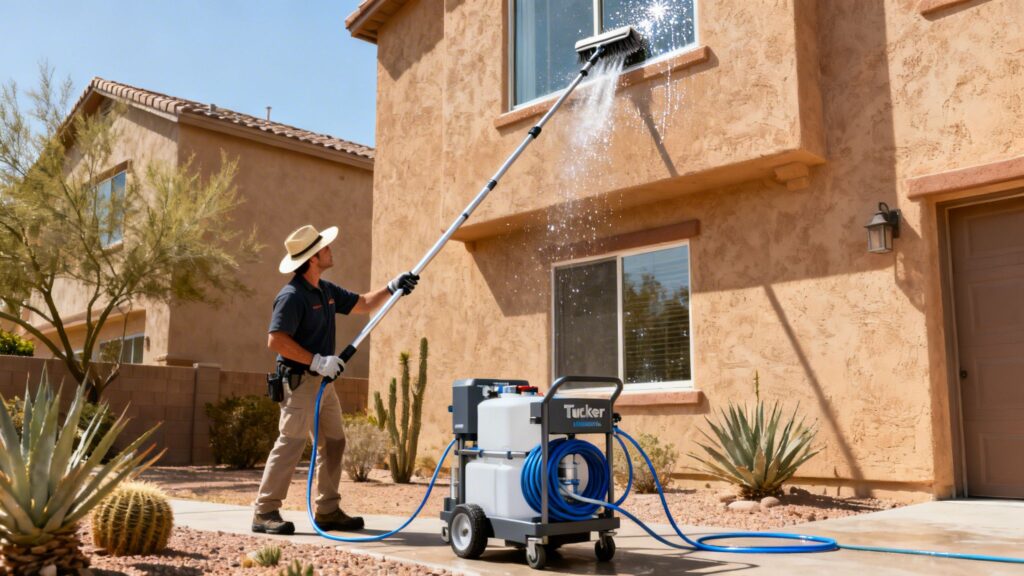
If you've spent any time in the professional window cleaning world, you've heard about water-fed poles. A Tucker water fed pole isn't just another tool; for many of us, it's the piece of equipment that completely changes the game. It’s a move away from ladders and toward a system that delivers a perfect, spot-free shine using purified water.
This isn't just about reaching a high window. It's a fundamental shift in how we think about safety, speed, and the quality of our work on both residential and commercial properties.
Why Pros Swear By Tucker Water Fed Poles

For any professional cleaning windows under the hot Arizona sun, a water-fed pole is less of an upgrade and more of a necessity. Forget climbing rickety ladders or the endless, repetitive motions of using a squeegee. At Sparkle Tech, we consider our Tucker water fed poles an essential part of our operation—they’ve completely reshaped our business from the ground up.
The magic is in the water itself. These poles connect to a purification system that filters regular tap water, stripping out all the minerals and impurities. The goal is to get the water to zero Total Dissolved Solids (TDS). When you scrub and rinse a window with this "pure water," it evaporates completely clean, leaving behind absolutely no spots or streaks.
The result is a flawless finish that traditional methods just can't replicate, especially on sun-baked glass. Clients always notice the difference, and that alone elevates the value of your service.
Beyond a Spot-Free Shine
But a perfect shine is only part of the story. The real impact is on how you run your business day-to-day. This method transforms three critical areas:
- Radically Improved Safety: Keeping both feet on the ground eliminates the single biggest risk in our industry: falling from a ladder. Suddenly, cleaning second-story windows or dealing with tricky architectural glass becomes a low-risk, routine part of the job.
- A Major Boost in Efficiency: You can clean windows in roughly half the time it takes with a ladder and squeegee. This isn't a small improvement. It means you can fit more jobs into your day, which directly translates to more revenue.
- Incredible Versatility: The same system you use for windows is perfect for cleaning solar panels, glass deck railings, and other non-porous surfaces. This allows you to easily add new, in-demand services to your offerings.
This shift toward safer, more effective tools isn't just happening here and there. The industry is moving away from risky, old-school methods, with the global market for these services projected to grow by 14.1% annually through 2032. This growth is a direct reflection of the clear-cut advantages that systems like Tucker water fed poles provide. You can dig into the numbers and see the financial impact for yourself by exploring detailed industry reports.
Choosing the Right Tucker Pole for Arizona Jobs
Picking the right Tucker pole is one of the first, and most important, decisions you'll make in your pure water cleaning journey. This isn't just about buying a piece of equipment; it's a strategic investment that will directly impact your speed, safety, and profitability on every job, from a single-story ranch in Mesa to a sprawling custom home in Scottsdale.
Your choice really boils down to three things: the pole's material, its length, and how stiff it is. Get these right, and you're setting yourself up for success.
Material Makes the Difference
For anyone working daily under the hot Arizona sun, the pole’s material is everything. The big debate always comes down to carbon fiber versus aluminum. While an aluminum pole might seem like a good, budget-friendly option to start, its limitations become obvious pretty quickly. Once you try to go higher than 20-25 feet, they get heavy and wobbly, making precise control nearly impossible. They're fine for ground-floor work, but that's about it.
This is where a carbon fiber Tucker water fed pole completely changes the game. They are dramatically lighter and far more rigid than aluminum. That rigidity is the key—it means less flex when you’re scrubbing a window 30 or 40 feet in the air. You get better pressure on the glass and more control, which means a better clean. The lighter weight also saves your back and shoulders over a long, hot day.
Think of it this way: you're tackling a big two-story home with lots of high, awkward windows. With a heavy, flexing pole, you're not just cleaning; you're fighting your equipment all day. A stiff carbon fiber pole lets you work faster and more efficiently, turning a brutal job into a profitable one.
The bottom line is that for professional, daily use in Arizona's residential market, a carbon fiber pole isn't a luxury—it's the smart business choice. The increase in efficiency and reduction in physical fatigue provide a return on investment that you'll feel immediately.
To help you decide, here’s a quick breakdown of how these materials stack up for typical jobs you'll encounter around the valley.
Tucker Pole Material and Length Guide for Arizona Jobs
| Material | Best For | Typical Lengths | Key Advantage |
|---|---|---|---|
| Aluminum | Ground-floor, single-story homes, or as a starter pole. | 15-25 ft | Low initial cost. |
| Hybrid | Occasional 2-story work; a good middle-ground option. | 25-35 ft | More rigid than aluminum without the full cost of carbon fiber. |
| Carbon Fiber | Daily professional use, 2-story+ homes, large residential jobs. | 30-50+ ft | Lightweight and extremely rigid, reducing fatigue and improving control. |
Ultimately, investing in a high-quality carbon fiber pole is an investment in your own endurance and the quality of your work.
Matching Pole Length to Arizona Homes
Once you've settled on carbon fiber, the next question is how long of a pole you actually need. You don’t want to be caught short on a job, but you also don’t want to be hauling around an excessively long pole for no reason.
From my experience cleaning homes all over Phoenix, Scottsdale, and Chandler, a pole in the 30 to 45-foot range is the sweet spot for the vast majority of residential work.
This length gives you more than enough reach for almost any two-story home, even those with tricky walk-out basements or high gable windows. A 45-foot pole, in particular, gives you the confidence to bid on virtually any residential project that comes your way without ever worrying about access.
Selecting the Right Brush for the Job
Of course, the pole is just the delivery system; the brush at the end is what does the real work. Choosing the right one is critical for getting spotless results without damaging surfaces.
Here’s a quick guide to the brushes you should have in your arsenal:
- Boar's Hair Brushes: These are your heavy-hitters. The stiff bristles are fantastic for a first-time clean where you're dealing with months or years of baked-on grime.
- Nylon Brushes: For routine maintenance cleans or delicate surfaces, a softer nylon brush is the perfect tool. They’re also what you should be using for solar panels, as aggressive bristles can cause micro-scratches.
- Hybrid Brushes: These offer the best of both worlds, combining the scrubbing power of boar's hair with the gentle touch of nylon. It's an excellent all-around choice for most situations.
A water-fed pole is a powerful tool, but it's just one part of a complete professional setup. To see how it fits into a full system, you can learn more by reading our guide on the best window cleaning tools. Having the right combination of pole and brush means you’re ready for anything the job throws at you.
Your First-Time Tucker Pole System Setup
Getting a new Tucker pole out of the box is a great feeling. But the real key to a smooth, profitable first day is nailing the initial setup. Let's go over how to assemble your system the right way, with a few pro tips you won't find in the instruction manual.
The goal here is simple: connect everything so it works flawlessly in the field. That means managing your hose to avoid those infuriating kinks, getting a leak-free connection to your purification system, and making sure you have a perfect, steady stream of pure water hitting the glass. A little patience now saves a ton of headaches later.
Assembling the Core Components
First, lay out your pole, hose, and brush. Carefully extend each section of your Tucker water fed pole. A common rookie mistake is cranking down on the clamps; make them snug and firm, but don't overtighten. You can easily crush the carbon fiber or strip the clamp over time.
Next, you'll thread the hose through the pole. Be sure to leave enough slack at the top. You want to connect the brush without putting any tension on the fitting, which can cause it to wear out or leak prematurely.
Once the hose is through, attach your brush head. Most Tucker brushes use a standard thread, but double-check that it’s screwed on tight. Nothing is worse than having a brush wobble around when you're trying to clean a window 30 feet in the air.
Pro Tip: Before you connect your pole to your pure water system, do a quick flush. Just connect your hose reel to a garden spigot and run water through it into a bucket for a minute. This clears out any dust or debris from the factory that could clog the tiny jets on your brush.
This one simple step can save you from the frustrating discovery of a weak or uneven spray pattern right when you're ready to start cleaning.
This diagram really simplifies how to think about matching your gear to the job.

As you can see, your equipment choices are a direct response to the demands of the job site, from the height of the windows to the type of dirt you're up against.
Connecting to Your Water Source
Now it's time to connect your hose reel to your water purification system. For us here in Arizona, this is non-negotiable. Our tap water is loaded with minerals, so you have to run it through a DI (deionization) tank or a full RO/DI (reverse osmosis/deionization) cart.
- Test Your Water Religiously: Get out your TDS meter and test the water coming out of the pole before it touches any glass. Your reading absolutely must be 0 PPM (Parts Per Million). Anything higher, and you’re guaranteed to leave mineral spots as the water evaporates in our intense sun.
- Don't Blast the Glass: You don't need a high-pressure jet of water. A steady, gentle flow is actually far more effective for scrubbing and rinsing. It also helps conserve your pure water and prevents the glass from flash-drying before you can perform the final rinse.
With everything hooked up, turn on the water and give every connection a once-over for leaks, from the tank all the way to the brush. Even a tiny drip can waste gallons of pure water and cut into your profits.
To see how all these pieces fit into the bigger picture, take a look at our complete guide to a water-fed pole window cleaning system. Getting this setup right from the start makes all the difference and ensures your first job with your new Tucker is a success.
Mastering Safe and Efficient Pole Technique
A tucker water fed pole is a game-changer for safety, no doubt about it. Keeping your feet firmly on the ground is always better than climbing a ladder. But here’s the thing: just owning a pole doesn't automatically make you a pro. The real difference between an exhausted amateur and an efficient professional who can work all day without wrecking their body comes down to technique.
The safety improvement is massive. A deep dive by OSHA showed that over a 15-year period, the vast majority of the 62 window cleaning fatalities were from ladder falls or high-rise rope accidents. These are risks that a water-fed pole practically eliminates for most residential and mid-rise jobs. With over 35,344 window cleaning businesses in the U.S. now, these tools have made the industry dramatically safer. You can see pros discussing these very safety studies on WFP use and what it means for them.
Posture and Pole Control
Your body is your most valuable asset in this business, so protecting it is priority number one. When you have a pole extended high in the air, the natural tendency is to lean back and use your lower back to counterbalance the weight. Don't do it.
Instead, get into a wide, athletic stance with your knees slightly bent. This forces you to engage your core and leg muscles, creating a stable base and taking the pressure off your spine. Think of your body as the anchor for the pole; the work should come from controlled movements in your arms and shoulders, not from heaving your back into it.
A great little trick to save your shoulders is what I call the "push-pull" or "rowing" motion. Forget about big, sweeping swings from side to side. Use short, controlled strokes to scrub the glass. This method gives you better agitation and stops the pole from turning into a giant pendulum that will wear you out fast.
Efficient Scrubbing and Rinsing
Working efficiently isn’t just about moving fast—it's about moving smart. The goal is to get maximum brush contact on the glass without pushing so hard that you’re fighting the pole.
Here’s a simple, field-proven method I use on every job:
- Get the Angle Right: Tilt the pole so the bristles are lying flat against the glass. You want the whole brush working for you, not just the tips. This cleans a much wider path with every single pass.
- Top-Down is the Only Way: Always, always start scrubbing at the very top of the window frame and work your way down. Gravity is your friend here; it pulls the dirty water down and out of the way, setting you up for a perfect rinse.
- The Final Rinse: This step is just as critical as the scrub. Once all the grime is agitated, lift the brush just a hair off the glass. Let a clean sheet of pure water flow from the top frame all the way down, carrying away every bit of loosened dirt.
When you nail these techniques, the tucker water fed pole feels like a natural extension of your body, not a heavy tool you have to wrestle with. This focus on ergonomics is key to a long, sustainable career. To really get into the nitty-gritty of why this works so well, check out our guide to pure water window cleaning.
Keeping Your Equipment in Peak Condition

Let's be honest—your Tucker water-fed pole is a core part of your business, and it only makes you money when it's working right. Proper, consistent maintenance is what separates the true professionals from the folks who are constantly sidelined by frustrating, preventable equipment failures.
Think of it like a pilot's pre-flight checklist. A few minutes of care before you leave for a job can save you from major headaches and lost time in the field. After all, a well-maintained pole and purification system not only lasts longer but delivers the perfect, spot-free results your clients are paying for.
Your Daily Maintenance Checklist
Before you even think about heading to your first job of the day, set aside five minutes to give your gear a once-over. This simple habit will save you hours of trouble down the line. Trust me, it's always better to find a small problem in your own driveway than on a client's property with the sun beating down.
Here’s a quick rundown I do every single morning:
- Pole Inspection: I always extend and collapse the pole completely. As you do, check every single clamping mechanism. You want them to be snug, but not so tight you're fighting them. Take a close look for any stress marks or tiny cracks in the carbon fiber, paying special attention to the areas around the clamps.
- Hose Check: Run your hands along the entire length of the hose. You're feeling for any kinks, rough spots from abrasion, or weak points that look like they're ready to spring a leak. I always double-check the connection points at the reel and the brush, as that's where most of the wear and tear happens.
- Brush Head and Jets: Give your brush a good look. Are the bristles getting frayed or matted down? A tired brush just smears dirt around instead of scrubbing it off. More importantly, make sure your rinse bar or pencil jets are totally clear. A single clogged jet can ruin a rinse and leave nasty water spots.
The Heart of Your Operation: Your Purification System
Out here in Arizona, the water purification system isn't just part of the setup—it's the most critical component. Our tap water has notoriously high TDS (Total Dissolved Solids), which means our filters are always working overtime. Knowing exactly when to change them is a skill you have to master.
The only number that matters is the one on your TDS meter. It should always read 0 PPM. The moment you see it creep up to 1, 2, or even 5 PPM, it's time to swap out your DI resin. Don't wait. Even a low TDS reading will leave spots on glass that's baking in the Arizona sun.
If you're running an RO/DI system, get in the habit of glancing at your pressure gauges. A big drop in pressure is a tell-tale sign that your RO membranes are getting clogged up and need a good cleaning or a full replacement. With our hard water, you should expect to burn through DI resin much faster than your RO membranes.
Focusing on pure water also gives you a huge environmental advantage. Water-fed poles are at the leading edge of eco-friendly cleaning, using only deionized water to lift and rinse away grime without any harsh chemicals. This approach can cut detergent use by up to 100 liters per month in larger facilities. It's a key reason why this technology is taking off in water-conscious places like ours. You can read the full research about these eco-friendly cleaning trends to see just how big the industry impact is.
Troubleshooting Common Field Issues
Even with the best maintenance routine, things just go wrong sometimes. When they do, the key is to have a quick fix ready so you can get back to work. Here’s how to handle the most common problems I've run into:
- Leaky Fittings: Nine times out of ten, a leak is caused by a worn-out O-ring. Do yourself a favor and keep a small bag of assorted O-rings in your truck. It's a two-minute fix that can save a job.
- Low Water Pressure: Don't panic. First, walk your hose line and check for any obvious kinks. If the hose is clear, the next culprit is usually your brush jets. A paperclip or a small pin is often all you need to clear a blockage and get the water flowing again.
- Sudden Water Spots: You were getting a perfect finish, and now suddenly you're seeing spots. The first thing you should do is pull out your TDS meter and re-test the water coming out of your pole. Your DI resin probably just gave out. This is exactly why every pro I know keeps a spare DI filter on the truck at all times. It's a true lifesaver.
Common Questions About Tucker Water Fed Poles
No matter how long you've been in the business, new gear brings new questions. We've spent years using Tucker water fed poles on jobs all over Arizona, and a few key questions pop up again and again. Here are the straight-up answers we give other pros, based on what we've learned in the field.
Can I Use a Tucker Water Fed Pole with Tap Water in Arizona?
I get this one a lot, and the answer is always a hard no. You can hook up your pole to a tap, but the results will be a disaster.
Arizona's water is notoriously hard. It's loaded with minerals—calcium, magnesium, you name it—which means our Total Dissolved Solids (TDS) readings are sky-high. If you spray that on a window, the water evaporates under our intense sun and leaves all those minerals behind. You’ll trade dirt for a permanent, spotty mess.
That's why a purification system is non-negotiable. It's the "pure water" part of pure water window cleaning. Whether you run a simple DI (deionization) tank or a full RO/DI (reverse osmosis/deionization) setup, the goal is the same: get your water down to 0 PPM TDS. Trust me, investing in a purification system isn't an upsell; it's fundamental to getting the spot-free finish that keeps clients happy.
What Is the Best Technique for Very Dirty Windows?
When you come across windows caked with months of dust and grime—a common sight after a monsoon—a quick scrub-and-rinse just won't cut it. You need a more deliberate approach to break through that built-up layer.
I always start with a more aggressive brush, like a boar's hair or a hybrid, to really dig in. Wet the glass and give the entire surface a thorough scrubbing. Don't just tickle the dirt; you want to agitate everything. I make sure to hit the frames and corners hard, since that's where dust loves to build up. Don't rinse yet! Let the pure water and the brush's agitation do the hard work of breaking everything down.
After you've loosened all the grime, it's time for the final rinse.
Start your rinse at the top of the window frame, letting a solid sheet of pure water flow down the glass. This creates a waterfall effect that carries every bit of loosened dirt down with it, leaving absolutely nothing behind to spot up. It’s this final, methodical rinse that guarantees a perfect finish on those really tough jobs.
How High Can I Realistically Clean with a Tucker Pole?
Tucker offers poles that can reach some serious heights, even up to 60 feet for handling five-story buildings. But let's talk about what's realistic for all-day work. The true limit depends on the pole's material and, frankly, your own strength and technique.
For the vast majority of residential work in the Phoenix area—think two-story homes, houses on hills, or those tall gable windows—a pole in the 30 to 45-foot range is your money-maker. A good 45-foot pole gives you the confidence to tackle pretty much any residential job that comes your way without hesitation.
Here's where the material really matters. A carbon fiber pole is much lighter and far more rigid than an aluminum or fiberglass one. That rigidity is key. When you're extended out past 30 feet, a flimsy pole becomes a nightmare to control. You'll waste energy just trying to keep the brush on the glass, leading to sloppy work and a worn-out operator. Investing in carbon fiber isn't about luxury; it's about being effective and efficient at height.
Ready to upgrade your equipment and see the difference a professional system can make? The team at Sparkle Tech Window Washing relies on top-tier gear to deliver flawless results on every job. Explore our services and see how we can make your property shine by visiting us at https://sparkletechwindowwashing.com.