



Sunlight is unforgiving. The window that looked fine last week suddenly shows dust, fingerprints, sprinkler spots, and a film you can't ignore once the morning light hits it. If guests are coming, the house is going on the market, or you're tired of looking through haze instead of glass, that search for window cleaning near me starts fast.
What matters next is slowing down just enough to hire the right company.
A lot of homeowners treat window cleaning like a quick commodity service. It isn't. Someone may be working around delicate glass, screens, painted sills, landscaping, tile floors, and sometimes higher access points around your home. This is also a real industry, not just a casual side hustle. The U.S. window-washing industry employs over 100,000 people and was projected to grow 13% between 2020 and 2028, according to Window Genie's industry statistics summary. That matters because a mature market brings both solid professionals and plenty of companies that sound similar online.
A good hire protects more than curb appeal. They protect your time, your property, and your confidence that the crew walking around your home knows what they're doing.
Beyond the Search Bar Finding the Right Professional
Typing window cleaning near me into Google gives you a list. It doesn't give you judgment. The company with the cheapest line in the preview isn't automatically the company you want on your property.
A strong local company should make you feel informed before you ever book. Their website should explain what's included, how they handle access, and what kinds of add-on services need special treatment. If you want a useful comparison point, Sparkle Tech's window cleaning guide is a practical example of the kind of homeowner-focused information that helps you sort real service details from generic promises.
What the search result can't tell you
Search rankings don't show whether a company protects floors indoors, whether they reinstall screens correctly, or whether they know the difference between routine glass cleaning and mineral stain removal. They also don't tell you how a crew behaves once they're inside your home.
That's why homeowners should look past slogans like “streak-free” and “professional.” Those terms are easy to write and harder to prove.
Practical rule: Hire the company that answers your specific questions clearly, not the one that gives the fastest vague quote.
Start with the job you actually need
Before you call anyone, define the scope in plain language:
- Glass location: Interior, exterior, or both.
- Access concerns: High windows, narrow side yards, or fragile landscaping.
- Extra buildup: Hard-water staining, heavy dust, paint specks, or bug debris.
- Related work: Screens, tracks, sills, solar panels, or screen repair.
That short list helps you compare companies on the same job instead of collecting random estimates for different scopes. It also helps you recognize when you're better off with a specialist rather than a general cleaner. If you're unsure whether your windows need a routine visit or a more involved service, this guide on knowing when to call a professional window washing company is a good starting point.
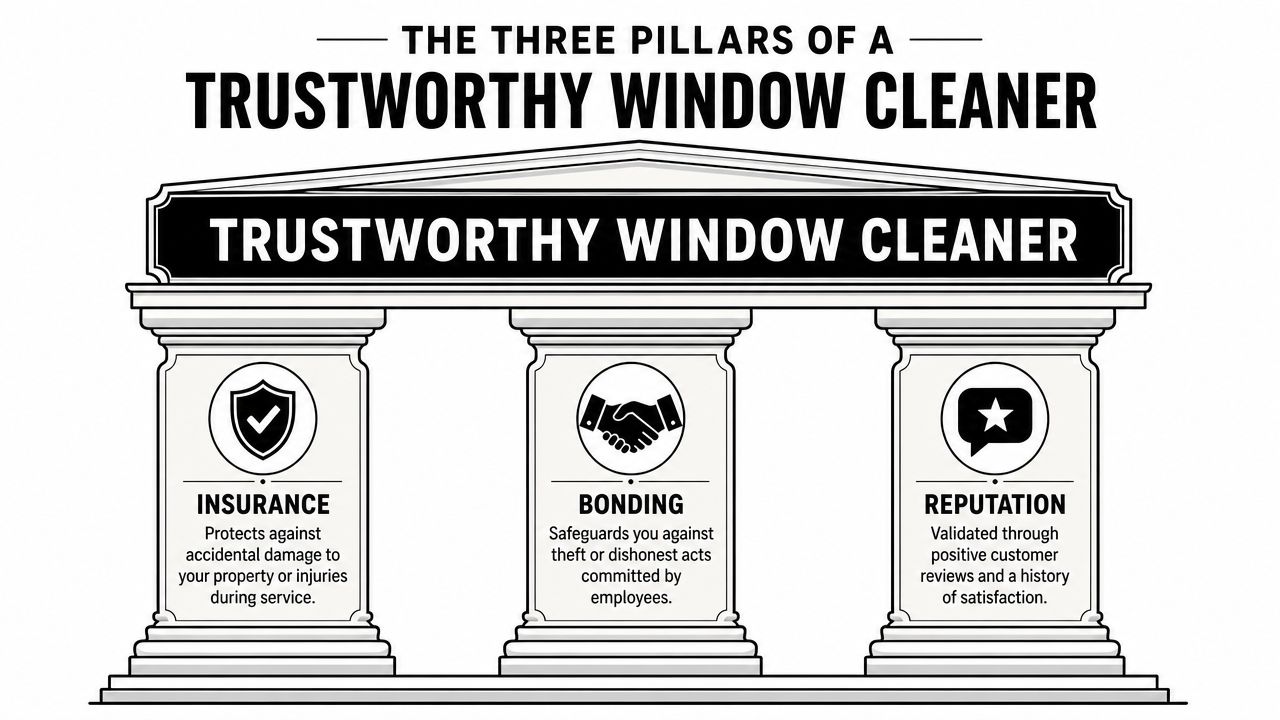
The Three Pillars of a Trustworthy Window Cleaner
A lot of local pages say they're insured, bonded, and reliable. Very few explain what that means for you as the homeowner. That gap matters. Window Genie's Wichita page points out that trust and accountability are often handled superficially in local search results, even though homeowners care about the practical differences between insured, bonded, and licensed providers.
Insurance means protection when something goes wrong
If a technician scratches glass, damages a frame, or knocks over something on your property, general liability insurance is the layer that may respond. For a homeowner, this is the first thing to verify because accidents don't have to be dramatic to become expensive.
The second piece is workers' compensation. If a worker gets hurt on your property, you don't want that risk floating back toward you because the company cut corners on coverage.
Ask for a current certificate of insurance. Don't feel awkward about it. A professional company should expect the question.
Bonding is different from insurance
A bond is not the same thing as general liability. Homeowners often hear both words and assume they overlap. They don't.
Think of it this way:
- Insurance is designed for accidental damage or injury-related exposure.
- Bonding is about protection tied to dishonest acts or failure to fulfill obligations, depending on the bond and the situation.
- Licensing or registration relates to legal standing and compliance where applicable.
If a company says it's bonded, ask what kind of bond they carry and what it covers. If they can't explain it clearly, that's useful information.
Homeowners shouldn't have to decode contractor language. A trustworthy cleaner should explain coverage in plain English and provide documentation without resistance.
Reputation is the proof behind the paperwork
Paperwork matters. So does pattern recognition.
Look for reviews that mention details such as punctuality, care inside the home, communication, handling of screens, and whether the final bill matched the original scope discussion. A pile of short reviews that only say “great job” tells you less than a few thoughtful ones that describe the actual experience.
Here's the standard I'd use:
- Ask for proof: Certificate of insurance, business name, and service details in writing.
- Check consistency: Reviews should match what the company says about itself.
- Watch how they answer questions: Good operators don't get defensive when you ask about liability, workers' comp, or damage procedures.
One Arizona-based option in this category is Sparkle Tech Window Washing, which states that it carries Workers Compensation, General Liability Insurance, and bonding, and is registered in Arizona. That doesn't remove the need to verify any provider's current documentation. It shows the kind of concrete information a homeowner should expect from any serious company.
From Shortlist to Hire The Vetting Process
Once you've got a few names, don't ask only “How much?” Ask, “How do you work?” The quote matters, but the process tells you whether the result will be smooth or frustrating.
What to look for before you call
A company's website can tell you a lot without saying it directly. If service descriptions are vague, that usually carries over into vague quoting. If the site clearly separates standard window cleaning from harder tasks like stain removal, screen work, or track detailing, that's a better sign.
Pay attention to these signals:
- Service clarity: Do they explain interior vs. exterior service?
- Real scope language: Do they mention screens, tracks, sills, or specialty surfaces?
- Local relevance: Do they sound like they understand Arizona conditions, or could the page belong to any city?
- Photos that match the work: Look for residential jobs that resemble your home, not just generic stock imagery.
Read reviews for patterns, not stars
A company can have a strong rating and still be a poor fit for your job. Read enough reviews to catch recurring themes. You're looking for operational habits.
Useful review clues include:
- Communication: Did they confirm arrival times and explain delays?
- Respect for the home: Did they use shoe covers, protect floors, and clean up?
- Problem handling: If something was missed, did they come back and fix it?
- Scope honesty: Did the final invoice match the work discussed?
A review becomes valuable when it describes behavior, not just satisfaction.
Ask local, direct questions
When you call, don't turn it into an interrogation. Keep it neighborly and direct. Good companies usually answer without script-reading because they know their process.
Here's a comparison table you can use.
| Question Category | What to Ask | Why It Matters |
|---|---|---|
| Credentials | Are you insured, bonded, and can you provide current proof? | Confirms whether the company can back up its claims. |
| Worker protection | Do you carry workers' compensation for your crew? | Helps you understand whether labor risk is properly covered. |
| Scope | What exactly is included in your standard window cleaning? | Prevents confusion about glass only versus screens, tracks, and sills. |
| Access method | How do you handle high or hard-to-reach windows? | Reveals whether they use safer, professional access methods. |
| Specialty work | Do you handle hard-water stains, solar panels, or screen repair? | Shows whether they can match the real needs of an Arizona home. |
| Home protection | What do you do indoors to protect floors, furniture, and window areas? | Tells you how careful the crew will be inside the house. |
| Quoting | Is your quote fixed for the agreed scope, or could it change on site? | Reduces surprise charges and helps you compare bids fairly. |
| Scheduling | What happens if weather or access conditions change on service day? | Clarifies how the company handles delays and safety calls. |
| Payment | When is payment due, and what forms of payment do you accept? | Avoids awkward surprises at the end of the appointment. |
| Follow-up | If I notice a missed spot after the crew leaves, what is your process? | Shows how the company stands behind the completed work. |
Narrow the list like a contractor, not a shopper
Once you've spoken with a few companies, eliminate the ones that are fuzzy on scope, evasive about insurance, or too quick to quote without questions. A competent window cleaner usually asks about home size, access, window type, and any special concerns before giving a meaningful estimate.
The right hire often isn't the lowest number. It's the company that makes it easiest to understand what you're paying for and easiest to trust once the work begins.
Decoding Quotes and Specialized Services in Arizona
Window cleaning quotes confuse homeowners for one simple reason. Two companies can use the same words and mean different scopes.
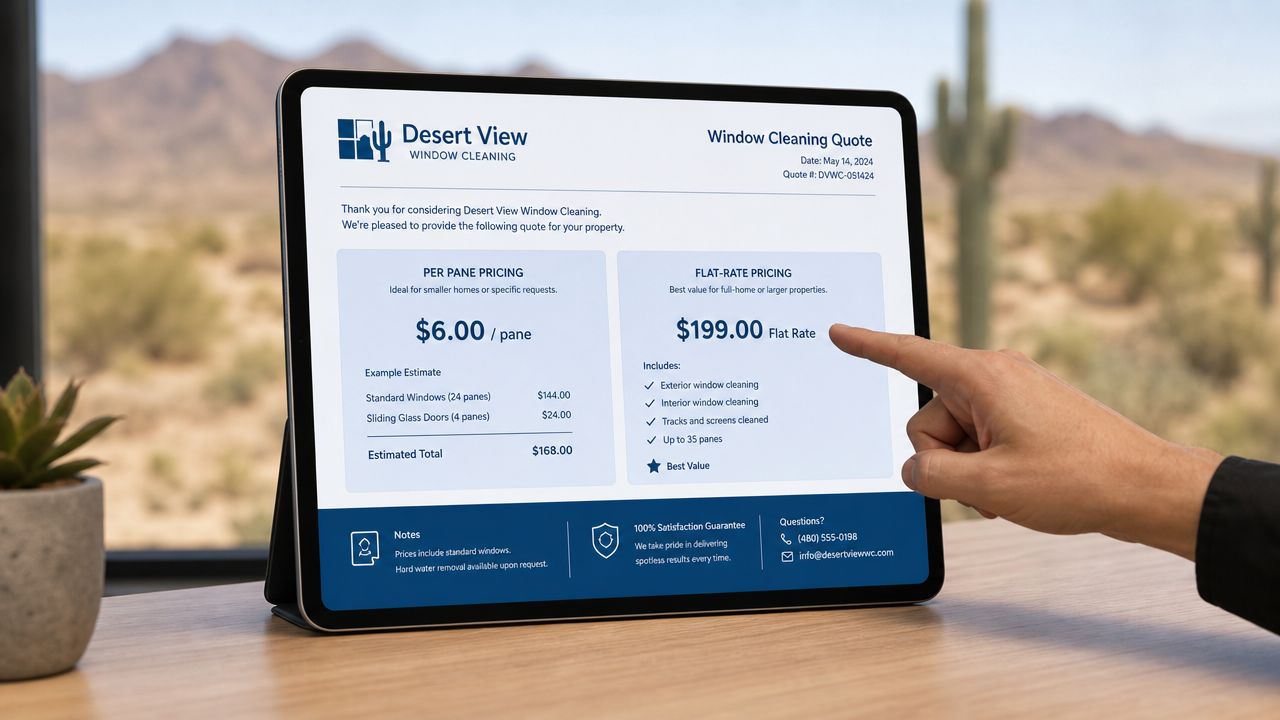
A realistic starting point is that the national average cost to clean windows is reported around $120 to $170, while one marketplace page places average pricing around $165 to $180, according to Thumbtack's window cleaning pricing page. That same page shows why estimates vary so much. Some jobs are priced at about $3 per exterior window or $4 to $5 for interior plus exterior service. It also lists add-ons such as $1 per window for water-stain removal, $8 per double-hung window, $9 per French door, and separate charges that can start at $199 for interior and exterior cleaning, $16 per exterior-only window, $5 each for screen shampoo, and $10 each for sill or track cleaning.
What changes the quote
The biggest driver of price is scope, not just house size. A quote for exterior glass only is not comparable to a quote that includes interiors, screens, and sill detailing.
Look for these line items when comparing bids:
- Glass coverage: Exterior only versus inside and outside.
- Window type: Standard panes, French doors, sliders, or specialty windows.
- Detailing level: Basic wipe-down versus tracks, sills, and frames.
- Correction work: Hard-water stain treatment is not the same as a maintenance clean.
A homeowner who asks only for “window cleaning” often gets a number that sounds good but doesn't include the work they expected.
Why Arizona homes need better scope matching
Phoenix-area homes create their own kind of quote confusion. Glass may be dusty, but dust isn't always the main issue. In many neighborhoods, the bigger problem is mineral buildup from sprinklers and irrigation overspray. That kind of staining may need specialty treatment, and results can depend on how long the deposits have sat on the glass.
Solar panels complicate the conversation too. A company might clean windows well and still not be the right fit for solar panel care. Homeowners should ask what method is used, what surfaces are included, and whether the provider separates standard glass cleaning from more sensitive exterior work.
If the quote doesn't describe the problem, it probably won't solve the problem.
That's why Arizona homeowners should insist on plain scope language. Ask whether the estimate includes standard cleaning, stain treatment, screen cleaning, track work, and any related services you care about. If you want a more detailed sense of how pricing structures are commonly framed, this guide on how much window cleaners charge is useful context before you compare local estimates.
Specialty services are where value shows up
A cheap quote can become expensive if it leaves behind the things bothering you most. In Arizona, those are often:
- Hard-water stain removal: Different from routine soap-and-squeegee work.
- Screen cleaning or repair: Important when desert dust collects fast.
- Track and sill cleaning: Easy to overlook, highly visible afterward.
- Solar panel cleaning: A separate service question, not an automatic inclusion.
The best quote is the one that matches the home, the glass condition, and the surrounding surfaces. That's what turns a search for window cleaning near me into a smart local hire instead of a disappointing appointment.
Your Home Prep Checklist for a Flawless Service Day
A smooth service day starts before the crew rings the bell. Good prep protects your belongings, speeds up the work, and helps the technicians focus on the glass instead of navigating avoidable obstacles.
Industry safety guidance also makes something clear. The first step should be a site risk assessment, and safer alternatives such as telescopic water-fed poles should be used whenever possible because falls are the main hazard in this trade, as explained in Window Hero's safety guidance for multi-story homes.
What to do before the crew arrives
You don't need to deep-clean your house for the cleaners. A few practical steps are enough.
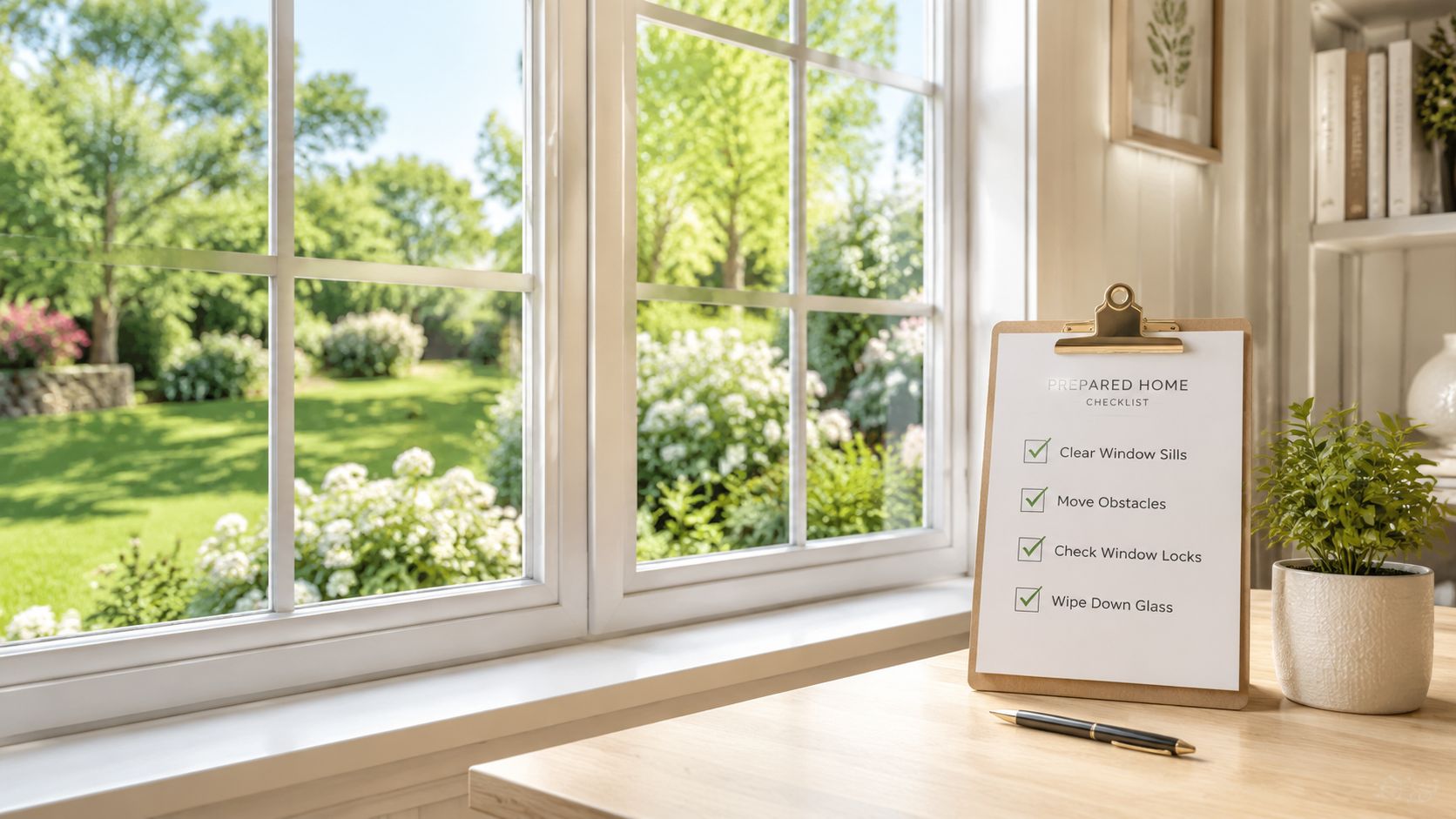
- Clear the window areas: Move plants, framed photos, candles, and small decor off sills.
- Create floor space: Pull fragile furniture or breakables a little away from interior windows.
- Secure pets: Keep dogs and cats in a safe, separate area so doors aren't swinging open during service.
- Make access points available: Gates, side yards, and rooms with windows should be easy to reach.
- Flag concerns early: Mention sticky screens, cracked panes, sprinkler-heavy sides of the house, or spots you especially want checked.
What a professional team should do
You should expect visible care from the crew, not just clean glass at the end. Professional habits matter.
A well-run team should:
- Protect interiors: Use drop cloths or towels where needed and respect flooring.
- Work methodically: Remove and reinstall screens carefully instead of rushing them.
- Adjust for conditions: If wind, rain, or heat creates a poor cleaning window, they should say so.
- Choose safer access: Ground-first planning and pole systems often make more sense than unnecessary ladder use.
If you want to prep screens ahead of time or better understand what technicians look for when handling them, this guide on how to clean window screens gives helpful context.
A short visual walkthrough can help you know what to expect on site.
Your printable checklist
Print or screenshot this before service day:
- Inside prep: Clear sills, move delicate items, secure pets.
- Access prep: Open gates, ensure room access, note any problem windows.
- Communication prep: Confirm scope, arrival window, and any specialty services.
- After-arrival check: Briefly walk the property concerns with the crew lead if needed.
That small effort makes the appointment calmer for everyone and usually leads to better results.
The Final Walk-Through and Maintaining Your Sparkle
The job isn't done when the tools are packed. It's done when you've looked at the work with the crew lead and confirmed everything matches the agreed scope.
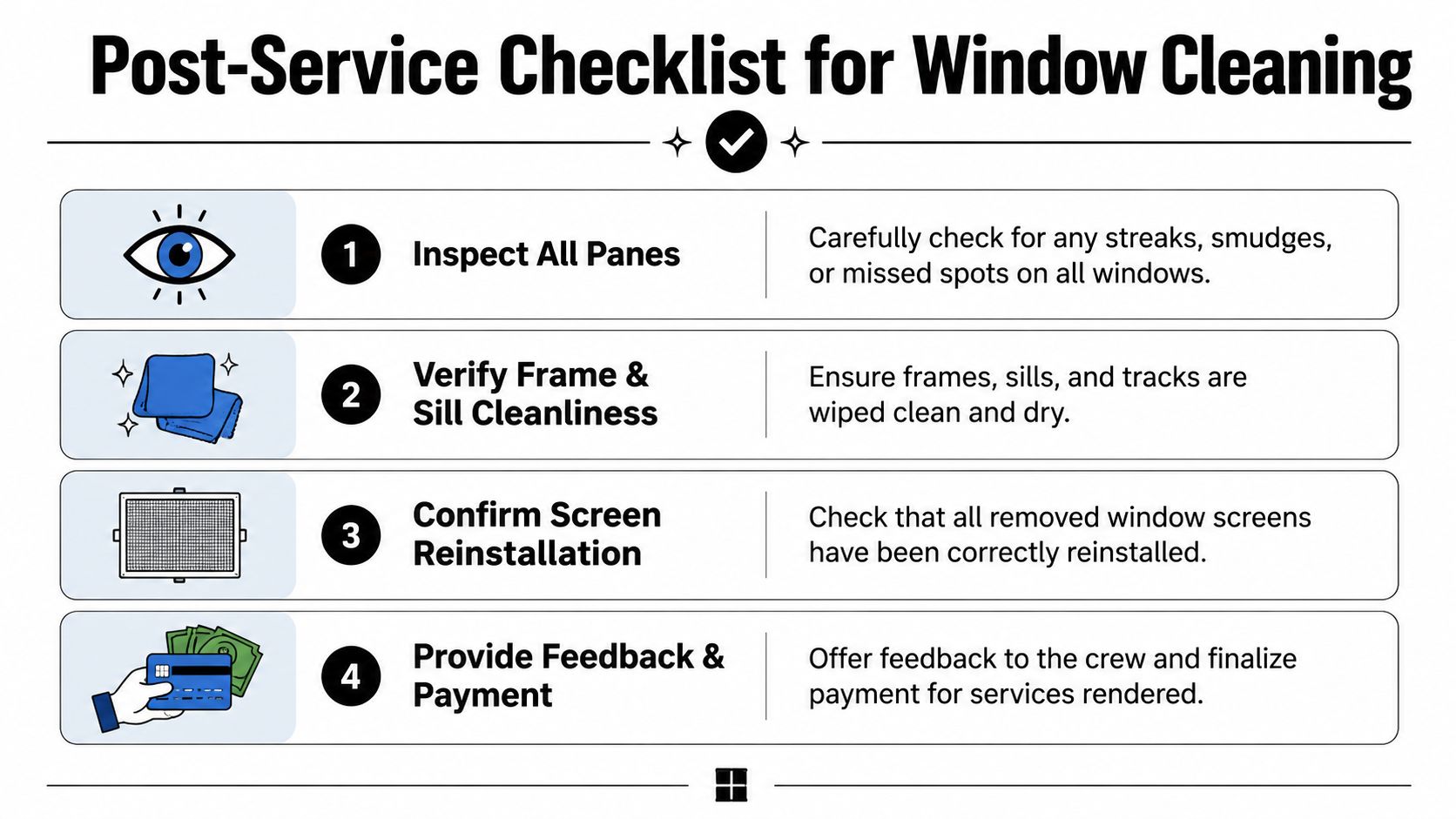
What to inspect before anyone leaves
Walk the home while the crew is still on site. Look at the glass from more than one angle because sunlight can reveal residue that shade hides. Check corners, lower edges, and any windows that had heavier buildup.
Focus on these points:
- Glass clarity: Look for streaks, drips, fingerprints, or missed edges.
- Tracks and sills: Make sure the level of detail matches what you purchased.
- Screen fit: Confirm screens are back in place and seated correctly.
- Surrounding area: Check that furniture, decor, and access points were left in order.
The final walk-through shouldn't feel confrontational. It's a quality-control step that gives the crew a fair chance to correct anything small before they drive away.
Turn one service into a workable routine
Once you find a company that communicates well and respects your home, keeping your windows in shape gets easier. In Phoenix, maintenance timing depends on your environment. Homes near active roads, desert dust, irrigation overspray, or lots of sun exposure usually need more attention than sheltered homes with limited exterior buildup.
A simple rule works well. Schedule cleaning when the glass starts bothering you before the deposits become harder to remove. That's especially true with mineral spotting and neglected screens.
If the company did good work, leave an honest review that mentions specifics. Future homeowners benefit most from reviews that describe punctuality, care inside the home, clear quoting, and how the crew handled any issues. That kind of feedback helps better companies stand out and makes your own next booking easier too.
If you're in Phoenix or elsewhere in Arizona and want a company that handles residential window washing, screen service, and related exterior cleaning with clear scope and documented protections, Sparkle Tech Window Washing is one local option to consider.