

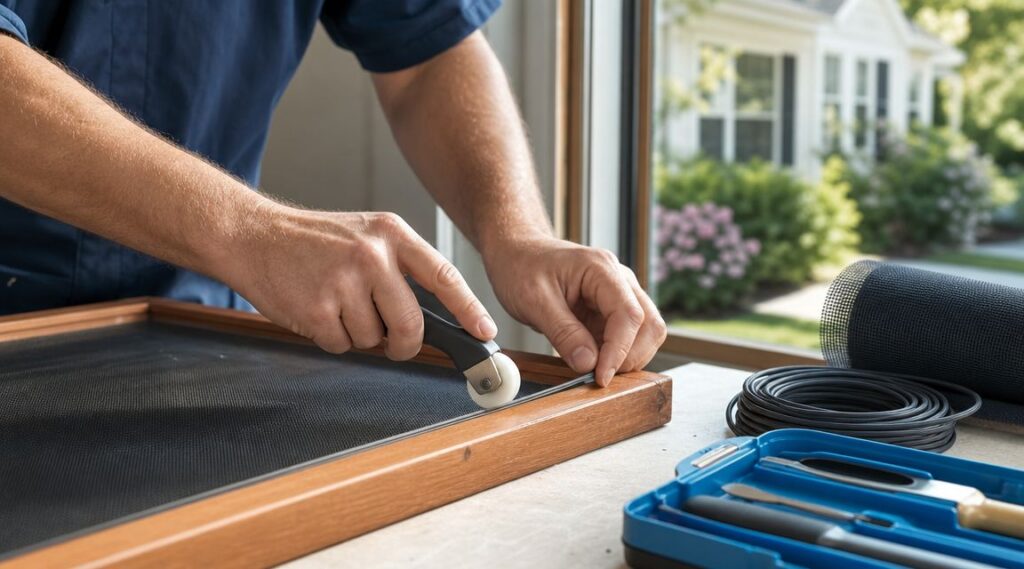
You notice the problem on a hot afternoon. You crack the window for some air, and the screen flexes at one corner, a small tear opens wider, and dust starts finding its way inside. That is usually when homeowners start searching for local window screen repair, but the smart first step is not calling around for prices. It is figuring out what kind of problem you have.
In Phoenix, that call matters. I see screens that look fine from ten feet away and fall apart once they come out of the frame. Sun, dust, and repeated use wear mesh and spline differently, so a quick patch can be a reasonable short-term fix on one screen and a waste of time on the next.
A good decision starts with a plain assessment. Some screens have one clean puncture and plenty of life left. Some need new mesh because the material has gone brittle. Others have frame damage, loose corners, or worn spline channels, which changes the job completely. If you are not sure what material you are looking at, this guide to common window screen material types helps you spot the difference before you buy repair parts.
The goal is simple. Spend a few minutes checking the screen, then decide whether this is a 15-minute DIY fix, a full rescreen, or a job better handed to a local pro.
Is Your Window Screen Damaged or Just Worn Out
A torn screen isn't always the main problem. Sometimes the hole is small and the rest of the screen is still solid. Other times the mesh has aged out, and the tear is just the first visible sign.

Start with the mesh
Stand inside with daylight behind the screen and inspect the full panel, not just the obvious damage. You're looking for three things:
- Single-point damage. One puncture or one short tear often means the rest of the mesh may still be serviceable.
- Brittle mesh. If the screen feels dry, crunchy, or weak at the touch, the material is wearing out.
- Multiple weak spots. If you see several tiny splits, fraying edges, or spots where the weave looks thin, a patch won't last long.
In Phoenix, heat and dust are rough on screens. Existing guidance often misses the practical call on repair versus replacement, especially in hot, dusty markets where repeated re-screening from UV wear can turn into false economy. A marketplace source notes repair is often cheaper at $65 to $150, but for some homes a full replacement with better material is the better long-term move (repair versus replacement guidance).
If the mesh tears easily when you press near the damaged area, you're not dealing with one problem. You're dealing with an aging screen.
Check the spline and frame
The spline is the rubber cord that locks the mesh into the frame. If it's pulled out, cracked, or shrunken in the corners, the screen may look torn when the actual failure is edge retention.
Look over these trouble spots:
- Corners pulling loose. This usually means the mesh has lost tension or the spline isn't holding.
- Bent frame rails. Even a mild bend can keep a screen from sitting flat in the window.
- Twisted frame shape. If the frame rocks on a flat surface, it may not be worth a simple rescreen.
- Loose fit in the opening. A screen that won't stay seated often has frame issues, not just mesh issues.
Material matters too. If you're not sure whether you have standard fiberglass, aluminum, pet-resistant, or solar mesh, this guide to window screen material types helps you identify what you're working with before you approve any repair.
A simple field test
Remove the screen and lay it flat. Press lightly across the middle of the mesh and then around the perimeter.
If the center gives a little but stays even, that's normal. If one side sags more than the other, if the corners ripple, or if the mesh looks loose near the groove, the screen is probably past patch territory and into rescreen or rebuild territory.
Quick DIY Triage What You Can Fix in 15 Minutes
Some problems are worth a quick garage-level fix. Not every damaged screen needs a service call the same day.
Good candidates for a temporary DIY fix
If the damage is minor and the frame is still square, you can often buy time with basic tools.
- Tiny hole from impact. A small adhesive screen patch can keep bugs out for now.
- Short split near the center. A patch works if the surrounding mesh is still strong.
- One corner of spline lifting. You can sometimes press it back into the channel if the spline isn't brittle or stretched.
- Missing pull tab with otherwise solid mesh. That's usually a small parts issue, not a full screen failure.
If you want a basic walkthrough before deciding whether to try it yourself, this page on how to repair window screens is a useful starting point.
What doesn't usually hold up
DIY tends to go wrong when people try to fix tension without the right process. A durable professional repair is usually a full rescreen, not a patch. That means removing the old spline, replacing the whole mesh, and using a spline roller to create even tension because weak tension leads to wrinkling and sagging (professional rescreen process).
Here's the short version of what works and what doesn't:
- Patch the hole if the rest of the mesh is healthy. This is a stopgap, not a reset.
- Reseat a popped spline only if it still feels flexible. Brittle spline usually pops back out.
- Stop if the mesh has gone loose across the panel. Once tension is uneven, the repair quality drops fast.
- Don't cut repair material flush. Flush edges tend to fail sooner.
Practical rule: If you're spending more time fighting wrinkles than making progress, the screen is asking for a full rescreen.
The 15-minute decision
DIY triage makes sense when your goal is temporary bug control and the rest of the screen is still structurally sound. It doesn't make sense when the damage is near the edge, the frame is bent, or the mesh is sun-weakened across more than one area.
That's the difference many homeowners miss. The question isn't just "Can I fix this?" It's "Will this still look and work right after the next few weeks of heat, dust, and regular window use?"
Deciding Between DIY Repair and Hiring a Professional
Cost, time, and finish quality all come into play. A lot of homeowners think DIY automatically saves money. Sometimes it does. Sometimes it just turns one damaged screen into a crooked one.
When DIY makes sense
DIY is reasonable if the screen is easy to remove, the frame is intact, and the damage is limited to a very small area. It's also a fair option if you don't care much about appearance and you only need a temporary fix.
If you have one simple problem on one accessible window, patching it yourself can be worth the effort.
When a pro is the smarter call
Professional mobile screen repair isn't some brand-new app-based service category. It's a long-established local trade. Some mobile screen businesses have been operating since 1964, and others since 1982, which tells you this model has been built around on-site convenience for decades (mobile screen service history).
That matters because convenience isn't just a bonus. It's often the whole point. You don't have to pull every screen, load them into a vehicle, guess on material, and hope they fit right when you bring them back.
| Factor | DIY Repair | Professional Service |
|---|---|---|
| Damage type | Best for tiny holes or a minor popped spline | Better for tears, sagging mesh, worn spline, or frame issues |
| Tools needed | Patch kit, utility knife, possible spline tools | Technician arrives with mesh, spline, rollers, and fitting tools |
| Finish quality | Depends on your tension control and trimming | More consistent fit, tension, and edge finish |
| Time | Fast if the issue is truly small | Faster overall when multiple screens need work |
| Material choice | Limited to what you buy in advance | Easier to match material to use case |
| Risk | Easy to end up with wrinkles or loose edges | Better choice when fit and durability matter |
A homeowner test I trust
Ask yourself these three questions:
- Do you have more than one damaged screen?
- Is any screen on an upper window, oversized opening, or awkward frame?
- Do you want the repair to last, not just hold for now?
If you answered yes to any of those, a professional visit usually makes more sense.
A patch solves a hole. A proper rescreen solves the screen.
One practical middle ground is to DIY the tiny issue and hire out the rest. That's common. Homeowners often patch one guest-room screen, then call a mobile service for the brittle patio-side and sun-facing screens where fit, material, and tension matter more.
How to Find and Vet a Local Screen Repair Pro
A search for repair window screen near me gives you a mix of handymen, hardware-store pages, and actual mobile screen specialists. Those are not the same thing.
Ask about on-site service first
One of the biggest gaps in online advice is convenience. Many homeowners want a technician who can measure, fit, and finish in a single visit, and that's a key question to ask when comparing providers (on-site same-day service guidance).

When you call, don't start with "How much per screen?" Start with this:
- Can you repair on-site, or do screens need to be taken away?
- Can you measure, fit, and finish in one appointment?
- Do you handle bent frames, or only mesh replacement?
- What materials do you stock on the truck?
- Is there a minimum trip charge or service minimum?
If you're trying to judge whether a local company is established and visible enough to trust, it also helps to understand what a real local listing should include. This explainer on understanding Google Business Profile for local SEO gives useful context on how legitimate local service businesses show up and manage their presence.
Check trust signals, not just star ratings
Reviews matter, but they shouldn't be the only filter. For work done at your home, ask direct questions.
Are you a registered LLC, and are you fully insured and bonded?
For Phoenix homeowners, that matters. A family-owned company like Sparkle Tech's screen repair service is one example of a provider that states its window screen repair and replacement service, along with insurance, bonding, and LLC registration details, so customers can verify those basics before booking.
Also ask these before you commit:
- Material options. Do they offer standard fiberglass, pet-resistant, or solar-oriented screen materials if needed?
- Repair limits. Will they tell you when replacement is smarter than repeated patching?
- Frame capability. Can they rebuild or replace damaged frame sections on-site?
- Quote clarity. Are you getting a per-screen price, a service minimum, or a whole-job quote?
Green flags and red flags
A good screen pro answers in plain language. They can explain why one screen should be rescreened and another should be rebuilt.
A weak provider usually says some version of "we can fix anything" without asking about frame condition, spline failure, screen type, or how many units you have. That's a warning sign. Screen work is simple only when the screen itself is simple.
What to Expect for Pricing and Materials
The quote usually comes down to one question. Are you paying for fresh mesh in a solid frame, or are you paying for a screen that has been cooked by Phoenix sun, packed with dust, and bent enough that it no longer sits right?

What the Price Ranges Mean
For a homeowner, the useful way to read a screen repair quote is by job type, not by a single average number. A small patch on one screen is the low end. A full rescreen costs more. A frame rebuild, corner replacement, new spline, or upgraded mesh pushes the price higher because the labor changes, not just the material.
In Phoenix, service minimums matter. One loose bathroom screen may cost more per unit than six patio and bedroom screens done in the same visit. That is why I tell people to pull every screen and inspect them before they book. Sun-facing windows, sliders near the yard, and rooms that collect the most dust usually show the wear first.
Here is what usually changes the number:
- Screen size. Larger screens take more mesh and more care to tension without waves.
- Mesh type. Standard fiberglass costs less than pet-resistant or solar-control material.
- Frame condition. Good frames keep the work simple. Bent or cracked frames add labor and parts.
- Corner and spline wear. Old rubber spline and brittle plastic corners often fail during rescreening.
- Quantity. Bundling several screens usually brings the per-screen cost down.
A cheap quote can still be expensive if the screen sags in six months or the frame goes back in crooked.
Why one material works better than another
Standard fiberglass is the default for a reason. It is affordable, easy to rescreen, and works fine on many homes. If the goal is to restore airflow and keep bugs out, it often does the job well.
Pet-resistant mesh is tougher, but it is not the right answer for every opening. It holds up better where dogs or cats push against the screen, though it is heavier and can be harder on older frames if the frame is already weak. Solar or sun-control screen can help with glare and heat on harsh exposures, but it also changes visibility and airflow. Some homeowners like that trade-off. Some do not.
In Phoenix, heat matters more than people expect. Mesh that sits on west-facing windows takes a beating. If the old screen is brittle, faded, and pulling away at the corners, paying for another patch usually does not make sense. A full rescreen with the right material lasts longer and looks better.
This short video gives a useful look at screen materials and handling before you approve a quote:
The cheapest screen repair isn't the one with the lowest ticket. It's the one you don't have to redo soon.
Common Screen Repair Questions
Can a torn screen be repaired without replacing the whole screen?
Sometimes, yes. A tiny hole or short tear can be patched if the surrounding mesh is still strong. If the mesh is loose, brittle, or torn near the edge, a full rescreen is usually the cleaner fix.
Is a bent frame repairable?
A slight bend might be correctable. A twisted, cracked, or badly warped frame usually keeps causing fit problems, even with new mesh. In that case, replacement or rebuild is often the better call.
What should I ask before booking a local screen repair service?
Ask whether they work on-site, whether they can finish in one visit, what mesh options they carry, and whether they handle frame damage or only mesh replacement. Also ask how they price grouped repairs so you can decide whether to bundle several screens into one appointment.
If you want help from a local company that also handles window screen service in Arizona, Sparkle Tech Window Washing provides on-site window-related services and lists its business details, including family ownership, LLC registration, insurance, and bonding, so homeowners can verify who they're hiring before scheduling.