

You’re probably looking at second-story glass right now that catches every bit of Arizona sun. The lower windows are manageable. The high ones are dusty, spotted, and streaked just enough to bother you every time you pull into the driveway.
That’s where high window cleaning stops being a simple chore and turns into a specialty trade. Height changes the tools, the risks, the workflow, and the margin for error. In dry climates, heat and airborne dust add another layer. A method that works fine on a cool morning in a mild climate can fail badly on hot glass in Phoenix.
Homeowners often assume the main problem is reach. Reach matters, but it’s only part of it. Key issues include safe access, water purity, drying conditions, wind control, and knowing when a window should not be cleaned a certain way. Good results come from matching the method to the glass, the building, and the weather.
The Challenge of Those Hard-to-Reach Windows
A common homeowner scenario goes like this. You notice the upstairs windows after a dust storm or after the sun hits them late in the afternoon. From inside, they look hazy. From outside, they look worse. You grab a ladder, a hose, a brush, and then you realize the angle is awkward, the ground isn’t perfectly level, and the windows are higher than they looked from below.
That’s the first reality of high window cleaning. Height changes everything fast. Even on a two-story home, you’re dealing with unstable footing, limited reach, body positioning, and the temptation to stretch just a little farther than you should.
In a hot, arid climate, there’s a second problem. The glass itself works against you. Heat bakes the surface. Dust settles quickly. Water can flash off before you’ve fully rinsed, which leaves mineral residue and streaks behind.
Why generic advice often fails
A lot of general cleaning advice assumes moderate temperatures, low dust, and calm conditions. That’s not how many Arizona jobs go. The practical challenge isn’t just getting water onto the glass. It’s keeping the process controlled long enough to remove grime and let the surface dry clean.
High windows don’t forgive rushed work. If the method is wrong, the mistakes stay visible from the street.
There’s also a difference between “reachable” and “serviceable.” A homeowner may technically reach a high pane with a consumer pole or ladder. That doesn’t mean they can scrub the frame, rinse thoroughly, protect nearby landscaping, avoid spotting, and do it safely.
What homeowners are usually up against
- Height and angles: Upper windows often sit above rooflines, narrow side yards, or decorative landscaping that limits ladder placement.
- Dust buildup: Fine desert dust clings to frames, tracks, and screens, then redistributes onto the glass during a sloppy rinse.
- Sun exposure: Direct sunlight accelerates drying and exposes every missed pass.
- Mixed materials: Painted trim, stucco, screens, and solar shading features can complicate how water and tools should be used.
The good news is that modern methods have made this work much safer and more effective than it used to be. The best residential results usually come from keeping the cleaner on the ground, controlling water quality, and treating climate conditions as part of the job instead of an afterthought.
Modern Methods for Cleaning High Windows
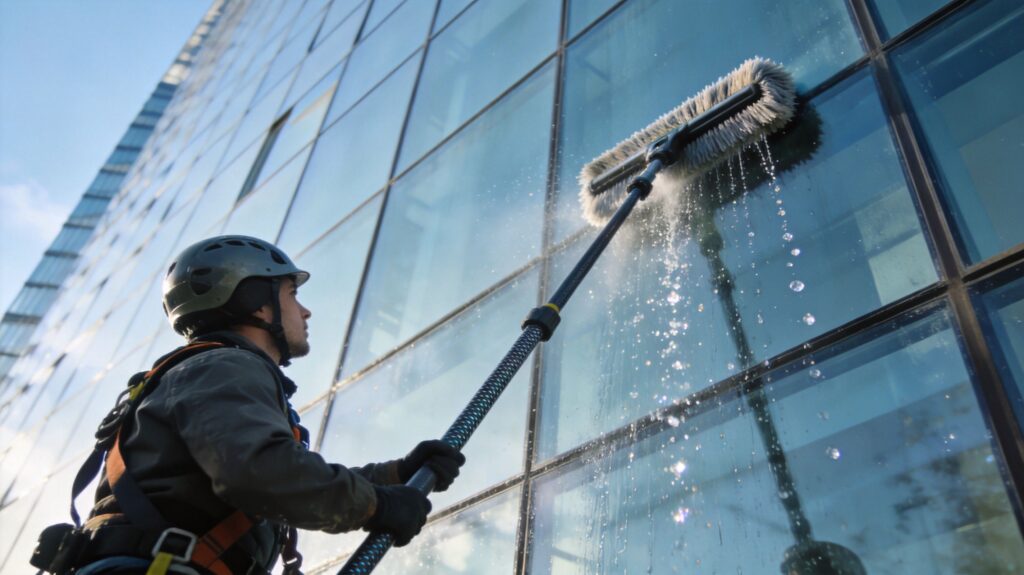
Ladders still have a place in window cleaning, but they’re no longer the default answer for most residential high glass. The modern standard for many homes is the water-fed pole system, which lets the cleaner work from the ground while scrubbing and rinsing upper windows with purified water.

That shift matters because the method solves two problems at once. It reduces the need to climb, and it changes how the glass is finished. Instead of soaping and squeegeeing by hand at height, the pole brush agitates dirt while purified water rinses the glass clean.
The ground-based method that works best on most homes
A proper water-fed pole setup can reach high windows without ladders or scaffolding. According to this guide to cleaning high windows, water-fed pole systems can extend up to 90 feet, use RO/DI filtration to produce water with total dissolved solids below 10 ppm, and in hard water areas like Arizona, where TDS can be 300 to 500 ppm, that purification is essential. The same source notes that pure water can cut cleaning time by 40 to 50 percent per pane compared to traditional squeegee methods while keeping the operator on the ground.
That last part is what homeowners should focus on. The system isn’t just a long stick with a brush on the end. It’s a controlled cleaning process built around purified water.
Why ladders and hand tools still get used
Traditional squeegee work still has advantages on some windows. If the glass has paint specks, adhesive, hard debris, or tight detailing around divided panes, hand work may still be the right call. Some first-floor windows, interior panes, and specialty glass need that level of direct control.
But for many exterior second-story windows, ladders introduce more risk and often less consistency. Once a cleaner starts stretching from a rung or shifting sideways to reach a corner, the setup is already less stable than it should be.
Practical rule: If a high window can be cleaned well from the ground, that’s usually the first option worth considering.
Arizona changes the method
Hot, arid climates demand a different rhythm. According to this Phoenix-area high window cleaning discussion, summer heat in the Phoenix Valley can exceed 110°F (43°C), which causes cleaning solutions to evaporate almost instantly on sun-baked glass. The same source notes that monsoon winds can make ground-based pole use unstable, and cites a 2025 OSHA report describing a 25% higher fall risk in the Southwest due to wind and heat fatigue.
That tracks with field reality. On hot glass, timing matters as much as technique. Good crews adjust by:
- Starting early: Pre-dawn or early morning work gives the glass time to stay wet long enough for a proper rinse.
- Working the shaded side first: Shade buys control. Direct sun shortens it.
- Watching wind before setup: A long pole becomes harder to stabilize when gusts start moving the brush head.
- Rinsing more deliberately after dust events: Dust doesn’t just sit on the pane. It loads the frame and edges.
Training matters here because the equipment only works well when the operator understands the system. Homeowners who want a feel for the standards behind safe technique can look at professional window cleaning training, which helps show why high window cleaning is a skill, not just a purchase.
A short demonstration helps make the method easier to visualize.
The Specialized Equipment Behind a Spotless Shine
A professional high window cleaning setup looks simple from the ground. In practice, it’s a system with parts that have to work together. If one part is wrong, the results fall apart fast.

The pole matters. The brush matters. The hose management matters. But the most overlooked component is the purification unit. A garden hose can push water to the glass. It can’t deliver the same finish because the water itself still carries minerals.
The parts that actually do the work
The pole is usually made for rigidity and low weight, because control matters more than brute force when you’re working high. A floppy pole wastes energy and makes it harder to keep even pressure on the glass. The brush head is chosen based on the job. Some hold more water, some scrub more aggressively, and some are better for routine maintenance than heavy buildup.
Then there’s the filtration unit. A typical setup uses multi-stage reverse osmosis and deionization. The same high-rise window cleaning equipment overview category is where homeowners can get a clearer sense of how specialized these systems are compared with hardware-store tools.
Why pure water is the secret
Think of purified water as the finish, not just the rinse. When the dissolved minerals are removed, the water can sheet, lift contamination, and dry without leaving the chalky spots that hard water creates. That’s why a pro can rinse a second-story window and walk away without squeegeeing it by hand.
According to the verified equipment data, these systems use RO/DI filtration and target TDS below 10 ppm, ideally near zero, because impure water leaves mineral deposits and haze. In Arizona, where source water can be much harder, this isn’t a nice extra. It’s the difference between a clean finish and a spotted one.
A hose and brush can make glass look wet. Purified water is what makes it dry clear.
What doesn’t work well
Several common homeowner shortcuts fail for the same reason. They move dirt around without controlling residue.
| Method | Main problem |
|---|---|
| Garden hose rinse | Hard water dries with visible mineral spotting |
| Consumer brush on extension pole | Limited scrubbing power, poor rinse pattern |
| Ladder with spray bottle | Slow, inconsistent, and risky on upper panes |
| Soap-heavy wash in direct sun | Solution dries before full removal |
This is also why two houses can look very different after “the same” cleaning. One crew used purified water, proper brush contact, and enough rinse volume. The other just got the glass wet and hoped the sun would do the rest.
Understanding the Critical Safety and Regulations
Homeowners tend to judge window cleaning by the result they can see. The cleaner judges it first by the risk they can’t ignore. That difference matters because the danger in high window cleaning isn’t theoretical.

Historically, this trade was brutal. According to this history and safety overview of high-rise window cleaning, one out of every 200 window cleaners in New York City was killed on the job annually in 1932. That same source explains that with modern regulations and equipment, the work is now statistically safer than driving a cab. It also notes that OSHA 1910.28 requires certified fall protection for work above 6 feet, including rooftop anchor points rated to 5,000 lbs per worker and inspected annually.
Those numbers tell a simple story. The work got safer because the industry stopped treating risk casually.
What those rules mean to a homeowner
You don’t need to memorize OSHA language. You do need to understand what compliance looks like in practical terms. If a worker is on your property doing work at heights, there should be a clear method, proper equipment, and insurance that protects both the worker and you.
That means looking for more than “we’ve done this for years.” Experience matters, but it doesn’t replace:
- Workers’ Compensation coverage
- General Liability insurance
- Bonding
- Proper fall protection when elevation requires it
- A legitimate business registration
A casual handyman with a ladder may be cheaper upfront. If something goes wrong, cheap disappears fast.
Residential work still needs a safety culture
Some homeowners hear “high-rise regulations” and assume that only applies to downtown towers. It doesn’t. The same safety mindset carries into residential work. A second-story foyer window, a glass stairwell, or a high exterior pane over hardscape can still create serious fall exposure.
For some jobs, that means using ground-based methods to remove the need for climbing. For others, it means controlled high-level access and strict setup discipline. The primary distinction isn’t commercial versus residential. It’s controlled versus improvised.
If a contractor shrugs off safety questions, that’s your answer.
Why compliance matters beyond window cleaning
Homeowners already deal with this idea in other home systems. When people research equipment rules for pools, pumps, or electrical upgrades, they usually want to know what protects them from liability and bad installation, not just what “works.” A good example of that mindset is 2021 pool pump law information, which shows how homeowners benefit when contractors follow current standards instead of old habits.
The same logic applies here. If a company uses high access, the equipment should be appropriate and maintained. If you want to understand the kinds of access systems professionals use on more complex jobs, window washing platforms offer a practical reference point.
The clean glass is the visible outcome. Safe execution is the essential service.
DIY vs Hiring a Professional A Clear Comparison
For homeowners, this usually comes down to one question. Is it worth buying the tools and doing the job yourself, or is it smarter to hire someone who already has the equipment and process dialed in?
The answer depends on the height, the number of windows, your tolerance for setup time, and how much risk you’re willing to take on. It also depends on your standard for the final result. “Good enough from the yard” and “clean in full afternoon sun” are not the same standard.

The cost side isn’t as simple as it looks
According to this DIY versus professional high window cleaning comparison, a DIY water-fed pole system can cost $400 to $1,200 initially plus maintenance. The same source says professionals achieve 40% better streak-free rates, that novices often face a 2 to 4 week learning curve, and that for homes with 10+ high windows, hiring a professional can be 20 to 30% more cost-effective in the long run when time, results, and risk are factored in. It also notes that homeowner’s insurance can have gaps for falls, while professional services carry Workers’ Compensation and General Liability.
That’s the comparison. DIY doesn’t just mean buying a pole. It means buying enough setup to do the work properly, learning how to use it, maintaining filters, and accepting the chance that the first few attempts may not look great.
A straight comparison
| Factor | DIY | Professional |
|---|---|---|
| Upfront cost | Equipment purchase and maintenance | Service fee |
| Safety exposure | Homeowner takes the physical risk | Risk managed by trained crew |
| Results | Depends on water quality and technique | More consistent finish |
| Time | Setup, cleaning, takedown, rework | Faster turnaround |
| Liability | Insurance gaps may apply | Business coverage typically applies |
When DIY can make sense
There are cases where a homeowner can reasonably handle it.
- Few upper windows: If you only have a small number of accessible high panes, a limited DIY setup may be enough.
- You already maintain equipment: Some homeowners are comfortable managing filtration, hoses, and technique.
- You’re working in mild conditions: Cooler, calmer conditions give you more margin for error.
When hiring usually wins
Other situations tilt strongly toward a pro.
- Large homes with many high panes: The scale alone makes efficiency matter.
- Hard water and heavy dust: Water quality problems show up fast on glass.
- Complicated access: Narrow side yards, landscaping, or awkward elevations make setup harder.
- You want it done once, not twice: Re-cleaning bad results is where DIY savings often disappear.
Better equipment doesn’t automatically produce better glass. The operator still has to know how to scrub, rinse, and read the conditions.
Your Checklist for Hiring the Right Window Cleaning Pro
Once you decide not to gamble on the job yourself, the next step is choosing carefully. High window cleaning isn’t a category where “licensed and insured” should be accepted as a casual claim. Ask for proof and read it.
A good contractor won’t act offended. They’ll expect the question.
What to ask for before booking
- Proof of General Liability insurance: This helps protect against property damage claims. If water gets where it shouldn’t, or something is damaged during service, this coverage matters.
- Proof of Workers’ Compensation: If a worker gets hurt on your property, this is one of the most important protections in the hiring process.
- Confirmation that the company is bonded: Bonding adds another layer of accountability and professionalism.
- Business registration details: A legitimate company should be properly registered in its state and operating under a real business entity.
- Method for your specific windows: Ask how they plan to clean your second-story glass. You want a real answer, not “we’ll figure it out onsite.”
What a strong answer sounds like
You’re listening for specifics. A professional should be able to explain whether they’ll use a water-fed pole, ladder access, or another method, and why that method fits your house. They should also be clear about whether screens, frames, and tracks are included, or whether that’s separate.
A vague answer usually signals one of two problems. Either the company doesn’t have a repeatable process, or they’re not used to working on homes like yours.
Red flags worth taking seriously
- Cash-only arrangements
- No written estimate
- No insurance documents available
- A heavy focus on “cheap” rather than safe
- No questions about your property layout, access, or window type
If you’re comparing services, it helps to review what a dedicated home window cleaning service should typically cover. Even if you don’t use that page as your final choice, it gives you a baseline for what a structured residential offering looks like.
One more thing matters. Pay attention to how the company talks about safety. Companies that treat safety as an inconvenience often treat quality the same way.
Your Path to Sparkling High Windows in Arizona
High window cleaning looks simple from the driveway. In practice, good results depend on method, water quality, weather timing, and a real safety standard. That’s especially true in Arizona, where hot glass, hard water, and airborne dust expose weak technique fast.
For most residential upper windows, the smart approach is ground-based cleaning with a properly set up water-fed pole system. It reduces fall exposure and gives the glass a better chance to dry clean when purified water is doing the finishing work. When access gets more complicated, the right answer isn’t improvisation. It’s a contractor with the training, equipment, and coverage to handle the work correctly.
The hiring decision comes down to a few absolute requirements. Verify insurance. Ask about Workers’ Compensation. Confirm bonding and registration. Make sure the company can explain its method for your specific home in plain language.
If you’re in Arizona and want the job handled without the guesswork, that combination of climate experience, safe process, and proper business credentials matters more than a low quote. Clean high windows should improve your view, not create a risk problem on your property.
If you want sparkling upper windows without dealing with ladders, hard water spotting, or heat-related streaking, Sparkle Tech Window Washing offers Arizona homeowners a safer, fully insured path to clean glass. Their family-owned team serves the Phoenix Valley and beyond with Workers Compensation, General Liability coverage, bonding, and registered Arizona business credentials, so you can book high window cleaning with confidence.