

A lot of property managers notice the same problem the same way. You step outside, look up at a building you’re responsible for, and realize the glass no longer reads as sharp, bright, or premium. It looks tired. Tenants may not say much at first, but they notice. Prospects notice. Ownership notices.
In Phoenix, that decline happens faster than many people expect. Dust hangs on the glass, hard water leaves mineral residue when the wrong method is used, and strong sun exposes every streak. On a mid-rise or tower, window cleaning stops being a basic janitorial task and becomes a building operations decision. You’re not just paying for cleaner glass. You’re paying for access planning, risk control, scheduling, tenant coordination, and a result that holds up in a harsh climate.
That’s why high rise window cleaning services deserve a more practical explanation than most websites give. Property managers need clear standards, a realistic way to compare bids, and an honest view of what drives cost.
Your Building's First Impression Starts with a Clear View
A high-rise doesn’t get judged only from the lobby. People judge it from the parking lot, the street, nearby offices, and from inside looking out. If the facade looks hazy, spotted, or neglected, the building feels less cared for even when the rest of the property is well managed.
In Phoenix, this matters even more because glass plays such a big role in how office towers, mixed-use buildings, condos, and hospitality properties present themselves. The light is strong. Reflections are sharp. Clean glass looks exceptional. Dirty glass looks worse than it would in a softer climate.
Clean windows affect more than appearance
Property managers usually start asking about service after one of three things happens:
- Tenant complaints increase. Upper-floor tenants lose the clear view they’re paying for.
- Ownership is preparing for tours or renewals. A dull exterior weakens presentation.
- Maintenance teams realize the issue isn’t cosmetic anymore. Stuck-on dust, residue, and runoff start to behave like surface contamination, not simple dirt.
That’s the point where a professional contractor should be evaluating the facade, not just quoting a quick rinse.
The scale of the industry reflects how important this has become. The global window cleaning services market was valued at USD 151.18 billion in 2025 and is projected to grow to USD 16.85 billion by 2034, with growth tied to expanding urban high-rise development and the need for specialized cleaning in dense cities, according to Fortune Business Insights' window cleaning services market analysis.
High-rise work is a maintenance function
A cautious property manager is right to ask hard questions. On a tower, the job involves:
- Facade access planning
- Crew safety systems
- Water quality control
- Protection for pedestrians and entries
- Coordination with building operations
Clean glass is the visible result. The real service is controlled execution on an occupied building.
That’s why two quotes that sound similar on the phone can be very different in practice. One contractor may be pricing a real high-rise operation. Another may be pricing a best-case scenario that falls apart once the crew gets on site.
The Science Behind a Streak-Free Shine at 30 Stories
Most streak problems come from one issue. The water itself is dirty.
Tap water carries dissolved minerals. When it dries on glass, those minerals stay behind as spots, haze, or residue. In Phoenix, where mineral-heavy water and heat work against you, that problem gets exposed fast. If a cleaner uses the wrong water, the sun finishes the mistake.

Why purified water changes the result
Professional exterior glass cleaning often relies on purified water, not because it sounds advanced, but because it solves the basic chemistry problem.
Here’s the simple version:
- Regular water leaves solids behind. Those solids become visible when the water evaporates.
- Purified water removes the mineral load. That means it can dry clean instead of drying dirty.
- A brush agitates bonded dust and film. The rinse carries it off the glass without leaving fresh residue.
That’s why a crew using deionized or otherwise purified water can get a cleaner finish on the exterior than a crew using untreated hose water and expecting the sun to cooperate.
Arizona exposes weak technique
Phoenix creates three common failure points:
- Fast evaporation: Water flashes off glass quickly in direct sun.
- Dust loading: Fine desert dust clings to frames, seals, and corners.
- Hard water risk: If irrigation overspray or untreated water hits the facade, spotting can lock in.
A basic bucket-and-squeegee method still has its place, especially on detailed work and interiors, but it won’t solve every exterior condition on its own. On larger facades, good results depend on matching the method to the glass, the height, and the residue type.
What works and what doesn't
A few practical distinctions matter.
| Approach | What it does well | Where it struggles |
|---|---|---|
| Purified water cleaning | Large exterior areas, routine maintenance, reduced spotting | Heavy mineral staining or post-construction residue |
| Traditional hand detailing | Edges, interiors, touch-up work, stubborn marks | Large-scale exterior production if access is slow |
| Generic soap-heavy cleaning | Temporary visual improvement | Leaves residue if mixed poorly or dried too fast |
Practical rule: If the glass looks worse a day after cleaning than it did right after, the issue usually isn’t effort. It’s water quality, technique, or both.
The best crews don’t just “wash windows.” They control the variables that create streaks in the first place.
How Professionals Safely Reach Every Window
The first question on a high-rise job isn’t how to wash the glass. It’s how to reach it safely, efficiently, and without disrupting the building more than necessary.
Different buildings need different access methods. A flat mid-rise with open ground clearance can be cleaned one way. A tower with setbacks, recessed windows, canopies, and pedestrian traffic needs another.

Water-fed pole systems
For lower and mid-rise sections, Water-Fed Pole Systems can safely reach up to 80 feet from the ground and reduce fall risks by over 90% compared to suspended access methods, according to this breakdown of high-rise cleaning methods and safety systems.
That matters because every foot of work completed from the ground removes exposure, setup time, and complexity.
A water-fed pole system uses lightweight poles, a brush head, and purified water. It works especially well on:
- Mid-rise buildings
- Podium levels
- Courtyard-facing glass
- Facade sections above landscaping where lifts are awkward
What it does well is obvious. Crews stay on the ground. Setup is simpler. Pedestrian planning is often easier.
Its limit is also obvious. Once the building gets taller or the facade gets more complex, the pole is no longer the right tool.
Rope descent systems
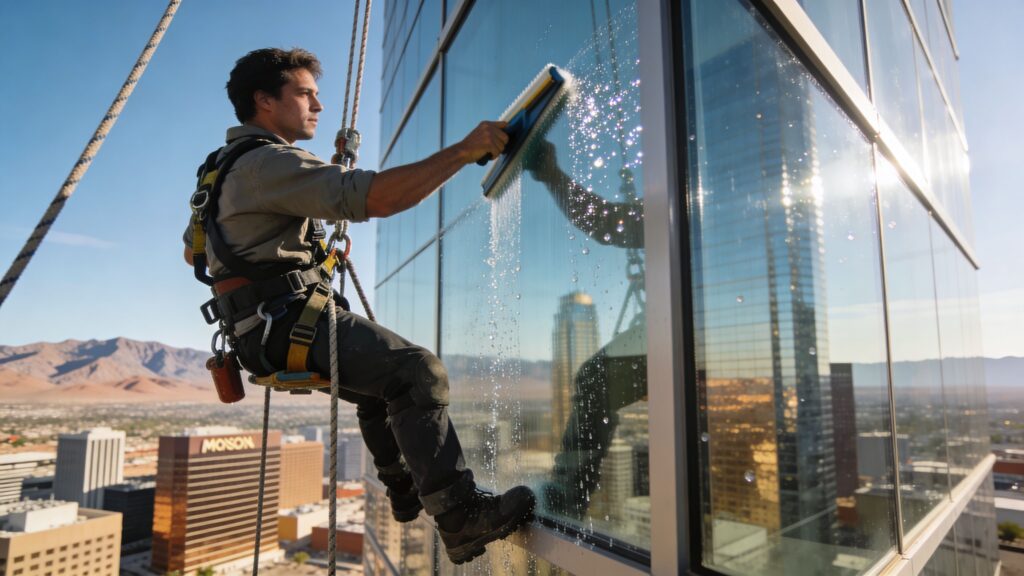
Rope access is the most flexible option for true high-rise work. It’s often the right choice when the facade includes setbacks, narrow drops, architectural features, or areas that fixed platforms can’t reach cleanly.
A rope access crew works from a controlled descent system anchored at the roof. The value of this method is precision. It allows trained technicians to work specific drops with a high degree of control.
Good proposals explain why rope access is being used instead of just naming it. A serious contractor should be able to show that the roof anchors, descent path, ground control, and rescue planning all fit the building.
For readers who want a more detailed look at the tools involved, this guide to high-rise window cleaning equipment gives a useful overview of the gear and access setup behind this kind of work.
Here’s a short visual if you want to see the equipment categories in action.
Building maintenance units and suspended platforms
On some towers, the right answer is a Building Maintenance Unit, or BMU. These are permanent roof-mounted systems designed to move a cradle or platform along the facade.
The advantage is production and stability. As noted in the source above, BMUs can cover 200 to 400 square meters per hour when conditions and building design support that method.
That makes BMUs especially useful for:
| Method | Best fit | Main trade-off |
|---|---|---|
| Water-fed poles | Lower heights and open access areas | Limited reach |
| Rope descent | Complex towers and difficult geometry | Requires more specialized planning |
| BMU or platform | Large, uniform high-rise facades | Depends on installed building systems and setup logistics |
BMUs and suspended platforms are often the right call for broad, repetitive facade runs. But they aren’t automatically cheaper or simpler on every site. If setup is slow, roof access is constrained, or parts of the facade are interrupted by architectural features, the platform may need support from another method.
The best access plan is rarely the one with the fanciest equipment. It’s the one that matches the building without creating avoidable risk or downtime.
That’s why experienced high rise window cleaning services usually recommend a method mix, not a one-method answer for every elevation.
The Critical Importance of Safety and Insurance
A high-rise cleaning contract is a risk-transfer decision as much as a maintenance decision. If a contractor gets hurt, drops equipment, damages facade elements, or shuts down part of your property unexpectedly, the cheapest quote stops looking cheap.
The history of the trade makes that plain. High-rise window cleaning was once among the most hazardous jobs, with one in 200 cleaners in New York City high-rises killed annually in 1932. Modern protocols and equipment changed that dramatically, which is why current standards matter so much, as explained in this review of how dangerous high-rise window cleaning has been historically.

The paperwork matters because the risk is real
Property managers should ask for documentation before scheduling, not after an incident.
The essentials are straightforward:
- General liability insurance protects against damage claims involving the property or third parties.
- Workers' compensation covers the contractor’s employees if they’re injured on the job.
- Bonding gives the client another layer of protection if contracted work isn’t completed properly.
If you want a plain-English overview of why this category matters, this explanation of liability insurance for contractors is a useful starting point.
A professional contractor should also provide a current certificate of insurance. If they hesitate, send an outdated document, or can’t explain limits and coverage types, that’s a warning sign.
What a safety-minded contractor should be able to explain
Good safety conversations are specific. Bad ones stay vague.
Ask these questions and listen to the quality of the answer:
How will your crew access this building?
A real answer names the method, roof conditions, and site controls.What training do your technicians have?
You want an answer grounded in actual high-rise work practices, not generic “we train our people.”How do you protect pedestrians and tenant access points?
The contractor should discuss barricades, drop zones, scheduling, and communication.What happens if weather or building conditions change?
A serious company pauses or adjusts the job. It doesn’t force production to keep a date.
Insurance isn't a formality
A lot of buyers treat insurance as a box to check. It’s more than that. Coverage quality often reflects how seriously a company treats operational discipline.
For a practical explanation of the coverage high-rise contractors should carry, this page on insurance for a window cleaning business outlines the protections clients should expect to see.
Owner's view: If a contractor talks more confidently about price than about their safety plan, keep asking questions.
In high rise window cleaning services, professionalism isn’t just about leaving clean glass. It’s about running a controlled job where your building, your occupants, and the contractor’s crew are all protected.
Understanding the Cost of High Rise Window Cleaning
Most pricing pages in this industry are frustrating for one reason. They say “competitive rates” and stop there.
That leaves property managers trying to compare bids without knowing what’s inside the number. The gap is real. Major providers often avoid concrete breakdowns, which leaves buyers with little budgeting guidance, as noted in this discussion of high-rise window cleaning pricing transparency.

What actually drives the quote
For high rise window cleaning services, cost usually comes from five core variables.
Height and access difficulty
A building that can be handled with ground-based equipment is priced differently from one that requires rope work, roof coordination, and controlled drop zones.
The more complex the access, the more labor planning and risk management get built into the quote.
Facade design
Uniform glass is faster to clean than a facade with deep mullions, recessed panels, ledges, fins, shade structures, or interrupted elevations.
Architectural complexity doesn’t just slow production. It can also force a method change.
Soil level and water conditions
First-time cleans often cost more than maintenance cleans. Heavy dust loading, mineral spotting, runoff stains, and frame buildup all increase labor.
In Phoenix, hard water history matters. If the building has irrigation overspray or mineral residue, the quote may reflect restoration work rather than simple maintenance cleaning.
Frequency
Recurring service usually improves budgeting because the facade stays in manageable condition. The contractor spends less time fighting old buildup and more time maintaining a standard.
That’s why one-time clean pricing and contract pricing are often very different even when the building is the same.
Site logistics
A quote should also reflect real operating conditions such as:
- Restricted work hours
- Tenant-sensitive entrances
- Parking and staging limitations
- Need for traffic or pedestrian control
- Roof access procedures and approvals
How to compare two proposals
Don’t compare bottom-line price first. Compare assumptions.
Use this framework:
| Quote item | What you should look for |
|---|---|
| Scope | Does it specify exterior only, interior, frames, ledges, and touch-up expectations? |
| Access method | Does it explain how the crew will reach each elevation? |
| Safety plan | Are site controls and insurance requirements addressed clearly? |
| Cleaning frequency | Is this a first-time restoration clean or routine maintenance pricing? |
| Exclusions | Does it identify hard water stain removal, scheduling restrictions, or access delays? |
A useful reference for building owners trying to decode these variables is this overview of commercial window cleaning cost.
A low quote can mean efficiency. It can also mean missing scope, weak insurance, or unrealistic labor assumptions. The paperwork usually tells you which one it is.
The right question isn’t “What’s the cheapest price?” It’s “What level of access, risk control, and finish quality am I buying?”
How to Choose Your High Rise Cleaning Partner
Once you understand access, safety, and pricing, the buying process gets simpler. You stop shopping for a vendor and start screening for a capable operator.
That mindset is useful in property operations generally. If you’re also evaluating broader building support relationships, this guide on finding the right partner for overall property management is a good reminder that process quality matters as much as price.
Ask questions that force specific answers
A strong interview with a contractor should sound more like a pre-job meeting than a sales call.
Start with these:
Can you provide a current certificate of insurance?
A good answer is immediate and document-backed.What access method are you proposing for our building, and why?
The contractor should mention facade layout, roof conditions, and site constraints.How will you protect entrances, walkways, and tenants during the work?
You want a concrete site-control plan, not “we’ll be careful.”What does your scope include, and what is excluded?
Defining the scope prevents misunderstandings.
Know what weak answers sound like
Property managers often spot trouble by tone before they spot it in writing.
Red flags include:
- Vague confidence: “We do this all the time” without explaining the method.
- Thin documentation: insurance discussed verbally but not delivered.
- No site-specific planning: same answer for every type of building.
- Loose scope language: words like “as needed” without defining the standard.
Look for operational maturity
A mature contractor usually does three things well.
First, they inspect before they promise.
Second, they write proposals that match the actual building.
Third, they communicate like they expect to coordinate with management, engineering, and tenants.
That’s what separates a real high-rise service provider from a general exterior cleaning company trying to stretch into tower work.
A contractor doesn’t need the flashiest presentation. They need clear answers, correct paperwork, and a plan that fits your building.
Use a short decision checklist
Before you approve a contract, confirm these points:
- Insurance is current and adequate
- Access method matches the building
- Scope is written clearly
- Disruption controls are addressed
- The company can explain how Phoenix conditions affect the work
If those five items are solid, you’re usually dealing with a company that understands the job beyond the sales pitch.
The Sparkle Tech Process From First Call to Final Inspection
A Phoenix property manager usually calls after the same pattern repeats. The west-facing glass looks dusty again, sprinklers have left mineral spotting on lower levels, and the last contractor gave a price that sounded good until the exclusions started showing up on site.
Sparkle Tech Window Washing handles that problem with a tighter process than the usual estimate-and-schedule routine. The first call is used to sort the building into the right service path: routine maintenance cleaning, first-time restoration after a long gap in service, or a mixed scope where some elevations need standard cleaning and others need hard water treatment. In Phoenix, that distinction matters because sun-baked mineral deposits and airborne dust do not come off the glass the same way.
The site review is built around three things. How the building can be accessed. Which elevations are taking the worst sun, dust, and irrigation exposure. What will affect tenant movement, entry points, and engineering coordination during the job. That gives the property manager a usable plan instead of a generic promise.
Sparkle Tech also breaks the glass into condition zones before work starts. Lower glass near landscaping or misting systems is often tagged separately from upper elevations because the labor is different and the result standard is different. A pane with loose dust and light film is a cleaning item. A pane with baked-on hard water may need restoration work or may improve only partially if the mineral etching is permanent. Owners deserve that answer before the crew is on the drop.
That is one place where pricing gets clearer. Instead of blending every condition into one vague number, the process separates recurring work from corrective work so a building can budget more accurately. For Phoenix properties, that often means approving a heavier first service, then moving to a predictable maintenance cycle that keeps the glass from sliding back.
On service day, communication is structured and brief. The property contact gets a start confirmation, the crew lead checks access and restricted areas, and any change in wind, roof conditions, or occupant activity is addressed before the work area expands. Crews adjust their sequence around direct sun and fast drying conditions because Phoenix glass can flash dry and streak if the method is not matched to the heat.
A common example is a mid-rise office building near active construction. Upper glass may clean up with standard exterior service, while the first three floors need extra passes and spot treatment because of dust loading and sprinkler overspray. Treating the whole building as one uniform task either inflates the price or produces uneven results. Separating those conditions keeps the quote and the outcome more honest.
The final inspection follows the same logic as the site review. Sparkle Tech checks completed elevations against the original condition notes, touches up any misses within scope, and flags panes where staining is no longer a cleaning issue but a surface damage issue. The property manager is not left guessing what was cleaned, what improved, and what would require separate restoration or glass replacement planning.
That process is why a high-rise job in Phoenix should feel controlled from the first conversation to closeout. Clear condition notes, realistic expectations, and steady communication usually matter more than the lowest number on the first page.
Frequently Asked Questions
Property managers usually ask the same practical questions after reviewing proposals. Here are concise answers that help during budgeting and vendor selection.
| Question | Answer |
|---|---|
| How often should a high-rise building be cleaned? | It depends on tenant expectations, facade exposure, surrounding dust, and how visible the glass is to the public. In Phoenix, buildings exposed to roadway dust, construction activity, or hard water overspray usually need a more proactive schedule than sheltered properties. |
| Will window cleaning disrupt tenants or visitors? | It shouldn’t if the contractor plans the job correctly. Good crews coordinate access, protect walkways, manage drop zones, and schedule around sensitive building activity. |
| Is exterior-only service enough? | Sometimes. For many commercial properties, exterior cleaning handles the biggest appearance issue. But interiors, frames, ledges, and lobby glass may need separate scope if you want the whole building to present cleanly. |
| Why do quotes vary so much between contractors? | Usually because the assumptions differ. One quote may include difficult access, insurance, site protection, and detailed scope. Another may leave those items vague. |
| Can all buildings be cleaned with poles from the ground? | No. Ground-based methods are excellent within their useful range, but taller or more complex buildings often require rope access or a platform-based solution. |
| What should I ask for before approving the job? | Ask for insurance documentation, a written scope, the proposed access method, a site safety plan, and a clear explanation of what is excluded from the price. |
| Does Phoenix weather change the cleaning approach? | Yes. Heat, dust, sun exposure, and hard water all affect the method, schedule, and maintenance cycle. A contractor who ignores those conditions is likely to underperform. |
If you’re budgeting for high rise window cleaning services in Arizona and want a proposal that explains the access method, safety requirements, and cost drivers in plain language, contact Sparkle Tech Window Washing . A clear site review and a well-scoped quote make it much easier to compare options and protect your building.