

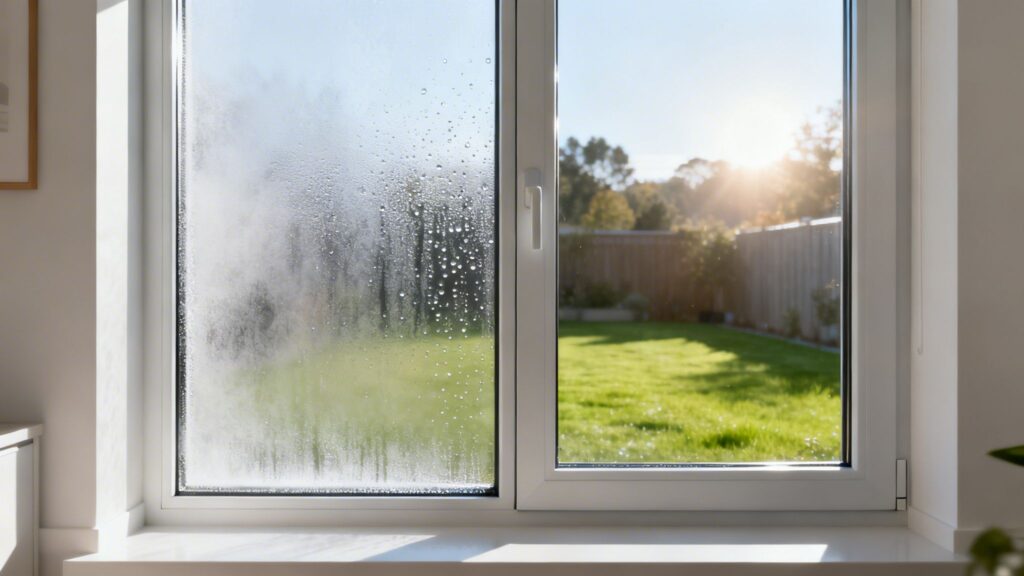
You wake up after a cool morning in Phoenix, walk past the patio door, and notice a cloudy patch in the glass. You grab a towel, wipe the inside, and nothing changes. You step outside, try that side, and still nothing. The haze is trapped in the window.
That moment throws a lot of homeowners off. It looks like dirt, but it does not clean off. It looks like moisture, but it is in the one place you cannot reach. In Arizona, this often shows up after monsoon humidity swings, on colder winter mornings, or on windows that take heavy afternoon sun.
If you are dealing with condensation on inside of double pane windows, the first thing to know is that not all condensation means the same thing. Some moisture is a household humidity issue. Some is normal weather behavior. But fog or haze between the panes points to a window problem, not a housekeeping problem.
The good news is that this is diagnosable. You can figure out what kind of condensation you have, what works, what does not, and whether the fix is a simple indoor humidity adjustment or a glass repair issue. In Phoenix and across Arizona, that distinction matters because intense heat and UV exposure are rough on seals, spacers, and vinyl frames.
That Annoying Fog Inside Your Windows Explained
A common Arizona version of this problem starts like this. A monsoon storm rolls through, humidity jumps, the night cools off, and the next morning one bedroom window looks milky. You clean it. The haze stays put.
That usually tells you one important thing right away. You are not looking at a dirty surface. You are looking at moisture or residue trapped inside the insulated glass unit.
Homeowners often call this “inside the window,” and that wording makes sense because the fog appears to live somewhere in the middle of the glass. It is frustrating because it blocks the view, makes the home look neglected, and raises a bigger question about whether the window is still doing its job.
In practice, there are three very different situations that get lumped together:
- Moisture on the room side of the glass usually points to indoor humidity.
- Moisture on the outdoor side is often normal when conditions line up.
- Moisture between the panes points to seal failure.
Phoenix adds another layer to the problem. Many generic guides are written for cold, wet climates. They miss what desert heat does over time. In Arizona, windows take long hours of direct sun, strong UV exposure, and large temperature swings between hot days and cooler nights. Those stresses can age seals faster than many homeowners expect.
If the fog will not wipe off from either side, stop treating it like a cleaning problem. Start treating it like a failed window system until proven otherwise.
That difference matters because some window issues are mostly annoying, while others keep getting worse the longer they sit. Trapped moisture can move from “ugly” to “permanently damaging” if you wait too long.
Why Fog Appears Between Your Window Panes
To understand fog between the panes, start with how a double-pane window is built. It is an insulated glass unit, or IGU, with a sealed airspace between two panes of glass. That sealed pocket is what gives the window much of its insulating value.

How the glass unit is built
Inside that unit, the spacer sets the gap between the panes, and the edge seal keeps outside air from entering. Many units also contain desiccant in the spacer. Desiccant works like a moisture sponge. It grabs trace vapor left from manufacturing and small amounts that may seep in over time.
That system only works while the seal stays intact.
Once the perimeter seal starts to break down, humid air slips into the cavity between the panes. At first, the desiccant can keep up. After it becomes saturated, moisture begins condensing on the interior glass surfaces, and the haze you see is no longer a cleaning issue. It is a failed sealed unit. If you want a plain-language breakdown of how that perimeter seal works, this guide on what a window seal does in an insulated glass unit is a useful reference.
What failure looks like in real life
Seal failure rarely shows up all at once. The first signs are often a light haze in the morning, a patch of fog near the bottom corners, or streaking that seems to sit in the middle of the glass. Homeowners often notice it only after repeated cleaning does nothing.
A good comparison is a cooler with a worn lid gasket. The cooler may still look fine from the outside, but it no longer holds conditions inside the way it should. A failed IGU behaves the same way. The space between the panes is no longer controlled.
Over time, that trapped moisture can leave behind mineral residue or etching. In older or badly failed units, I also watch for riverbedding, the wavy, irreversible damage that can form on the glass surface after long-term seal failure. At that stage, the problem has moved beyond fog.
Why Arizona windows fail sooner than homeowners expect
Phoenix is hard on insulated glass. Long hours of direct sun heat the glass and the frame, then nighttime cooling pulls those materials back in the other direction. That daily expansion and contraction puts steady stress on the edge seal.
UV exposure adds another problem. Seal materials dry out, harden, and lose flexibility faster in Arizona than they do in milder climates. A window can look fine from across the room while the perimeter seal is already aging at the edges.
As noted earlier in the InterNACHI condensation guidance, insulated glass depends on that sealed airspace staying dry. In Arizona, heat and UV shorten the life of that system more often than generic window advice acknowledges.
When fog is trapped between the panes, the moisture is a symptom. The underlying failure is at the seal, and desert sun often speeds up that failure.
That is why this issue deserves quick attention. The longer moisture stays inside the unit, the higher the chance of residue, permanent haze, or glass damage that cannot be polished away.
Is It Seal Failure or Just High Humidity
The fastest way to diagnose this issue is to forget the word “foggy” and focus on location. Where the moisture sits tells you almost everything.
Start with the wipe test
Use a clean microfiber towel and check both sides of the window.

If the moisture wipes off on the room side, the issue is usually indoor humidity. Bathrooms, kitchens, laundry areas, and homes using evaporative cooling can all raise indoor moisture enough to create surface condensation.
If it wipes off on the outside, the window may be colder than the outdoor dew point. That can happen on cool mornings, especially after monsoon moisture or overnight temperature drops.
If it does not wipe off from either side, and the haze stays trapped in the center of the glass, that is the classic sign of seal failure. If you want a plain-language breakdown of how the sealed unit works, this guide on what is a window seal is a useful primer.
Three clues homeowners can trust
You do not need special tools for an initial diagnosis. Look for these patterns:
- Bathroom mirror behavior. If mirrors fog up after showers and the same room’s window wipes clear from the inside, indoor humidity is the likely cause.
- Morning-only dew outside. If the moisture disappears after the sun warms the glass and you were able to wipe it from the exterior, that is usually normal surface condensation.
- Persistent haze with a dirty edge look. If the cloudiness hangs around, sometimes with mineral-like staining or a milky ring near the spacer, the seal has likely failed.
A simple checklist for homeowners
Ask yourself these questions in order:
- Can I wipe it off from inside the house
- Can I wipe it off from outside
- Does it appear only during a weather event, or does it stay
- Do I see distortion, haze, or residue near the edges between panes
- Is the same issue showing up on more than one sun-exposed window
One “yes” at the wrong point can change the diagnosis. The key one is this: if the moisture is trapped between panes, it is not a humidity-management problem.
If the fog lives in the middle of the glass, fans and dehumidifiers may help the room feel better, but they will not repair the window.
Why Phoenix homes get misdiagnosed
Arizona homeowners often assume a fogged unit cannot be moisture-related because the climate is dry. But dry climate does not protect a failed seal. Once outside air starts entering the unit, even brief humidity spikes can reveal the weakness.
That is why many failed seals become obvious during monsoon season or after cool winter mornings. The weather did not create the failure. It exposed it.
Managing Condensation Short-Term vs Long-Term
Homeowners usually want two answers right away. What can I do today, and what fixes this for good? Those are different questions.
What helps when the problem is indoor humidity
If the moisture is on the room side of the glass and wipes away, focus on reducing interior moisture load.
Open the bathroom exhaust fan during and after showers. Run the kitchen hood while boiling water. Keep blinds cracked open so air can move across the glass. In some homes, a dehumidifier helps, especially in rooms that stay closed up.
If your window looks cloudy but the issue is really surface moisture mixed with residue, this guide on how to clean between window panes can help you tell the difference between accessible buildup and a sealed-unit problem.
What does not fix a failed seal
When condensation is trapped between panes, short-term hacks usually waste time.
Drilling holes, using a heat gun, trying DIY defog sprays, or forcing air into the unit may change the appearance briefly, but they do not restore the seal. They also do not put the insulating performance back. In some cases, they leave the unit looking worse or create new damage around the edges.
Comparing Window Condensation Solutions
| Solution Type | Best For | Effectiveness | Cost Range |
|---|---|---|---|
| Ventilation and exhaust fan use | Interior surface condensation from daily moisture | Good for humidity-related condensation | Varies |
| Dehumidifier use | Rooms with persistent indoor moisture | Good for humidity-related condensation | Varies |
| Opening blinds and improving airflow | Glass that stays cool behind closed coverings | Helpful for light interior condensation | Minimal to moderate |
| DIY defogging attempts | Failed seals between panes | Poor as a lasting fix | Varies |
| Insulated glass replacement | Failed seal with frame still in good condition | Strong long-term fix | Varies |
| Full window replacement | Failed seal plus frame, sash, or operation issues | Strong long-term fix | Varies |
Understanding the Trade-off
Humidity management is worth doing when the moisture is on the inside surface of the glass. It is practical and often enough.
Seal failure is different. You can delay the repair decision, but you are not solving the problem. The longer a failed unit sits, the more time moisture has to stain surfaces, corrode components, and leave you with fewer good repair options later.
Permanent Solutions for Failed Window Seals
Once fog is trapped between the panes, the repair decision comes down to condition, age, and cost. In a Phoenix home, I also look at sun exposure right away. A west-facing window that bakes all afternoon often fails harder and earlier than the same window on a shaded side of the house.

Option one, replace the glass unit
Contractors usually call this IGU replacement or glass-only replacement. The failed insulated glass unit comes out, and a new sealed unit goes back into the existing sash or frame.
This option makes sense when the window frame is still straight, the sash opens and locks properly, and the problem is limited to the insulated glass. If the structure around the glass is still sound, replacing only the glass is usually the cleanest fix with the least disruption.
Good candidates for glass-only replacement usually have:
- Frames that are still solid with no soft spots, spread corners, or visible warping
- Normal operation during opening, closing, and locking
- Failure isolated to the glass rather than the sash, hardware, or surrounding wall area
The benefit is straightforward. You restore clarity and insulating performance without removing the full window assembly.
Option two, replace the entire window
Full replacement is the better call when the trouble extends past the sealed glass. If the frame is warped, the sash is loose, hardware is failing, or water has affected nearby materials, glass-only replacement may solve only part of the problem.
That is common in Arizona. Long heat cycles and strong UV exposure can stress seals, vinyl, finishes, and moving parts at the same time. For a local explanation of those weather stresses, see this overview of the effects of weather on windows in Phoenix AZ.
Full replacement costs more, but it can be the smarter investment if the whole unit is aging out. It also gives you the chance to choose better solar-control glass, stronger frame materials, and features that hold up better on hot south and west exposures.
The part many homeowners do not hear soon enough
A failed seal is not only a visibility problem.
Moisture trapped between panes can leave permanent staining and etching on the glass surface. Window pros often call one form of that damage riverbedding. It shows up as a wavy, washed-out distortion in the glass, and once it is there, cleaning will not remove it. This detail changes the repair timeline.
In Phoenix, the urgency is higher because heat and UV tend to speed up seal breakdown. If you wait too long, a window that could have been handled with a glass-unit replacement can turn into a larger replacement job because the glass appearance is permanently damaged or nearby parts have started to corrode.
If the window has moved beyond light fogging and now shows haze, mineral staining, or visible distortion, the glass may already be permanently compromised.
How to decide between glass replacement and full replacement
Start with the whole window, not just the cloudy center.
Choose glass replacement when the seal failure is isolated and the rest of the unit is still in good working order. Choose full replacement when you see frame movement, recurring leaks, sticking operation, failed locks, or several windows aging the same way on the same sun-heavy side of the house.
A few checks help narrow it down:
- Look at the corners for separation, cracking, or small gaps
- Inspect the frame for heat-related warping, especially on west-facing windows
- Run the window through a full open, close, and lock cycle
- Check nearby units with the same age and exposure for similar failure patterns
A quick visual example can help you understand the replacement process and what professionals are evaluating on site.
Why insulation still matters after the repair
Replacing the failed glass fixes the window. It does not fix every comfort problem around that opening.
Rooms with heavy afternoon sun often benefit from better shading, insulation, and air sealing so the new unit does not work as hard. If you want to address the room as a system, this guide on how to improve home insulation is a useful companion.
What works and what does not
Professional IGU replacement restores the sealed airspace and the look of the glass. Full window replacement solves larger frame, sash, and hardware problems.
Defogging services may make the glass look clearer for a while, but they do not recreate the original factory seal. If lasting performance matters, especially in the Arizona sun, choose a repair that replaces the failed component.
Preventing Window Failure in the Arizona Climate
Phoenix windows age differently than windows in milder places. The desert is hard on sealants, frame materials, and anything that spends hours facing direct afternoon sun.

Heat and UV do more than raise room temperature
People often think of window stress only in terms of energy bills. The bigger issue is material fatigue. Glass, spacer, sealant, vinyl, and metal all expand and contract at different rates. In Arizona, those cycles repeat constantly.
Add long-term UV exposure and the edge seal can dry out, stiffen, or lose flexibility. Once that perimeter starts weakening, humidity events expose the problem fast.
For a local look at these weather stresses, this overview of the effects of weather on windows in Phoenix AZ gives a useful regional context.
Practical prevention that helps
You cannot make windows last forever, but you can reduce avoidable stress.
- Manage direct sun exposure with exterior shade screens, awnings, or well-used interior coverings on west- and south-facing windows.
- Keep drainage paths clear so water does not sit around frames after storms or irrigation overspray.
- Inspect perimeter caulk and glazing lines for visible cracking, shrinkage, or separation.
- Watch monsoon season closely because sudden humidity spikes tend to reveal weak seals that looked fine during dry weeks.
- Choose quality replacements with materials and warranties suited for high-heat climates rather than asking which window is “best.”
Do not ignore adjacent moisture issues
Failed windows and moisture trouble sometimes overlap, especially around older frames, poorly sealed openings, or rooms with weak ventilation. If you are checking the area around a problem window, this mold inspection checklist for Phoenix homes is a useful way to think through surrounding warning signs without guessing.
Small habits that extend window life
The best prevention is often routine observation. Clean the glass regularly enough that you notice changes early. Pay attention to windows that get the harshest sun. If one unit starts showing haze, inspect nearby units with the same exposure instead of waiting for each one to fail one by one.
Arizona homeowners often spot seal failure late because they assume haze is dust or hard-water residue. The sooner you identify trapped condensation correctly, the more options you usually keep.
If you are replacing windows, ask specific questions about solar exposure, seal design, frame material behavior in desert heat, and whether the warranty language clearly covers your climate. That is a better conversation than asking which window is “best.”
When to Call a Professional for Your Windows
Some window problems are easy to sort out on your own. Others are worth a professional set of eyes before you spend money in the wrong place.
Call a pro if you have confirmed that the haze is between the panes. At that point, cleaning is no longer the answer. You need someone to assess whether the insulated glass alone can be replaced or whether the frame and sash also have issues.
Signs it is time to stop troubleshooting
A professional inspection makes sense when any of these are true:
- You cannot tell where the moisture is located after doing the wipe test.
- The fogging stays put and appears trapped between the panes.
- The window no longer operates normally or does not lock properly.
- You see edge staining, corrosion, or visible distortion in the glass.
- More than one window is showing the same symptoms on the same side of the home.
What a good inspection should include
A useful window inspection is not just someone glancing at foggy glass. They should look at the frame condition, operation, edge seal area, surrounding caulk, drainage, and signs of heat-related movement.
That matters in Arizona because a failed glass unit is sometimes only part of the story. On heavily exposed elevations, the frame itself may have started moving or warping in ways that affect the long-term repair choice.
Where a window care professional fits in
A skilled window cleaning professional often spots seal failure early because clean glass reveals defects that dirt hides. During regular service, technicians can notice haze patterns, moisture trapped between panes, mineral staining that is not on the surface, and edge deterioration that homeowners miss.
That does not mean every cleaner repairs windows. It means an experienced window care company can give you an honest read on whether you are dealing with dirt, humidity, or a failed insulated unit, and then point you toward the right next step.
If you are seeing condensation on inside of double pane windows and you want a clear local opinion before replacing anything, professional inspection is money well spent.
If your windows look foggy and you are not sure whether it is surface moisture, hard-water residue, or a failed seal, Sparkle Tech Window Washing can help you get clarity. Their team serves Phoenix-area homeowners with professional window cleaning and can identify signs that suggest a deeper glass issue, so you can make the right repair decision before the damage gets worse.