



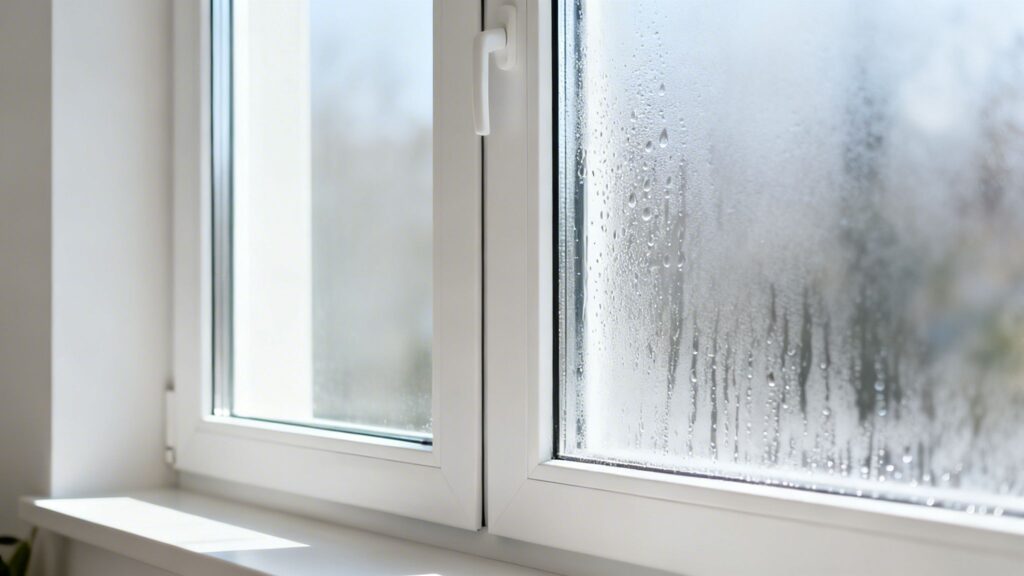
If you've ever noticed a foggy haze or moisture trapped inside your double-pane windows, you're looking at a classic sign that something’s not right. It’s frustrating because you can't just wipe it away. This isn't just an annoying visual—it's a red flag that your window’s seal has broken.
When that happens, the insulating barrier that makes the window energy-efficient is gone, letting humid outside air seep right in between the panes.
Why Is There Fog Between My Window Panes?

That impossible-to-reach fog is known as condensation between window panes, and it’s the telltale sign of a failed Insulated Glass Unit (IGU). Modern double-pane windows are more than just two pieces of glass; they're a sealed unit engineered to keep your home comfortable.
Think of it like a thermos. When it's properly sealed, it keeps your coffee hot for hours. But if that seal breaks, the heat escapes almost immediately. A window's IGU works the same way. A special insulating gas, usually argon, is trapped between the panes. Once the seal fails, that gas leaks out and is replaced by regular, moisture-filled air. This is what causes the fog you see as that trapped humidity condenses on the glass.
Differentiating Window Condensation Types
Before you panic, it’s important to realize that not all window condensation is a bad thing. Moisture can show up in three different spots, and where you see it tells you everything you need to know about your window’s health. Figuring out the location is your first step. For a deeper dive, you can learn more about what causes windows to fog up.
Here’s the main thing to remember: If the moisture is between the panes of glass, the window's seal has failed. If it's on the inside or outside surface you can wipe away, your window is actually doing its job insulating your home.
To help you figure out what's going on, here's a quick comparison of the different types of condensation you might see.
Is Your Window Condensation a Problem?
This simple table will help you identify whether you're seeing normal moisture or a clear sign of window failure.
| Condensation Location | What It Means | Recommended Action |
|---|---|---|
| Between the Panes | The window's seal has failed. It's no longer insulating properly and has allowed moisture to get trapped inside. | This is a job for a professional. The IGU will need to be replaced, or in some cases, the entire window. |
| On the Interior Surface | Your windows are working, but the humidity inside your house is too high. Warm, moist air is hitting the cool glass and condensing. | Improve your home's ventilation. Try using a dehumidifier or running exhaust fans in the kitchen and bathrooms. |
| On the Exterior Surface | Great news! Your windows are providing excellent insulation. The outer pane is staying cool enough for morning dew to form on it. | No action is needed at all. This is a sign of a high-performance, energy-efficient window doing its job perfectly. |
Ultimately, knowing where the condensation is forming gives you a clear path forward—whether it’s making a simple adjustment to your home's humidity or calling a pro for a repair.
What's Really Happening Inside a Foggy Window
To get to the bottom of that frustrating fog, you have to understand that your double-pane window is more than just glass. It’s actually a sealed system called an Insulated Glass Unit (IGU), and its whole job is to act as a barrier to save you money on energy bills.
Think of it like a transparent thermos for your house—it's designed to keep the heat in when it's cold outside and keep it out when the summer sun is beating down. When that system breaks down, the first sign of trouble is often that trapped condensation between window panes.
The Anatomy of an Insulated Glass Unit
Let's quickly break down the parts of an IGU. Each component has a specific and crucial role in making the whole thing work.
- Two Panes of Glass: You have the two panes you can see, but the real magic happens in the sealed space between them.
- The Spacer: This is the frame that runs around the perimeter, separating the two glass panes and creating a uniform gap.
- Insulating Gas: That gap isn't just empty space or plain air. It’s filled with a harmless, invisible gas—most often argon—which is much better at insulating against heat transfer than regular air.
- The Desiccant: Hidden inside the spacer is a special material, like tiny silica beads, designed to absorb any stray moisture that was trapped inside when the window was made.
The entire assembly is sealed shut with a primary and secondary sealant around the very edge. This dual-seal is the gatekeeper—it keeps the argon gas in and moisture out. When that seal is broken, the window's insulating ability is gone for good.
What "Seal Failure" Really Means
When we talk about a "failed seal," it's rarely a dramatic, visible event. It's almost always a slow, quiet failure of the sealant that bonds the glass to the spacer. Over years of exposure to the elements—from the intense heat of summer to the freezing cold of winter—the window materials constantly expand and contract. That relentless stress eventually causes the seal to weaken and develop a tiny breach.
Once that small opening appears, things go downhill fast. The heavy argon gas slowly leaks out, and humid outside air gets sucked in to replace it. For a while, the desiccant material inside the spacer does its job, absorbing the incoming moisture. But it can only hold so much, and eventually, it becomes completely saturated.
This is the tipping point. With the desiccant overloaded, the water vapor now trapped inside has nowhere else to go. When the outer pane of glass gets cool, that moisture condenses into the fog, streaks, and droplets you see but can't wipe away. You can get a more in-depth look at this in our guide on what a window seal is.
How to Confirm Your Window Seal Has Failed
Before you jump to conclusions, it's smart to do a quick check to make sure the problem really is condensation between the window panes. This simple test takes just a few minutes and will tell you exactly what you're dealing with, so you can figure out your next move.
The easiest way to diagnose a failed seal is what I call the "cleaning test." Grab a good glass cleaner and give the inside of the window a thorough wipe-down. Then, head outside and do the same for the exterior pane.
Now, step back and take a good, hard look. If you can still see that foggy patch, moisture streaks, or tiny water droplets, they're trapped in the middle. You can be 100% certain the seal has failed. The fogginess remains because you simply can't reach the surface where it's forming.
Other Telltale Signs of a Broken Seal
Besides the obvious fog, there are a few other clues that point to a broken seal. These usually show up after the window has been compromised for a while.
- Distorted or "Funhouse" Reflections: As the pressure changes inside the sealed unit, the panes of glass can start to bow slightly. Look at the reflection of a tree or a house across the street—if it looks wavy or distorted, that's a classic sign of failure.
- A Chalky or Stained Appearance: After months or even years of moisture getting in, condensing, and evaporating, it can leave behind mineral deposits. This often looks like a white, chalky film on the inside surfaces of the glass that you just can't clean off.
This whole process is a predictable chain reaction. This image breaks down how a small breach eventually leads to the foggy mess you see.

As the graphic shows, the inert argon gas that was providing insulation escapes, and moist, everyday air gets sucked in. When the temperature is right, that moisture condenses. Unfortunately, once you see it, reading up on how to clean between double windows won't help, as that space is supposed to be permanently sealed off.
A broken window seal is more than just an ugly smudge. It's a sign that your window has lost its insulating power. Your HVAC system has to work that much harder to keep your home comfortable, which means higher energy bills.
While the condensation itself is the first thing you'll notice, a failed seal can cause bigger headaches down the road. If you ignore it, the constant moisture can eventually lead to signs of water damage in walls around the window frame. Spotting the problem early is the best way to prevent these more serious issues. Once you've confirmed it's a failed seal, you can confidently start looking at your repair or replacement options.
Choosing Between Window Repair Or Full Replacement
So, you've confirmed it: that frustrating fog is sealed between the panes of your window. The good news is you have options. The big question now is whether a targeted repair or a full replacement is the right move for your home.
Your decision really boils down to balancing cost, performance, and the long-term health of your windows. While a quick fix might sound appealing, it's crucial to understand what each option actually accomplishes—and what it doesn't.
You may have come across services offering "window de-fogging." The process usually involves drilling a tiny hole in the glass, spraying a cleaning solution inside, and then installing a small one-way vent to let moisture escape. It can clear the view temporarily, but this is a cosmetic patch, not a real repair.
A de-fogging service can't bring your window's insulation back to life. The moment the seal failed, the insulating argon gas escaped for good. Even after de-fogging, the seal is still broken, leaving you with an inefficient window that can drive up your energy bills.
Understanding Your Permanent Options
For a solution that permanently restores both your clear view and your window's energy efficiency, you have two main paths: replacing just the glass unit or replacing the entire window, frame and all. The best choice depends entirely on the condition of your existing window frames.
IGU Replacement: The "Glass Transplant"
The first option is an Insulated Glass Unit (IGU) replacement. Think of it like a window transplant. A technician carefully removes the failed, foggy glass unit from your current window frame and installs a brand-new, factory-sealed IGU right in its place. If your window frames are still in good shape, this is a fantastic and cost-effective solution.
An IGU replacement is the perfect fit when:
- The window frame—whether it's wood, vinyl, or fiberglass—is still solid, free of rot, and works properly.
- Your windows aren't ancient, maybe less than 15 years old.
- You only have one or two windows with seal failure.
When a Full Window Replacement Makes More Sense
Your other option is a full window replacement. This is the whole works. The entire old window—frame, sash, and glass—is torn out, and a completely new unit is installed in its place. It's a bigger investment, but for older windows or frames with multiple problems, it’s often the smartest one.
A full replacement is probably the way to go if you're seeing these issues:
- The frame itself is warped, cracked, feels soft to the touch, or shows obvious signs of water damage and rot.
- You feel drafts, or the window is a struggle to open, close, and lock securely.
- Your windows are over 20 years old, and you're already thinking about bigger upgrades to improve your home's energy efficiency.
Going with a full replacement doesn't just solve the condensation problem. It's a total upgrade. You get modern frame materials, better locking mechanisms, and the latest in energy-saving glass technology, all of which can boost your home's comfort and value.
Breaking Down the Costs of Fixing Foggy Windows
Once you’ve spotted that frustrating fog and decided it’s time to act, the next big question is always about the cost. Understanding what goes into the price of fixing condensation between window panes will help you set a realistic budget and know what to expect from a quote.
You’re essentially looking at two permanent fixes: replacing just the glass unit (the IGU) or swapping out the entire window, frame and all. One is a surgical repair, while the other is a complete replacement—and their price tags reflect that.
What Drives the Final Price
So, what makes one job cost more than another? A few key things will influence the final bill. The size of the window pane is the most obvious factor; bigger glass simply costs more.
The type of glass matters, too. If your windows have special features like Low-E coatings to reflect heat or are built with a triple-pane design for extra insulation, the replacement unit will be more expensive than a standard, no-frills pane.
Finally, think about where the window is. A simple, ground-floor window is a straightforward job. But a custom-arched window on the third story? That’s a whole different ballgame requiring ladders, scaffolding, and more time, which will increase labor costs.
Pro Tip: Before you call for a quote, do a little digging for your original window paperwork. Many manufacturers offer a warranty that covers seal failure for 10 to 20 years. If you're still within that window, the company might cover the cost of the new IGU, leaving you responsible only for the labor to install it. It's always worth checking!
Comparing Your Investment Options
To help you see how these two choices stack up, let's look at the costs and benefits you can expect. The table below gives a snapshot based on 2026 national averages, but remember that prices in your area may be different.
Cost and Benefit Breakdown IGU vs Full Window Replacement
| Factor | IGU Replacement | Full Window Replacement |
|---|---|---|
| Average Cost | $150 – $450 per window | $500 – $1,500+ per window |
| Best For | Newer windows (<15 years) with solid, undamaged frames. | Older windows (20+ years) or any window with a warped, rotted, or drafty frame. |
| Key Benefit | Restores insulation and clarity for a lower initial cost. | A complete upgrade that improves energy efficiency, home security, and property value. |
Ultimately, replacing the IGU is a fantastic, targeted repair. It solves the immediate problem of foggy glass and restores your window's insulating power without the expense of a full replacement.
A full window replacement, on the other hand, is a much bigger project. It’s an investment that not only gets rid of the fog but also tackles any underlying problems with an old, inefficient, or damaged frame, giving your home a major performance upgrade.
Tips to Extend the Life of Your Windows

Let's be realistic—the seals on any insulated glass unit will eventually give out. But with a little regular attention, you can significantly push back the day you see that dreaded condensation between window panes. It's all about simple, routine maintenance to head off the common culprits behind premature seal failure.
The best place to start is just by being observant. Turn every window cleaning session into a quick health check. As you're wiping down the glass, take a moment to run your fingers along the edges where the glass meets the frame. Do you feel any sealant that's starting to crack, peel away, or look brittle? Catching this early is a huge win.
Smart Window Maintenance Habits
Great window care goes beyond streak-free glass. To really protect your windows, you need to think about the entire assembly and make sure it's doing its job of keeping moisture on the outside.
Keep Weep Holes Clear: Take a look at the exterior bottom of your vinyl or metal window frames. You should see tiny slots or holes—these are "weep holes" designed to let rainwater drain out. If they get clogged with dirt or debris, water can back up directly against the window's seals. A small brush or even a straightened paperclip can be used to gently clear them out.
Maintain Exterior Caulk: The caulk that seals your window frame to the siding is your home's first line of defense against water intrusion. Give it a look-over once a year. If you spot any caulk that's shrinking or cracking, it's time to re-apply it. This simple fix prevents moisture from sneaking into the wall around the window frame, where it can cause all sorts of problems.
One of the worst things you can do is power wash your windows. The intense, high-pressure spray can easily compromise the seals, forcing water into the IGU and causing the exact failure you're trying to prevent. A gentle hand-wash is always the safer bet.
Controlling the moisture inside your home also makes a big difference. Learning how to reduce humidity in your home takes a lot of the pressure off your windows, especially during cold weather when condensation is most likely to form.
By turning these simple tasks into habits, you can add years to the life of your windows and keep them looking crystal clear.
Frequently Asked Questions About Window Condensation
When you see fog trapped between your window panes, a lot of questions probably pop into your head. It’s a common problem, and we get calls about it all the time. To clear things up, here are answers to the questions we hear most from homeowners just like you.
Is Condensation Between Window Panes an Emergency?
No, you don’t need to panic or make a late-night call. But you should treat it as an urgent problem. That fog is a clear sign that the seal on your double-pane window has failed.
Your window has officially lost its insulating power. That means your HVAC system has to work overtime just to keep your home comfortable, and you'll start paying for it on your energy bills. While it won't cause your wall to collapse overnight, leaving it for months or years allows moisture to sit inside the frame, which can lead to rot and mold. It’s a problem that only gets worse—and more expensive—the longer you wait.
Can I Fix a Broken Window Seal Myself?
Unfortunately, this is one of those jobs that really isn't for the weekend warrior. Fixing a broken window seal is a factory-level process that just can't be replicated at home. It involves specialized machinery to pull the panes apart, thoroughly clean the interior surfaces, inject a new layer of inert gas like argon, and then perfectly reseal the unit under controlled pressure.
Any DIY attempt is a temporary fix at best and won't bring back the window's insulating value. The only real, long-term solutions are to have a professional replace the sealed glass unit (the IGU) or the entire window itself.
Keep in mind that "de-fogging" services are cosmetic fixes. They might clear the view, but they do not repair the broken seal or replace the lost insulating gas, leaving your window inefficient.
How Long Should a Double Pane Window Last?
You can generally expect a quality double-pane window to last anywhere from 15 to 25 years. Most manufacturer warranties will even cover a failed seal for 10 to 20 years.
Of course, that lifespan depends on a few things: the quality of the window and the initial installation, your local climate (extreme temperature swings are tough on seals), and how much direct sun exposure it gets.
Will a New Window Unit Lower My Energy Bills?
Yes, absolutely. When you replace a failed, foggy IGU with a new, properly sealed and gas-filled unit, you're restoring the window's insulating barrier.
This new unit makes it much harder for outdoor heat or cold to get in, which helps keep your home's temperature stable. You'll likely see a noticeable difference in your heating and cooling costs.
Ready to get a clear view and restore your home’s energy efficiency? The experts at Sparkle Tech Window Washing can assess your windows and provide the best solution. Contact us today for a professional consultation.