



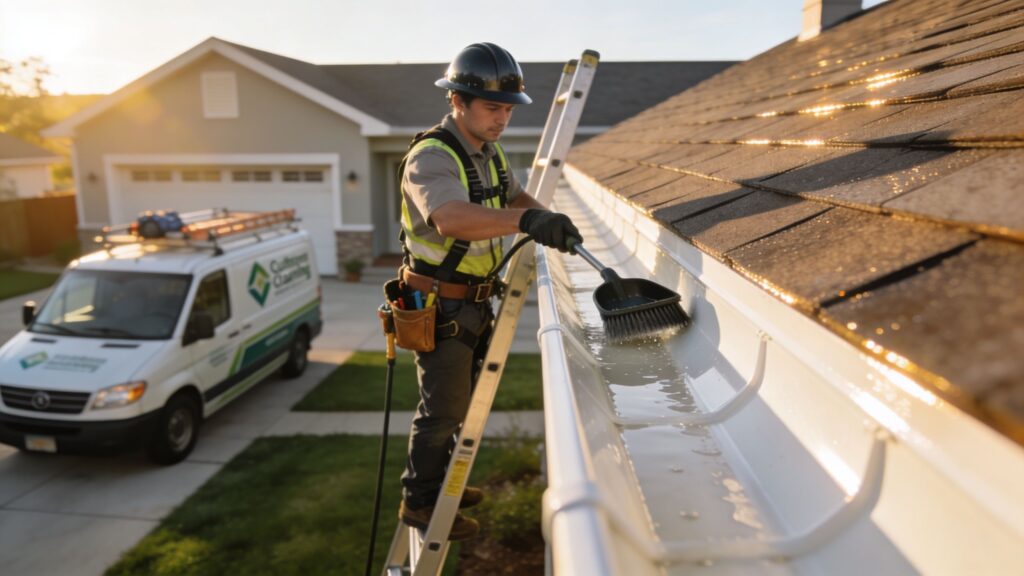
If you already run a window washing, solar panel cleaning, or exterior maintenance company, you’ve probably felt the same pattern. A strong stretch of bookings gets followed by a softer patch, crews still need hours, and you start looking at your customer list wondering what else those homes already need.
That’s where a cleaning gutter business makes sense. Not as a brand-new company from scratch, but as an extension of work you already know how to sell, schedule, and perform. The same customers who trust you around glass, screens, and rooflines usually need gutter service too. You already know the neighborhoods, the property types, and the season when debris starts piling up.
The mistake is treating gutter cleaning like a completely separate trade. In practice, it works best as a tightly integrated service line inside an existing exterior cleaning operation. When it’s set up that way, the path to profitability is faster, the marketing is simpler, and the operational learning curve is far smaller.
Why Gutter Cleaning is Your Next Profitable Service
A lot of exterior service businesses hit the same wall. Window work slows down in certain stretches, premium add-ons don’t book consistently enough, and you end up with labor capacity that isn’t earning what it should. Gutter cleaning solves a very practical problem. It gives you a service customers already understand, tied to obvious maintenance needs, with natural demand in the same residential markets you already serve.

This isn’t a tiny side niche. The global gutter cleaning services market was valued at approximately US$1.2 billion in 2023 and is projected to reach about US$1.9 billion by 2033 at a 5.1% compound annual growth rate, according to Fact.MR’s gutter cleaning services market analysis. That matters because it confirms what a lot of operators already see in the field. Homeowners increasingly treat gutter work as recurring preventive maintenance, not just an emergency cleanup after overflow starts.
Why the fit is so good for existing service companies
If you already clean windows or panels, you’ve got a head start that a startup operator doesn’t. You likely already have:
- An active customer list with homes that need roofline maintenance
- Scheduling systems that can absorb another service line
- Field crews used to ladders, setup, and customer-facing work
- Vehicles and storage that can carry added gear with minor changes
That combination changes the economics. You’re not trying to educate a cold market from zero. You’re adding a service to people who already know your name and already bought from you once.
Practical rule: The best gutter jobs are often sitting inside your current route density, not in some new territory you have to fight to win.
Where the money usually shows up first
The first gains usually don’t come from fancy equipment or huge ad spend. They come from simple bundling and route efficiency. A crew already on site for exterior work can often add gutter cleaning with far less friction than booking a separate appointment later. That means fewer gaps in the day and better revenue per stop.
Gutter work also gives your business a stronger maintenance identity. Instead of being seen as “the company that cleans windows,” you become the crew that handles the visible exterior upkeep people keep putting off.
That shift matters because homeowners rarely want five different vendors for related jobs. They want one trusted company that can handle the outside of the house well, safely, and without drama.
Building Your Foundation for Legal and Insured Operations
Most operators get excited about tools first. That’s backward. Before you market a single gutter cleaning job, your business paperwork and insurance need to reflect the work you are doing.
If you already run an exterior service company, this is much easier than starting from zero. That’s one reason this discussion on integrating gutter cleaning into an existing service operation points to a real profit opportunity for companies that already have insurance, licensing, and client relationships. The shortcut isn’t in skipping admin. It’s in updating what you already have instead of building an entire legal structure from scratch.
Start with your insurance agent
Call your insurance agent before you put gutter cleaning on your website or invoice. Don’t ask a vague question like “Am I covered for gutters?” Be specific about the actual tasks your crews will perform.
Use a checklist like this in that conversation:
- Work at heights exposure. Tell them whether crews will use extension ladders, roof access, or both.
- Property damage scenarios. Ask whether your general liability coverage extends to gutter-related damage, including fascia, soffit, downspouts, siding, and landscaping cleanup issues.
- Employee activity. Confirm that workers compensation classifications still fit the added work your technicians will perform.
- Vehicle and equipment transport. Ask whether carrying added ladders, blowers, vac systems, or debris containers changes anything on the commercial auto side.
If the policy language is unclear, don’t guess. Get written confirmation from the carrier or broker.
Update your business records before you advertise
A lot of owners assume their LLC can “just do it” because the new work is close to what they already offer. Sometimes that’s fine. Sometimes it creates headaches later when a claim, licensing question, or contract review exposes a mismatch between your listed business activity and your actual services.
Review these items:
LLC operating documents
Make sure your business purpose language is broad enough to include gutter cleaning and related exterior maintenance services.State and local registration
Verify that your business registration and any required trade filings match the added service line.Service agreements and estimates
Add gutter-specific terms. Spell out debris removal, downspout flushing, water testing if offered, and any limits on repairs.Safety policy documentation
Your internal documents should reflect ladder use, roof access rules, and pre-job hazard review.
Don’t treat this as red tape. Treat it as the part that keeps one bad claim from wiping out a profitable service line.
Tighten the scope before crews go live
Operationally, the cleanest setup is to define what your company does and does not do from the start.
For example, decide these questions early:
- Will you remove debris only, or also flush downspouts?
- Will you perform minor sealing and reattachment work?
- Will crews ever walk roofs, or only work from ladders and ground-based systems?
- Will you service properties with steep rooflines or heavy tile exposure?
Those decisions affect insurance, training, sales language, and pricing. They also keep your team from improvising on site just because a customer asks for one extra favor.
A cleaning gutter business gets profitable faster when the scope is narrow at first. Add complexity later, after your process is stable.
Gearing Up with the Right Tools and Vehicle Setup
A lot of owners overspend early on gear they don’t yet know how to use efficiently. Others go too cheap, then burn crew time with awkward setups and messy job flow. The smarter move is to build your toolkit in layers.
Start with equipment that lets you complete jobs safely, neatly, and without wasting motion. Then upgrade when your volume proves the need.

Good gear for day one
Your basic setup should be simple and reliable:
- Extension ladders with the right reach for your target homes
- Ladder stabilizers to improve contact and help protect gutters and siding
- Gutter scoops for packed debris
- Buckets or debris bags for controlled removal
- Gloves, eye protection, and non-slip footwear
- Hose or basic flush setup if your service includes downspout testing
- Tarps for ground protection and cleanup control
This setup works when you’re testing demand and learning your local housing stock. It’s also easier to fit into a van or truck already used for window cleaning.
Better gear when speed starts to matter
Once the service line is booking regularly, convenience becomes profit. The faster your crew can set up, move, and leave a property clean, the stronger your margins become.
Useful upgrades include:
- Blower extension kits for light dry debris
- Tool belts or bucket hooks to reduce climbing interruptions
- Dedicated downspout nozzles for flushing blockages
- Labeled storage bins so gutter tools don’t mix with window gear
- Ladder rack improvements that reduce loading hassle
Workwear matters more than many owners admit. Gutter jobs are dirty, repetitive, and rough on clothing. A clean, durable uniform also changes how customers read your professionalism the moment the crew steps out. If you need a practical reference for outfitting crews without buying junk, Jackd Workwear’s guide for tradies is worth a look.
Best gear when safety and efficiency drive the upgrade
At higher volume, the strongest upgrade is usually a professional gutter vacuum setup. Ground-based cleaning isn’t right for every property, but it can be a strong fit for many routine jobs. It reduces some ladder time, keeps crews working faster, and creates a more repeatable process.
This is also the point where you start separating “nice tool” from “profitable tool.” Buy equipment that removes friction from jobs you already book often. Don’t buy gear because it looks advanced.
For a practical walkthrough on one common field complication, this guide on how to clean gutters with gutter guards is useful because guarded systems often change both your tool choice and your labor flow.
A quick visual helps if you’re planning gear expansion:
Set up your vehicle like a production space
The truck or van setup matters almost as much as the tools themselves. If your crew has to dig through a pile of mixed equipment, every stop gets slower and sloppier.
A clean vehicle layout usually includes:
- Ladders outside or overhead so they don’t bury small tools
- One shelf or bin zone dedicated to gutter work
- Sealed containers for dirty gloves and wet debris tools
- A cleanup station with towels, hand cleaner, and spare bags
- A visible restock system so missing items are obvious before the next route
The goal isn’t perfection. It’s making sure the crew can pull up, grab the right gear in order, complete the work, and leave the property looking better than they found it.
Mastering Non-Negotiable Safety Protocols
A cleaning gutter business can be profitable. It can also hurt people fast when the owner gets casual about ladders, roof edges, or overhead utilities. Safety has to stay separate from tool talk because tools are optional upgrades. Safety rules are not.
The easiest way to lose money in gutter work is to think only about revenue and ignore exposure. One slip, one bad ladder placement, or one rushed decision near service lines can damage a technician, a customer’s property, and your company’s future in the same afternoon.

The rules that don’t bend
Every crew needs a fixed set of field rules. No exceptions because the house is “easy” or the stop is “quick.”
- Inspect the ladder before it comes off the vehicle. If rails, feet, locks, or rungs are questionable, that ladder doesn’t go on the house.
- Set ladders on stable ground only. If the footing is poor, fix the setup or don’t do the job.
- Maintain three points of contact. That rule sounds basic because it is basic. It still prevents bad decisions.
- Use stabilizers where appropriate. They improve control and help avoid leaning directly into fragile gutter sections.
- Treat power lines as a stop sign. If overhead conditions are unsafe or unclear, reassess the entire plan.
Safety culture isn’t what you say in training. It’s what the crew does when the homeowner says, “Can you just reach that last section real quick?”
Build a pre-job pause into every site visit
A strong crew doesn’t jump out and start climbing. They pause first. That habit alone cuts down on rushed judgment.
Use a short pre-work checklist:
Ground conditions
Wet soil, gravel, irrigation runoff, decorative rock, and uneven pavers all affect ladder placement.Access path
Look for gates, narrow side yards, AC units, pool equipment, and fragile landscaping.Roofline complexity
Valleys, second-story transitions, tile, and awkward corners change the safest approach.Electrical hazards
Scan for overhead service drops and nearby conductors before unloading long ladders.Customer expectations
Confirm scope before the first setup so no one is improvising halfway through the job.
If you want a homeowner-focused reference that also helps your team speak confidently about timing and maintenance, this article on when to clean out gutters is useful for explaining service windows without overcomplicating the conversation.
Protect the crew from shortcuts
Owners often think accidents come from inexperience. A lot of the time they come from familiarity. Once technicians have done enough jobs, they start believing they can shave corners safely.
That’s why your process has to force discipline:
- No carrying loose handfuls of debris down ladders
- No overreaching to save a reposition
- No roof access without clear internal rules
- No job completion pressure that rewards speed over control
A slow, controlled technician is cheaper than a fast technician who damages gutters, slips a ladder, or scares customers.
If you want a reputation that supports premium pricing, safety has to be visible. Customers notice stabilized ladders, deliberate setup, protective gear, and careful cleanup. They may not know every rule you follow, but they know when a crew looks under control.
Pricing Services and Crafting Irresistible Upsells
Pricing is where many gutter add-ons either become a strong profit center or stay a messy side service. If your numbers are loose, crews work hard and the calendar fills up, but the margin never feels right. If your pricing is too rigid, sales reps struggle to quote quickly and customers get confused.
A useful benchmark keeps you honest. According to Jim’s guide to starting a gutter cleaning business, a full-time gutter cleaning technician should generate between $80,000 and $120,000 in annual revenue. The same source notes common pricing of $1.00 to $2.50 per linear foot, and that a standard single-story home generates $70 to $200 per cleaning. Those numbers are best used as guardrails, not as autopilot pricing.
Pick a pricing model your team can actually use
Some owners love highly customized quoting. In the field, that often slows down sales and creates inconsistency. The best model is the one your office and crew can explain quickly and repeat accurately.
| Model | Typical Rate (2026) | Pros | Cons |
|---|---|---|---|
| Per linear foot | $1.00 to $2.50 per linear foot | Easy to scale to property size, useful for forecasting, creates consistent quoting logic | Requires accurate measurement habits, can feel too technical for some customers |
| By story or home size | Single-story homes commonly fall in the $70 to $200 range | Simple to explain, fast to quote, works well for common residential jobs | Can underprice complex layouts or heavy debris loads |
| Hourly rate | Qualitative only | Helpful for unusual cleanup, repair-heavy visits, or one-off problem jobs | Customers often dislike open-ended billing, harder to sell as a routine service |
Bundle around homeowner convenience
The upside for an existing exterior service company isn’t the standalone gutter ticket. It’s the bundle.
A homeowner who already booked window cleaning has already said yes to maintenance. That means the friction is lower than trying to sell a cold prospect on a separate trip. The offer works best when it feels practical, not pushy.
Try language like this:
“Since we’re already servicing the exterior, we can take care of the gutters during the same visit so you don’t need another appointment later.”
That script works because it sells convenience first. Not fear. Not technical jargon.
Build your upsells in layers
You don’t need a giant menu. You need a short stack of related options that crews can spot naturally on site.
Good pairings include:
Window cleaning plus gutter cleaning
Best for homes where roofline debris and dirty glass show up together.Solar panel cleaning plus gutter service
Useful when roof access planning is already part of the visit.Minor gutter issue reporting
Even if you don’t repair every issue, documenting sagging sections, leaks, or clogged downspouts adds value.Gutter guard conversations
Not every company installs them, but many should at least identify when recurring debris makes the conversation relevant.
A lot of owners price bundles by discounting too heavily. That’s usually the wrong move. The win is route efficiency, fewer separate dispatches, and stronger average ticket value. You can pass some value to the customer without training them to expect bargain pricing every time.
Watch margin, not just top-line sales
The simplest way to improve pricing is to review completed jobs by labor reality, not just by invoice amount. A gutter job that looks good on paper can still be a drag on the schedule if setup is awkward, debris is extreme, or access is poor.
For owners who need a better framework for reading profitability instead of just revenue, this breakdown of calculating gross and net construction profits is useful because the logic applies well to service businesses too. The labels may come from construction, but the discipline is the same. Know what the job sold for, what the labor and overhead really cost, and whether the bundle improved the day.
What tends to work and what doesn’t
What works:
- Fast quoting rules
- Simple package offers
- Clear scope limits
- Crew notes that flag upsell opportunities before the office follows up
What doesn’t:
- Custom pricing on every house
- Heavy discounts just to “get the gutter job”
- Selling repairs your team isn’t trained to perform
- Letting technicians make pricing decisions on the fly
A profitable cleaning gutter business isn’t built by charging the most. It’s built by pricing in a way that matches your process, your route density, and your actual labor habits.
Winning Locally with Smart Marketing and SEO
Most owners overthink marketing when they add gutter cleaning. They imagine they need a new brand, a separate website section for every neighborhood, or some expensive campaign to break into the market.
You usually don’t. Local service businesses win this category by being visible, specific, and easy to trust.
That opening exists because the U.S. market is fragmented. According to NGutter’s gutter services statistics overview, no single company holds more than 5% market share in the U.S. gutter services market. For a local operator, that matters more than national brand chatter. It means homeowners are still choosing among nearby providers, not defaulting to one dominant name.
Tighten your Google Business Profile first
Your Google Business Profile does more heavy lifting than most company websites for local service intent. If someone searches for gutter cleaning nearby, they want a provider, a service area, reviews, and a way to contact you fast.
Focus on basics done well:
Service categories
Make sure gutter cleaning is clearly represented if the platform allows it within your service setup.Photos
Use real jobsite photos. Clean vans, ladders set properly, debris removal, before-and-after roofline shots.Service descriptions
Mention the actual services you perform, such as debris removal, downspout clearing, and bundled exterior maintenance.Review prompts
Ask existing customers to mention gutter service by name when they leave feedback.
Market to the list you already own
The cheapest audience is usually your existing customer base. These people already opened the door to your crew, approved an estimate, and paid an invoice.
Use direct channels first:
Short announcement email
Tell customers you now offer gutter cleaning as part of exterior maintenance visits.Invoice inserts or door hangers
Keep the message simple. “Add gutter cleaning to your next exterior service appointment.”Follow-up reminders
If a crew notes visible debris, your office can send a short service recommendation after the visit.
If you need a broad reminder on keeping outreach simple and audience-specific, Silva Marketing’s startup advice is a useful reference. The startup framing is different, but the local lesson holds up. Clear message, clear audience, clear next step.
Win the local page before chasing broad traffic
A lot of service companies try to rank for huge generic phrases while ignoring the pages most likely to convert. Build pages around real service combinations and real customer intent.
One practical example is a focused service page like this resource for window and gutter cleaners, which aligns with how homeowners often think. They’re not always searching for one isolated trade. They’re looking for a company that can handle related exterior upkeep in one visit.
The local operator usually wins by being the clearest answer in a small service radius, not by sounding like the biggest company in the state.
Keep your message plain
Avoid cute slogans and inflated promises. Homeowners respond better to direct language:
- What you clean
- Where you work
- How they book
- Why combining services saves hassle
That’s enough. In a fragmented market, trust and clarity beat noise.
Hiring Your First Tech and Scaling Operations
The first hire changes everything. Up to that point, quality lives mostly in your own habits. Once another technician starts doing the work, your process has to become teachable.
Don’t hire your first gutter tech based only on whether they seem hardworking. Hard work helps, but it doesn’t replace judgment, consistency, and calm behavior on ladders. The person you want is coachable, steady, and comfortable following process without freelancing every job.
What to look for in the first technician
Previous exterior service experience helps, but mindset matters more. A technician can learn your gutter workflow. It’s much harder to teach reliability to someone who cuts corners by instinct.
Strong signs:
- Shows up on time without excuse patterns
- Listens carefully and repeats instructions back clearly
- Respects safety rules without mocking them
- Keeps work areas orderly
- Speaks to customers in a calm, professional way
Weak signs usually show up fast too. If a candidate brags about doing things “their own way” before they’ve learned your system, pay attention.
Interview for judgment, not charisma
Ask questions that reveal decision-making:
- “What would you do if a ladder setup felt unstable after you already carried tools over?”
- “How do you handle a customer asking for extra work that wasn’t approved?”
- “What tells you a jobsite is taking longer than planned for a good reason versus poor work habits?”
- “How do you leave a property so the customer feels the visit was professional?”
The best answers sound controlled and specific. You want someone who pauses, assesses, and communicates. Not someone trying to sound fearless.
Hire the technician who respects procedure. The one who wants to impress you by taking risks usually gets expensive.
Use a simple training checklist
Training should move in a fixed order. Don’t throw a new technician into the field with random exposure and hope they absorb the system.
A practical checklist looks like this:
Day one orientation
Company standards, service scope, customer communication, cleanup expectations.Equipment handling
Ladder carry, ladder inspection, stabilizer use, debris tools, vehicle loading order.On-site workflow
Arrival routine, hazard scan, customer confirmation, service sequence, final walkthrough.Quality control
Debris removal, downspout verification if included, property protection, photo documentation if used.Closeout
Cleanup, notes for office follow-up, reporting visible issues outside scope.
The key is repetition. New hires don’t need ten different methods. They need one clear method repeated until it becomes automatic.
Scale by removing owner-only knowledge
A lot of small service businesses stall because the owner keeps too much in their head. If only you know how to quote odd layouts, calm picky customers, or identify profitable bundle opportunities, growth stays fragile.
Start documenting things your team can follow:
- Approved pricing logic
- Which properties fit your service scope
- When to decline a job
- How to flag repair opportunities without overpromising
- What a finished property should look like before departure
That’s how you move from “I added gutters” to “I built a cleaning gutter business that runs consistently.” The service itself isn’t the hard part. Standardizing the work is.
If you’re in Arizona and want a trusted team for exterior maintenance, Sparkle Tech Window Washing provides professional service backed by workers compensation, general liability insurance, bonding, and an established presence in the Phoenix valley. If you need help with window washing and related exterior cleaning services, they’re a strong local option.