



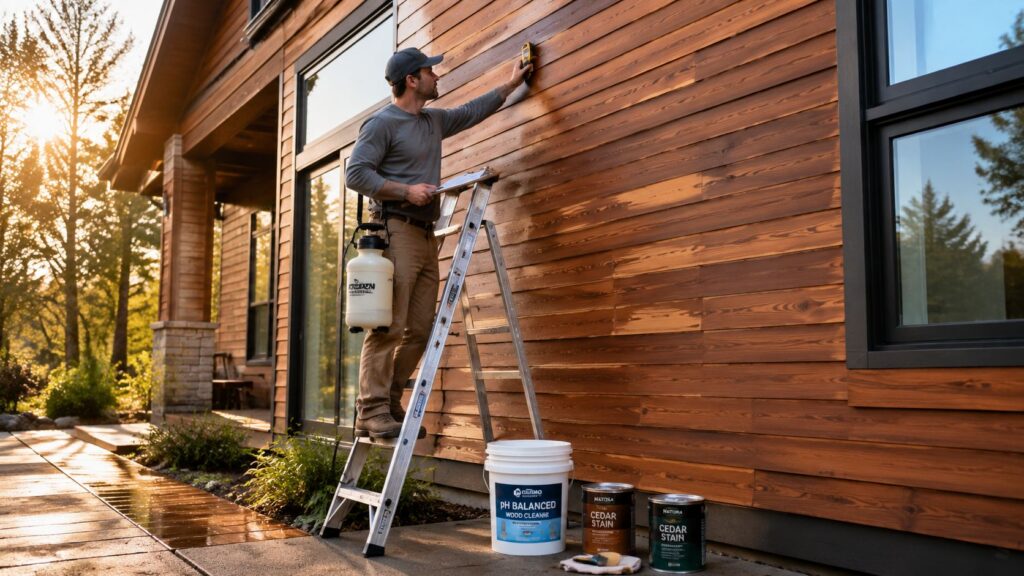
If you're standing in the yard looking at cedar siding that's still beautiful from the street but a little tired up close, you're in the right place. Most homeowners don't lose cedar because they ignored it completely. They lose it because upkeep stayed vague. A wash here, a stain there, maybe a quick tube of caulk when something looked off.
That approach gets expensive.
Good cedar siding upkeep works better as a system. You inspect on a schedule. You clean gently. You fix small failures while they're still small. You refinish before the wood starts begging for help. Done that way, cedar stays in the category it belongs in: a premium exterior material that rewards attention and punishes delay.
The Foundation of Upkeep Your Annual Siding Inspection
The most valuable tool in cedar siding upkeep isn't a pressure washer or a stain brush. It's a slow annual inspection.
Structured inspection cycles reduce cedar siding lifecycle cost by 15 to 25%, and homes with annual visual inspections have 60 to 70% fewer incidents of moisture-related rot because small defects get repaired before they become chronic leak paths, according to cedar siding inspection-driven maintenance findings from the verified data above.

What to inspect first
Start at the bottom of the house and work around it the same way every year. Bring a notepad, your phone for photos, a small flashlight, and if you have one, binoculars for upper walls. Consistency matters more than speed.
Look closely at these areas:
- Butt joints and board ends because cedar often takes on moisture at exposed end grain first.
- Flashing transitions above windows, doors, trim breaks, and roof-to-wall intersections.
- Drip edges and horizontal trim tops where water can sit longer than it should.
- South- and west-facing walls because sun exposure often shows finish fatigue early.
- Areas behind shrubs and near downspouts because air movement drops and splashback rises.
What different symptoms usually mean
Not every ugly spot is a crisis. Some are early warnings. Some are cosmetic. Some mean it's time to stop guessing and probe further.
Use this field guide:
| Sign | What it often suggests | What to do next |
|---|---|---|
| Faded color | UV wear and finish breakdown | Plan cleaning or refinishing review |
| Black or green streaking | Mildew, algae, or trapped moisture | Clean and check airflow nearby |
| Open gaps at joints | Seasonal movement or failing seal details | Monitor closely and repair if water can enter |
| Rust-colored stains below fasteners | Incompatible or failing fasteners | Replace suspect fasteners |
| Soft wood at ends or lower edges | Possible rot | Probe gently and consider professional assessment |
Practical rule: If the wood feels firm and the finish looks tired, that's usually a maintenance project. If the wood feels soft, flakes away, or stays damp long after surrounding areas dry, treat it as a repair problem first.
A checklist worth repeating every year
Walk the house and answer these plainly:
- Are any boards loose, split, cupped, or pulling away?
- Do you see mildew or organic growth near trim, soffits, or shaded walls?
- Are flashing edges tight and visible where they should be?
- Is caulking around windows and doors cracked, missing, or separating?
- Do lower courses show splashback, soil contact, or persistent staining?
- Are gutters overflowing onto siding or dumping near corners?
Gutter issues and cedar problems often show up together. If runoff control is part of your weak spot, this homeowner's guide to cleaning gutters with gutter guards is worth reviewing alongside your siding inspection plan.
A good inspection doesn't just tell you what is wrong. It tells you what to do this season, what can wait, and what deserves a professional set of eyes before hidden damage spreads.
Seasonal Cleaning The Right Way to Wash Cedar
Most cedar gets hurt during cleaning, not protected by it.
The common mistake is thinking dirt needs force. Cedar responds better to control. The goal is to remove grime, mildew, pollen, and surface contamination without roughing up the wood fibers or driving water behind the siding.

Soft washing versus pressure washing
Here's the practical comparison homeowners need.
| Method | How it works | Why it helps or hurts cedar |
|---|---|---|
| Soft washing | Low-pressure spray or hand application with a mild cleaner and rinse | Cleans surface contamination while preserving the wood surface |
| Pressure washing | High-force water stream aimed at the siding | Can gouge fibers, force water into joints, and leave the surface fuzzy |
In high-humidity or coastal exposure, annual or biannual cleaning and inspection can reduce moisture-related damage by up to 60% because regular removal of mildew and organic growth helps extend finish life and slows decay, according to verified cedar maintenance guidance for humid and coastal climates.
High pressure works on concrete. Cedar isn't concrete. Once the surface gets torn up, stains don't absorb the same way and weathering accelerates.
If you're tempted to use a machine because it seems faster, read this cautionary overview on pressure washer window cleaning. The same thinking applies to nearby exterior materials. Force can create damage that wasn't there before.
A safe washing routine
For regular seasonal cleaning, keep the process simple:
- Pre-wet nearby plants: Protect landscaping before any cleaner touches the wall.
- Choose a gentle cleaner: A pH-balanced detergent is the right starting point for cedar.
- Work in manageable sections: Clean one wall segment at a time so solution doesn't dry on the surface.
- Use soft tools: A pump sprayer, low-pressure nozzle, soft-bristle brush, and garden hose are enough.
- Rinse thoroughly: Leftover cleaner residue can interfere with future finish performance.
A practical order looks like this: wet the surface lightly, apply cleaner from the bottom up to reduce streaking, let it dwell briefly, agitate stubborn areas with a soft brush, then rinse well.
Clean cedar the way you'd clean a wood tabletop you care about. Dissolve and lift contamination. Don't blast the surface until it gives up.
When cleaning is enough and when it isn't
A lot of cedar siding upkeep goes sideways because homeowners clean a wall, see the color brighten, and assume they restored protection. They didn't. They restored appearance.
Seasonal washing is for dirt, pollen, mildew film, and general freshening. Prep cleaning before refinishing is more deliberate. That later process needs to leave the wood clean, dry, and ready to accept stain properly.
Signs cleaning alone may be enough:
- Surface grime only: The finish still beads lightly and looks intact.
- Minor organic growth: It brushes off without exposing bare wood underneath.
- Even color loss: The wall looks dull, not patchy or raw.
Signs you may be moving toward refinishing season:
- Patchy absorption: Some areas darken immediately when damp while others don't.
- Exposed bare spots: The protective finish has worn off unevenly.
- Recurring staining: The wall cleans up, then looks weathered again quickly.
Cleaning is maintenance. It is not a substitute for treatment. Cedar rewards homeowners who understand that difference.
Protecting Your Investment Restaining and Refinishing
Refinishing is where cedar either gets a new lease on life or gets set up to fail early. Most bad results come from rushing. The stain isn't usually the villain. The prep is.
Cedar siding typically needs restaining every three to seven years, with homes in coastal or high-humidity climates often landing in the 3 to 5 year range and temperate inland homes stretching closer to 5 to 7 years. The average homeowner expenditure is around $3,300 per restain cycle, based on a 2026 residential cedar siding maintenance cost report.

The four-stage refinishing method
A proper refinishing sequence includes cleaning, drying to 20% moisture content or less, light abrasion with 80 to 120 grit, and controlled recoating. That method can produce refinishing intervals of 4 to 7 years, versus 2 to 3 years when steps like abrasion or proper drying are skipped, according to verified cedar refinishing methodology guidance.
Here is what each stage looks like in the field.
1. Clean for adhesion, not just appearance
Remove dirt, chalky old finish, mildew, and extractives. Use a pH-balanced cleaner and low pressure or hand scrubbing. If the siding still feels slick, dusty, or contaminated, the new coating won't bond evenly.
This is not the place for bleach-heavy shortcuts or aggressive blasting. You're preparing wood fibers, not stripping a driveway.
2. Let the cedar dry fully
This is the step impatient homeowners skip. It matters.
Use a pin-type moisture meter. If the reading is above the manufacturer's acceptable threshold, wait. Verified guidance calls for wood to dry to 20% moisture content or less before coating. Stain over damp cedar and you trap a problem under a fresh-looking surface.
3. Abrade lightly
A light pass with 80 to 120 grit sandpaper or an abrasive pad does two things. It removes weak, degraded finish. It also opens the surface for better stain adhesion.
This isn't heavy sanding. You're not reshaping boards. You're creating a clean, receptive surface.
4. Recoat with control
Use a high-quality brush and follow spread-rate directions from the stain manufacturer. Penetrating semi-transparent and semi-solid stains are common choices for cedar because they highlight grain while adding protection. The key is even application.
More product isn't better. Over-application can leave sticky areas, uneven penetration, and premature failure.
Choosing the finish
For most cedar siding upkeep systems, penetrating stains are easier to maintain than heavy film-forming coatings. They tend to wear more naturally and are simpler to renew without dramatic peeling issues.
A quick decision guide:
- Semi-transparent stain: Shows more grain and natural variation. Best when the cedar surface still looks attractive and relatively even.
- Semi-solid stain: Hides more variation while keeping some wood character. Useful when color has become patchy.
- Solid coating: Can create a more uniform look, but future maintenance gets less forgiving if adhesion starts failing.
If you're comparing techniques used on broader exterior projects, this overview of quality external facade painting is useful for understanding disciplined prep and coating control, even though cedar has its own wood-specific rules.
The best stain job doesn't look thick. It looks even, absorbed, and calm.
The mistakes that cost the most
A failed refinish usually traces back to one of these:
- Staining damp wood: The finish may look acceptable at first, then lose adhesion.
- Skipping abrasion: Weak material stays on the wall and becomes the failure plane.
- Applying in the wrong weather: Direct hot sun, wind, or incoming rain can ruin consistency.
- Using cheap brushes: Cedar shows lap marks and sloppy edges fast.
- Treating all walls the same: Exposure changes by elevation. One side may be ready before another.
If the siding has widespread coating failure, lots of board replacement, or complicated second-story access, a professional crew often saves money by getting prep and timing right the first time.
A Stitch in Time Essential Minor Repairs
Cedar doesn't usually jump from healthy to catastrophic overnight. It gives warnings. Small splits, raised fasteners, hairline gaps, mildew spots. Catch those early and you keep repair work local instead of rebuilding a whole elevation later.
Fasteners and loose boards
Start with anything that's moving.
If a nail has backed out or left a rust streak, don't just hammer it deeper and walk away. Remove it if possible and replace it with a stainless steel or hot-dipped galvanized fastener that suits exterior cedar use. Then make sure the board sits flat without being overdriven, because crushed wood around the fastener can hold moisture.
If a board feels loose but still sound, secure it before wind and water widen the gap.
Small cracks and open seams
Not every crack needs a board replacement. Short, non-structural checks and narrow openings can often be stabilized.
Use a high-quality exterior-grade wood filler where a filler is appropriate, or a compatible paintable sealant where movement is expected around trim transitions. The rule is simple: fill only what needs to block water entry. Don't smear caulk across every natural wood joint and expect cedar to behave better.
A sensible repair sequence looks like this:
- Clean the area and let it dry.
- Trim away loose fibers.
- Apply the repair material neatly.
- Let it cure fully.
- Touch up finish only after the repair is stable.
Localized mildew or early decay
Surface mildew can often be cleaned if the wood underneath remains firm. Early decay is different. Probe gently with an awl or screwdriver tip in suspect spots, especially near butt joints and lower board ends.
Use this distinction:
- Surface issue: Discoloration wipes or scrubs off, and the wood feels solid.
- Repair issue: The tool sinks in easily, the surface crumbles, or the board edge stays soft.
A thirty-minute repair is cheap. A ignored leak path behind cedar rarely stays small.
When you find one bad spot, widen your inspection area. Water rarely lands in only one place. It travels, wicks, and hides. A key skill in cedar siding upkeep isn't just fixing the visible symptom. It's correcting the condition that fed it.
Your Cedar Siding Maintenance Calendar
A good maintenance calendar turns cedar siding upkeep from an occasional scramble into a routine you can budget for. That matters because cedar's biggest costs usually arrive when owners lose track of timing.
The major planning number is straightforward. Cedar siding typically requires restaining every three to seven years, with 3 to 5 years more common in coastal or high-humidity climates and 5 to 7 years more realistic in temperate inland settings. The average homeowner expenditure is around $3,300 per restain cycle, according to verified cedar siding maintenance cost guidance.

A simple year-round rhythm
You don't need to do everything every season. You do need a repeatable pattern.
| Season | Main job | What to watch |
|---|---|---|
| Spring | Full walk-around inspection and light cleaning | Winter movement, moisture stains, failed caulk |
| Summer | Minor repairs and refinishing work | Dry weather windows, stable cure conditions |
| Fall | Debris control and drainage check | Leaf buildup, splashback, clogged gutters |
| Winter | Observation | Ice, runoff, and any siding staying wet too long |
What each season should include
Spring
This is your decision season. Inspect every wall, photograph problem spots, and clean off the winter film so you can see the wood clearly. If you maintain a broader home checklist, this seasonal home maintenance checklist fits well alongside a siding review.
Summer
Handle the detail work. Replace failed fasteners, repair isolated cracks, and schedule refinishing if your inspection showed it's time. Dry, steady weather usually gives you the best chance at clean prep and proper curing.
Fall
Get debris away from the walls. Make sure runoff is moving away from the house and not down the siding face. Trim back plant growth that traps moisture and blocks airflow.
Winter
You're mostly watching. Note where snow, ice, or irrigation creates repeat wetting patterns. Those notes are valuable when spring inspection starts.
Budgeting and planning ahead
The easiest way to soften cedar's maintenance cost is to stop treating each restain as a surprise. Put the likely cycle on a calendar now, then adjust based on what your annual inspections show.
A practical system includes:
- A siding log: Photos by elevation, dated once a year.
- A repair list: Small issues grouped by urgency.
- A finish record: Product name, color, and application date.
- A tool routine: Brushes, sprayers, ladders, moisture meter, and sanding supplies cleaned and stored properly.
If you want a better process for keeping your gear ready between projects, this Extend tool life guide is a helpful framework for preventive tool care.
Good cedar upkeep doesn't feel random when the calendar does the remembering for you.
Knowing Your Limits When to Call a Professional
DIY cedar maintenance makes sense up to a point. Past that point, confidence turns into risk.
Call a professional when you find soft or spongy boards across multiple areas, repeated staining that suggests water is getting behind the siding, evidence of insect activity, or any repair that moves beyond isolated board work. The same goes for second-story access. Cedar projects become much less forgiving when ladders, scaffolding, and uneven weather windows enter the picture.
Red flags that should stop a DIY project
These deserve a harder line:
- Multiple failed boards in one wall section: That often points to a hidden moisture source, not bad luck.
- Persistent dampness: If one area stays wet noticeably longer than the rest, there may be a drainage or flashing defect.
- Rot around windows or roof intersections: Those details are easy to misdiagnose from the ground.
- Widespread finish failure: Large areas of peeling, raw exposure, or uneven absorption need a coordinated refinishing plan.
- Unsafe access: If you can't stand comfortably and work accurately, it's not a homeowner project anymore.
If you need help sorting repair options, this guide on how to find local contractors is a practical starting point for vetting the right kind of exterior professional.
Hire help when the problem is hidden, elevated, or spreading. That's where experience pays for itself.
Quick FAQ
Can I use bleach to clean my cedar siding
Avoid harsh bleach-heavy cleaning shortcuts. Gentle, cedar-appropriate cleaning methods are safer for the wood surface and for future finish performance.
What's the difference between semi-transparent and solid stain
Semi-transparent stain lets more grain and variation show through. Solid coatings create a more uniform look but can be less forgiving to maintain once adhesion problems begin.
Do I need to reseal after every wash
Not after every wash. Cleaning and treatment are different tasks. Wash to remove contamination. Refinish when inspection shows the protective finish is wearing out.
Is one bad board a big deal
One bad board is manageable. One bad board that sits next to failed caulk, dark staining, and soft trim usually means you should investigate further before doing cosmetic touch-ups.
Should I do every wall at once
Not always. Different sides of the house weather at different rates. Many homeowners get better long-term results by inspecting each elevation objectively and planning work based on exposure, not symmetry.
If your home's exterior needs expert help staying clean, sharp, and easier to maintain, Sparkle Tech Window Washing & window screens is a smart local resource. Their team serves Arizona homeowners with professional window washing and window screen services that support a cleaner, better-kept exterior overall.