



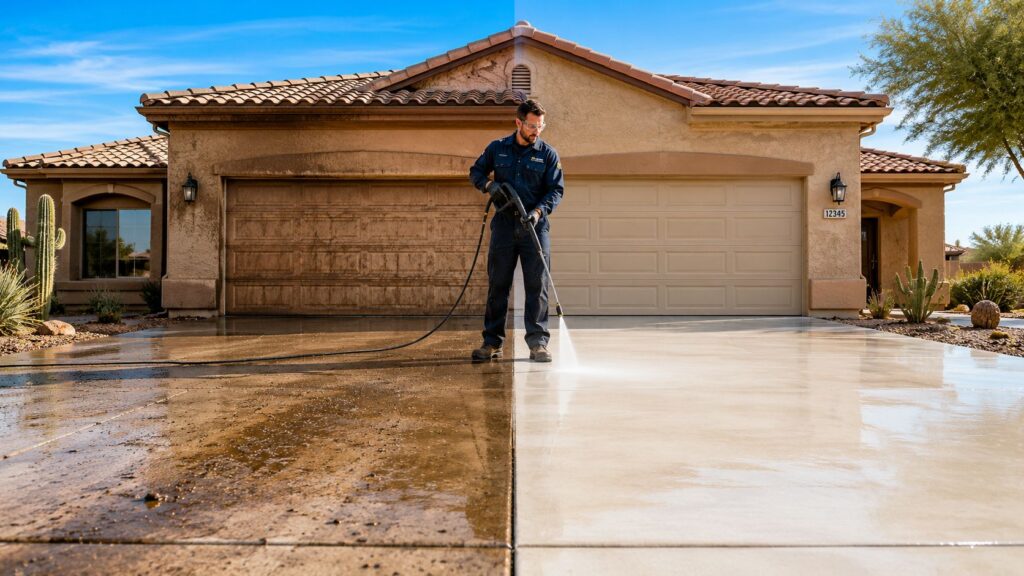
Pressure washing a house often falls in the $240 to $700 range, and many residential jobs are priced around $0.10 to $0.50 per square foot. In Phoenix and across Arizona, your final price usually comes down to the surface, the stain level, the height of the work, and how much prep or specialty treatment the job needs.
If you're looking at a dusty stucco exterior, a driveway darkened by tire marks, or a patio that picked up months of desert grime after monsoon season, you're probably seeing the same thing most Arizona homeowners see. The dirt isn't always dramatic, but it builds up slowly until the whole property looks tired.
The tricky part is that two quotes for the same house can look very different and both can be legitimate. One company may price by square footage. Another may price by labor time, access difficulty, and cleaning method. A low number isn't always a bargain, and a high number isn't always padding.
A fair pressure washing service cost starts with understanding how contractors think. Once you know what goes into a quote, it's much easier to spot the difference between careful work and a rushed wash that can scar stucco, etch concrete, or force water where it doesn't belong.
Decoding Your Pressure Washing Bill Before It Arrives
Arizona homes get dirty in a specific way. Fine dust settles into textured stucco, hard water leaves mineral traces around pool areas, and sun-baked buildup clings harder than people expect. By the time most homeowners start shopping for service, the question isn't whether the house needs cleaning. It's how much a proper cleaning should cost.
National pricing gives you a useful starting point. House washing is commonly priced by square footage, and broad residential pricing often lands in the ranges already mentioned at the top of this guide. But those baseline figures don't tell you whether your quote includes soft washing for delicate surfaces, chemical treatment for stains, or protection for nearby plants and fixtures.
Practical rule: A pressure washing bill makes more sense when you separate the job into three parts: how much area is being cleaned, how difficult that area is to clean, and how much setup the crew has to do before water even starts flowing.
In Phoenix, that last part matters more than many homeowners realize. A simple concrete pad with open access is one thing. A stucco home with tight side yards, decorative lighting, screened patios, and potted plants around every corner is another.
Before approving any quote, look for clear scope. A good estimate should tell you what surfaces are included, what method will be used, and whether stain treatment or specialty chemicals are extra. That level of detail protects you from two common problems: paying too much for vague work, or paying too little for a job that gets done too aggressively.
Per Square Foot vs Per Hour How Pros Price Their Work
The two pricing models you'll see most often are per square foot and per hour. In U.S. residential work, Taskrabbit lists an average hourly rate of $52 per hour, while Thumbtack reports a national average of $75 to $90 per hour. The same guidance also places typical house-cleaning work around $0.08 to $0.50 per square foot, depending on surface difficulty and buildup, in its 2026 pressure washing cost guide.
Per square foot works best when the area is predictable
Think of this like buying flooring. If the space is easy to measure and the work is fairly consistent, square-foot pricing is efficient for both sides. Contractors often lean this way for house exteriors, flat patios, walkways, and other surfaces where production time is easier to estimate.
For homeowners, this model is easier to compare. If one quote includes the full exterior and another excludes side walls, those differences can be measured and discussed.
A good square-foot quote usually works well when:
- The surface is open and measurable: Driveways, standard exterior walls, and broad patio areas are easier to estimate this way.
- The cleaning method is consistent: One cleaning process across most of the property keeps pricing stable.
- The contractor already knows production pace: Experienced crews often know what a certain type of surface typically takes.
Hourly pricing fits messy or mixed jobs
Hourly pricing is more like hiring a tradesperson for troubleshooting. If the contractor is dealing with several small areas, changing nozzles and chemicals, protecting delicate finishes, or handling stain removal that may or may not respond quickly, time-based pricing can be the honest approach.
That happens often in Arizona on properties with a little of everything. Stucco walls, cool decking, pavers, painted block walls, and shaded areas with organic buildup don't always belong in one neat square-foot formula.
When a job has a lot of variables, an hourly quote can be more transparent than a fake flat price that hides shortcuts.
If you're comparing bids and want a reality check, a simple pricing calculator can help you determine optimal service rates based on the type of work being done.
The same logic shows up in neighboring exterior trades too. If you've ever looked at how companies price glass, screens, and access challenges, this breakdown on how much window cleaners charge will feel familiar.
Why two honest quotes can look different
One contractor may convert everything into square footage. Another may build the quote around labor time because the property is awkward to access. Neither method is automatically better.
What matters is whether the model fits the work. If a company tries to force a complicated job into a cheap per-square-foot quote, something usually gets cut. That might be prep, stain treatment, rinsing time, or surface protection.
The 6 Key Factors That Drive Pressure Washing Costs
A real quote isn't built from square footage alone. Contractors look at the property and ask a more practical question: how long will this take to clean correctly without causing damage?

Surface type changes the method
Concrete, painted wood, vinyl, block, stone, and Arizona stucco don't get cleaned the same way. Concrete can usually handle more aggressive work. Stucco can't. On a textured stucco wall, the wrong tip and too much pressure can leave visible lines or blow water into cracks and weak spots.
That difference affects labor because the crew has to choose the right method, not just the fastest one.
Soil load matters more than homeowners think
Light desert dust is one thing. Oil drips, rust marks, algae in shaded corners, and hard water buildup around pool decks are another. Some stains need dwell time with specialty chemicals before rinsing. Others need multiple treatment passes.
The more stubborn the contamination, the less useful a simple "wash and rinse" quote becomes.
On-site reality: The dirt you can see is only part of the job. The real cost often comes from what has bonded to the surface.
Height and access add time fast
A single-story ranch home with room to move around is efficient. A two-story home with narrow side yards, fragile landscaping, decorative fixtures, or hard-to-reach rooflines slows everything down. Workers spend more time on hose management, ladder positioning, rinsing control, and protecting nearby surfaces.
That doesn't just affect speed. It affects risk.
Prep work can be a hidden line item
Most homeowners focus on washing time, but prep often decides whether the job goes smoothly. Furniture may need to be moved. Electrical outlets may need protection. Delicate plants may need to be pre-wet or covered. Entry doors, cameras, and light fixtures may need extra care.
Here's a simple breakdown of what often changes the quote:
| Cost driver | Why it raises or lowers price |
|---|---|
| Surface size | Bigger areas require more labor, water, and setup time |
| Material type | Delicate finishes need lower pressure and slower technique |
| Stain severity | Heavy grime or specialty stains need treatment and repeat work |
| Access difficulty | Heights, tight spaces, and obstacles reduce efficiency |
| Prep needs | Protecting property and moving obstacles adds labor |
| Travel and routing | Distance and scheduling efficiency affect mobilization cost |
Chemicals are part of the job, not an upsell by default
Commercial guidance often builds pricing from a cost stack that includes labor burden, overhead allocation, and chemical use, which is one reason the same task may be quoted around $0.10 to $0.50 per square foot or $75 to $150 per hour. The same guidance notes that flatwork often lands around $0.08 to $0.20 per square foot, while roofs and vertical surfaces usually command higher rates because access, risk, and dwell time increase labor minutes per square foot, according to Moon Invoice's contractor pricing guide.
Some jobs need only standard detergents. Others need rust removers, degreasers, or treatments designed for organic growth. In Phoenix, mineral staining and baked-on grime can push a basic wash into specialty-cleaning territory.
If you want a business-side explanation of when fixed pricing makes sense and when time-based pricing is smarter, this article on flat rate vs hourly pricing for contractors gives a solid overview.
Travel is real, especially in Arizona
Phoenix metro jobs can still involve serious drive time once you factor in traffic, spread-out neighborhoods, and service calls outside the core valley. For companies that work statewide, routing matters. A small standalone job far from other scheduled work often costs more to mobilize than homeowners expect.
Typical Pressure Washing Costs in Phoenix and Arizona
Phoenix isn't a separate pricing universe, but local conditions do change how often a "basic wash" turns into more involved work. The valley's dust, heat, monsoon residue, and hard water can all increase cleaning difficulty even when the square footage looks straightforward on paper.
As a national benchmark, Angi reports an average house pressure washing cost of $311, with a broad range of $100 to $707. It also places house washing at $0.10 to $0.50 per square foot. For driveways, Angi reports $100 to $500 overall, with a typical rate of $0.20 to $0.40 per square foot, in its house pressure washing cost guide.

What Phoenix homeowners usually run into
Stucco is the big one. Arizona homes often have textured exterior finishes that hold dust in all the little pockets. They need controlled cleaning, not brute force. Pool areas are another common issue because splashout and hard water can leave mineral residue around cool decking, pavers, and patio edges.
Driveways tend to be more predictable. If the concrete is open and mostly dealing with dirt, tire shadowing, or general discoloration, pricing is usually easier to keep within a standard range. Once oil, rust, paint drips, or deep organic staining show up, the quote often changes because treatment time changes.
Why local quotes can feel inconsistent
Two Phoenix-area properties with similar square footage can price differently for simple reasons:
- Stucco texture differs: Rougher finishes trap more dust and need slower rinsing.
- Sun exposure changes the stain profile: Baked-on grime behaves differently than shaded buildup.
- Water type leaves different residue: Poolside areas often need more than a rinse.
- Outdoor layouts vary: Courtyards, side gates, paver transitions, and desert landscaping all affect labor.
Some homeowners compare pressure washing and window service shopping at the same time. If that's your situation, this guide to window washing service cost can help you line up both projects realistically.
In Phoenix, the challenge usually isn't the amount of dirt. It's how tightly that dirt is bonded after months of heat, dust, and mineral exposure.
That local reality is why a neighbor's low quote doesn't always translate to your house. The pressure washing service cost depends less on zip code alone and more on what Arizona weather has done to your specific surfaces.
DIY vs Pro A Realistic Cost Breakdown
Renting a machine sounds simple. For a small, open concrete area, it can be. For a full Arizona home exterior with stucco, painted trim, windows, pool decking, and landscaping, DIY gets complicated fast.
The issue isn't just whether you can spray water. It's whether you can clean each surface effectively without stripping paint, forcing water behind trim, gouging wood, or leaving tiger-striping on concrete.
A quick visual comparison helps:

What DIY usually underestimates
Most homeowners think first about the machine. In practice, the harder part is choosing the right pressure, the right tip, the right detergent, and the right technique for each material. That's where problems start.
A few common DIY mistakes:
- Too much pressure on stucco: This can scar the finish or drive water where it shouldn't go.
- Wrong angle on windows and trim: Water can get past seals or into vulnerable edges.
- Uneven concrete cleaning: Fast wand movement leaves visible streaking.
- Skipping pretreatment: Some stains won't release well with water alone.
There's also the time factor. Setup, hose management, moving furniture, protecting nearby items, testing surfaces, and cleanup take longer than people expect. For a homeowner, that often turns into most of a day or a full weekend.
This short video gives a helpful look at the kind of technique and control that separates decent results from damage:
What you're paying for with a professional
A pro quote covers more than labor. You're paying for method selection, equipment that can handle different surfaces, chemical knowledge, workflow efficiency, and insurance coverage if something goes wrong.
Professional crews also know when not to pressure wash. Some surfaces should be soft washed. Some stains need treatment before any rinse. Some problem areas are better handled by hand tools, surface cleaners, or targeted applications rather than blasting everything uniformly.
Hiring a pro isn't about avoiding effort. It's about avoiding irreversible mistakes on surfaces that are expensive to repair.
For homeowners who are thinking specifically about glass and overspray risk, this article on pressure washer window cleaning is worth reading before you try to clean around windows yourself.
The honest comparison
DIY can make sense for a small, durable, low-risk area if you're comfortable learning the process and accepting the time commitment. It makes less sense when the job includes delicate finishes, mixed materials, hard water staining, second-story sections, or anything around windows and landscaping.
For most full-house exterior cleaning in Arizona, the professional route is usually less about convenience and more about surface protection.
An Insider Look At How a Professional Quote Is Built
You call for a quote on a one-car driveway in Phoenix, then a second company prices a full driveway, front walk, and patio for not much more. That gap usually comes down to how each contractor builds the job, not guesswork.
A professional quote starts with a site visit or a careful review of photos, then a scope. In Arizona, that scope matters more than many homeowners realize because the same property can have coated concrete, painted block, stucco, pavers, pool decking, and hard water buildup in one work area. Each surface changes the method, the chemical mix, the rinse process, and the risk.
Small jobs often carry a minimum charge for a simple reason. The crew still has to load the rig, drive across town, unload hoses, protect nearby areas, clean, rinse, and pack everything back up. In Phoenix, windshield time is part of the cost.
Thumbtack reports that many contractors use minimum service fees or tiered pricing, and its power washing prices guide shows why smaller jobs do not scale down neatly. Setup, travel, and teardown still take time even when the square footage is modest.
Here is what I expect to see behind a solid quote:
- Defined scope: Exact surfaces, approximate square footage, access issues, and whether stain treatment is included
- Labor time: Setup, cleaning, detail work, and breakdown, not just spray time
- Materials: Detergents, spot treatments, fuel, and protection supplies
- Equipment use: Surface cleaners, soft wash equipment, extension wands, recovery tools, or specialty nozzles
- Business overhead: Insurance, vehicle costs, maintenance, scheduling, and admin time
- Risk allowance: Extra care around glass, painted surfaces, electrical fixtures, plants, and pool areas
That last part is where cheap bids usually fall apart.
If one quote says "house wash" and another spells out the wall type, oxidation risk, plant protection, stain treatment, and rinse plan, those are not equal proposals. One contractor has mapped the job. The other may be pricing a best-case scenario and planning to sort out the details on site.
Phoenix area quotes also get shaped by local conditions that national articles usually miss. Hard water staining can turn a basic rinse into restoration work. Blowing dust settles into textured stucco and expansion joints. Full sun speeds up dry times, which affects dwell time for cleaning solutions and can add labor on hot days.
A fair quote should be specific enough that both sides know what is included, what is excluded, and what results are realistic. If that detail is missing, the low number can get expensive fast once add-ons, stain exceptions, or surface problems start showing up.
Hiring Smart Questions to Ask and Tips to Save Money
The easiest way to avoid trouble is to ask sharper questions before the job is booked. A good contractor won't get annoyed by that. They should be able to explain how they'll clean your surfaces, what they'll protect, and where the price comes from.

Questions worth asking every company
Use this as a shortlist when you're comparing bids:
- Ask about insurance: General liability and workers' compensation matter when crews are working around your home.
- Ask how they clean stucco and delicate finishes: In Arizona, that answer tells you a lot about experience.
- Ask what chemicals they'll use: You want to know how they handle plants, pets, painted areas, and poolside surfaces.
- Ask for a written estimate: Scope should be clear before the job starts.
- Ask what happens if stains remain: Some marks respond fully, some improve partially, and honest contractors will say so up front.
The best question isn't "What's your lowest price?" It's "What exactly is included in this price?"
Smart ways to lower your cost without lowering quality
You can often improve the quote without pushing the contractor into cutting corners.
- Clear the work area first: Move patio furniture, potted plants, and vehicles if the contractor asks you to.
- Bundle related exterior work: When one crew handles multiple tasks on the same visit, setup time gets used more efficiently.
- Schedule before buildup gets severe: Light grime is easier to clean than long-neglected staining.
- Get multiple detailed quotes: Compare scope, not just the final number.
- Be flexible on timing: Contractors may be able to route your job more efficiently on certain days.
A fair pressure washing service cost isn't the lowest number on the page. It's the price for cleaning that fits your surfaces, your stain level, and the actual labor required to do the job safely in Arizona.
If you're in the Phoenix valley and want a written quote that accounts for real exterior conditions, Sparkle Tech Window Washing & window screens handles window washing and screen-related services across Arizona, and the company notes that it's insured, bonded, and registered in the state. If you're already coordinating exterior cleaning, it's worth asking for a clear scope so pressure washing, glass, and screens are planned together instead of priced as disconnected add-ons.