
Your house looks dingy, the driveway has dark streaks, and the patio feels older than it is. That's usually when Raleigh homeowners start searching for a pressure washing service in Raleigh and get hit with two bad options. One contractor wants to blast everything with high pressure. Another gives a vague quote with no explanation of what they'll clean, protect, or avoid.
That's where most hidden costs start.
A good exterior cleaning job isn't just about getting dirt off the surface. It's about removing buildup without forcing water behind siding, fraying screens, loosening trim, or shortening the life of delicate exterior parts. Window screens, painted wood, solar panels, door seals, light fixtures, and camera housings are where rushed work gets expensive.
The practical question isn't “Should I pressure wash?” It's “What should be pressure washed, what should be soft washed, and what should be left alone or cleaned by hand?” That's the difference between a house that looks better for months and a house that needs avoidable repairs next week.
Understanding Pressure Washing and Its Gentler Cousin Soft Washing
Pressure washing and soft washing aren't competing buzzwords. They're two different tools for two different jobs.
Consider the difference between a garden hose and a fire hose. A fire hose has the force to strip heavy buildup off durable surfaces. A garden hose won't do that, but it's far less likely to tear up something delicate. Exterior cleaning works the same way. Pressure washing uses a stronger water stream for hard, durable materials. Soft washing uses lower pressure, usually paired with cleaning solutions, to clean surfaces that can be damaged by force.

Where pressure washing works
Pressure washing makes sense on surfaces that can take impact, such as:
- Concrete driveways and walkways where embedded grime sits in the pores
- Brick and some masonry where the surface is dense and durable
- Certain stone surfaces if the operator understands the material and uses the right nozzle distance
- Heavily soiled hardscapes that need force to break loose buildup
On these surfaces, stronger pressure can save time and improve results. But even here, technique matters. Too much pressure, too close to the surface, can leave visible striping or etching.
Where soft washing is the safer choice
Soft washing is usually the smarter method for:
- Vinyl siding
- Painted wood
- Stucco
- Roofing materials
- Trim, seals, and fixtures
- Areas around cameras, lights, and mounted accessories
A Raleigh contractor worth hiring should make surface-specific pressure selection part of the job. Providers that distinguish between pressure washing and soft washing do it for a reason. Using the wrong water pressure can damage siding, roofing, trim, seals, and attached fixtures, and nearby equipment like security cameras and motion lights also need protection from overspray and impact, as noted by Raleigh hiring guidance on pressure and soft washing methods.
Practical rule: If a contractor talks about “washing the whole house” with one machine setting, that's a warning sign.
If your home has vinyl siding, it helps to review vinyl siding advice from Penn Ohio, because it reinforces the same core point: mold and grime need the right cleaning method, not just more force.
For glass-adjacent areas, screens, frames, and trim, the line between safe cleaning and accidental damage gets thin. That's why homeowners often look into whether pressure washers should be used around windows before approving exterior cleaning on the front of the house.
Popular Pressure Washing Applications for Raleigh Properties
Some jobs are obvious the moment you pull into the driveway. Others sneak up on homeowners until the whole exterior starts to look tired.
Raleigh has a busy, established market for this work, not a niche service category. Local marketplace data shows at least 173 pressure-washing pros on one platform, and one leading Raleigh provider listing shows 310 reviews and 516 hires on Thumbtack's Raleigh pressure washing marketplace. That kind of provider density means homeowners have choices, but it also means quality varies.
House exteriors that look dull or streaked
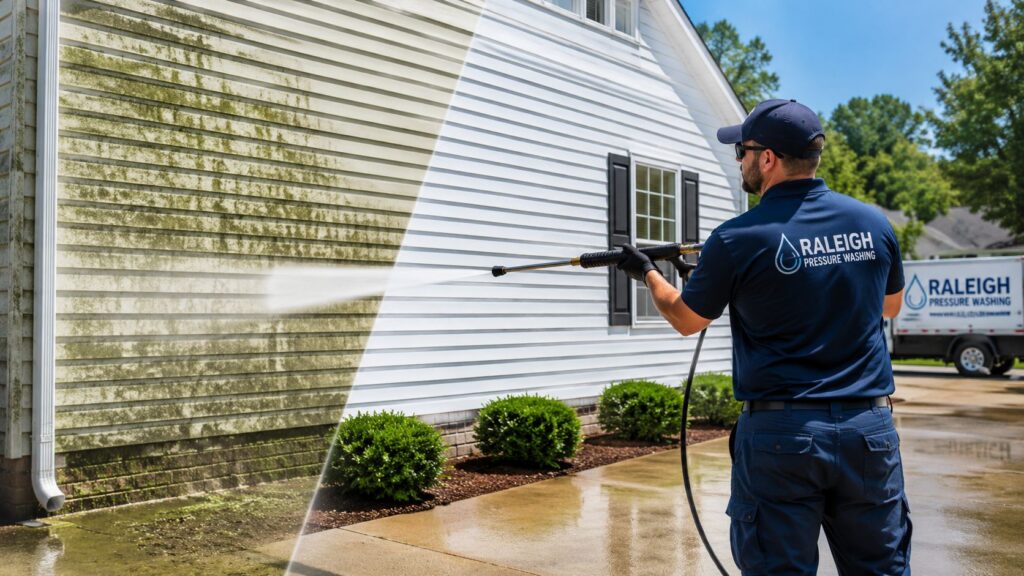
A common call starts with siding that has gone from clean to greenish, gray, or blotchy. The homeowner usually notices it first on the shaded side of the house or around downspouts. On vinyl and painted surfaces, soft washing is often what restores the color without beating up the finish.
The visible change can be dramatic, but the true value is selective cleaning. A careful crew treats the siding one way, the trim another, and the screens and fixtures with extra caution or separate handling.
Driveways, walks, and entry areas
Concrete is one of the classic pressure washing wins. A driveway can hold dirt, tire residue, organic staining, and general surface grime that makes the whole property feel older. Cleaning it changes curb appeal quickly because it's one of the largest visual surfaces on the lot.
Entry paths matter too. When those surfaces are stained or slick, the problem is partly cosmetic and partly practical.
Dirty concrete makes the whole house look neglected, even when the siding is in decent shape.
Decks, patios, and outdoor living zones
Many DIY pressure washing jobs frequently go wrong. Wood decks can be cleaned, but aggressive pressure can fur the wood, raise fibers, and leave a rough surface that feels worse after cleaning than before. Patios and tiled outdoor areas also need method changes based on the material and joint condition.
If you have tile or pavers around a seating area, pool surround, or backyard entertaining space, a useful reference is how to clean outdoor tiles. The main takeaway is the same one good contractors follow: the surface dictates the cleaning method.
Awnings also get overlooked. They collect dirt, pollen, and organic film, but they don't respond well to a one-size-fits-all wash. Homeowners comparing exterior maintenance tasks often look at awning cleaning service details separately because fabric and frame materials need a different approach than concrete or brick.
Storefronts and visible frontage
For small commercial buildings, customer-facing exteriors are usually the priority. Sidewalk edges, entrance pads, façade staining, and grime under signage make a place look poorly maintained fast. Pressure washing helps there, but only if the operator pays attention to painted surfaces, window edges, electrical fixtures, and signage materials.
Decoding Pressure Washing Prices in Raleigh
Most Raleigh homeowners don't struggle with the idea of paying for exterior cleaning. They struggle with understanding why one quote is modest and another is much higher for what sounds like the same job.
The short answer is that this market isn't flat rate. Independent consumer-service data shows the average Raleigh house pressure wash costs $221, with a typical range of $157 to $298. Hourly pricing commonly runs from $45 to $150 per hour, and some listings estimate work at roughly $0.10 to $0.50 per square foot depending on the surface type according to Angi's Raleigh pressure washing cost guide.
Estimated Pressure Washing Costs in Raleigh 2026
| Service Type | Typical Cost Range | Primary Cost Factors |
|---|---|---|
| Average house pressure wash | $157 to $298 | Home size, number of stories, material, buildup level |
| Average reported house price | $221 | Typical residential exterior wash conditions |
| Hourly pricing | $45 to $150 per hour | Labor time, complexity, setup, access |
| Square foot pricing | $0.10 to $0.50 per square foot | Surface type, sensitivity, cleaning scope |
| 1,500-square-foot house | $150 to $750 | Surface condition, stories, material, labor time |
| 2,500-square-foot house | $250 to $1,250 | More area, more access work, more detailing |
Why the range is so wide
A homeowner sees “house wash” on a quote and assumes each company is pricing the same task. Usually they aren't.
One company may be quoting a basic exterior rinse on easy-to-access siding. Another may be pricing around:
- Two-story access needs that slow production
- Mixed materials such as vinyl, brick accents, painted trim, and wood details
- Heavy organic buildup that needs dwell time and repeat treatment
- Delicate areas that require soft washing or hand-cleaning instead of fast, high-output work
- Protection steps around lights, cameras, plants, and door hardware
A larger home doesn't just have more square footage. It often has more windows, more trim lines, more hose management, and more detail work near sensitive areas.
How to read a quote without getting burned
Low quotes can be real, but they can also hide shortcuts. A cheap bid often leaves out one of the things that protects your property: prep work, method changes, spot treatment, or post-clean walkthrough.
Ask these questions when comparing estimates:
- What surfaces are included? House only, or also driveway, walkway, porch, steps, patio?
- Which areas will be soft washed? If the answer is “everything gets pressure washed,” keep shopping.
- What prep is built in? Covering outlets, managing overspray, moving lightweight items, protecting delicate fixtures.
- What counts as extra? Deep staining, second-story access, detached structures, or fragile attachments.
- What happens if buildup doesn't release in one pass? You want a clear answer before work starts.
A solid quote doesn't just list a price. It shows that the contractor has already thought about risk.
The DIY vs Professional Pressure Washing Decision
DIY pressure washing looks simple because the machine does the loud part. The hard part is judgment.
You have to choose the tip, control the distance, read the surface, manage runoff, avoid forcing water into places it shouldn't go, and stop before “clean enough” becomes “damaged.” That's why this decision is less about ambition and more about margin for error.

When DIY can make sense
A careful homeowner can sometimes handle limited, low-risk jobs. Think sturdy concrete in an open area with good drainage and no delicate finishes nearby. Even then, patience matters more than aggression.
DIY may fit if you're dealing with:
- A small hard surface that's easy to test in a hidden area
- Light surface grime rather than thick organic staining
- Clear access with no nearby screens, fixtures, or painted wood
- Enough time to work slowly and correct technique as you go
Where homeowners get into trouble
The common mistakes are predictable. Holding the nozzle too close. Using too much pressure because the first pass looks satisfying. Treating every material the same. Spraying upward under siding laps. Hitting screens, seals, light fixtures, or wood edges directly.
Those errors don't always show up immediately. Water can get behind cladding. Wood can fuzz and dry rough. Concrete can show wand marks after it dries. Screens can bend or tear.
A similar thing happens with gutter cleaning. People assume the task is straightforward until they discover the system details matter more than expected. That's why many homeowners researching exterior maintenance also read about cleaning gutters with gutter guards. The equipment matters, but process matters more.
What you're really paying a professional for
Hiring a pro isn't just paying for water under pressure. You're paying for decisions made before the trigger gets pulled.
A competent crew usually brings:
| DIY Approach | Professional Approach |
|---|---|
| You guess at pressure and nozzle choice | They match pressure, tip, and stand-off distance to the surface |
| One machine setting feels faster | They shift methods between concrete, siding, trim, and fixtures |
| Damage risk sits with you | A reputable company should have insurance and a defined process |
| Your weekend disappears into setup and cleanup | The crew handles prep, washing, and pack-down |
If the job includes fragile trim, screens, painted surfaces, or mounted equipment, professional service usually costs less than correcting a bad DIY result.
How to Hire the Best Pressure Washing Service in Raleigh
A truck, a pressure washer, and a business name don't tell you much. The best hiring move is to vet process, protection, and local track record before you compare prices.
Start with the checklist below, then use the conversation itself to gauge professionalism. Clear answers usually signal a company that has done this many times. Evasive answers usually signal shortcuts.

The vetting checklist that matters
- Ask how they decide between pressure washing and soft washing. This is one of the fastest ways to separate trained operators from one-setting cleaners.
- Verify insurance directly. You want proof of general liability and workers' compensation, not a vague “yes, we're covered.”
- Request a written scope. It should identify what they're washing, what they're protecting, and what's excluded.
- Look for Raleigh-area experience. Local homes often have the same trouble spots, from shaded siding to pollen-heavy buildup and sensitive trim details.
- Read reviews for specifics. Generic praise is less useful than comments about communication, care around landscaping, and whether the crew respected delicate surfaces.
- Ask about attached fixtures. Security cameras, motion lights, decorative lanterns, and doorbell devices need a plan.
- Get clarity on post-job inspection. A solid company doesn't vanish after the rinse.
Questions worth asking on the first call
Some homeowners feel awkward sounding “too technical.” Don't. A good contractor won't mind, because the questions are normal and practical.
Ask things like:
- What parts of my property would you soft wash instead of pressure wash?
- How do you handle screens, light fixtures, and exterior cameras?
- Will you pre-treat organic staining or just rinse it?
- Who is responsible if water intrusion or visible surface damage happens?
- Do you walk the job with me before and after?
If a contractor answers every question with “We wash houses all the time, don't worry about it,” that's not reassurance. That's avoidance.
A short video can help you hear the difference between polished sales language and process-based explanation.
What professionalism looks like on paper
Strong companies tend to send quotes that read like work orders, not napkin math. They identify surfaces, methods, access concerns, and customer prep. They also explain what can and can't be guaranteed. For example, old oxidation, permanent staining, or pre-existing damage may remain even after proper cleaning.
That kind of clarity protects both sides. It also tells you the contractor is thinking like an operator, not just a seller.
Your Raleigh Pressure Washing Project From Start to Finish
Once you hire a contractor, the project should feel orderly, not chaotic. Most good jobs follow the same basic flow.

Before the crew arrives
The process usually starts with a conversation, photos, or an on-site look, then a written quote. After scheduling, the company should tell you what to do ahead of time. Typical prep includes closing windows, securing pets, moving light furniture or décor, and giving access to outdoor water if needed.
This is also the time to point out anything fragile or unusual. Tell them about loose trim, old screens, recent paint, sensitive plants, cameras, or electrical accessories you don't want treated casually.
What happens on service day
A professional crew should arrive, inspect the work area, and set up before spraying. Good technicians notice what could become a problem. They check access, identify delicate areas, and adjust their plan before they start.
On Raleigh service platforms, many pressure-washing jobs are reported to finish within 30 minutes to several hours, and some projects need an additional 15 to 30 minutes for setup and pack-down, based on Raleigh pressure washing job timing data. That doesn't mean speed should be the only goal. It means a practiced crew should look organized.
After the wash
The last step is the walkthrough. You should have a chance to see the finished work, ask questions, and point out any missed areas before payment is wrapped up.
A clean finish isn't the only thing to check. Look at screens, trim edges, fixture mounts, and places where water could have been forced into gaps. A careful company expects that inspection and won't rush you through it.
Raleigh Pressure Washing FAQs and Critical Considerations
The biggest problems in exterior cleaning usually don't come from the surfaces everybody talks about. They come from the surfaces everybody ignores.
Will pressure washing damage window screens
It can.
Window screens are one of the easiest items on a house to damage during exterior cleaning. High pressure can stretch mesh, tear corners, loosen spline, bend frames, or blast debris deeper into the screen instead of removing it cleanly. Even when the damage isn't obvious on the same day, screens can come out of a wash looking wavy, loose, or prematurely worn.
The smarter approach is to treat screens as separate components, not as something to blast through on the way to the siding. Depending on the condition and material, that can mean removing them for gentler cleaning, hand-cleaning, or keeping direct pressure off them entirely.
What about solar panels
Solar panels also deserve caution. The panel itself may look sturdy, but the cleaning risk isn't just the glass face. It's the surrounding hardware, seals, edges, coatings, and the way residue gets moved across the surface.
A rushed contractor may see a roof-mounted panel and think “glass equals easy.” That's not a safe assumption. Pressure, poor angle control, or harsh handling can create problems that aren't immediately visible. If your property has solar, ask the contractor whether they clean panels at all, and if so, exactly how. If the answer sounds improvised, don't include the panels in the pressure washing scope.
Should one contractor clean everything outside
Not always.
That's one of the hidden-cost issues most homeowners don't hear upfront. A company may be competent on concrete and siding but not the right fit for screens, solar, fine window details, or other delicate assemblies. There's no rule that says one crew must handle every exterior surface.
In some cases, splitting the work is the cheaper move long term. Use a pressure washing company for the hardscape and a specialist for items that need a gentler process.
Are permits needed for residential pressure washing in Raleigh
For routine residential cleaning, homeowners usually focus less on permits and more on practical site concerns. The contractor should still work responsibly around runoff, landscaping, outlets, and nearby fixtures. If a project goes beyond basic house and surface washing into other kinds of property work, ask the company directly whether any local requirements apply.
That answer should be specific to your property, not generic.
What should you move or protect before service
A short prep list prevents a lot of frustration:
- Move lightweight furniture and décor so crews don't have to work around fragile items.
- Close and latch windows and doors before the service window begins.
- Identify sensitive equipment such as cameras, doorbells, outdoor lighting, and speakers.
- Point out problem areas like loose screens, failing caulk, chipped paint, or water intrusion history.
- Discuss plants near treatment zones if detergents or runoff are part of the cleaning process.
What's the smartest way to avoid hidden repair costs
Choose the contractor who talks most clearly about limits.
That means they explain what they'll pressure wash, what they'll soft wash, what they'll avoid, and what they recommend handling separately. It also means they don't treat your house like a concrete slab with windows attached.
For homeowners who care about screens, glass, and delicate exterior components, adjacent specialists can make sense. Sparkle Tech Window Washing & window screens offers window washing and window screen services that are separate from pressure washing, which is often the safer division when screens are a priority.
If your main concern isn't just dirt but avoiding damage to screens and other delicate exterior components, it's worth talking with a company that handles those details separately. For homeowners comparing pressure washing with gentler exterior care, Sparkle Tech Window Washing & window screens is a practical starting point for window and screen-related service.