

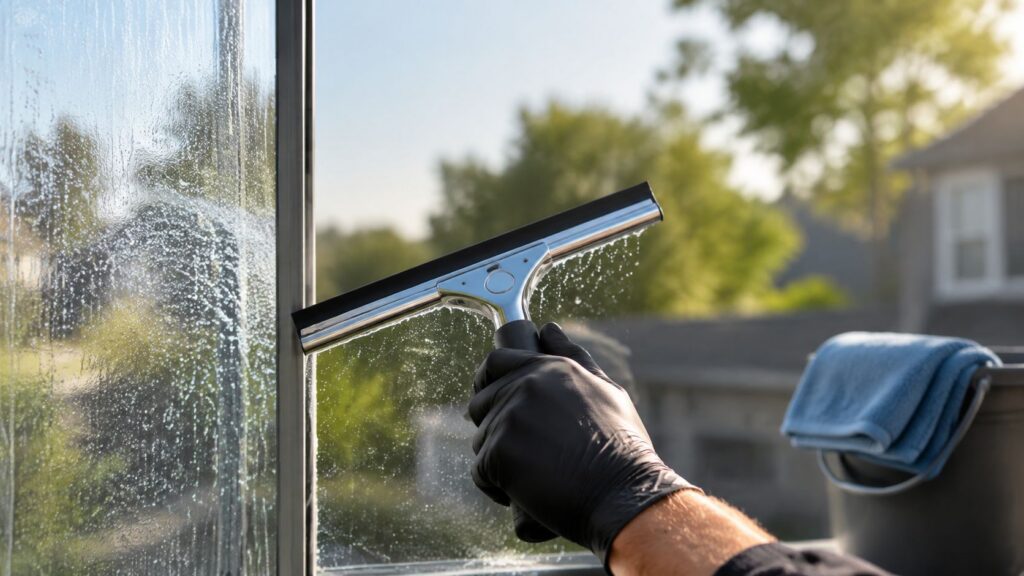
Saturday afternoon is gone. The bucket is still out, the paper towels are damp, and the windows looked clean until the light hit them sideways. Then every streak showed up at once. Fingerprints turned into haze. A few dried drips ran down from the top corners you couldn't quite reach. From the kitchen table, the glass somehow looks worse than when you started.
That's the moment most homeowners realize window cleaning isn't just about getting glass wet and wiping it around.
Professional squeegee window cleaners solve a very specific problem. They don't just make windows look better for an hour. They remove the dirty water from the glass cleanly, control the edges, catch the drips, and leave behind a finish that still looks right when the Arizona sun comes through hard. That's the difference between a quick chore and a trade.
The End of the Streaky Window Struggle
Most DIY window jobs fail for the same reason. The dirt gets loosened, but it doesn't get fully removed. It gets pushed around, diluted, smeared, and then left to dry back onto the glass in thin lines or cloudy patches.
A homeowner usually starts with good intentions. Spray bottle in one hand, towel in the other. The first pane looks decent while it's still damp. By the third or fourth window, the cloth is already carrying grime, the edges are wet, and the sun starts exposing every pass.
Why windows look worse after you clean them
Glass is unforgiving. On a countertop, a little residue doesn't stand out. On a window, especially with backlighting, even a faint film shows immediately. That's why amateur cleaning often creates three common problems:
- Residual film that catches light and makes the pane look dull
- Edge drips that slide down after you thought the job was finished
- Lint and smudges from paper towels, old rags, or overused microfiber
The frustration isn't that people aren't trying hard enough. It's that the method is working against them.
Clean glass isn't just washed glass. It's glass with the dirty solution fully removed before it has a chance to dry.
What changes when a pro takes over
Professional squeegee window cleaners use a method built around removal, not rubbing. The glass gets scrubbed with solution to break up grime, then the contaminated water is lifted off in a controlled pass. After that, the edges and frames are detailed so the finish holds.
That process matters even more on large picture windows, French panes, mirrors, and glass doors where every streak is obvious. It also matters on homes where dust, pollen, sprinkler mist, and hard sun keep putting stress on the glass between cleanings.
A professional finish doesn't come from secret spray. It comes from tool quality, hand control, and knowing what not to do. That's the part most basic guides miss, and it's why homeowners who've struggled with streaks often stop trying to imitate a pro with household supplies.
What Professional Squeegee Cleaning Really Means
Professional squeegee cleaning is a sequence. First, the soil on the glass has to be loosened. Then that dirty liquid has to be removed in one smooth, controlled action. If either step is weak, the result suffers.
The method has deep roots in the trade. The first widely cited written reference to a window-cleaning squeegee appeared in 1918, and 1936 is often cited as the year the modern tool was standardized, marking the move from improvised scrapers to a purpose-built tool for removing soapy water from glass. It remained core professional technology until water-fed poles gained traction in the early 1990s, as noted in this history of the window-cleaning squeegee.
The simple science behind the finish
Think of it this way. A rag behaves like a broom on dusty concrete. It moves material around and picks up some of it, but not in a uniform line. A squeegee works more like a plow. It creates a clean leading edge and pushes the dirty solution off the surface in a controlled sheet.
That only works when the glass is prepped correctly. The cleaning solution loosens grime and reduces surface tension. The applicator spreads it evenly. Then the squeegee removes the slurry before it dries back onto the pane.

What the pro is actually controlling
A professional isn't just dragging rubber across glass. They're constantly managing several things at once:
- Soap coverage so dry spots don't grab the blade
- Blade angle so water moves ahead of the rubber instead of slipping under it
- Pressure so the contact line stays even from end to end
- Overlap so thin missed strips don't remain between passes
- Detailing so the edges, corners, and frame don't re-wet the pane
Practical rule: If the dirty water stays on the glass too long, the job usually turns into buffing, touching up, and chasing streaks.
That's why professional squeegee window cleaners look fast. They're not rushing. They're following an order that prevents rework.
Professional Tools Versus a Bucket and Rag
A real window cleaning kit isn't fancy for the sake of it. Each tool solves a specific problem. The wrong rubber leaves lines. The wrong size slows the work down. The wrong cloth leaves lint at the perimeter. Homeowners often own some version of these tools already, but not the versions built for finish work.

The difference starts with the squeegee itself
Professional channels aren't generic. The rubber has to sit correctly in the channel and contact the glass evenly. According to Unger's professional guidance, the channel must hold the rubber blade with a precise 0.015-inch compression tolerance to maintain uniform pressure and prevent water from slipping past the edge, which is a main cause of streaking. That same guidance notes that 12-inch squeegees are standard for residential work, while 14-inch or larger blades improve efficiency on bigger windows. You can review those details in Unger's professional squeegee product guidance.
A cheap store-bought squeegee usually fails in one of two ways. The blade is too stiff, so it chatters and skips. Or the frame doesn't hold the rubber evenly, so one side clears while the other leaves a wet trail.
Side-by-side on the tools that matter
| Professional setup | Typical DIY setup | What changes on the glass |
|---|---|---|
| Precision channel with quality rubber | Basic all-purpose squeegee | The pro tool keeps an even contact line |
| Microfiber washer or applicator sleeve | Sponge or random rag | The solution goes on evenly instead of patchy |
| Lint-free detailing cloths | Paper towels or bath towels | Corners finish clean without fibers |
| Multiple blade sizes | One tool for every pane | Large panes go faster, small panes stay controlled |
| Extension systems or access tools | Ladder plus spray bottle | Safer reach and more consistent coverage |
The size choice is more critical than generally acknowledged. A blade that's too small forces too many passes on a large pane. A blade that's too large becomes clumsy in tight corners or divided windows.
For homeowners comparing methods, Sparkle Tech has a useful page on window cleaning tools and what they're used for. It helps show why pros carry more than one squeegee and more than one cloth.
What doesn't work well at home
Some tools create extra work even when the glass technically gets clean.
- Paper towels leave lint and drag when they get damp.
- Old bath towels carry fabric softener residue and can smear edges.
- Kitchen sponges don't spread solution evenly across a full pane.
- One-size-fits-all squeegees are awkward on divided light windows and undersized on picture glass.
Good glass work is a finishing trade. The tools aren't accessories. They're part of the result.
Why Hiring an Insured Pro Matters for Your Home
Window cleaning sounds simple until ladders come out, screens are removed, furniture is nearby, and technicians are working around hard surfaces, landscaping, and upper-story glass. At that point, you're not just hiring someone to clean. You're allowing a service crew to operate on your property under real risk.
One reference source reported a median annual salary of $18,790 for window cleaners, with higher pay for workers using ladders, scaffolding, or safety belts because of increased risk, which reflects the hazards built into the trade. That's why insurance isn't paperwork for the file cabinet. It's part of the service itself, as discussed in this window cleaner trade reference.
What homeowners should verify before booking
If a company is working at height or moving through your home, three protections matter:
- General liability insurance protects your property if something is damaged.
- Workers compensation helps protect you from liability if a worker is injured on your property.
- Bonding adds protection tied to trust and conduct while the crew is in or around your home.
Those aren't luxury credentials. They're baseline safeguards.
Why this matters more than price alone
An uninsured cleaner can give a lower quote because they're carrying less overhead and less protection. That lower price can disappear instantly if there's broken glass, damaged flooring, a ladder incident, or a dispute about responsibility.
A qualified residential company should also be properly registered and clear about the scope of service. Are they cleaning just the panes, or also tracks and screens? Are they prepared for interior work? Do they have a process for protecting floors and furnishings? Homeowners can compare that against a dedicated home window cleaning service page when evaluating what is included.
If a company gets vague when you ask about insurance, that's your answer.
Trust shows up in small details
Professionalism isn't just the final shine. It shows up before the first pane is touched.
Listen for clear answers to ordinary questions. How do they access high glass? What happens if a screen is brittle? Who's responsible if something goes wrong? A seasoned company won't act offended by those questions. They'll expect them.
That's often the biggest difference between casual labor and a real service business. One is selling a quick job. The other is taking responsibility for the work, the property, and the people doing it.
Your Seamless Service Visit Explained
Most homeowners want the same thing from a service call. Show up when promised, work carefully, respect the house, and leave the windows looking noticeably better without turning the day upside down.
A professional visit should feel orderly from the first conversation to the last walkthrough.
To make the process easier to picture, this overview shows the usual flow.

What happens on appointment day
The first step is a quick review of the scope. The crew confirms which windows are being cleaned, notes any access issues, and identifies anything delicate such as tight furniture placement, alarm contacts, or older screens.
Inside, good technicians protect the work area as they go. Outside, they organize tools so hoses, poles, ladders, and buckets don't become a mess around the property. That sounds minor, but it's part of whether the visit feels professional or improvised.
Then the actual cleaning begins. Screens may be removed and set aside carefully. The glass is cleaned methodically, interior and exterior as scheduled, and edges are detailed before moving to the next opening.
Later in the visit, homeowners often appreciate seeing the process in action.
What affects the quote
Window cleaning quotes usually depend on practical factors rather than mystery formulas.
- Window count and style affect labor. Large sliders, French panes, and specialty shapes each take a different amount of handling.
- Access matters. Ground-level glass is different from upper-story windows or tight side yards.
- Condition changes the approach. Dusty windows clean differently than glass with adhesive, paint specks, or mineral residue.
- Included services such as screens, tracks, and frame detailing can change the scope.
The final walkthrough
A proper finish includes inspection. The crew should check the panes, catch any lingering edges or drips, and confirm the work with you before leaving.
That last step matters because windows are all about light and angle. What looks clean from one side may show a small issue from another. A careful walkthrough gives the homeowner confidence and gives the company a chance to fix anything immediately.
Maintenance Tips and Your Hiring Checklist
Once the windows are professionally cleaned, the goal is to keep them looking good as long as possible without accidentally creating more work. Most homeowners don't need a full DIY routine between services. They just need a few habits that prevent buildup.
The bigger issue is knowing when a normal touch-up won't solve the problem. Basic how-to advice is everywhere, but there's far less discussion about tradeoffs and when a squeegee is the wrong tool, especially on glass with heavy mineral buildup from sprinklers in hot climates like Arizona. That gap is noted in this discussion of window cleaning tradeoffs and hard water issues.

What homeowners should do between cleanings
A little restraint helps. Over-cleaning glass with random products often causes more haze than the dust ever did.
- Dust the sills and frames lightly so debris doesn't wash back onto the glass the next time moisture hits.
- Spot clean small marks carefully with clean microfiber and plain water rather than layering on strong household sprays.
- Watch sprinkler patterns if exterior panes keep getting spotted. Repeated mineral deposits can become a restoration issue, not a maintenance issue.
- Leave stubborn buildup alone if you're unsure what it is. Scraping or aggressive rubbing can turn a simple stain into damage.
Hard water spotting is where many DIY jobs go sideways. What looks like ordinary dirt may need a different process entirely.
Your hiring checklist
If you're comparing squeegee window cleaners, ask direct questions.
- Are they licensed, insured, and bonded? If they hesitate, keep looking.
- Do they clean screens and tracks, or only the glass? Scope should be clear before the appointment.
- Do they work regularly on homes like yours? Residential work has its own pace, access issues, and care standards.
- Do they explain what they'll do with mineral buildup or stubborn stains? Not every mark comes off in a standard cleaning.
- Is the pricing straightforward? You should know what's included before the crew arrives.
- Are they local and established in Arizona? Regional experience matters when heat, dust, and sprinkler spotting are part of daily conditions.
A useful follow-up for scheduling is this guide on how often windows should be cleaned, which helps homeowners think through timing based on their property and environment.
Quick answers to common questions
How often should windows be professionally cleaned?
It depends on exposure, landscaping, dust, pets, and how particular you are about the view. Some homes can go longer. Others need more regular attention because the exterior glass takes a beating.
Can a squeegee fix hard water spots?
Not always. A standard cleaning removes surface soil. Mineral staining often needs specialized treatment beyond a routine wash.
Are interior windows worth doing too?
Yes, especially if you notice haze in morning or afternoon light. Interior film builds slowly, so many homeowners stop seeing it until it's gone.
Clean windows change a house more than one might expect. If you want a crew that handles the glass, screens, and the details around them with proper protection in place, Sparkle Tech Window Washing & window screens serves homes across Arizona with residential window washing and window screen service.