

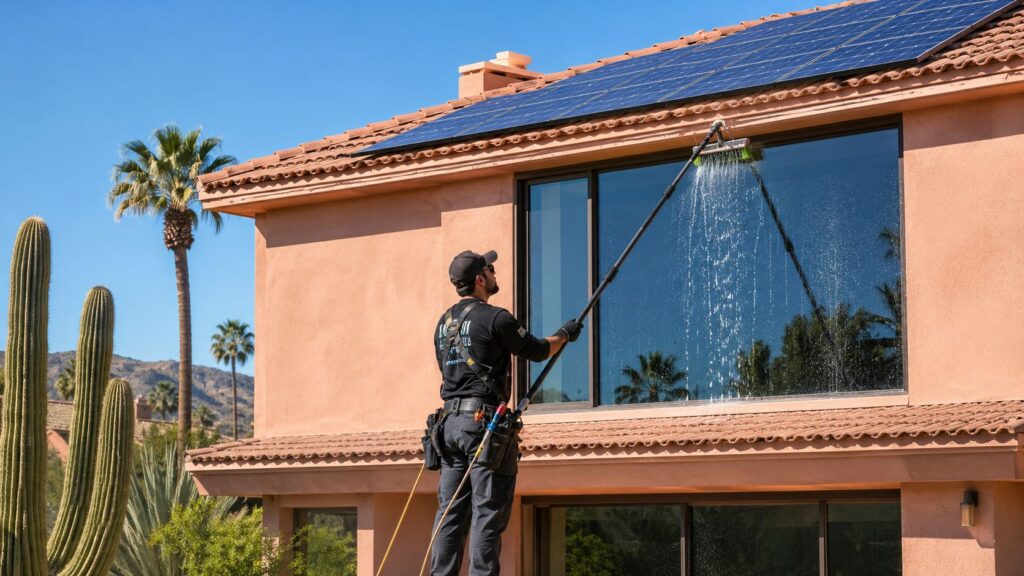
If you're in Phoenix, you already know what happens. You clean the windows, they look decent for a day, and then the dust shows back up, the sprinkler spots catch the afternoon sun, and the glass starts looking tired all over again. A quick wipe with paper towels and spray usually makes it worse once the heat dries everything before you can finish.
That's why it helps to understand what professional window washing cleaners do, especially in a desert climate. This isn't just a weekend chore anymore. The U.S. window washing industry is a mature trade with $2.9 billion in 2024 revenue, projected to reach $3.2 billion by 2029, according to IBISWorld's window washing industry report. Homeowners feel that professionalism in the details: safer access methods, better tools, cleaner rinse water, and fewer streaks baked on by the sun.
Why Your Phoenix Windows Need More Than a Quick Wipe
Phoenix windows deal with a rough combination of dust, hard water residue, heat, and intense light. Glass doesn't just get dirty here. It gets coated, baked, and exposed every day. When that buildup sits too long, it becomes much harder to remove cleanly without smearing residue across the pane.
A lot of homeowners still think window cleaning is mostly a bucket, a rag, and some hustle. In reality, window washing cleaners work in a trade that's structured, specialized, and safety-driven. That matters because the right method depends on the glass, the height, the access, and the conditions on the day of service.
Why Phoenix creates different cleaning problems
In cooler climates, you can get away with more DIY trial and error. In Phoenix, the sun punishes bad technique fast. If a cleaning mix flashes off too quickly, you're left chasing streaks. If tap water dries on the glass, the minerals stay behind. If you scrub dirty glass without the right prep, fine grit can drag across the surface and frames.
For many homes, the main issue isn't whether the glass can be cleaned. It's whether it can be cleaned well.
- Dust buildup: Desert air leaves a film that can make otherwise clear glass look dull.
- Hard water spotting: Irrigation and hose spray often leave mineral residue behind.
- Heat exposure: Cleaning solution can dry before it's properly removed.
- Second-story access: Many homes have windows that are awkward or unsafe to reach casually.
If you've noticed that your windows look worse in full sun than they did while you were cleaning them, that's normal in Arizona. The light reveals every missed edge and every dried mineral trace. A local guide on how Phoenix weather affects your windows gets into that climate piece in more detail.
Phoenix glass usually doesn't need more soap. It needs the right timing, the right rinse, and the right access method.
That's the difference between making the window wet and getting it clean.
Services Professional Window Cleaners Offer
Most homeowners think of window cleaning as glass only. In practice, a complete service usually covers a lot more than the pane itself. The surrounding parts of the window often hold the dirt that keeps coming back.
Residential glass cleaning inside and out
Interior and exterior cleaning are different jobs. Inside glass usually has fingerprints, light dust, pet nose marks, and everyday film. Outside glass deals with pollen, dirt, water spots, bug residue, and weather exposure.
A proper residential service often includes:
- Interior window cleaning: Careful detailing around furniture, floors, and window treatments.
- Exterior window cleaning: Removal of dust, residue, and environmental buildup from outside glass.
- Track and sill cleaning: Dirt collects there first, and it spreads back onto the glass if ignored.
- Frame wipe-downs: Helpful for presentation and for keeping edges from looking dingy after the glass is clean.

Screen work that actually matters
Screens are easy to overlook until they're torn, sagging, or packed with dust. Dirty screens don't just affect curb appeal. They also block airflow and throw dust back onto the glass when the wind kicks up.
That's why many professional window washing cleaners also handle:
- Screen cleaning
- Screen repair
- Rescreening for damaged mesh
- Slider and patio screen service
If a screen is brittle from sun exposure, aggressive cleaning can damage it. A pro should know when to wash it, when to brush it lightly, and when replacement makes more sense than forcing one more season out of failing material.
Solar panels and glass railings
Phoenix homeowners also ask about other exterior surfaces that behave like windows but need different handling.
Solar panel cleaning matters because dust buildup can interfere with how cleanly the panel surface receives sunlight. The work has to be done with methods that protect the panel surface rather than just blasting it with whatever's handy.
Glass railing and balcony glass cleaning is another specialty item. These surfaces show handprints, irrigation overspray, and dust quickly. They also tend to have awkward edges and hardware that collect grime in corners.
A good service call doesn't stop at the obvious pane. It handles the surrounding surfaces that make the whole job look finished.
The Pro's Toolkit and Techniques for a Streak-Free Finish
The biggest difference between DIY cleaning and professional work usually comes down to tools, water quality, and technique. Not effort. Plenty of homeowners work hard on their windows. The problem is that bad conditions and basic household tools can still produce a streaky result.

The classic tools still matter
For accessible glass, the traditional setup still works well in skilled hands:
- Squeegee: The main finishing tool for flat glass
- T-bar washer or scrubber: Loosens dirt before the pull
- Microfiber detailing cloths: Clean edges and catch residual moisture
- Extension poles: Help reach higher glass without overreaching
- Track brushes and towels: Handle the mess most DIY jobs skip
A pro isn't just wiping glass. They're managing water on the pane, controlling the edge line, and preventing dirty runoff from recontaminating the clean area.
Why purified water changes the result
For exterior work, especially on taller or harder-to-reach windows, water-fed pole systems are one of the most useful tools in the trade. Professional systems use multi-stage purified water to eliminate dissolved minerals, which matters because those minerals are what leave spots and streaks when ordinary tap water air-dries. That's why purified-water cleaning can produce a clean finish without needing a hand-dry on every exterior pane, as explained in this overview of professional water-fed pole systems and purified water cleaning.
That detail is especially important in Arizona. When the rinse water is clean enough, the glass can dry without the usual mineral residue getting baked into the surface.
For homeowners who like understanding the broader care side of specialty glass, a solid parallel resource is this marine glass cleaning guide. Boat windshields deal with a different environment, but the same general lesson applies: the wrong product or residue leaves you fighting clarity instead of restoring it.
Why Phoenix heat punishes the wrong cleaning mix
A lot of DIY recipes sound good because they're cheap and easy. Vinegar. Dish soap. Rinse aid. A little of this, a little of that. The trouble is that hot glass and direct sun can make any mix dry too fast.
When solution dries before it's properly squeegeed or rinsed, it leaves trails, haze, and edge marks. Wind makes that harder by pushing water where you don't want it and drying the pane unevenly.
Here's a short look at what tends to happen:
| Method | Where it works | What can go wrong in Phoenix |
|---|---|---|
| Basic spray and paper towels | Small interior touch-ups | Lint, smearing, uneven drying |
| Soap-and-water DIY mix | Mildly dirty glass in shade | Residue if overused, streaks in heat |
| Hose rinse with tap water | Almost nowhere on finish glass | Mineral spotting after drying |
| Purified water-fed pole | Exterior panes and high glass | Requires proper equipment and technique |
| Professional squeegee finish | Ground-level and interior glass | Needs skill to avoid edge lines |
If you're curious what pros carry and why the tool choice matters, this breakdown of window cleaning tools used for better results is worth a look.
After the scrub and rinse, technique still matters. This short video gives a useful visual of the kind of controlled movement that makes glass finish cleaner.
What works better than guesswork
On a real Phoenix job, a cleaner has to read the conditions. Early morning shade may be workable. West-facing glass in late afternoon usually isn't. A dusty lower pane may need a different first pass than a cleaner upper pane. And some homes need mixed methods on the same visit.
One practical option local homeowners use is Sparkle Tech Window Washing & window screens for combined glass and screen service, especially when the dirt isn't limited to the pane itself. That kind of bundled approach can make sense when screens, tracks, and exterior glass are all contributing to the problem.
Clean windows come from controlling residue. If the dirt, soap, or minerals stay behind, the streaks do too.
DIY vs Hiring a Pro A Realistic Cost and Safety Analysis
DIY window cleaning makes sense for some situations. If you have a few easy first-floor panes, decent shade, and the patience to work slowly, you can improve the look of the glass. But once the windows are high, awkward, sun-beaten, or covered in spotting, the trade-offs get sharper.

The real cost is more than the bottle of cleaner
Homeowners often compare DIY to the service quote and stop there. What gets missed is the stack of little costs around the job: tools, towels, extension poles, replacement rubber, cleaning solution, and the time to set up, clean, and put everything away.
Then there's the redo factor. If the first pass leaves haze or streaks, you're doing it twice.
Here's the honest side-by-side view:
| Factor | DIY approach | Hiring a professional |
|---|---|---|
| Upfront cost | Lower at first, but tools add up | Service fee is clear from the start |
| Time | Usually a half-day or more for a full house | Much faster for most homeowners |
| Results | Can be good on simple glass | More consistent on mixed or difficult windows |
| Access | Limited by comfort and equipment | Better suited for awkward and elevated areas |
| Safety | Risk rises quickly with height | Safer methods and trained handling |
Where DIY usually breaks down
DIY tends to fall apart in a few familiar situations:
- Second-story windows: Reaching them safely is the first problem.
- Hard water spotting: Household mixes don't always remove or prevent residue.
- Large homes: The job gets long, and quality drops as fatigue sets in.
- Detail work: Tracks, screens, corners, and cut-up panes eat time.
Practical rule: If you need a ladder to “just get one last section,” you're already in the danger zone for a homeowner job.
For high or awkward windows, avoiding ladders by using telescopic poles or water-fed pole systems is widely considered the safest approach because it reduces fall risk, as noted in this guide on cleaning high windows without ladders.
A simple decision filter
You probably don't need to hire out every pane in every house all the time. But these are good signs it's worth it:
- The windows are above comfortable reach
- You've tried cleaning before and still see streaks in the sun
- The property has screens, tracks, or glass railings that need attention too
- You value your Saturday more than a trial-and-error project
If you're comparing service fees, this local guide on what window cleaners charge helps frame what usually affects the quote.
The honest answer is simple. DIY can work for small, easy jobs. Professional service starts making a lot more sense when safety, access, finish quality, and your time all matter at once.
Safety First Why Insurance and Training Protect You
Window cleaning can look simple from the ground. It isn't. The danger isn't just dirty glass or a slippery ladder rung. It's the combination of elevation, awkward body position, tools in hand, and surfaces that don't forgive mistakes.
One OSHA-based analysis cited by Gitnux found 88 window cleaning accidents over 15 years, with 62 fatalities, which is why training and insurance matter so much in this trade, according to Gitnux's window cleaning industry statistics page.

What to verify before anyone starts work
If someone is working on your property, you should know what protects you if something goes wrong.
- General Liability insurance: Helps protect against accidental property damage.
- Workers' Compensation: Matters if a worker gets hurt on the job.
- Bonding: Adds another layer of business accountability.
- Documented training: Shows the company treats safety as an operating standard, not a guess.
Those aren't paperwork details. They're homeowner protection.
Why this matters on residential jobs too
Some people hear “insurance” and think of high-rise crews only. But residential work still involves ladders, roof lines, uneven surfaces, irrigation overspray, tight side yards, and second-story access. A cleaner can be careful and still face risk. If that cleaner isn't properly covered, the homeowner can get pulled into a mess nobody wanted.
For a plain-English overview of what contractor coverage typically includes, this article on contractor insurance requirements from My Policy Quote is a useful starting point.
Ask for proof. A legitimate company won't act offended by that question.
There's another layer here beyond insurance. High-access work is governed by formal safety standards, and companies handling that kind of work should understand equipment inspection, training, and compliance requirements. Homeowners don't need to become experts in regulations. They do need to hire people who already are.
Preparing for Your Window Cleaning Visit What to Expect
A smooth service day usually comes down to simple prep. You don't need to deep clean the house before window cleaners arrive, but a few small steps help the crew work faster and help you avoid interruptions.
A short checklist before the appointment
- Clear the window sills: Remove candles, plants, framed photos, and small decor.
- Move fragile items nearby: Glassware, lamps, and leaning artwork should be out of the work zone.
- Secure pets: Friendly dogs can still get underfoot, and nervous pets usually prefer a quiet room.
- Open access points: Gates and side yards should be easy to reach if exterior glass is being cleaned.
- Note any problem areas: Point out stuck screens, hard water spots, or windows that haven't opened properly.
If you have alarms or sensors on certain windows, it helps to mention that before the work starts.
What service day usually looks like
A professional crew should walk the property, confirm the scope, and explain how they'll move through the home. Inside, they should work carefully around floors, furniture, and window coverings. Outside, they should choose the method that fits the height and the condition of the glass.
Most homeowners appreciate two things most:
- Clear communication before work begins
- A final walkthrough before the crew leaves
That final check matters. It gives you a chance to look at any windows that were a concern and ask about anything unusual, like staining that turned out to be permanent etching rather than removable dirt.
If a company rushes in without confirming the job details, that's usually how misunderstandings happen.
Good window washing cleaners make the visit feel organized, not disruptive.
Choosing a Great Cleaner and Your Top Questions Answered
When you hire a window cleaner, the safest move is to judge the company by process, not promises. Clean branding is nice. What matters more is whether they work like professionals.
A homeowner checklist
Look for these signals before you book:
- Proof of insurance and bonding: Ask to see it.
- Clear written quotes: You should know what's included.
- Local communication: Calls, texts, and scheduling should be straightforward.
- Service range that fits your needs: Glass only is different from glass, screens, and tracks.
- Reviews that sound specific: General praise is less useful than comments about punctuality, care, and result quality.
If you run other home service businesses or you're curious how service companies keep their schedules full, this piece on generating power washing appointments gives a helpful look at the operational side of booking local field work.
Common questions homeowners ask
How often should Phoenix windows be cleaned?
That depends on dust exposure, irrigation overspray, nearby construction, and how noticeable the buildup is to you. Homes in dusty areas or with frequent hard water spotting usually need more regular attention than shaded homes with less exposure.
Can windows be cleaned with screens in place?
The glass can be accessed differently depending on the window style, but a full result usually means dealing with the screens too. Dirty screens can make freshly cleaned glass still look dull from inside.
Are hard water spots always removable?
Not always. Some are surface residue. Others have sat long enough to etch or stain the glass. A good cleaner should tell you the difference instead of promising a perfect fix on every pane.
Do I need to be home the whole time?
For interior work, usually yes or at least available at the start and finish. For exterior-only service, some homeowners arrange access and return for a final check.
If your windows are fighting Phoenix dust, sun, and hard water, it helps to work with a company that handles both glass and screens as part of the same problem. Sparkle Tech Window Washing & window screens is a family-owned Arizona company offering window washing and screen services, including repair and rescreening, with the insurance and business registration details homeowners should expect.