

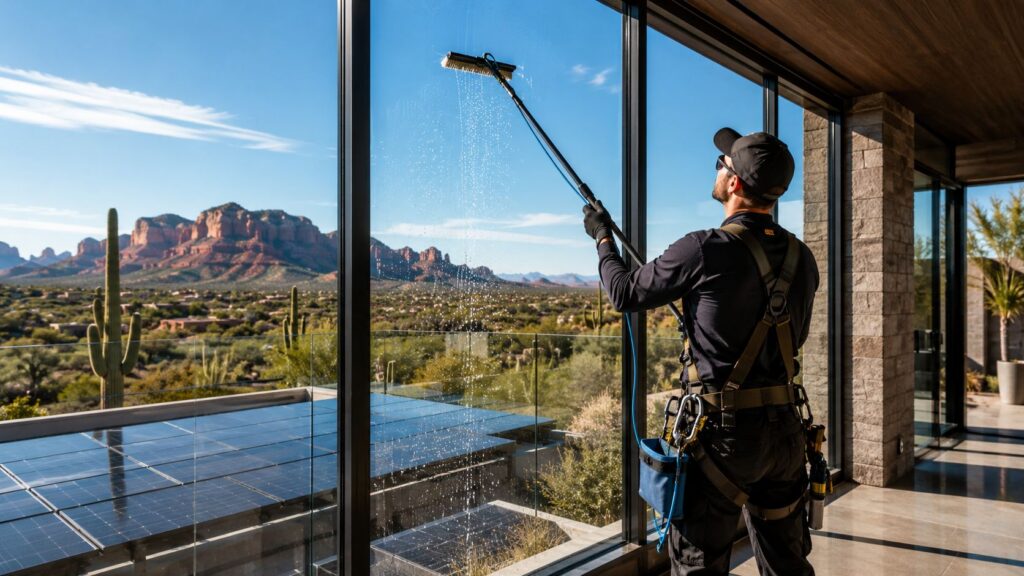
You step outside on a bright Arizona morning, look back at the house, and the glass tells the whole story. Fine desert dust has settled on the exterior. Sprinkler spots have baked onto the lower panes. The sun hits everything at the worst possible angle, so every smear suddenly looks permanent.
That's why window cleaning in Arizona feels harder than it should. A quick spray and wipe might work for an hour, then the light comes back and shows every missed edge, mineral spot, and drip line. What frustrates most homeowners isn't the idea of cleaning windows. It's doing the work and still not getting that clear, polished result.
Your Complete Arizona Window Cleaning Guide
Arizona homes deal with a rough combination of dust, hard water, heat, and intense sun. One week your glass looks fine. After a wind event, a few sprinkler cycles, and a hot afternoon, it looks tired again. That doesn't mean your windows are impossible to maintain. It means the approach has to match the climate.

A lot of homeowners start with the same plan. Grab a spray bottle, paper towels, maybe a hardware-store squeegee, and spend a Saturday on the glass. Then the sun dries the solution too fast, the tap water leaves residue, and the upper windows still look neglected because they were awkward or unsafe to reach.
Why this is a real trade
Professional window cleaning didn't appear out of nowhere. The trade became recognized in the late 19th century as taller buildings required specialized skills and equipment, and one milestone was the founding of the French Cleaning Institute in 1878 by Marius Moussy to organize professional window washers, as outlined in this history of window cleaning.
That history matters because it explains something homeowners notice right away. Good window cleaning isn't just “wipe the glass.” It's technique, access, water quality, tool choice, and timing.
Practical rule: In Arizona, the biggest challenge usually isn't removing dirt. It's cleaning in a way that doesn't create new spotting as the glass dries.
What homeowners usually want
Homeowners aren't looking for a technical explanation. They want a home that looks cared for and a view that feels open again. In practical terms, that usually means:
- Clear exterior glass after dust, pollen, and storm residue build up
- Spot-free lower panes where irrigation leaves mineral marks
- Cleaner interiors without haze, fingerprints, and pet nose prints
- Less hassle dealing with ladders, screens, and awkward windows
If you're comparing local providers, it also helps to understand how service businesses present their work online. This cleaning company SEO growth playbook is useful if you want to see how reputable cleaning companies structure their service pages and what details they should make easy to verify.
What Professional Window Cleaning Includes
Most homeowners use “window cleaning” to mean the glass only. In practice, a professional job usually covers more than that, because dirty details around the pane can make even clean glass look unfinished.
The work usually includes more than the pane
A complete residential visit often includes interior and exterior glass, plus the surrounding surfaces that collect dust and grime.
Common service items include:
- Exterior pane cleaning for dust, pollen, hard water residue, and storm film
- Interior pane cleaning for fingerprints, haze, pet marks, and cooking residue
- Frame wipe-downs so edges don't hold visible dirt after the glass is done
- Sill cleaning because dead bugs, dust, and debris settle there first
- Track detailing to remove compacted dirt that interferes with how windows open and close
That last point gets overlooked. Tracks don't need the same treatment every visit, but when they're heavily packed with dirt, the whole window feels neglected no matter how clear the glass is.
Related services homeowners often need
Window work also overlaps with a few services that make sense to handle at the same time:
- Screen cleaning
- Screen repair or rescreening
- Glass railing and pool fence cleaning
- Solar panel cleaning
- Hard-to-reach specialty glass
Solar panels are especially relevant in Arizona. Dust and film collect there just like they do on windows, and the same climate issues apply. Intense sun, baked-on residue, and poor rinsing technique can leave a panel looking cleaner, yet it remains unclean.
Clean glass is only part of the job. Screens, tracks, and frames are what separate a quick rinse from a finished result.
Why skylights and angled glass change the job
Generic advice has its limits. Skylights, clerestory windows, angled panes, and other nonstandard glass aren't just “higher windows.” They change the tool contact, body position, and safety requirements.
Independent instructional material on hard-to-reach glass points out that water-fed pole work depends on a precise angle to the glass, and that angled or skylight surfaces may require specialized attachments or technique changes instead of ordinary methods, which is why generic how-to advice often fails on these windows, as shown in this instructional example on nonstandard glass technique.
For homeowners, the takeaway is simple:
- Flat, reachable windows are the easiest to maintain yourself.
- High or awkward windows usually need better tools than what is commonly kept at home.
- Angled glass often looks “mostly clean” while still holding residue because the tool never made full contact.
That's why professional window cleaning often includes planning the access method, not just bringing cleaner and towels.
Common Window Cleaning Methods and Supplies
There are two methods most homeowners will encounter. The traditional squeegee method and the water-fed pole system. Both work. The difference is where each one works best, and how much the result depends on water quality, heat, and access.
Traditional squeegee method
This is the classic approach. Apply solution to the glass, scrub, detail the edges, then remove the water with a squeegee blade before it dries.
It still makes sense for many jobs, especially indoors and on detailed windows where close control matters. French panes, small cut-ups, interior mirrors, and lower glass with tight edges often respond well to hand work.
Traditional supplies usually include:
- Applicator sleeve to loosen dirt
- Squeegee with a good rubber blade
- Detail cloths for edges and corners
- Scraper, when appropriate, for stuck-on debris
- Bucket and cleaning solution
The downside in Arizona is speed. If the glass is hot, solution can dry fast enough to leave drag marks and edge residue before you finish the pass.
Water-fed pole system
A water-fed pole system changes the process. Instead of scrubbing with soap and finishing with a hand squeegee, the cleaner uses a telescopic pole with a brush and rinses the glass with pure water.

Pure water matters because dissolved minerals are the primary cause of spotting. A professional setup uses a TDS meter to verify water purity, and one industry guide also recommends maintaining a brush angle of around 20 degrees on the pane so pressure transfers efficiently while rinsing. That combination is central to modern pole work, as explained in this pure water window cleaning guide.
Which method works better in Arizona
For homeowners, the actual answer is not “one is always better.” It's more specific.
| Method | Best use | Trade-off |
|---|---|---|
| Traditional squeegee | Interior glass, detailed panes, close-up finishing | Slower on large exteriors and often ladder-dependent |
| Water-fed pole | Exterior glass, upper stories, broad window banks | Depends on proper filtration and good technique |
If you want to see what a modern pure-water setup looks like in practice, this overview of a water-fed pole window cleaning system gives a useful example of the equipment category.
The biggest mistake with exterior glass is using regular tap water and expecting it to dry clear in direct Arizona sun.
DIY Window Cleaning vs Hiring a Professional
DIY window cleaning can absolutely make sense. If you have a single-story home, moderate buildup, easy access, and enough patience to work early, you can improve your windows yourself. But Arizona changes the math.
Where DIY works well
DIY is usually reasonable when the job is simple and controlled:
- Interior glass with fingerprints or light film
- Ground-level exterior windows you can reach safely
- Small touch-ups between full cleanings
- Screen dusting and light sill wipe-downs
If you work early in the day, keep the glass cool, and avoid heavily mineralized tap-water rinsing, you can get acceptable results on straightforward windows.
Where Arizona makes DIY harder
High heat and rapid evaporation significantly affect cleaning chemistry and increase spotting risk, and site conditions also matter because runoff near paved areas and landscaping has to be managed carefully. Those climate and runoff challenges are highlighted in this FHWA drainage guidance, which is useful context for exterior cleaning in hot environments.
That sounds technical, but homeowners feel it in obvious ways. Cleaner dries before you finish. Lower panes spot again after rinsing. Water runs onto decorative concrete, planters, or nearby beds. By late morning, the work gets more physical and less forgiving.
The practical trade-off
A homeowner cleaning their own windows is paying in time, effort, and retry work. A professional is usually charging for process control. Better access, better water, better tools, and fewer do-overs.
Here's the side-by-side view.
| Factor | DIY Approach | Professional Service |
|---|---|---|
| Cost | Lower out-of-pocket if you already have supplies | Higher direct cost, but includes labor and equipment |
| Time | Often takes most of a day or more | Usually much faster because the crew works systematically |
| Results | Good on simple windows, inconsistent on sun-exposed exteriors | More consistent, especially on large exterior glass |
| Water quality | Often uses tap water, which can leave residue | May use purified water systems for spot-free rinsing |
| Safety | Fine at ground level, risky once ladders enter the job | Better for high access when done by trained, insured workers |
| Heat exposure | Homeowner absorbs the physical strain | Work is scheduled and equipped around exterior conditions |
| Screens and tracks | Easy to postpone or skip | More likely to be handled as part of a complete visit |
When hiring a pro is the smarter move
Professional help makes more sense when any of these show up:
- Second-story windows or hard-to-reach glass
- Heavy hard water spotting
- Skylights or angled panes
- Large homes with many exterior windows
- You've cleaned them before and still saw streaks after drying
There's also the quality issue. A lot of DIY jobs look fine from inside the room. Then the afternoon light hits the exterior and every line appears.
A balanced recommendation
For Arizona homeowners, a hybrid approach often works well. Handle light interior upkeep yourself if you want. Save the exterior deep clean, upper windows, skylights, and specialty glass for a professional visit.
One provider in that category is Sparkle Tech Window Washing, which offers residential window washing along with related screen and glass-cleaning services in Arizona. That's the kind of bundled service setup many homeowners use when they want the whole exterior to look finished, not just the glass.
Window Cleaning Prices and Recommended Frequency
Most homeowners ask two questions first. What does professional window cleaning cost, and how often should it be done? The honest answer is that pricing depends on the house, and frequency depends on the location of the home, how exposed it is to dust, and how clean you want the property to look between visits.

How companies usually price the work
Most residential window cleaning quotes are built around one of these structures:
- Per window or per pane pricing for straightforward homes
- Package pricing when glass, screens, and tracks are grouped together
- Custom bid pricing for homes with difficult access, skylights, or unusual layouts
- Hourly pricing in some specialty or cleanup situations
Per-window pricing is easy to understand. Package pricing often makes more sense when the homeowner wants the whole job completed at once, including screens and tracks. Custom bids become more common when the house has high glass, specialty architecture, or heavy buildup.
What changes the quote
A fair estimate usually depends on a short list of variables.
- Window count and style matter because large sliders, divided-light panes, and specialty shapes all take different amounts of labor.
- Access changes everything. Ground-floor glass is one thing. Tight side yards, tall entry windows, and awkward landscaping are another.
- Condition of the glass matters too. Light dust is routine. Mineral buildup, paint specks, adhesive residue, and neglected tracks require more time.
- Add-on services such as screen cleaning, screen repair, or solar panel cleaning can shift the total.
If you want a more detailed breakdown of how local companies think about estimates, this guide on how much window cleaners charge gives a useful overview of the pricing logic homeowners usually see.
If a quote seems vague, ask what's included. “Windows cleaned” can mean just the glass, or it can mean glass, frames, sills, screens, and tracks.
How often Arizona homes should schedule service
There isn't one perfect schedule for every house. A home on a quiet interior street won't load up with dust the same way a property near open desert, active construction, or a busy road will.
A practical schedule looks like this:
- Twice a year works for many homes that want solid curb appeal without constant maintenance.
- More frequent service makes sense for homes with big view windows, heavy sprinkler spotting, or higher standards for exterior appearance.
- Seasonal timing often works well before major gatherings, after dusty periods, or when pollen and storm residue accumulate.
For homeowners who want a visual sense of what goes into a professional estimate and service call, this video is a helpful reference.
The right frequency is the one that keeps buildup manageable. Once hard water and dust layers sit too long, the work shifts from maintenance to restoration.
Choosing a Safe and Insured Window Cleaner
Clean windows matter. Liability matters more. The wrong hire can expose a homeowner to damaged property, unsafe ladder work, and a lot of uncertainty if someone gets hurt on site.
Why safety isn't a formality
Window cleaning at height crosses into a more serious category once the work is performed more than 48 inches above grade, because ANSI IWCA I-14.1 applies in that range and sets equipment and safe-use requirements intended to reduce fall risk. Cornell's program excerpt tied to that standard also notes a roof-slope condition of not more than 1:12 in that context, which underscores how specific safe access can become, as shown in these ANSI I-14.1 excerpts for building owners and managers.
For a homeowner, that means this: once a worker is off the ground and dealing with height, this is no longer a casual side job. It's regulated risk.
What to verify before anyone starts
Ask direct questions. A legitimate contractor should be comfortable answering them.
Insurance status
Ask whether the company carries General Liability and Workers' Compensation coverage. Those protect against different risks, and both matter.Business registration
Verify that the company is properly registered to operate, not just advertising online or through a marketplace app.Who performs the work
Ask whether the people on site are company workers or subcontractors. That affects oversight and can affect liability questions.Access method
Ask how they plan to reach high or awkward windows. A clear explanation usually tells you a lot about professionalism.
Documents worth requesting
Don't settle for verbal reassurance if the project involves work at height or a large home.
Request:
- Certificate of Insurance
- Business name matching the quote
- Written scope of work
- Confirmation of what's included, such as screens, tracks, or only glass
A clean estimate is good. A clean paper trail is better.
Red flags homeowners should take seriously
Some warning signs are easy to miss because they sound convenient.
| Red flag | Why it matters |
|---|---|
| Cash-only, no paperwork | Harder to verify business legitimacy and scope |
| No proof of insurance | Leaves too much uncertainty if there's damage or injury |
| Very vague service description | Creates disputes about what was supposed to be cleaned |
| Unsafe-looking access plan | Suggests the company cuts corners under pressure |
If you're comparing residential providers, this page for a home window cleaning service is the kind of service listing that should clearly describe what the company offers and the type of work it performs.
Ask for proof before the appointment, not after something goes wrong.
Why Arizona Trusts Sparkle Tech for a Flawless Shine
Arizona homeowners usually want the same combination from a contractor. Clear results, careful work, and no uncertainty about who's on the property. That's especially important in a service category this established. IBISWorld reports the U.S. window-washing market is expected to reach $2.9 billion in 2024, with 35,344 businesses operating in the industry and an average profit margin of 6.7% of revenue, which shows a large but fragmented market where business stability and professionalism matter when choosing a provider, according to this IBISWorld window washing industry summary.
That scale cuts both ways. Homeowners have choices, but not every company operates with the same level of documentation, insurance, or consistency. In a crowded service market, the companies worth considering are the ones that make risk management and scope clarity easy to verify.
What makes a local provider worth trusting
A good Arizona window cleaner should understand local conditions without needing them explained. Hard water spotting on lower glass. Dust accumulation after windy stretches. Heat that changes how exterior work needs to be scheduled. Solar panels and glass railings that need careful handling instead of a rushed rinse.
Sparkle Tech Window Washing LLC is a family-owned company based in the Phoenix valley that services anywhere in Arizona. According to the publisher information provided here, the company carries full Workers Compensation, General Liability Insurance, is bonded, and is registered in Arizona for customer protection.

Why insurance details matter to homeowners
A lot of homeowners know they should ask about insurance, but they're not always sure what those coverages are supposed to do. If you want a plain-English overview, this article on essential coverage for Florida businesses is a useful reference for understanding the role of General Liability coverage in contractor situations.
That kind of background helps when you're comparing estimates. You're not just buying cleaner glass. You're choosing how much confidence you want in the company's paperwork, operating standards, and accountability.
The practical bottom line
For Arizona homes, clean windows come from matching the method to the conditions. That means proper water quality, safe access, realistic scheduling around heat, and attention to the surrounding details that make the final result look complete.
If a company can document its insurance, define its scope, and handle the kinds of windows Arizona homes have, that's the kind of contractor homeowners tend to keep calling.
If you want help with residential window cleaning, screens, solar panels, or other exterior glass on your Arizona property, contact Sparkle Tech Window Washing to request a quote and get a clear scope of work before the job is scheduled.