



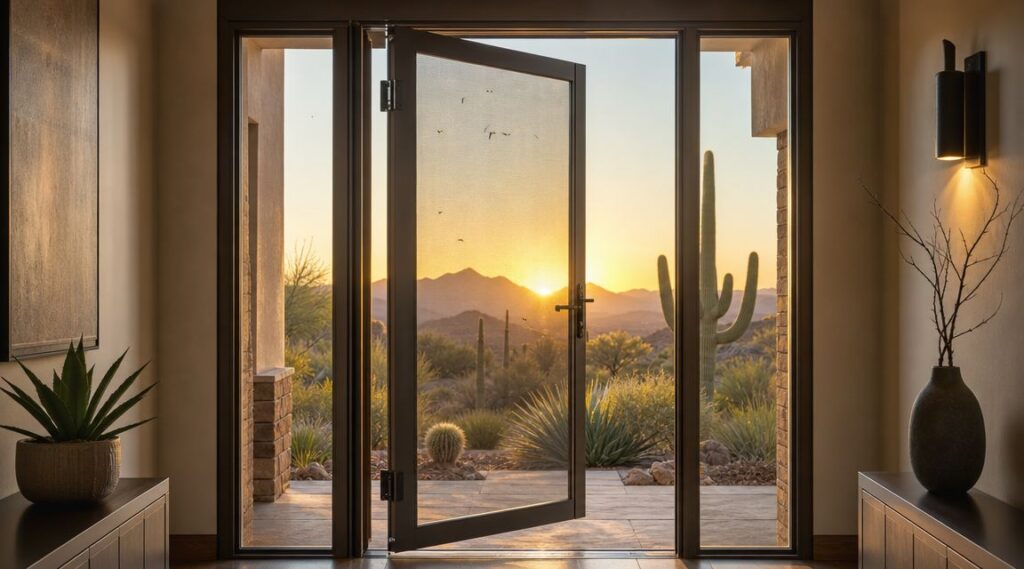
You open the back door after sunset, feel that short stretch of cooler Arizona air, and want to keep the house open for an hour. Then the trade-off shows up fast. Mosquitoes find the light, little flying insects collect near the doorway, dust starts riding in, and a door that looked fine last year suddenly feels loose, scraped up, or hard to slide.
That's why bug screens doors matter more in Arizona than a lot of generic home guides admit. Here, a screen door has to do more than keep bugs out. It has to survive hard sun, abrasive dust, frequent use, and the kind of wear that shows up early on tracks, spline, corners, and mesh tension. If the door is wrong for the opening, or the mesh is wrong for the exposure, you'll feel it quickly.
Screens also have a longer practical history than is often appreciated. They became important for more than comfort. As Our State's history of screen doors notes, insects were tied to disease risk, and in the 1930s nearly one-third of rural Southern residents lived in homes with no window screens and suffered chronic malaria. That same source notes that modern screens now do more than insect exclusion. They also support ventilation, solar control, and allergen reduction.
Enjoy Arizona Breezes Without the Bugs
In Arizona, the goal usually isn't to leave every door open all day. It's to use the good windows of the day well. Early morning, shaded evenings, and the brief stretches after a storm can make natural airflow worth having. A good bug screen door lets you use those moments without turning the house into an invitation for insects and windblown debris.
The problem is that desert conditions punish weak screen systems. Intense sun breaks down materials. Dust loads up the mesh and tracks. Monsoon gusts expose loose frames and cheap rollers. A basic screen that might last comfortably in a milder climate can become a recurring headache here.
What Arizona homeowners usually get wrong
A lot of people shop by appearance first. They pick a frame style they like, then treat the mesh as an afterthought. That usually leads to one of two outcomes: a door that looks clean but wears out too fast, or a heavier-duty setup that feels clumsy because it doesn't match the opening or traffic pattern.
The better approach is to judge a bug screen door by four practical points:
- Opening type: Patio slider, front entry, side yard, balcony, or French door setups all behave differently.
- Sun exposure: West-facing and south-facing doors usually need tougher material choices.
- Traffic level: Kids, pets, deliveries, and backyard use all change what will hold up.
- Maintenance tolerance: Some systems stay cleaner and operate better with less effort.
Practical rule: In Arizona, the right screen door is the one you'll still want to use after a dusty month, not the one that only looks good on installation day.
What actually matters day to day
A useful bug screen door should open easily, seal consistently, and stay square under normal use. It should also be simple to clean, because dust buildup doesn't just make it look bad. It affects airflow and movement. If your current screen door sticks, rattles, drags, or bows, that isn't just cosmetic wear. It's usually a sign the system wasn't well matched to the opening, the environment, or both.
Choosing Your Ideal Door Bug Screen Type
The frame style matters as much as the mesh. Homeowners often focus on what the screen is made of, but the opening itself sets the limits. As Blue Giant's product specifications show, one residential swivel insect screen door is limited to a maximum order width of 1300 mm, a maximum height of 2500 mm, and a maximum order area of 2.5 m², while industrial systems can be built for openings up to 14 ft wide by 14 ft high. The takeaway is simple: door performance depends on geometry and mechanism, not just the mesh.
Bug screen door type comparison
| Door Type | Typical Cost | Durability | Best For |
|---|---|---|---|
| Sliding screen door | Budget to mid-range | Good if track and rollers stay clean | Patio doors and backyard access |
| Hinged screen door | Mid-range | Very good with a solid frame and closer | Front doors, side entries, back doors |
| Retractable screen door | Mid to premium | Good when professionally fitted and maintained | Homes that want a cleaner look when screen isn't in use |
| Magnetic curtain screen | Low | Low to moderate | Temporary setups, rentals, light-use openings |
Sliding screen doors
For many Arizona homes, the patio slider is the most practical option. It suits common backyard layouts, it's familiar, and replacement parts are usually straightforward.
What works:
- Simple operation: Their operation is intuitive.
- Good for daily backyard traffic: Grilling, pool access, pets, and patio use.
- Easy to rescreen: If the frame is still square, replacing mesh is often possible.
What doesn't:
- Dirty tracks cause trouble fast: Arizona dust turns smooth rollers into rough rollers.
- Cheap frames get sloppy: Once the frame twists, the seal around the perimeter suffers.
- Wind can expose weak fitment: A loose slider chatters, jumps, or drags.
Hinged or swinging screen doors
A hinged screen door works well at front and side entries where you want positive closure and a more traditional look. In Arizona, this style can be a strong choice because it doesn't rely on a floor track the same way a patio slider does.
A good hinged door closes with authority, seals better than a flimsy magnetic setup, and handles frequent use well. The downside is clearance. If the landing is tight, or furniture and planters crowd the entry, swing direction becomes a real issue.
A hinged door is often the better answer when homeowners are tired of fighting a worn sliding track.
Retractable screen doors
Retractables solve a visual problem. When open, the mesh disappears into a housing, so the doorway looks cleaner and the screen stays protected when not in use.
That said, retractables aren't magic. They need careful measuring, straight mounting surfaces, and proper tension. In Arizona, they also need owners who will keep dust out of the track or guide. If you want an always-ready workhorse for heavy traffic, a standard framed screen often holds up better.
Magnetic curtain screens
These are the quick fix. They install fast, cost less, and can help on low-stakes openings. For rentals or very temporary use, they have a place.
For a primary entry, they usually disappoint. Stronger airflow can separate them, pets push through them, and the seal isn't as reliable as a framed system. If the goal is real insect control during Arizona evenings, this is usually a stopgap, not a long-term answer.
Screen Materials Matter Especially in Arizona
Arizona is where mesh choice stops being a minor detail and becomes the whole job. The frame gets the attention, but the mesh takes the punishment. It deals with sun, dust, claws, hands, wind pressure, pollen, and whatever blows across the yard.
Modern screens evolved from much older wire-based products. According to this history of insect screens, the earliest insect screens appeared in the United States during the 1820s, and by 1861 a company producing wire mesh sieves found that the same wire cloth could be painted and sold as window screens. That early shift still reflects the basic purpose today: create a barrier that allows airflow while keeping unwanted things out.
Fiberglass mesh
Fiberglass is common for a reason. It's flexible, easy to work with, and usually the easiest material to install cleanly in standard residential frames. For many doors, especially lower-stress openings, it's a sensible default.
Its weakness in Arizona is long-term exposure. Strong sun and repeated heat cycles are hard on any material that depends on flexibility. Once fiberglass starts feeling dry, brittle, or easy to crease, it's usually nearing the end of its useful life.
Aluminum mesh
Aluminum is stronger in feel and holds a crisp look. It can be a good fit for homeowners who want a more rigid screen surface and don't want the softer feel of fiberglass.
The trade-offs are practical:
- It can dent or crease more permanently
- Cut edges can be less forgiving during handling
- Frame fit matters more because rigidity shows mistakes faster
For some desert homes, aluminum makes sense on lower-traffic openings where people won't keep pressing into the mesh.
Pet screen
Pet screen is heavier and tougher. If dogs jump at the screen, kids push through it, or the door sees repeated contact, this upgrade can prevent repeated rescreening.
The trade-off is that heavier mesh can slightly reduce openness. You may notice a denser appearance and a bit less free airflow than lighter standard mesh. In homes with active pets, that's often still the right trade.
Solar screen
For Arizona homes, solar screen is often the most overlooked option for door applications. It does more than insect control. Our State notes that some fiberglass screen products can block more than 75% of UV radiation and that ultra-fine meshes can filter pollen and allergens, which is part of why today's screens serve multiple functions beyond bug blocking.
If your doorway gets hammered by sun, solar mesh can make daily living more comfortable. It cuts glare, adds daytime privacy, and reduces that harsh heat load feeling near the opening. The compromise is visibility. You don't get the same open look as standard insect mesh.
For a more detailed breakdown of mesh options, this guide to window screen material types is useful if you're comparing durability, visibility, and specialty applications.
DIY Installation vs Professional Service
By the time a homeowner calls after a bad install, the pattern is usually the same. The new bug screen door looked fine on day one, then Arizona heat exposed every shortcut. Corners start rubbing, the latch stops lining up, rollers drag in dusty tracks, or a thin gap at the frame turns into the exact opening flies and gnats need.
When DIY makes sense
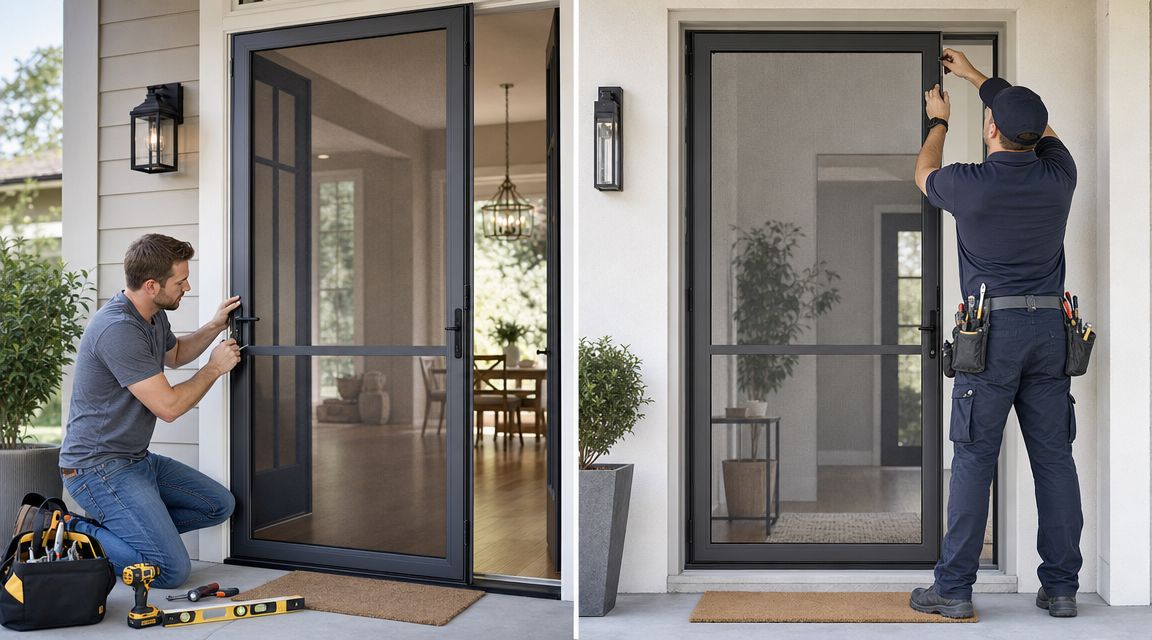
DIY is reasonable for a straightforward rescreen on an existing frame that is still in good shape. If the frame is square, the corners are tight, and the door already rolls and latches correctly, replacing worn mesh is often manageable with a spline roller, utility knife, a flat work surface, and some patience.
It works best under a few conditions:
- The frame is still square: New mesh will not fix a twisted or bent door.
- The opening is standard: Older Arizona homes sometimes have settling or wear that throws alignment off just enough to matter.
- You can control screen tension evenly: Tight enough to stay flat, not so tight that the frame bows.
- The hardware is still sound: Good rollers, a clean track, and a latch that already meets properly save a lot of frustration.
The biggest DIY mistake is treating installation like a fabric job instead of a fit job. In desert conditions, that distinction matters. Heat expands materials, dust adds drag, and a door that is only slightly out of alignment indoors will often perform worse after a few hot afternoons.
Where professional service earns its keep
Professional service makes the most sense for sliding screen doors, retractable units, oversized openings, and any door that has more than one issue going on at once. If the frame is racked, the track is worn, the rollers are failing, or the latch side has shifted, replacing mesh alone usually wastes time and material.
A proper service call addresses the whole assembly. That means measuring the opening as it exists now, checking for frame spread, inspecting corners and spline channel condition, testing roller movement, and making sure the door seals closely enough at the perimeter to keep out smaller Arizona pests. On many homes, that full check matters more than the mesh itself.
Maintenance standards for larger commercial openings point to the same principle. An industrial door service schedule exists because fit, hardware condition, and recurring adjustment affect long-term performance. Residential screen doors are simpler, but they still fail at the rollers, track, corners, and latch long before homeowners blame the actual cause.
If you want a clearer idea of the steps involved before scheduling help, this guide on installing window screens gives a useful baseline for measurement, fitting, and screen handling.
Here's a short visual overview of installation basics and where fit issues usually happen:
A practical split is simple. Handle a basic rescreen yourself if the door already fits and operates correctly. Call for service when the problem involves the frame, rollers, track, closure, or a door that has to survive heavy sun and dust without constant adjustment. In Arizona, those details decide whether the screen still works by the end of summer.
Cleaning and Maintenance for Desert Durability
Arizona screens don't fail only from age. They fail from neglect. Dust settles into the mesh, tracks collect grit, pollen sticks when moisture hits it, and small fit problems turn into bigger gaps. Maintenance isn't a cosmetic extra. It's part of whether the screen still works.
Poor upkeep also changes performance. The maintenance guidance summarized in this referenced discussion of screen care and airflow loss notes that damaged or poorly fitted screens create openings for insects, and that clogged mesh from dust and pollen can reduce airflow. That's exactly why bug screen doors need recurring service instead of a one-time install mentality.
A practical maintenance routine
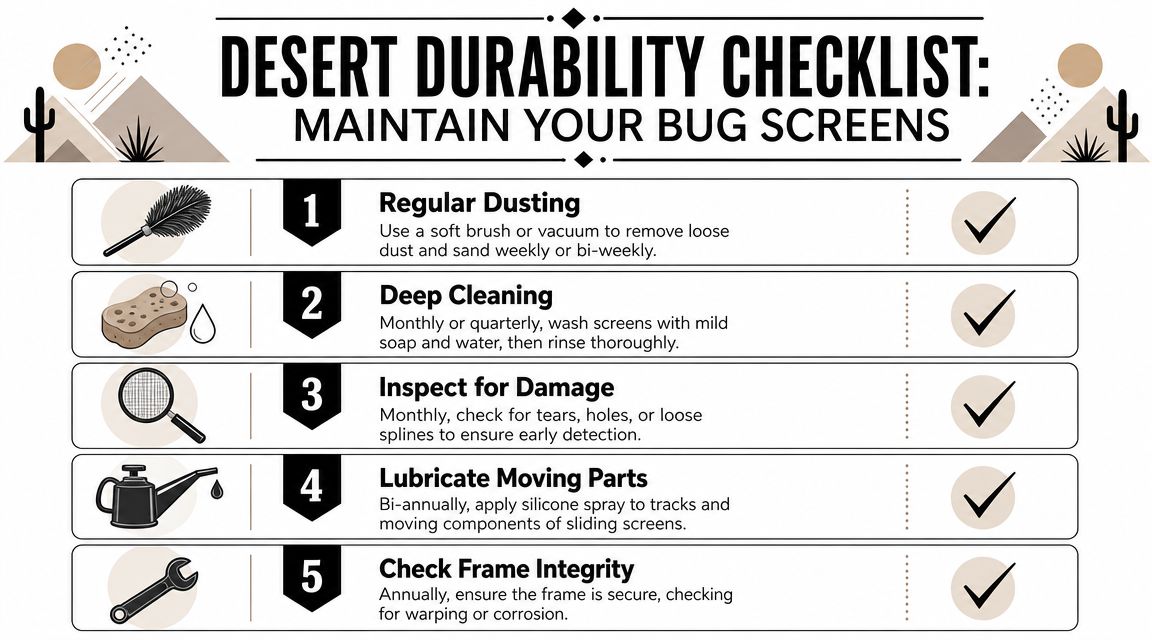
- Dust first, don't scrub first: Use a soft brush or vacuum with a brush attachment to lift dry dust before washing. Rubbing wet mud into mesh just packs debris deeper.
- Wash gently: Mild soap, water, and a soft sponge or microfiber cloth are enough for most residential screens.
- Rinse thoroughly: Soap film grabs new dust quickly.
- Let the screen dry before closing it into a tight track or cassette: This matters especially on retractable systems.
For homeowners who want a more detailed cleaning walkthrough, this guide on how to clean window screens covers the basics well.
What to check besides the mesh
The mesh gets attention because you can see it. The hardware often causes the bigger day-to-day annoyance.
Inspect these parts regularly:
- Tracks: Sliding doors need grit removed before rollers start grinding.
- Spline: If it's shrinking, cracking, or lifting, the mesh won't stay tensioned.
- Corners and frame joints: Tiny separation grows into wobble and poor sealing.
- Handle and latch area: These loosen gradually from repeated pulling.
- Bottom rail: This area takes shoe hits, pet bumps, and vacuum strikes.
Treat your screen door like a moving part of the house, not a static accessory. That mindset alone prevents a lot of avoidable replacements.
Borrow a lesson from commercial maintenance
A good way to think about upkeep is the same way building managers think about operational doors. A planned industrial door service schedule is useful reading because it reinforces a basic truth: frequent-use openings last longer when you inspect and service them on schedule instead of waiting for failure.
For homes, that means checking bug screens doors before peak use seasons, after dusty weather, and after monsoon wind events. Small service at the right time beats full replacement later.
Recognizing Damage and Knowing When to Repair
Most failing screen doors don't start with a giant rip. They start with small clues. The mesh looks slightly loose. One corner doesn't sit flat. The door drags in a spot it used to clear. Homeowners often wait until the screen becomes unusable, but the earlier signs are easier and cheaper to deal with.
Damage you can usually fix
Small, isolated problems can sometimes be handled without replacing the whole assembly.
Examples include:
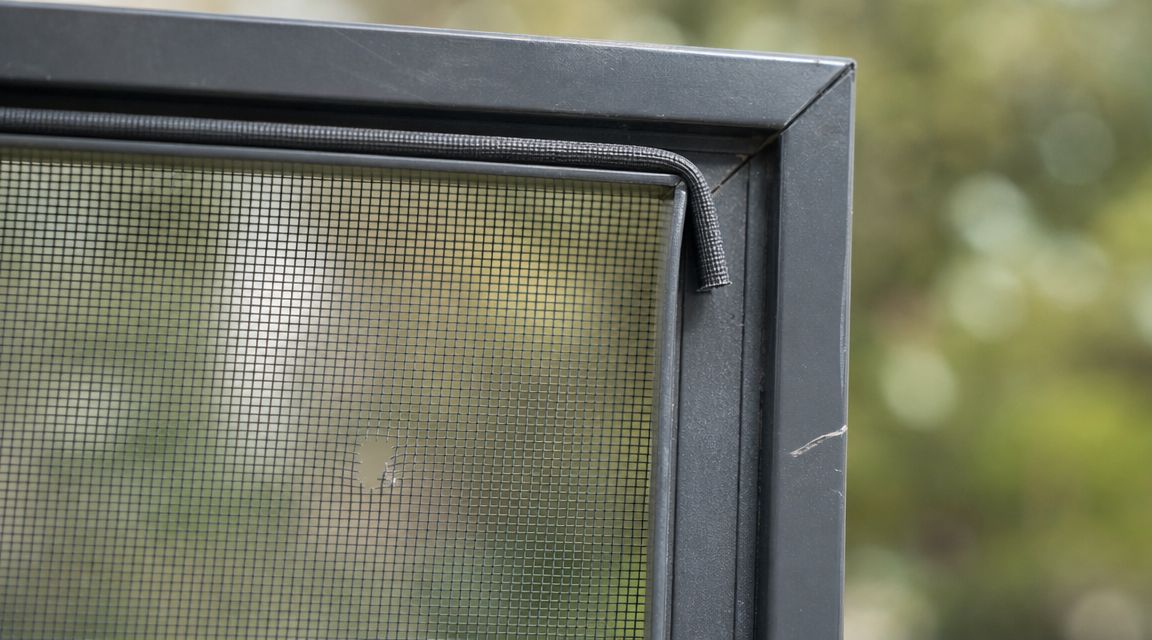
- Tiny punctures or one small tear: A patch may buy time on a low-visibility area.
- Minor roller adjustment issues: If the frame is still straight, some sliders can be tuned.
- Loose debris in a track: Cleaning can solve what feels like a hardware failure.
These fixes make sense when the rest of the screen door is in solid condition. If the frame is square, the corners are tight, and the mesh is generally sound, a limited repair can be worthwhile.
Damage that usually means rescreening or replacement
Other failures aren't worth pretending you've solved.
Watch for these:
- Sagging mesh across a broad area
- Spline pulling out or turning brittle
- Bent frame rails
- Corners separating
- A sliding screen that repeatedly jumps track
- Visible gaps between frame and opening
A broad sag means the screen has lost tension or the frame has changed shape. A brittle spline means the mesh retention system itself is failing. Bent frames almost never become reliable again with a patch.
If insects are getting through at the perimeter, the problem usually isn't “just the screen.” It's the fit.
A simple decision test
Use this rule at home:
| Problem | Usually worth DIY | Usually worth professional repair |
|---|---|---|
| Small puncture | Yes | If appearance matters or mesh is already aging |
| Loose track debris | Yes | If rollers still bind after cleaning |
| Sagging mesh | Rarely | Yes |
| Bent frame | No | Yes |
| Failing retractable tension or alignment | No | Yes |
If you patch the same door more than once, stop patching and inspect the whole system. Repeated failure in the same opening usually means the frame, track, or mesh choice is wrong for how that door gets used.
Why Choose Sparkle Tech for Your Screen Needs
A screen door that works in Arizona has to do more than stop bugs. It has to keep its fit through heat, handle dust in the track, and keep moving after months of hard sun on the frame, rollers, and mesh.
That is where professional service earns its keep. Good screen performance comes from the whole assembly: frame condition, mesh choice, hardware, track alignment, and how tightly the door fits the opening. If one part is off, the door may still close, but it will drag, gap, rattle, or wear out early.
In desert climates, those small setup errors show up fast. I see it all the time with doors that were patched instead of corrected. New mesh gets installed into a frame that is already out of square. Rollers get replaced, but the track is still packed with grit. The result looks better for a short time, then the same problem comes back.
For homeowners who want help with repair, rescreening, or new installation, Sparkle Tech Window Washing offers screen-related service in Arizona, including work tied to bug and sun screen needs. The practical benefit is straightforward. The frame, mesh, and operating parts can be evaluated together, so the fix matches the actual failure instead of treating every problem like a simple tear.
Sparkle Tech is family owned and serves the Phoenix Valley and other Arizona areas as a licensed, bonded, and insured business. That matters on jobs involving exterior access, custom-fit replacement parts, or repeat service on openings that get heavy daily use.
If your bug screen door is torn, dragging, loose at the frame, or wrong for Arizona sun and dust, contact Sparkle Tech Window Washing to discuss screen repair, rescreening, or a new custom-fit screen solution for your home.