

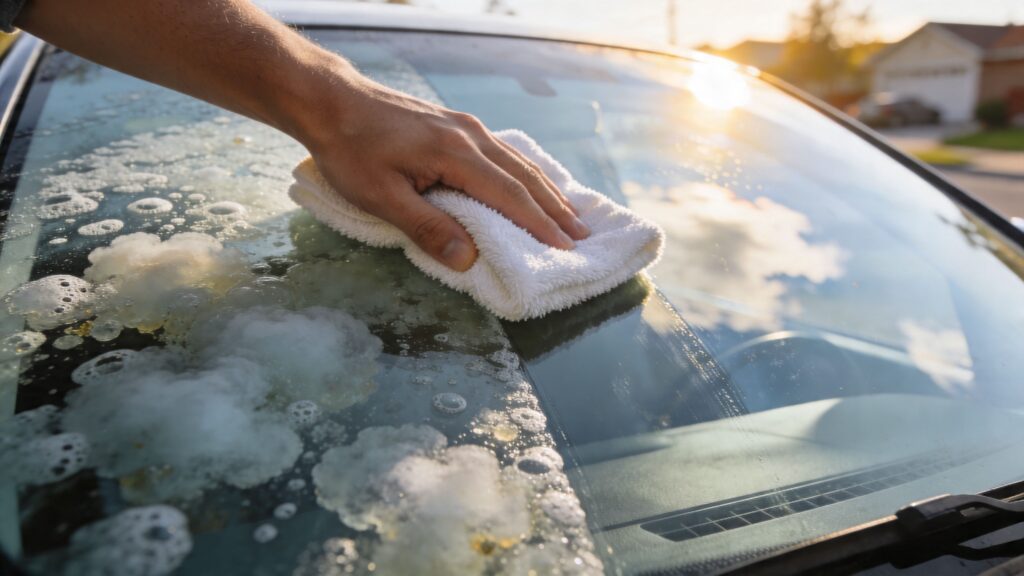
You wash the car, step back, and the glass still looks dirty. In the Phoenix sun, those chalky rings can show up fast, especially on a windshield or side glass that heated up before you finished drying. A lot of drivers treat that as a cosmetic problem. It isn’t just cosmetic.
Water spots on car glass can turn a clean windshield into a glare machine at sunrise, after dark, or during monsoon rain. Some spots wipe off easily. Others have already bonded to the surface and need a much more careful approach. The trick is knowing which kind you’re dealing with before you start scrubbing.
Understanding Why Water Spots Form on Glass
A common Phoenix scenario goes like this. The car gets washed in the driveway, the sun hits the windshield, and by the time the towels come out, the glass already has pale circles and a rough feel. That isn’t plain dirt. It’s mineral residue left behind when water evaporates.

What’s actually left on the glass
Hard water spots on car glass primarily form from minerals such as calcium and magnesium left behind when droplets evaporate. In Arizona's Phoenix Valley, water hardness often exceeds 200 mg/L, classified as very hard, which, when combined with ambient heat over 95°F (35°C), can bake minerals into the glass within hours (msglassoutlet.com).
Those minerals don’t behave like normal dust. They cling to the surface, and once heat gets involved, they can start bonding harder than anticipated. If you want a broader primer on what causes water spots on cars, that background helps explain why the same rinse water can leave very different results on paint versus glass.
Surface spots versus etched spots
Not every spot is the same, and that matters.
| Type | What it looks like | What it feels like | Typical response |
|---|---|---|---|
| Surface spot | White ring or haze on top of the glass | May feel slightly rough | Often responds to mild acids or careful mechanical cleaning |
| Etched spot | Dull mark that seems “in” the glass | Can feel smooth but still remain visible | Usually needs polishing or more advanced correction |
Surface spots sit on top. These usually come from hard water drying before the glass is wiped down.
Etched spots are worse. They start when minerals and contaminants stay on the glass long enough for heat and chemistry to damage the surface itself. Acid rain, bird droppings, dust, road brine, and exhaust fallout can all make the residue more aggressive.
Practical rule: If the mark disappears when the glass is wet and reappears as it dries, you’re often looking at a deposit. If it stays visible even after cleaning, it may be etched.
Why Arizona makes the problem harder
Phoenix drivers deal with two things at once. The water is mineral-heavy, and the glass gets hot fast.
That combination changes the job completely. A mild spot in a cooler climate can become a stubborn deposit here because the sun accelerates evaporation and leaves the minerals behind in a tighter, harder crust. On hot days, the windshield can go from wet to spotted before you move around the vehicle once.
That’s why people think, “I just washed this, why does it already look bad again?” The answer usually isn’t bad soap. It’s untreated mineral water plus heat plus delay.
DIY Remedies for Removing Light Water Spots
If the spots are fresh and still on the surface, start with the gentlest option first. For most homeowners, that means a distilled white vinegar and distilled water mix before trying anything abrasive.

Vinegar works because its mild acidity helps break down alkaline mineral residue. It won’t fix etched glass, but it’s a smart first test for light water spots on car glass.
What to gather first
You don’t need a shelf full of detailing supplies. You do need the right basics.
- Distilled white vinegar for the cleaning solution
- Distilled water so you’re not adding new minerals
- Two clean microfiber towels, one for cleaning and one for drying
- A spray bottle
- Shade or a cool workspace, because the solution should never dry on hot glass
Avoid paper towels. They don’t clean as evenly, and they can leave lint behind.
How to use the vinegar mix
A simple approach works best.
- Mix equal parts vinegar and distilled water in a spray bottle.
- Move the car into shade or wait until the glass is cool.
- Spray a small section first, not the whole windshield.
- Let it dwell briefly so the minerals have time to soften.
- Wipe with a microfiber towel using controlled, overlapping passes.
- Buff dry with a second towel before the solution evaporates.
Work one small area at a time. The mistake I see most often is spraying the whole windshield and then chasing dried cleaner around the glass.
Don’t use this method on blazing hot glass. If the solution flashes off too quickly, it can streak and leave you guessing whether you removed the spot or just moved it around.
What success looks like
Fresh spots usually fade in stages. The ring softens first. Then the haze clears. If a mark looks lighter after one pass, repeat the process instead of pressing harder.
If the glass feels smooth but the spot remains visible, that’s the point where vinegar has probably done all it can do. More pressure won’t solve etching.
A quick visual walkthrough can help if you want to compare your results and technique:
What not to do with light spots
A lot of DIY trouble starts with impatience.
- Don’t scrub dry glass. You’ll increase friction and risk scratching.
- Don’t use dirty towels. Grit trapped in microfiber does more damage than vinegar ever will.
- Don’t jump straight to razor blades or harsh pads. That’s how a simple mineral spot turns into avoidable glass damage.
- Don’t treat every white mark the same. Some are deposits. Some are etching. The glass tells you which one you have.
If vinegar improves the spot, keep going carefully. If it doesn’t, move up to a stronger method instead of forcing a weak one.
Advanced Techniques for Severe Mineral Stains
Once vinegar stops helping, the job changes. Now you’re dealing with either thicker mineral buildup or the early stages of bonded staining. At this stage, product choice and technique matter a lot more than effort.

Three stronger options and their trade-offs
Not every severe spot needs the same tool.
| Method | Best for | Upside | Risk |
|---|---|---|---|
| Dedicated water spot remover | Mineral buildup that hasn’t etched deeply | Chemical action does the work | Can streak or affect nearby surfaces if misused |
| Clay bar treatment | Light bonded contamination mixed with mineral residue | Good for decontamination | Limited against heavy, baked-on deposits |
| Polishing compounds | Embedded staining and clarity correction | Can restore appearance | Requires more skill and careful pad choice |
A dedicated remover is usually the next logical step after vinegar. These are formulated for mineral deposits, and they save effort when the problem is still on the surface.
Clay has a place, but people overestimate it. It can lift contamination, but it isn’t the best answer for every hard water mark.
Polishing compounds can help on stubborn glass, though they move the work into correction rather than simple cleaning. If you’re already seeing distortion, haze that won’t break, or marks that look below the surface, stop guessing and assess the glass before going further.
If the damage looks more like actual mineral bonding or surface corrosion than removable spotting, this guide on water etching on car windows helps separate a stain from true glass damage.
Where #0000 steel wool fits
For severe, non-etched spots, using #0000 steel wool with a lubricant can have a success rate over 90%, but professionals caution that amateurs must first mask adjacent paint and use light, even pressure to avoid causing micro-scratches, a common mistake in 20-30% of amateur attempts (adamspolishes.com).
That sounds simple. It isn’t casual work.
How to use #0000 steel wool correctly
Use this only on plain automotive glass. Not on paint. Not on trim. Not on guessing.
- Mask the edges first. Tape off surrounding paint, rubber, and trim.
- Lubricate the area well. Glass cleaner works as the slip layer.
- Test a small section. Pick a corner and inspect it before continuing.
- Use light, even pressure. Let the wool skim the glass. Don’t grind.
- Wipe and inspect often. Stop as soon as the deposit breaks.
- Rinse and dry immediately.
If you hear harsh drag or feel the wool catching, stop. Either the glass isn’t lubricated enough, or the contamination is beyond what this method should handle.
The biggest mistake is overworking one spot. People think more pressure equals faster results. On glass, too much pressure usually means you’re creating a second problem while chasing the first one.
When commercial help makes more sense
Some jobs have crossed out of DIY territory even if the spots still look “cleanable.”
Call for help if you notice any of these:
- The spot remains after chemical cleaning and careful mechanical cleaning
- You see dull patches in direct sun
- Night glare looks worse even when the glass is clean
- The windshield has broad hazing rather than isolated rings
- You’re not sure whether the glass is factory tinted, filmed, coated, or previously polished
This is also the point where a service like Sparkle Tech Window Washing can be one practical option among others if you want an inspection and removal approach that matches the actual condition of the glass rather than a trial-and-error routine at home.
How to Prevent Water Spots on Your Car Glass
Removal is always slower than prevention. In Phoenix, the best habit isn’t fancy. It’s fast.
According to auto detailing experts, the single most effective prevention method is immediate drying after a wash or rain. This simple step can reduce the formation of new water spots by as much as 80-90%, an essential practice in hard water regions (ocdcarcare.com).

The habits that matter most
You don’t need a complicated routine. You need consistency.
- Dry the glass immediately. A clean microfiber drying towel is still the most useful tool most car owners can own.
- Wash in shade when possible. Heat speeds evaporation and leaves minerals behind before you can wipe them.
- Treat sprinklers as a warning sign. If the car is parked where irrigation hits it, the spots will keep coming back.
- Keep dedicated glass towels separate. Towels used on wheels or lower panels shouldn’t touch automotive glass.
Add a protective barrier
A good glass sealant changes how water behaves on the surface. Instead of flattening out and drying into rings, the water beads and leaves more cleanly.
That’s where hydrophobic protection helps. If you want a straightforward explanation of how the surface behavior changes, this article on the difference between hydrophilic and hydrophobic glass makes the chemistry easier to picture.
A protective coating doesn’t make minerals disappear. It gives them less time and less surface contact to bond.
Improve the water you wash with
The best drying habit in the world still has limits if the rinse water is loaded with minerals. In hard water areas, changing the rinse water itself can make maintenance easier.
For homeowners exploring filtered rinse options, a reverse osmosis water system is one example of the kind of setup people look into when they want fewer mineral deposits left behind after washing.
That kind of setup isn’t mandatory for everyone. But if you’re washing multiple vehicles, exterior glass, or other surfaces in Arizona, cleaner water gives you a better starting point.
A simple prevention checklist
Use this after every wash:
- Glass cooled down before washing
- Final rinse completed
- Microfiber towel ready before water starts drying
- Windshield, side glass, and rear glass fully dried
- Sealant maintained when water stops beading well
Most water spots on car glass don’t become severe because they’re impossible to prevent. They become severe because the car sat wet in the sun one too many times.
The Hidden Dangers and When to Hire a Pro
This is the part most guides skip. Severe spotting on a windshield isn’t just ugly. It changes how you see through the glass.
Severe water spots can impair driver vision by up to 30-50% in low-light or rainy conditions by scattering light and increasing glare. That’s a significant safety risk, as impaired visibility is a contributing factor in over 20% of all wet-road accidents, according to NHTSA reports referenced in this source (youtube.com).
At night, those etched or mineral-loaded areas catch headlights and streetlights differently than clean glass. In rain, they can disrupt smooth water movement across the windshield. Instead of a clear field of view, you get glare, blur, and inconsistent sheeting.
Signs you’ve moved past a DIY fix
A professional should look at the glass if any of these are happening:
- Oncoming headlights bloom harder than they used to
- Wiper passes don’t restore a clean view
- The glass looks cloudy even after careful cleaning
- You can see marks in certain sun angles but not others
- The problem is spread across the whole windshield, not just a few spots
Some of these issues come from deposits. Some come from etching. Some are a mix of both.
Clean-looking glass isn’t always safe glass. The real test is how it behaves in glare, rain, and low light.
Why pro service matters here
Professional correction makes sense when the job requires machine polishing, deeper assessment, controlled water quality, or a more exact diagnosis than a driveway test can provide. In the Phoenix valley, that threshold gets reached faster because heat and hard water work together.
If you’re weighing whether the problem is still manageable at home, this guide on knowing when to call a professional window washing company is a good reality check.
The point isn’t to outsource every spot. It’s to recognize when a visibility problem has become a driving problem.
Common Questions About Water Spots on Glass
Can I use these methods on tinted windows
Be careful. Factory-tinted glass is different from aftermarket tint film.
Glass-only methods may be fine on the outside of plain glass, but they’re not automatically safe for film. Don’t use abrasive methods on tint film unless the product maker specifically says it’s safe.
Do water spots affect paint too
Yes. The same mineral residue that shows on glass can also sit on paint and leave marks behind. The difference is that drivers usually notice the windshield first because visibility drops before paint damage becomes obvious.
Should I use ammonia glass cleaner
For routine cleaning, use a product intended for automotive glass and be careful around tint. If you’re fighting mineral deposits, ordinary household glass cleaner often isn’t the right tool anyway. Water spots need deposit removal, not just streak removal.
Will a clay bar always remove water spots on car glass
No. Clay can help with bonded contamination, but it has limits. If the problem is a hard mineral crust or actual etching, clay may improve the surface without fully clearing the mark.
How do I know if the spot is etched
Wash the glass, dry it well, and inspect it in direct light. If the mark stays visible after careful cleaning and doesn’t respond to a mild first-step treatment, etching is possible. That’s when aggressive DIY methods usually stop being smart.
If your windshield or side glass still looks hazy after careful cleaning, or the glare gets worse at night and during rain, Sparkle Tech Window Washing can help assess whether you’re dealing with removable mineral buildup or true etching. For Phoenix-area drivers, that kind of evaluation can save time, protect the glass, and improve visibility where it matters most.