

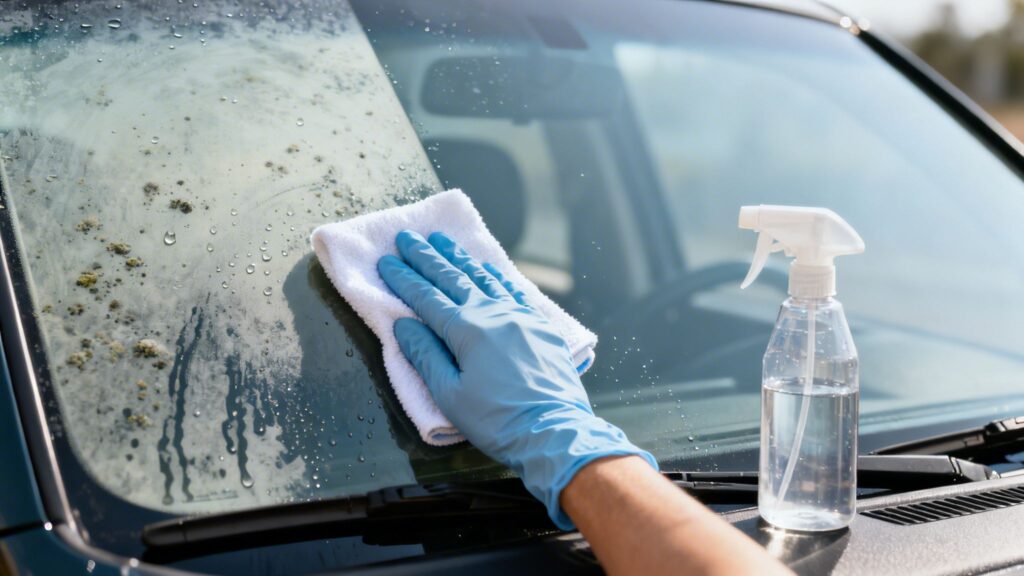
To get those stubborn water stains off your windshield, you need a way to dissolve the mineral deposits left behind by hard water. The most reliable method is to start with a mild acid, like a simple 50/50 mix of white vinegar and distilled water, or a dedicated commercial water spot remover. Just apply it to the glass, gently work it in with a microfiber towel, and rinse everything off completely.
Why Your Windshield Attracts Stubborn Water Stains
Ever notice how those chalky white spots seem to weld themselves to your windshield? It all comes down to the water itself. When a water droplet evaporates, it leaves behind any minerals it was carrying—usually calcium and magnesium. That chalky residue is what we call a hard water stain.
The problem is especially bad in sunny, dry regions. For drivers in states like Arizona, where Phoenix's tap water is notoriously mineral-rich, these stains are a constant battle. In fact, it's estimated that over 70% of vehicles in arid states deal with visible water spots every year, which can be a real hazard for visibility. You can see what causes water spots on cars in more detail to understand the science behind it.
What’s more, glass isn't as perfectly smooth as you might think. On a microscopic level, it has tiny imperfections where minerals can get a foothold. Some glass is treated to be more water-repellent (hydrophobic), while untreated glass (hydrophilic) lets water spread out, increasing the surface area for evaporation and stains. You can explore more on the difference between hydrophilic and hydrophobic glass to see how your windshield's properties play a role.
Diagnosing the Severity of Your Stains
Before you grab any cleaner, take a moment to assess the damage. Not all water spots are the same, and using the wrong method can either be a waste of time or, even worse, damage your glass. I’ve found it’s best to categorize them into three levels of severity.
To help you figure out what you're up against, here's a quick reference table. It’s a simple way to diagnose the stains on your windshield and jump straight to the most effective removal strategy.
Identifying Your Water Stain Type
| Stain Level | What It Looks Like | Best Removal Strategy |
|---|---|---|
| Level 1 | Faint, surface-level chalky outlines. Feels smooth to the touch. | A simple vinegar solution or a dedicated water spot spray. |
| Level 2 | More defined, stubborn spots. You might feel a slight texture. | A stronger commercial cleaner, possibly with light scrubbing from a clay bar. |
| Level 3 | The spot is gone, but a faint "shadow" or etching remains. | Mechanical polishing with a glass-specific compound is needed. The minerals have etched the glass. |
This process helps you avoid using a sledgehammer to crack a nut. You can always move up to a more aggressive method if the first one doesn't work.

The flowchart above gives you a great visual guide. Fresh, faint spots are Level 1. More bonded, stubborn spots that have been baked on by the sun are Level 2. If you clean the spot and a mark is still there, you’re dealing with Level 3 etching.
Pro Tip: Always start with the least aggressive cleaning method first. You can always escalate to a stronger product or more intense technique, but you can't undo etching caused by a method that was too harsh.
Once you know what you’re dealing with, you can gather the right tools for the job. Now, let’s get into the specific supplies you'll need.
Gearing Up: Your Water Stain Removal Arsenal

Before you even think about tackling those water spots, let’s talk gear. Showing up to the fight with the right tools makes the difference between a frustrating afternoon and a crystal-clear windshield. This is about building a go-to kit that can handle anything from faint spotting to seriously etched-in mineral deposits.
The Non-Negotiables
First things first, let's cover the basics. These are the items you’ll use on nearly every cleaning job, and they’re essential for making sure you don't cause more harm than good.
- Microfiber Towels: You can never have enough. I recommend having at least three to four clean, high-quality towels on hand—one for applying your cleaner, another for the rinse, and a final dry one for that perfect, streak-free buff.
- Spray Bottles: Grab two. You'll want one for your cleaning solution and a separate one filled with plain, distilled water. This makes rinsing precise and easy.
- Painter’s Tape: A roll of blue painter's tape is a lifesaver. Use it to mask off the delicate rubber trim, gaskets, and painted surfaces around your windshield. This simple step protects them from any acidic cleaners or abrasive compounds you might use later.
Cleaning Agents: From Mild to Wild
The cleaner you reach for depends entirely on how bad the stains are. I always keep a few options in my garage so I can step up my attack if the first attempt doesn’t cut it.
Always start with the least aggressive method first. A simple mix of 50% distilled white vinegar and 50% water is a fantastic, safe starting point for dissolving light mineral deposits. It's cheap, effective, and you probably already have it.
If that homemade solution doesn’t make a dent, it’s time to move on to a dedicated, commercial water spot remover. These products are specifically formulated to break down those stubborn mineral bonds much more effectively. For a closer look at what separates the good stuff from the bad, check out our deep dive on the best window cleaning tools and cleaners.
Bringing Out the Big Guns
When you’re dealing with more severe Level 2 or Level 3 stains, you need to get a little more physical with your approach.
A detailing clay bar and its companion lubricant is the perfect next move. The clay glides over the glass, grabbing and lifting away bonded contaminants without scratching the surface. It’s surprisingly effective.
For the absolute worst stains—the ones that are physically etched into the glass—you'll need cerium oxide. You mix this fine powder into a slurry and use it with a polishing pad to gently level the glass surface itself, effectively erasing the etching. Some old-school pros might even mention #0000 steel wool, but I only recommend this as a last resort. If you go this route, you must use extreme caution and constant lubrication to prevent scratching your windshield.
DIY Solutions for Light Water Spots

When you're dealing with fresh, faint water spots—the kind that show up after a rogue sprinkler attack or a less-than-perfect car wash—you don't need to reach for the heavy-duty chemicals just yet. More often than not, the best tool for the job is already in your kitchen cabinet.
A simple acidic solution can easily dissolve those light mineral deposits before they have a chance to etch into the glass. This is the first method I recommend to anyone trying to get rid of those annoying chalky outlines on their windshield.
The Vinegar and Water Method
The hero here is plain old distilled white vinegar. Its natural acidity is fantastic at breaking down the calcium and magnesium that create water spots.
All you need is a spray bottle with a 50% distilled white vinegar and 50% distilled water mix. The secret here is using distilled water. Tap water contains its own minerals, and using it would be like trying to dry yourself off in the rain—you'd just be adding more deposits to the glass.
Before you get started, make sure your windshield is clean and, most importantly, cool to the touch. If you try this on hot glass or in direct sunlight, the solution will evaporate almost instantly, leaving you with even more streaks. Your best bet is to work in a garage or wait for a shady part of the day.
Lightly spray the vinegar mix onto a small section of the glass. You want it wet, but not so saturated that it's dripping down onto your paint. Now, just let it sit for a minute or two. This "dwell time" is what allows the vinegar to do its job and dissolve the minerals.
Grab a clean microfiber towel and wipe the area using straight, even strokes. Flip the towel over to a dry side and give the glass a final buff to bring out a streak-free shine. If a few stubborn spots are hanging on, don't worry. Just repeat the process.
Don't underestimate this simple trick. The 5% acetic acid content in a 50/50 white vinegar solution has been shown to dissolve around 90% of light stains in less than five minutes. It’s a go-to for pros like us at Sparkle Tech Window Washing, especially in the Phoenix heat where quick, effective solutions are non-negotiable. You can find more professional tricks in this detailed guide on cleaning hard water stains from your windshield.
Alternative DIY Cleaners
If you're out of vinegar or just want to try something different, a couple of other common household items can also get the job done on light water spots.
Lemon Juice: Just like vinegar, the citric acid in lemon juice is a great stain remover. Mix it 50/50 with distilled water in a spray bottle and follow the same steps: spray, wait, and wipe. I'd recommend straining the juice first to avoid leaving any pulp behind on your glass.
Baking Soda Paste: For spots that need a little more convincing, a baking soda paste can provide some gentle scrubbing power. Mix a bit of baking soda with a few drops of water until you have a paste about the consistency of toothpaste. Apply it directly to the stain with a microfiber cloth and rub gently in small circles. It’s a mild abrasive that can lift deposits without scratching the glass. Just be sure to rinse the area thoroughly with distilled water to get all the residue off.
Tackling Tougher Stains with Commercial Products
So, you’ve tried the vinegar solution, and those stubborn, sun-baked mineral deposits are still staring back at you. Don't worry, it happens. When household remedies don’t have enough muscle, it’s time to call in the specialists: commercial-grade water spot removers. These cleaners are formulated with more potent agents that are designed to do the heavy lifting for you, saving a ton of elbow grease and frustration.
Before you grab a bottle, a quick but important word on safety. We're dealing with stronger chemicals now, so careful handling is non-negotiable. Always pull on a pair of nitrile gloves to protect your skin. It’s also smart to use painter's tape to mask off the rubber gaskets and painted trim around your glass. An accidental drip can easily stain or damage these sensitive surfaces.
The Power of Oxalic Acid Cleaners
One of the most effective and surprising products for this job is something you might already have under your sink: Bar Keepers Friend (BKF). Its secret weapon is oxalic acid, a powerhouse chemical that excels at dissolving the very calcium and magnesium that make up hard water spots.
You can find it as a powder or a pre-mixed liquid, but I’ve always preferred the powder. It gives you complete control over the consistency.
- Make a Paste: Start by sprinkling some powder into a small bowl and adding a few drops of water. Mix it until you have a thin paste—think pancake batter consistency.
- Apply and Agitate: Using a damp, non-abrasive applicator pad, work the paste into a small section of the glass. Use gentle, circular motions for about 60 seconds. You don't need to apply a lot of pressure; let the acid do the hard work.
- Rinse Thoroughly: As soon as you're done, immediately flood the area with distilled water. This neutralizes the acid and washes away any leftover residue.
- Dry and Check: Grab a clean microfiber towel, dry the section completely, and inspect your work. If a faint spot remains, just repeat the process before moving on.
Don't just take my word for it. Professional detailers have put this method to the test, with some finding that an oxalic acid cleaner like BKF can eliminate 95-100% of auto glass spots in just a few minutes—far outperforming vinegar. Another head-to-head test showed it cleared 99% of even etched-in stains, proving just how effective it is against serious mineral buildup.
Dedicated Water Spot Removers
Another great route is to use a product specifically made as a car glass water spot remover. These are often gels designed to cling to vertical surfaces like your windshield, giving the active ingredients more dwell time to break down those mineral bonds. You can browse through a range of professional water spot remover options for windows to see what’s out there.
Application is usually dead simple: dab a little onto an applicator, work it into the glass, let it sit for a moment, and then buff it off with a fresh microfiber towel. These products are engineered to be tough on stains but safe on automotive glass, which makes them an incredibly reliable choice.
Safety First: No matter which product you use, always test it on a small, hidden spot first, like a lower corner of the windshield. This quick check ensures it won't cause any unexpected clouding or hazing on your glass.
Using a Detailing Clay Bar
Sometimes, even after the spots are gone, the glass feels gritty or rough to the touch. This means you’re dealing with bonded contaminants—tiny particles of industrial fallout, tree sap, or road grime that have latched onto the surface.
This is the perfect job for a detailing clay bar. When you glide the clay across a lubricated surface, it safely shears off these bonded particles without scratching the glass.
Just spray the glass with a clay lubricant (a mix of car shampoo and water in a spray bottle works in a pinch) and gently rub the clay bar back and forth across the glass. You’ll actually feel the surface change from rough to perfectly slick as the clay picks up the contaminants. It’s an amazing finishing step for getting your glass flawlessly clean.
Advanced Polishing for Etched-In Water Stains
So, you’ve tried every spray, paste, and vinegar solution, but those ghostly water spots are still laughing at you. If your cleaners aren’t cutting it, you’re likely dealing with something more serious than a surface deposit. The minerals have actually etched into the glass, creating microscopic pits that no cleaner can lift out.
At this point, you have to shift from cleaning to polishing. This means physically abrading the glass surface to level it down to the bottom of the etch marks. It's an incredibly effective technique, but there's no undo button. Get it right, and your glass will be perfectly clear. Get it wrong, and you could end up with a wavy, distorted view or even a bill for a new windshield.
Using a Cerium Oxide Slurry
For a true professional-grade fix, the industry standard is cerium oxide. This is an ultra-fine powder that, when mixed with water, becomes a slurry capable of polishing glass to optical clarity without scratching it.
To do this right, you’ll need the proper equipment. This isn't a job for elbow grease alone.
- A dual-action (DA) polisher is a must. It’s far safer on glass than a high-speed rotary buffer, which can generate enough heat to warp the glass permanently.
- You’ll also need dedicated glass polishing pads. These are usually made of firm rayon or felt, designed to work the slurry without absorbing it all.
- Of course, you'll need cerium oxide powder and a spray bottle filled with distilled water to keep things lubricated.
The game plan is to mix the cerium oxide powder with water until it has the consistency of a thin milkshake. Dab a few pea-sized dots of the paste onto your polishing pad, give the windshield a quick mist of water, and set your DA polisher to a low speed (usually a 2-3 setting).
Work in small, manageable sections, about 2×2 feet at a time. Guide the polisher across the glass in slow, overlapping passes, first horizontally and then vertically. The most important rule here is to never let the slurry dry out on the glass. Keep the area damp with your spray bottle. A dry slurry will stop polishing and can create its own scuffs.
After a few complete passes, stop and wipe the section clean with a microfiber towel to inspect your work. Deep etches won’t disappear in one go. It might take several rounds of polishing, but patience will pay off.
Many professional detailers swear by this method for even the most hopeless-looking glass. When done correctly, cerium oxide polishing can effectively remove over 99% of etched-in mineral stains, restoring clarity on windshields that have been spotted for years. You can read more on how experts tackle this issue in this guide to cleaning hard water stains from Jalopnik.com.
The Manual Alternative: #0000 Steel Wool
If a power polisher isn't in your budget, there is a manual option, but you need to be extremely careful. You can use #0000 super-fine steel wool. I can't stress this enough—using any coarser grade will absolutely leave your windshield covered in fine scratches.
With this method, lubrication is everything. Drench the glass with soapy water or a quality glass cleaner. Then, with very light pressure, gently rub the steel wool over the affected spots. You’re not trying to scrub the glass; you’re just trying to knock down the high points of the mineral deposits. Let the tool do the work.
Knowing When to Call a Professional
This is where you need to be honest with yourself. If the idea of taking a power tool to your windshield makes you nervous, or if the etching is so deep you can feel it with your fingernail, it’s time to call in a pro.
A reputable auto detailer or glass specialist has the experience to remove the damage without putting your windshield at risk. A mistake at this stage can easily turn a cosmetic issue into a $500+ windshield replacement, which is a much worse outcome than a few stubborn spots.
How to Prevent Water Stains from Coming Back

You’ve put in the elbow grease and your glass is finally crystal clear. Now, let's keep it that way. Preventing water spots is a whole lot easier than removing them, and it all comes down to a few smart habits.
If there's one habit I drill into every car owner, it’s this: dry your car immediately after washing. Never let water air-dry on the glass or paint, especially if you're in a sunny or hard-water area. Those seemingly innocent droplets are full of minerals that get left behind once the water evaporates.
Taking a few minutes to dry your glass with a quality microfiber towel can prevent up to 85% of new stains from forming. It’s a simple step, but it’s the most effective one you can take.
Apply a Protective Barrier
For more robust, long-term protection, I always recommend a good glass sealant or hydrophobic coating. These products create an incredibly slick surface that water just can't stick to. Instead, it beads up and rolls right off, taking all those pesky minerals with it.
Think of a good sealant as a semi-permanent raincoat for your windshield. Water has a much harder time clinging to the surface, which dramatically cuts down on the evaporation that causes spots.
This same logic applies to any vehicle glass, not just cars. Many of the same principles are used for protecting your boat's windshield from future water spots, where the exposure to water is even more constant.
A couple of other small adjustments can make a surprising difference:
- Use a Spot-Free Washer Fluid: Not all washer fluids are created equal. Look for one specifically designed to be "spot-free" or "filtered" to avoid spraying minerals directly onto your clean glass.
- Keep Your Wiper Blades Clean: Dirty wipers are a common culprit. They just smear a film of grime and mineral-rich dirt across your windshield every time you use them. A quick wipe-down with a damp cloth during your wash routine is all it takes to fix this.
A Few Common Questions
Even with the best guide, you're bound to run into a few questions once you start tackling those stubborn spots. Here are the answers to some of the most common ones we get from drivers dealing with water-stained glass.
Can I Just Use Windex to Get Rid of Hard Water Stains?
I wish it were that easy, but unfortunately, no. Your standard blue glass cleaner is fantastic for everyday smudges and fingerprints, but it simply doesn't have the right ingredients to fight mineral deposits.
Those tough, chalky spots are made of calcium and magnesium left behind by evaporated water. Windex just isn't acidic or abrasive enough to break them down. You’ll end up scrubbing endlessly with no results. You really need a dedicated acidic solution, like vinegar, or a specific hard water spot remover.
Is Steel Wool Actually Safe for My Windshield?
This is a big one, and the answer is yes—but with some very important rules. If you grab the wrong kind or use it incorrectly, you absolutely risk scratching your glass.
The only type you should ever let near your windshield is #0000 grade steel wool. This is the finest grade available, and it's actually softer than automotive glass. The secret to using it safely is lubrication. Never, ever use it dry. Douse the area with soapy water or a glass cleaner and apply only light pressure, letting the steel wool do the work. Using a coarser grade or pressing too hard is a guaranteed way to leave scratches.
Pro Tip: After you've cleaned off a stubborn spot, run your fingernail over the area. If you feel a slight dip or a rough patch, the minerals have started to etch into the glass itself. At this point, simple cleaners won't help. The only way to fix it is with a glass polishing compound, like cerium oxide, which gently levels the surface.
A quick word of caution on tinted windows: most tint is a delicate film applied to the inside of the glass. Abrasives like steel wool and even harsh chemicals can easily scratch, peel, or discolor it. If you have tinted windows, stick to gentler methods and always test any product on a small, hidden spot first.