

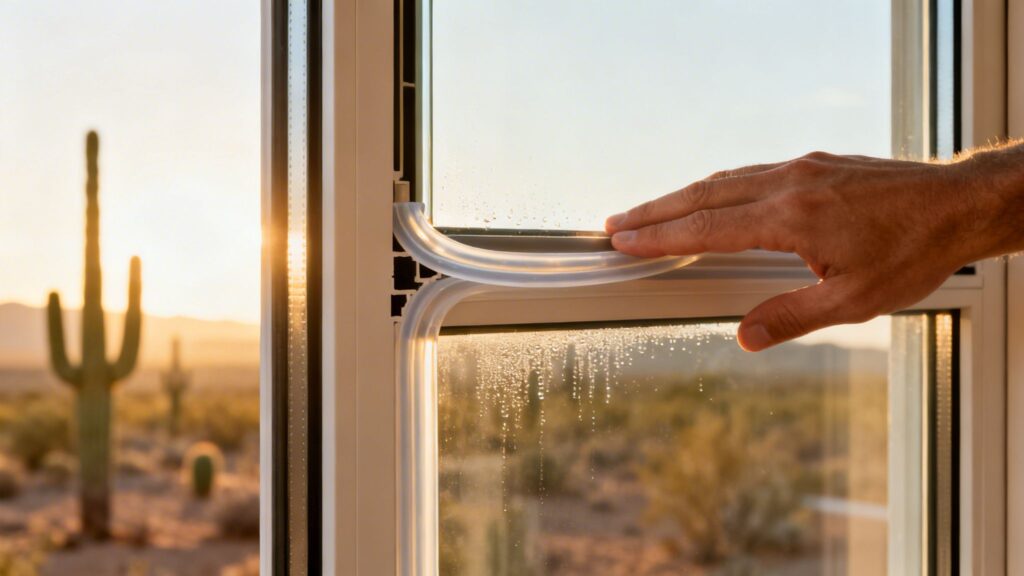
When we talk about windows, we usually think about the glass or the frame. But tucked away between them is one of the most important parts of your entire home: the window seal.
So, what is it exactly? A window seal is the flexible, often rubber or silicone, strip that creates an airtight barrier between the glass pane and the window frame. Its mission is simple but crucial: keep your comfortable, conditioned air in and the harsh Arizona elements out.
Understanding Your Window Seal: The Unsung Hero of Home Comfort
Think of the gasket on your refrigerator door. When you close the door, that rubber strip creates a perfect seal, locking the cold air inside. Your window seal does the exact same job, but for your entire house, working tirelessly 24/7.
Without that seal, your window is little more than a hole in the wall. This unassuming component is the quiet guardian that stops drafts, muffles street noise, and prevents rain from creeping in. Here in Arizona, its role is even more pronounced—it's your home's frontline defense against scorching heat and ever-present dust.
The Core Job of a Window Seal
A healthy window seal is a true multi-tasker, and its performance directly impacts your home's comfort and your bank account.
Before we dive into what happens when they fail, let's break down the essential jobs a healthy window seal performs every single day.
The Core Functions of a Healthy Window Seal
| Function | What It Does for Your Arizona Home |
|---|---|
| Energy Efficiency | Locks in your cool, air-conditioned air, forcing your AC to run less and saving you money on electricity bills. |
| Weather Protection | Creates a watertight barrier against monsoon rains, preventing leaks that can cause mold, wood rot, and costly structural damage. |
| Noise Reduction | Dampens outside sounds like traffic, barking dogs, and landscaping crews, creating a more peaceful indoor environment. |
| Dust & Allergen Barrier | Blocks dust, pollen, and other airborne particles from getting inside, which significantly improves your indoor air quality. |
This protective barrier is especially critical for older homes. Across North America, it's estimated that over 40% of homes built before 1980 have deteriorating seals. These aging components can allow up to 30% more energy to leak out compared to homes with modern, intact windows. You can find more details in this window seal market data report if you want to dig deeper.
A healthy window seal is one of the hardest-working, yet most overlooked, components of a home. It’s the invisible shield that directly translates into lower energy bills and a more comfortable living space.
The Two Types of Window Seals and What They Are Made Of
When we talk about a "window seal," it sounds like a single thing, right? But it’s actually a tag team of two different components, each with its own specific job. Getting to know both is the first step in spotting trouble before it gets serious.
First up is the part you can actually see and touch: the weatherstripping. This is the flexible gasket running along the moving parts of your window, like where the sash meets the frame. Its whole purpose is to create an airtight closure, blocking drafts and keeping rain out. Simple, but crucial.
The second part is the real unsung hero: the insulated glass unit (IGU) seal. This one works behind the scenes, tucked away between the panes of your double- or triple-pane windows. It’s what keeps the panes perfectly spaced and, more importantly, locks in the insulating gas (usually argon) that does the heavy lifting for your window's energy efficiency.
Materials Matter, Especially in the Arizona Sun
The type of seal is only half the story; what it’s made of is just as important. Here in Arizona, the intense sun and wild temperature shifts put enormous stress on materials. You need something that can take a beating without getting brittle and giving up.
Here are the most common materials you'll find:
- EPDM Rubber: Think of this as the all-terrain tire of window seals. It’s a tough synthetic rubber that excels at resisting heat, UV exposure, and weather. It stays flexible whether it’s scorching hot or surprisingly chilly, making it a perfect fit for our climate.
- Silicone: Known for being incredibly flexible and standing up to extreme temperatures and moisture. Silicone doesn't tend to shrink or crack with age, so it provides a reliable, long-lasting barrier.
- Vinyl: This is often the more budget-friendly choice, but there's a trade-off. In a climate like ours, prolonged exposure to intense heat and UV rays can make vinyl stiff and brittle, leading to a much shorter lifespan.
This flowchart shows exactly what a healthy window seal is doing for your home day in and day out.

From comfort to your energy bill, it’s clear how much rides on this one component.
A window seal isn't just a piece of rubber; it's a carefully engineered barrier. Choosing the right material is like picking the right tires for your car—what works in a mild climate might not survive an Arizona summer.
This is why high-performance materials are non-negotiable here. Materials like EPDM and silicone hold a commanding 60% market share among top window manufacturers, valued for their potential 30-year durability.
Contrast that with cheaper vinyl seals, which can degrade 40% faster in our brutal 110°F summers. Suddenly, that upfront saving doesn't look so good. Material choice is a long-term investment in your home. You can discover more insights about these market trends to see why quality matters.
In the end, it doesn't matter if it’s the visible weatherstripping or the hidden IGU seal—the material's quality will determine how well your window performs and for how long.
Why the Arizona Sun Is Your Window Seal’s Worst Enemy
Window seals are built to be tough, but they have a formidable opponent here in Arizona: the sun. That relentless, beautiful sunshine we all love is also public enemy number one for the protective seals around your glass, causing even high-quality materials to eventually break down.

The main issue is something called thermal stress. A great way to picture it is to think about bending a paperclip back and forth. It holds up for a while, but with enough repetition, the metal weakens and snaps. Your window seals go through a similar, albeit slower, process every single day.
When the morning sun beats down, your window glass, frame, and seal all expand from the heat. Then, as the desert temperature plummets at night, they all shrink back down. This constant cycle of expansion and contraction puts a massive amount of physical strain on the seal, stretching and compressing it until it eventually gives up, cracks, or pulls away from the frame.
The Constant Battering from UV Rays
On top of the temperature rollercoaster, the sheer intensity of the sun’s ultraviolet (UV) radiation is brutal. UV rays are incredibly effective at breaking down the chemical bonds in common seal materials like rubber, vinyl, and even some types of silicone.
It's a lot like leaving a plastic lawn chair out in the yard all summer. By September, it's faded, brittle, and one wrong move could snap a leg. That same process, known as UV degradation, is happening to your window seals. They lose their flexibility, become hard and chalky, and become incredibly prone to cracking. For a deeper dive into our local climate's impact, you can read more about the effects of weather on windows in Phoenix, AZ.
A window seal's lifespan in Arizona is a constant battle against thermal stress and UV degradation. Each day of intense sun and fluctuating temperatures is another small step toward eventual failure.
Other Culprits That Hasten the Decline
While the Arizona sun is undoubtedly the main adversary, a few other factors can speed up the demise of your window seals. Knowing what to look for can help you catch small issues before they turn into big, expensive headaches.
Here are a few other common contributors:
- Age and Material Fatigue: It's a simple fact of life—materials wear out. After 10-15 years of service, even the best seal will have lost much of its original elasticity and ability to create a tight barrier.
- Poor Initial Installation: A window that isn't installed perfectly level and square creates uneven pressure points on the seal. This localized stress means one specific spot will wear out and fail much sooner than the rest of the window.
- Physical Damage: Life happens. An errant golf ball, an overzealous pressure washer, or even scraping with the wrong tool during cleaning can nick or tear a seal. This tiny bit of damage is all it takes for air and moisture to get in, starting a chain reaction that leads to total seal failure.
Often, it’s not just one of these things but a combination of them working together that finally compromises your window’s defenses against the elements.
How to Spot a Broken Window Seal Before It Gets Worse
A broken window seal rarely announces itself with a bang. Instead, it’s a quiet failure, a slow creep of subtle clues that are easy to miss if you aren't looking for them. Learning to spot these early warnings is the key to fixing the problem before it snowballs into bigger issues like water damage, mold, or shocking energy bills.

Think of it like finding a slow leak in a tire—you can patch it up early and avoid getting stranded. By paying attention to your windows throughout the day and in different weather, you can become your own home's best troubleshooter.
The Tell-Tale Sign: Condensation Between the Panes
This is the big one. If you see fog, haze, or moisture droplets trapped between the layers of glass in your double-pane window, you have a broken seal. It's a classic, undeniable sign that the insulated glass unit (IGU) has failed. No amount of wiping will get rid of it because the moisture is sealed inside.
This happens when the airtight barrier is breached, letting outside air seep into the space meant for insulating gas. The desiccant material inside the spacer bar gets overwhelmed and can no longer absorb any more moisture, which then condenses on the glass. If this is happening at your home, our guide on what causes windows to fog up can give you even more detail.
A foggy window isn't just an eyesore; it's a flashing sign that your window's insulating power is gone. The argon or krypton gas has escaped, and humid, unconditioned air has taken its place.
Windows clouded by faulty seals don't just obstruct your view; they can slash visibility by as much as 25%. Here in Arizona, that leaked-in moisture often leaves behind stubborn hard water mineral buildup, which can reduce transparency by another 35%. Many homeowners find they need professional window cleanings at least twice a year just to manage the film.
Other Subtle Clues to Look (and Listen) For
While condensation is the smoking gun, other symptoms often show up much earlier. Training your eyes and ears to catch these smaller signs can give you a huge head start on getting things fixed.
Here's a quick checklist to run through.
Failed Window Seal Diagnostic Checklist
Use this simple table to check your windows for the less obvious signs of a broken seal. Catching any of these early can make a big difference.
| Symptom | What It Looks/Feels Like | What It Means |
|---|---|---|
| Drafts or Whistling | A cool breeze near a closed window or a faint whistling sound on windy days. | Air is actively pushing through a gap in the seal. A properly sealed window should be silent. |
| Increased Outside Noise | You're suddenly hearing more traffic, lawnmowers, or neighborhood chatter. | The seal, which also dampens sound, has lost its integrity, letting more noise pollution inside. |
| Visible Water Stains | Discolored paint, damp spots, or peeling texture on the windowsill or the wall below. | Moisture is getting past the seal, likely during rain or window washing, and damaging surrounding materials. |
| Distorted Glass | Reflections in the window appear wavy, warped, or bowed, especially from an angle. | The pressure inside the IGU has changed due to the broken seal, causing the glass panes to flex. |
By keeping an eye out for these clues, you're not just maintaining your windows—you're protecting your home's comfort, efficiency, and value.
The Hidden Costs of Ignoring a Failed Window Seal
That little bit of fog between your window panes or the faint draft you feel on a windy day might seem like a small thing. It’s easy to ignore. But treating a broken window seal like a minor issue is a bit like ignoring a slow leak in your car tire—sooner or later, it’s going to leave you with a much bigger, more expensive problem.
That seemingly insignificant gap is a gateway to a whole host of headaches. What starts as a simple efficiency problem quickly snowballs, hitting your wallet where it hurts month after month.
Skyrocketing Arizona Energy Bills
Here in Arizona, the most immediate and painful consequence of a failed window seal is the spike in your energy bills. Think about it: your AC is designed to cool the air inside your home. When a seal gives way, it's the equivalent of leaving a window cracked open 24/7. Hot desert air relentlessly seeps in, while your precious, expensive cool air escapes.
This forces your air conditioner into a constant, uphill battle. It has to run longer and work harder just to keep your home at the temperature you set. During a sweltering Arizona summer, that extra workload shows up loud and clear on your monthly electricity bill.
A compromised window seal turns your AC unit from an efficient cooling system into an expensive, overworked appliance. You're essentially paying to cool your neighborhood, one draft at a time.
The Threat of Water Damage and Mold
Energy waste is just the beginning. A broken seal is also an open invitation for moisture. When our famous monsoon season rolls around, the wind-driven rain can easily push its way through a faulty seal and seep into the wall cavity around your window. This hidden moisture creates the perfect breeding ground for mold and mildew, which are not only a health hazard but also a nightmare to get rid of.
Over time, this moisture can also cause some serious damage:
- Wood Rot: The window frame, the sill, and even the structural studs inside your wall can start to decay.
- Paint Damage: Telltale signs include bubbling, peeling, or water stains appearing on the drywall near the window.
- Structural Weakness: In the worst-case scenarios, long-term water intrusion can compromise the integrity of the wall itself.
The numbers don't lie. Simply having high-performance seals can boost a home's energy efficiency by 20-25%. That's a huge deal when cooling can make up 60% of your total energy use. Nationwide, U.S. homes lose billions every year to these kinds of inefficiencies, and an astonishing 40% of that loss is traced right back to windows. Explore the full report on window efficiency savings to see the bigger picture. Fixing a failed seal isn’t just a simple repair; it's a critical investment in your home's health and your financial stability.
Your Guide to Window Seal Repair and Replacement

Finding a failed window seal can feel like a major headache, but look at it this way: it’s a clear sign that your home’s defenses need a little attention. The great news is you’ve got options, from simple DIY fixes to full-on replacements. What you do next really just depends on the specific problem you’re facing.
For example, if the weatherstripping around the moving part of your window (the sash) is cracked and peeling, that’s usually an easy fix. This is the seal you can actually see and touch. Replacing it is a fantastic weekend project that immediately stops drafts and boosts your home’s comfort.
The internal seal on a dual-pane window, however, is a whole different ballgame. If you’re seeing that dreaded fog between the panes, it means the IGU (Insulated Glass Unit) seal has broken. Fixing this involves some serious professional gear to get inside the glass, replace moisture-absorbing materials, and refill the unit with inert gas. This is definitely not a DIY job.
Repair or Replace: The Big Decision
So, do you patch it up or start fresh? The answer usually boils down to cost versus long-term benefit.
A quick weatherstripping replacement is almost always a smart move. But when an IGU seal fails on an older window, the decision gets a bit trickier. You could pay to have the IGU repaired, but if the window frame itself is warped, cracked, or inefficient, you’re just putting a band-aid on a much larger issue.
Take a good look at the window’s age and overall condition. Foggy glass is often just the most obvious symptom. If you’ve also noticed it’s a real pain to clean the glass effectively, that’s another strong hint that a full replacement might be the better long-term investment. Our guide on how to clean between window panes can help you diagnose just how bad the situation is.
Deciding between repair and replacement is an investment calculation. A quick fix solves today’s problem, while a replacement solves tomorrow’s problems, too.
It’s no surprise that homeowners are focused on this. Globally, 32% of all window-related renovation projects involve seal replacements, all in the name of better thermal performance. And it pays off—properly sealed and maintained windows can last up to 25 years longer.
When a window seal is completely shot or you’re ready to upgrade your home’s efficiency, it’s time to call in the experts. Exploring professional window installation services is the logical next step. A brand-new, high-performance window doesn't just fix a broken seal; it elevates your home’s insulation, security, and curb appeal all at once.
Got Questions About Window Seals? We’ve Got Answers.
We've walked through the ins and outs of window seals, but it's natural to still have a few questions bubbling up. Let's tackle some of the most common things we hear from homeowners just like you.
How Often Should I Check My Window Seals Here in Arizona?
Living in Arizona means our homes are in a constant battle with the elements. That's why we recommend giving your window seals a good look-over at least twice a year.
A great time to do this is in the spring, right before the summer heat really kicks in, and then again in the fall as things start to cool down. Honestly, the easiest way to stay on top of it is to have them checked during a professional window cleaning. A trained eye can easily spot the early warning signs of trouble, like seals that are getting brittle, starting to crack, or pulling away from the glass.
Is a Broken Window Seal Really Going to Affect My Energy Bill?
You bet it will. Think of a window seal as the gasket on your refrigerator door—once it's broken, it's no longer airtight.
When a seal fails on one of your windows, that protective barrier is gone. During our brutal Arizona summers, hot air starts sneaking in, and all that precious, expensive cool air from your AC starts leaking out. Your air conditioner is forced to work overtime just to keep up, and that extra work shows up as a nasty surprise on your monthly power bill.
The classic tell-tale sign of a completely failed seal is a foggy window. If you're seeing condensation or a milky haze trapped between the panes of your double-pane window, the seal on that insulated glass unit (IGU) is toast. No amount of cleaning will wipe it away because the moisture is locked inside.
At that point, the only real fix is to have a professional repair or replace the glass unit to get your window's insulating properties back.
Maintaining your windows and their seals isn't just about looks; it's a critical part of keeping your Arizona home comfortable and efficient. For a professional inspection and a view that’s second to none, you can always count on the team at Sparkle Tech Window Washing. Schedule your free estimate online today!