
If you're in Arizona with a high-reach job on your hands, you've probably found yourself searching for a "spider lift rental near me." You're in the right place. This guide is the complete walkthrough for finding the perfect atrium lift, whether you're washing windows, cleaning solar panels, or tackling tricky building maintenance. We'll cover everything from picking the right model to navigating costs and safety.
Finding The Right Spider Lift Rental In Arizona

When you're dealing with height in a tight or delicate space, a standard boom lift or a simple ladder just won't do the job. That’s where spider lifts, also known as atrium lifts, become an absolute necessity. Their specialized design is precisely what makes them so invaluable for all kinds of work across the Phoenix valley and the rest of the state.
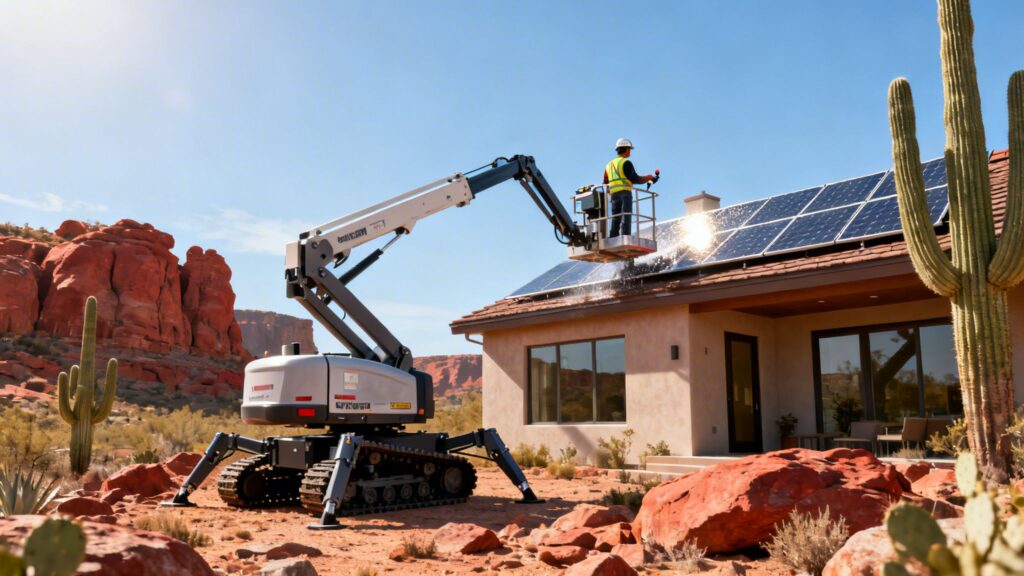
Unlike their bulky counterparts, these are compact, problem-solving machines. Thanks to their articulating booms and distinctive spider-like outriggers, they can get into difficult job sites that other equipment can't even approach.
Key Advantages for Arizona Projects
Think about the unique challenges here. From a residential window cleaning job in a tight Scottsdale backyard to commercial building maintenance in downtown Phoenix, a spider lift offers some serious advantages. It isn't just about the height; it's about getting there safely and without causing a headache.
Here’s what really sets them apart:
- Compact Footprint: Many models are surprisingly narrow, able to squeeze through a standard 36-inch gate or even a doorway. This opens up access to enclosed courtyards, interiors, and backyards that are off-limits to bigger lifts.
- Low Ground Pressure: Spider lifts move on rubber tracks that spread the machine's weight out. This is a critical feature for protecting delicate surfaces—think expensive pavers, manicured lawns, or even interior flooring—from getting chewed up.
- Uneven Terrain Stabilization: The independent "spider leg" outriggers are the game-changer. They allow the lift to set up securely on slopes, stairs, and the uneven desert terrain so common around here.
I’ve seen it firsthand time and time again. The ability to position a lift on a sloped driveway to clean second-story windows without cracking a single paver is what sells a homeowner. It turns a logistical nightmare into a pretty straightforward job.
Why Planning Ahead Is Crucial
Before you even start calling around for a spider lift rental near me, you need to do your homework. One of the most common and costly mistakes I see is people just renting the biggest lift they can find. That’s a recipe for disaster. You have to think through the exact working height, the ground conditions on site, and any gates or narrow paths you need to get through.
Taking a few minutes to measure access points and really look at the work area will save you a ton of time and money down the road. It guarantees the machine you rent is actually right for your project, preventing frustrating delays and the risk of property damage. This guide will walk you through exactly how to do that, so you can make the right call and find a rental partner you can trust.
Choosing The Perfect Lift For Your Project

Picking the wrong spider lift doesn't just cause a headache—it can blow your budget and completely throw your project off schedule. Getting this right from the very beginning is the single most important step for a smooth, efficient job.
It all boils down to three things: the working height you need, the weight you're putting in the basket, and the ground you'll be working on. Guessing isn't an option. You need to be precise to make sure the machine you rent can actually do the job safely once it's on-site.
Calculate Your Required Working Height
First things first, how high do you really need to go? Don't just eyeball it. Grab a laser measure or a long tape and get an exact measurement from the ground to the highest point you need to reach.
Here’s a pro tip I always give: add a 5 to 10-foot buffer to your final measurement. This extra room gives you some much-needed flexibility. It also prevents you from running the boom at its absolute maximum extension, which can feel a lot less stable when you're up there. This buffer also accounts for an operator's height in the basket, ensuring you have a comfortable working range.
Determine The Necessary Weight Capacity
Next up is weight—a critical safety calculation you can't afford to get wrong. Spider lifts have a strict maximum weight capacity, usually somewhere between 400 and 500 pounds. Overloading the basket is one of the most dangerous mistakes you can make.
To figure out your total load, simply add up the weight of:
- Operator(s): Are you sending one person up or two?
- Tools and Equipment: Think about everything you need—pressure washers, buckets, squeegees, water-fed poles, and any other gear.
- Materials: Don't forget to account for any materials you’re bringing up, like cleaning solutions or replacement parts.
Always rent a lift with a capacity that’s comfortably above your total calculated weight. Pushing the limits is never worth the risk.
Ever since they became widely available in the early 2000s, spider lifts have been a game-changer for window cleaners and building maintenance crews. On many jobs, these machines can cut labor time by up to 40% compared to traditional scaffolding. That's a massive boost in efficiency. You can see more on their industry impact in this in-depth analysis on spider crane use.
Match The Lift To Your Job Site Terrain
Finally, take a hard look at the ground where the lift will be set up. This is especially important across Arizona's diverse landscapes, as the surface conditions dictate which machine is right for the job.
- Indoor or Delicate Surfaces: Working inside an atrium or on nice pavers and manicured lawns, like you'd find in a Scottsdale community? You’ll need a lift with non-marking tracks. These white or gray rubber tracks are designed to prevent scuffs and damage.
- Outdoor and Rough Terrain: If your site is gravel, dirt, or uneven desert ground, you'll want a lift with standard black crawler tracks. They provide much better traction and durability for tougher conditions.
The lift’s outriggers are great for leveling on a slope, but the ground itself has to be firm enough to support the pressure pads. If you’re on soft soil or grass, you’ll need to ask the rental company for larger support plates to spread the load and stop the lift from sinking.
Spider Lift Model Comparison For Cleaning Tasks
Making the right choice is much easier when you can see how these factors play out for different jobs. This table breaks down which models are typically best suited for common cleaning scenarios, helping you find the right fit before you start searching for a "spider lift rental near me."
| Feature | Compact Model (e.g., 40-50 ft) | Mid-Size Model (e.g., 50-70 ft) | Best For |
|---|---|---|---|
| Reach | Excellent for one or two-story buildings. | Necessary for two to three-story residential or commercial buildings. | Residential Window Cleaning: Compact models are usually sufficient. Commercial Buildings: Mid-size models are often required for higher windows and facades. |
| Access | Can fit through single gates and narrow side yards. | May require double gates or wider access points. | Tight Access Jobs: Compact models are the go-to for enclosed backyards. Open Lots: Mid-size lifts are fine if space isn't an issue. |
| Weight | Lighter and gentler on sensitive surfaces like lawns or pavers. | Heavier, requiring more care on delicate ground. | Lawn & Pavers: Compact models with non-marking tracks are ideal. Asphalt & Concrete: Either model works well. |
By thinking through these three key areas—height, weight, and terrain—you’ll be able to confidently choose a spider lift that's not just adequate, but perfect for your project's unique demands.
Navigating The Rental Process and Paperwork
Alright, you've pinpointed the right spider lift for the job. Now comes the part that can feel a bit daunting: getting the rental locked in and wading through the paperwork. Don't worry, it's actually pretty straightforward once you know what to look for.
First things first, you need to find a solid rental company in the Phoenix area. A quick search will give you a list, but a slick website doesn't tell the whole story. I always dig deeper. Check their Google reviews, ask other local contractors for recommendations, and give them a call to feel out their expertise.
A real pro will grill you with questions about your job—the working height, site access, and ground conditions. They want to make sure you’re getting the right machine. If they seem too eager to just take your order without that conversation, that’s a big red flag for me.
Verifying Insurance and Bonding
This is the one step you absolutely cannot afford to skip. For my own business, working with a fully insured and bonded partner is a non-negotiable rule. Any reputable rental company should be able to provide proof of their coverage without hesitation. Always ask for it.
Here’s what you need to see on their certificate of insurance:
- General Liability Insurance: This is crucial. It protects against property damage or injuries to third parties that could be caused by the equipment.
- Workers' Compensation: This covers their own team members if they get hurt while delivering, setting up, or servicing the lift on your property.
- Proof of Bonding: This is a financial guarantee that they'll hold up their end of the contract.
Without this paperwork in hand, you could find yourself on the hook for accidents or damages. The peace of mind you get from knowing you're covered is worth its weight in gold.
I’ve learned from experience that a company’s professionalism with their insurance paperwork speaks volumes about their overall operation. If they’re organized and transparent here, they’re likely diligent about equipment maintenance and safety, too.
Understanding The Rental Agreement
Don't just skim the rental agreement before you sign. I know these documents can be dense, but a few key clauses demand your full attention. Zero in on the sections that detail responsibility for damages, fuel policies, and what happens if you need to return the lift late.
You also need total clarity on what's included in the quote. Does that price cover delivery and pickup? Are there hidden environmental fees or other surcharges? Asking these questions upfront is the best way to avoid surprise charges on your final bill and ensure a smooth spider lift rental near me experience.
It makes sense why rental vendors often see professionals make up the bulk of their business—sometimes as high as 85%. Companies like Sparkle Tech, which are set up as fully insured LLCs with Workers' Comp and bonding, can navigate the rental process with zero friction. On the cost side, while rates vary, atrium models are often praised for their excellent value and maneuverability in tight residential spots. You can dive deeper into what influences market rates in this guide to boom lift rental costs.
Operator Certification and Local Permits
One of the last big questions is: who is going to operate this thing? Per OSHA, anyone operating an aerial work platform has to be properly trained and certified. You've got two main paths.
- Self-Operation: If you or someone on your crew already has a valid aerial lift certification, you're good to go. This gives you maximum flexibility, but it also means all the operational responsibility falls on your team's shoulders.
- Hiring a Trained Operator: Most rental companies can provide a certified operator with the lift. This is often the safest and most efficient choice, especially for tricky or complex jobs.
Finally, do a quick check to see if your project needs a local permit. Any work that encroaches on public rights-of-way, like setting up on a sidewalk in Tempe or a street in downtown Phoenix, almost always requires a permit from the city. Your rental provider can usually point you in the right direction, but securing those permits is ultimately on you. Get it done before the lift arrives.
Understanding Rental Costs And How To Save

Let's talk numbers. Budgeting for a spider lift is where many projects go right—or wrong. The price you see advertised when you search for a "spider lift rental near me" is almost never what you'll actually pay, and knowing how the full cost breaks down is the key to keeping your project profitable.
Most rental yards structure their pricing in tiers, rewarding you for longer commitments. Daily rates will always be the highest. As soon as your job stretches beyond a couple of days, it almost always makes more sense to lock in a weekly rental.
Breaking Down The Common Pricing Structures
When you get a quote, you'll likely see these three options. Your project timeline is the deciding factor here.
- Daily Rate: Perfect for a quick, in-and-out job you are positive can be wrapped up in eight hours. It gives you flexibility but comes at a premium.
- Weekly Rate: This is the sweet spot for most jobs. If there’s any chance your work will spill into a third or fourth day, a weekly rate is usually cheaper than paying for several individual days.
- Monthly (28-Day) Rate: For any large-scale project or if you need the lift on-site for more than two weeks, this option offers the best value. It dramatically cuts your daily operating cost.
I've seen it happen a hundred times: a contractor books a daily rental, hoping to rush a job, only to need an extension. They almost always end up paying more than if they had just booked the weekly rate from the start. Be realistic with your timeline.
Watching Out For Hidden Costs
The base rental fee is just the starting point. Several other charges can creep onto your final invoice, so it’s crucial to ask about them upfront to avoid any nasty surprises.
Get crystal clear answers from the rental company on these potential add-ons:
- Delivery and Pickup Fees: These aren't cheap. Expect to pay anywhere from $150 to $300 each way, depending on how far you are from their yard.
- Fuel Surcharges: Many companies tack on a surcharge to delivery fees to cover fluctuating diesel and gas prices.
- Insurance Waivers: If you can't provide your own certificate of insurance that covers rented equipment, you’ll have to buy the rental company's damage waiver. This can easily add 10-15% to your total bill.
- Refueling Fees: Always, always return the machine with a full tank of fuel (for gas or diesel models). The price they charge to refuel it for you is far higher than what you'll pay at the pump.
Market conditions absolutely play a part in what you'll pay. With demand soaring in places like Arizona, rental stats forecast potential price hikes of 12%. It's not uncommon to see daily rates matching the $350-$900 range found in other hot markets. In fact, 68% of U.S. window firms now rent seasonally to manage cash flow—a strategy our team at Sparkle Tech uses to scale our insured fleet for major jobs. You can learn more about how market forces affect pricing in this overview of atrium lift equipment.
Smart Strategies For Saving Money
Getting a good deal doesn't mean you have to settle for less. With a little bit of planning, you can make a real dent in your rental costs.
- Book in Advance: Last-minute needs always come at a premium. If you can schedule your rental a few weeks out, you'll have more options and better pricing.
- Negotiate for Long-Term Rentals: If you know you need the lift for a month or more, don't be afraid to ask for a better rate. Rental companies love the predictable income from a long-term contract.
- Schedule During Off-Peak Seasons: Here in Arizona, spring and fall are prime time for construction. If your project is flexible, you might find lower rates during the hotter summer months or the cooler parts of winter.
- Bundle Your Needs: Do you also need a generator or a pressure washer? Renting all your equipment from one place gives you serious leverage to negotiate a package deal and saves a fortune on separate delivery fees.
Your Essential Pre-Use Safety Checklist
Let's be blunt: safety is everything when you’re working with a spider lift. Before that machine gets put to work—whether you're picking it up or it’s just been delivered to your site—a thorough inspection isn't just a good idea, it's non-negotiable.
Think of it as the pre-flight check every pilot performs. It’s a routine that builds confidence and catches small problems before they become catastrophic failures. Skipping this puts your crew, the property, and your entire project on the line.
The Initial Walk-Around
Your safety check starts the second you lay eyes on the lift. Don't wait until you're ready to fire it up. The first thing I always do is a complete 360-degree walk-around, looking for anything that seems out of place.
Here’s what should be on your radar during that initial scan:
- Obvious Damage: Look for fresh dents, bent components, or cracks in any welds, especially around the boom, chassis, and outriggers. What looks like a minor cosmetic issue could be a sign of a deeper structural problem.
- Track and Tire Condition: On a tracked model, inspect the rubber for deep gashes, chunks missing, or excessive wear. If it has tires, give them a quick check to make sure they’re properly inflated.
- Fluid Leaks: This one is huge. Scan the ground under the machine and all around the hydraulic hoses and connection points. Even a tiny drip of oil can signal a hose or fitting that's about to fail under pressure.
- Loose or Missing Parts: Make sure every pin, bolt, and safety guard is present and properly secured. I pay special attention to the pins holding the basket itself.
This walk-around only takes a few minutes, but it’s your first and best line of defense against a major incident.
Checking Mechanical and Hydraulic Systems
Once the visual check is clear, it's time to look under the hood, so to speak. You need to be sure the heart and muscle of the spider lift are ready to perform.
First, check your fluids. All of them. That means hydraulic oil, engine oil (on gas/diesel models), and coolant. Low levels are a major red flag. Low hydraulic fluid can lead to a total loss of power—the last thing you want when you're 60 feet up.
Next, get a close look at the hydraulic hoses. You’re searching for signs of aging like cracking, blisters, or spots where the hose has been rubbing against the frame. Double-check that all the fittings are tight. These lines are under incredible pressure, and a weak point is a disaster waiting to happen.
I tell every new technician on my team the same thing: a professional operator never skips the pre-use inspection. It's not about bureaucracy; it’s about ownership and safety. We’ve built our reputation at Sparkle Tech on being able to work safely and efficiently, and that culture starts with this simple, mandatory routine before every single job.
Testing All Controls and Safety Features
This is the final, most crucial step. You have to test every single function before putting any weight in the basket. Make sure you do this from both the ground controls and the basket controls to confirm everything is working as it should.
Fire up the engine and start methodically testing the controls. Cycle the boom through its entire range of motion—up, down, in, and out. Swing the turret from side to side. Every movement should feel smooth and immediate, with no hesitation or jerking.
Then, you absolutely must test the emergency systems:
- Emergency Stop: Hit the big red E-stop button from the ground, then from the basket. The machine needs to shut down instantly.
- Emergency Lowering: Know the procedure for lowering the basket if the engine dies. Test it. Every model has a slightly different system, so if you're unsure, that operator's manual is your best friend.
- Alarms and Lights: Confirm that the horn, any warning alarms, and the flashing beacons are all functioning.
Finally, do a quick check of your own gear. Is your safety harness free of frays or damage? Are the buckles solid? Check the lanyard and the anchor points inside the basket. A complete check, from the machine to your own PPE, is the only way to ensure a safe and successful day.
To make this process even easier, we've put together a quick-reference checklist. Use this before every single operation to ensure you haven't missed a thing.
Pre-Operation Spider Lift Inspection Checklist
| Area To Inspect | What To Check For | Status (OK/Needs Attention) |
|---|---|---|
| General Condition | Dents, weld cracks, bent parts, loose bolts/pins | |
| Fluid Levels | Hydraulic oil, engine oil, coolant are at proper levels | |
| Hoses & Fittings | No leaks, cracks, blisters, or signs of abrasion | |
| Tracks/Tires | Proper inflation (tires), no major gashes or wear (tracks) | |
| Control Panels | Both ground and basket controls are clean and readable | |
| Boom Operation | Smooth movement: raise, lower, extend, retract, rotate | |
| Emergency Stop | E-stop buttons (ground & basket) function instantly | |
| Emergency Lowering | System is functional and operator knows the procedure | |
| Safety Devices | Alarms, horn, and warning lights all work | |
| Basket | Floor is clear, gate closes securely, anchor points are solid | |
| Personal PPE | Harness and lanyard are in good condition, no damage | |
| Work Area | Ground is stable, no overhead power lines or obstructions |
Taking a few minutes to run through this table isn't just about compliance; it's about making sure everyone goes home safely at the end of the day. If anything gets marked as "Needs Attention," do not operate the lift until it's been addressed by a qualified technician.
Common Questions About Spider Lift Rentals
If you're searching for a "spider lift rental near me," you've probably got some questions. That's a good thing. These are specialized machines, and going into a rental prepared makes all the difference between a smooth job and a major headache.
Let's cut through the noise. Here are the straight answers to the questions I hear most often from homeowners and contractors across Arizona, whether they're working on a sloped yard in Fountain Hills or inside a Phoenix commercial building.
Do I Need Special Training To Operate A Spider Lift?
Yes, absolutely. This is non-negotiable. OSHA is very clear that anyone operating an aerial work platform—and that includes every spider lift—must be properly trained and certified. The controls might seem simple, but when you're working dozens of feet in the air, things can go wrong fast.
Any legitimate rental company will ask for proof of certification before they let you take the machine. If you or your team aren't certified, many providers offer training courses. Honestly, for tricky jobs, I often advise clients to just opt for a rental that includes a trained operator. It takes the liability off your plate and puts the controls in the hands of someone who runs these things for a living.
Can A Spider Lift Be Used On Grass Or Pavers?
It sure can. In fact, that's one of their biggest advantages. Spider lifts are engineered for low ground pressure. Their wide rubber tracks spread the machine's weight out, which is why they can work on delicate surfaces like nice lawns, paver patios, and even interior floors without leaving a mark.
Many models even have non-marking white or gray tracks just for this purpose. When you're booking the rental, make sure to tell them exactly what kind of surface you'll be on. They'll make sure you get a machine that won't tear up your client's property.
How Do I Know If I Need A Spider Lift Or A Boom Lift?
This usually boils down to two things: access and terrain. A standard wheeled boom lift is great if you have a wide-open, perfectly flat job site, like a big concrete slab or parking lot. They're typically faster to drive across a large, level area.
But a spider lift becomes the only real option when things get complicated.
- You need to get through a standard backyard gate.
- The setup spot is on a hill, uneven dirt, or even a staircase.
- The work is indoors, and you have to navigate through doorways.
- You have to reach up and over an obstacle like a pool, landscaping, or fixed equipment.
It’s the compact body and independently-leveling outriggers that make a spider lift so versatile. It’s not just about the height—it’s about being able to get the machine into the tight spot where you can actually use that height.
No matter the lift, a systematic safety check is crucial. This is the process every operator should have memorized.

Following this sequence—checking the machine's physical state, then its hydraulic power, and finally the controls—is fundamental to a safe day's work.
What Is The Best Way To Clean Solar Panels With A Lift?
Here in dusty Arizona, keeping solar panels clean is key to getting the power you're paying for. A spider lift is the perfect tool for the job because it lets a technician work on panels on steep or tall roofs without ever touching them. Putting weight on a panel is a great way to cause micro-cracks and kill its efficiency.
From the stable basket of a spider lift, a professional can use a deionized water-fed pole system. This is the industry-standard method—it cleans without leaving any mineral spots that block sunlight and avoids any damaging physical contact. Your solar array is a major investment; using the right equipment to maintain it is just smart business.
For professional window cleaning, solar panel maintenance, and other high-reach services, you need a partner with the right insurance, training, and equipment. The team at Sparkle Tech Window Washing is fully bonded and insured, bringing years of experience to every job site in the Phoenix valley and across Arizona. Visit us at https://sparkletechwindowwashing.com to get a free, no-obligation quote for your project.