



So you're ready to start a window cleaning business. Good. It's a fantastic way to become your own boss, and you can get started with a surprisingly small investment—often between $500 to $1,500 for the essential gear.
But where do you actually begin? It boils down to four main things: getting your business legal, buying the right equipment, figuring out your pricing, and then actually finding people who will pay you. Let's break down the roadmap.
Your Blueprint for a Thriving Window Cleaning Business
This isn't just another generic checklist. Think of this as your practical guide to launching a window cleaning business that actually lasts, especially right here in Arizona. We'll skip the fluff and give you a clear, actionable plan built on what works in the real world.
Before you even pick up a squeegee, you need to lay the groundwork. This is the high-level view of what it takes to turn your idea into a professional service that people trust and recommend to their neighbors.
The Pillars of a Solid Business
A successful business is about more than just cleaning glass; it's about building a solid operation from the ground up. Your journey starts by mastering these key areas.
- Getting Legal and Financially Ready: This means registering your business, getting the right insurance, and opening a separate bank account. Don't skip this.
- Investing in Professional Gear: We’ll cover the must-have tools for doing the job safely and efficiently, from a basic starter kit to a game-changing water-fed pole system.
- Creating a Smart Pricing Strategy: You need to know how to quote jobs so you can cover your costs, pay yourself a decent wage, and still have money left over to grow the business.
- Finding Your First Customers: We'll look at simple, low-cost ways to land those crucial first clients and start building a name for yourself.
A lot of new owners get hyper-focused on the cleaning technique and completely forget about the business side. You can be the best window cleaner in the world, but if you aren't profitable and protected, you're just running an expensive hobby.
By tackling these critical areas first, you’re setting yourself up for success. You’ll build a reliable, scalable business that can hold its own in the competitive Arizona market.
Getting Your Business on the Books: Legal and Financial Setup
Before you even think about buying a squeegee, you need to build the foundation of your business. This is the stuff that isn't glamorous—paperwork, legal decisions, insurance—but it’s what separates a professional operation from a side hustle. Get this right, and you'll protect yourself, your family, and your future profits.
First up, you need to decide what kind of business you're going to be. In Arizona, most new window cleaners go one of two ways: a Sole Proprietorship or an LLC.
A Sole Proprietorship is the path of least resistance. It's easy and cheap to get going because, legally, you are the business. But that's also the biggest risk. If a ladder slips and damages a client's property, your personal assets—your truck, your house, your savings—are on the line. It's a fast start, but it offers zero protection.
A Limited Liability Company (LLC) is exactly what it sounds like: it limits your liability. It creates a legal wall between your personal life and your business. If the business gets sued, they go after the business's assets, not yours. It costs a bit more and involves some extra paperwork, but it's a game-changer for your peace of mind.
Honestly, for anyone serious about making this a real career, forming an LLC is the only way to go. That initial cost is a small price to pay for knowing your personal finances are safe.
Making It Official
Once you've picked a business structure, it's time to make it real. This isn't just about looking professional; you'll need these pieces in place to get a bank account and insurance.
- Register Your Name: If you form an LLC, your business name gets registered with the Arizona Corporation Commission automatically. If you're a sole proprietor and want to use a catchy name like "Desert Clear Windows" instead of your own name, you'll need to register that as a trade name, often called a "DBA" (Doing Business As).
- Grab Your EIN: An Employer Identification Number (EIN) is like a Social Security number for your business. It's totally free from the IRS website and takes just a few minutes to get. You'll need it for banking and, eventually, for hiring.
With your registration and EIN sorted, march straight to a bank and open a business checking account. Do not, under any circumstances, mix your personal and business money. Keeping them separate makes tax season a breeze and protects that LLC shield you worked to set up.
Insurance: Your Financial Safety Net
Let me be clear: insurance is non-negotiable. It's the one thing that can save your business from a single, costly mistake.
The absolute must-have is General Liability Insurance. This is what covers you if you accidentally break something or someone gets hurt. Picture this: your extension pole slips and cracks a massive, expensive picture window. Without insurance, that bill comes directly out of your pocket and could easily sink your new business.
You'll find that most commercial clients won't even talk to you without seeing proof of insurance. A policy with at least $1 million in coverage is the industry standard and shows you're a serious professional. As your business grows and you start thinking about work vehicles, looking into fleet policies can be a smart move; understanding UK fleet insurance requirements can offer some useful insights, even if you're stateside, for seeing how commercial vehicle coverage is structured.
Finally, don't forget your local obligations. While Arizona doesn't have a statewide license for window cleaning, your specific city or county might. A quick phone call to your local city hall's business office will tell you exactly what permits you need to operate legally. Get this done from day one to avoid any headaches later on.
Assembling Your Professional Toolkit
Your reputation in this business is built one clean window at a time. The truth is, your work is only as good as the tools in your hand. Rolling up to a job with professional-grade gear does more than just help you work faster; it sends a clear message to the client that you're a serious pro they can trust. A smart investment in your toolkit is one of the most critical moves you'll make when getting started.
You don't need to buy out the entire supply store, but you absolutely need a solid set of core equipment. I like to think of it in two stages: the day-one essentials and the game-changing upgrades.
The Traditional Must-Haves
This is your bread and butter. It's the foundational kit every window cleaner starts with, and frankly, you can tackle the vast majority of residential and single-story commercial jobs with just these items.
- Squeegees: This is not the place to cheap out. Grab a few high-quality squeegees in various sizes—a 6-inch, 12-inch, and 18-inch will cover most situations. A top-notch rubber blade is what separates a frustrating, streaky mess from a perfect, crystal-clear finish.
- Applicators/Scrubbers: Often called a T-bar and sleeve, this is how you'll soap up the window and scrub away all that Arizona dust and grime before the squeegee does its magic.
- Buckets: You’ll want at least one rectangular bucket. Make sure it's wide enough for your biggest scrubber to dunk into easily—it's a small detail that saves a lot of hassle.
- Microfiber Towels & Scrims: You need an arsenal of absorbent, lint-free towels. Standard microfiber cloths are great for wiping down frames and sills. I also highly recommend a dedicated glass towel, often called a scrim, for detailing the edges and catching any pesky drips.
- Scrapers: A small, 1-inch scraper is indispensable for stuck-on gunk like paint flecks or bug residue. A word of caution: always use it on a wet window to avoid scratching the glass.
Upgrading to Modern Systems
Eventually, you'll get a call for a job that’s just too high or too complex for traditional methods. That's when a water-fed pole (WFP) system becomes your new best friend.
A WFP is an incredible piece of equipment. It pumps purified water up a long, telescoping pole to a brush at the end. The pure water naturally lifts dirt away, and because it contains no minerals, it dries completely spot-free. No squeegee needed. This system lets you clean second, third, and even fourth-story windows safely from the ground, which is a massive boost for both safety and speed.
The moment you stop turning down jobs because a window is "too high" is the moment your business's earning potential really opens up. A WFP system isn't just a tool; it's a ticket to a higher tier of work.
While the upfront cost can be a bit steep—often $1,500 or more—a WFP can pay for itself in just a handful of large, profitable jobs you otherwise couldn't have taken.
Of course, the right cleaning solution is just as important. A simple mix of dish soap and water can work in a pinch, but a true professional knows which chemicals are safe for different types of glass and window tints. Knowing what to use and what to avoid is crucial for protecting your client's property. You can dive deeper into this topic by reading our guide on window cleaning chemicals to avoid.
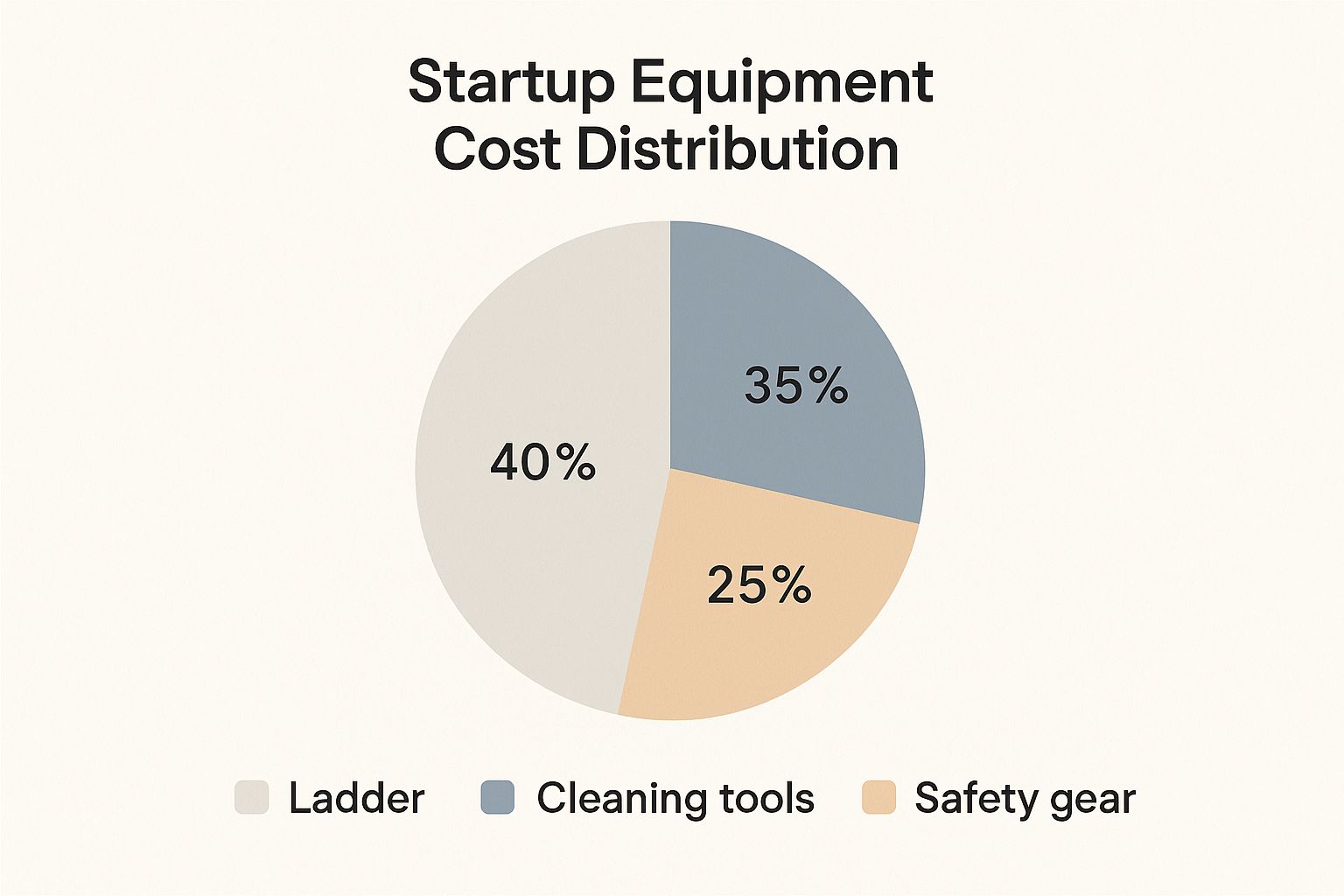
Startup Equipment Cost Breakdown
To give you a better idea of what to expect financially, here’s a look at the potential costs for your initial toolkit. Remember, you can start on a budget and upgrade your gear as your business brings in revenue.
| Equipment Category | Budget Option (Estimate) | Professional Grade (Estimate) | Key Considerations |
|---|---|---|---|
| Core Cleaning Tools | $150 – $300 | $400 – $600 | Pro-grade squeegees and scrubbers last longer and give better results. |
| Ladders | $200 – $400 | $500 – $800+ | A versatile multi-position ladder is a great start. Don't compromise on safety. |
| Safety Gear | $50 – $100 | $150 – $250 | Includes non-slip boots, gloves, and a quality tool belt. |
| Water-Fed Pole System | N/A (Upgrade) | $1,500 – $4,000+ | This is a significant investment for when you're ready to tackle larger jobs. |
| Miscellaneous | $100 – $200 | $200 – $300 | Buckets, towels, scrapers, and cleaning solutions. |
This table shows that you can get started for a relatively modest amount, but investing in higher-quality gear from the beginning can save you time and money in the long run.
Ladders and Safety Gear
Let's be clear: safety is non-negotiable. Your investment in proper safety equipment not only protects you but also gives your clients peace of mind.
A solid extension ladder is a must-have. Look for one with stabilizers (sometimes called "horns") that rest against the house, providing a much more stable and secure platform to work from. For interior work and lower exterior windows, a multi-position ladder like a Little Giant offers fantastic versatility.
Beyond the ladder itself, your safety kit should always include:
- Non-slip footwear to keep your grip on wet surfaces.
- Gloves to protect your hands from solutions and the elements.
- A good tool belt to keep your squeegees, towels, and scraper right where you need them, so you're not juggling tools on a ladder.
Starting with this professional toolkit means you're set up for efficiency, safety, and the kind of flawless results that build a great reputation and keep your phone ringing.
Nailing Your Pricing Strategy

Alright, let's talk money. Setting your prices can feel like walking a tightrope. If you quote too high, you risk scaring off new customers. But if you go too low? You'll find yourself working your tail off for pennies, unable to cover costs, let alone upgrade your gear.
Your pricing strategy is the engine of your business. It's what makes sure you're not just staying busy, but actually building a profitable company. The goal is to find that sweet spot—a price that screams "professional quality," stays competitive here in the Arizona market, and allows your business to grow. This isn't about plucking a number out of thin air; it’s about building a solid system to quote jobs fairly and with confidence.
The Most Common Ways to Price a Job
There’s no magic formula for pricing a window cleaning job. In reality, most seasoned pros use a mix of methods, tweaking their approach for each unique project. Getting a handle on these will help you give accurate estimates from day one.
Here are the three big ones you'll see in the industry:
- Per-Pane Pricing: This is your bread and butter, especially for residential work. It's simple and clean. You set a flat rate for each standard pane of glass, maybe something like $5 to $8 per pane. Customers get it immediately, and it's super easy for you to calculate on the spot.
- Hourly Rate: Charging by the hour (think $50 to $75+ per hour) works well for tricky commercial jobs or intense cleanups where you can't easily predict the time involved. The only downside? The faster and better you get, the less you make on the same job. It can feel like you're being penalized for being efficient.
- Flat-Rate Quoting: For big residential homes or entire office buildings, you'll often give a single, all-in price. This takes a bit more experience to estimate your time and supplies accurately, but clients love knowing the final cost upfront. No surprises.
The biggest mistake I see new owners make is underbidding just to land their first few clients. Don't forget: your price has to cover gas, insurance, supplies, equipment wear, taxes, and pay you a decent wage. If you're not pricing for profit, you're building a hobby, not a sustainable business.
What to Look for When Quoting a Job
A standard window is just your starting point. Mastering the art of the quote means learning to spot the little things that add time and effort to a job. These are the details that justify a higher price and ensure you're paid fairly for your hard work.
Basically, you should run through a mental checklist every time you pull up to a property:
- Window Type and Condition: Are you dealing with easy-to-clean picture windows or a house full of French panes? Those little squares take way more time. And are the windows just dusty, or are they caked with a decade of grime? A first-time clean always takes longer.
- Accessibility: This is a huge one. Can you reach everything from the ground or with a small step stool? Or are you going to need to break out the 24-foot extension ladder to get to those second-story windows over a sloped roof? The more ladder work, the more time and risk involved.
- Obstacles: Look for the things that will slow you down. I'm talking about thorny rose bushes planted right under the windows, heavy patio furniture that has to be moved, or sprinklers that are scheduled to go off mid-clean. You have to account for the extra time and care needed to navigate these headaches.
Thinking through these factors takes you from just having a price list to creating smart, accurate quotes that protect your bottom line. To see how these variables come together, check out our guide on the average cost of window washing for a more detailed breakdown.
How to Increase Your Average Ticket with Add-Ons
Once you're on the property and have built a little rapport with the client, you have a golden opportunity to earn more by offering a few key add-on services. Bundling these not only puts more money in your pocket but also gives the customer a much better result, making you their go-to expert.
Think beyond the glass. What else can you do to make their home sparkle?
- Screen Cleaning: This is the easiest and most logical upsell. What's the point of perfectly clean windows if you're just going to put dirty, dusty screens back on? Offer a thorough wash for an extra $3 to $5 per screen. Most people say yes.
- Track and Sill Detailing: The window tracks and sills are magnets for dirt, cobwebs, and dead bugs. It's a grimy job, and most homeowners hate doing it. Offer to detail them with brushes and a vacuum—it's an add-on that makes a huge difference.
- Hard Water Stain Removal: Here in Arizona, hard water is a constant battle. Those chalky white spots on glass, especially near sprinklers, require special chemicals and a lot of elbow grease to remove. This is a premium service that can significantly boost your profit on a job.
Winning Your First Clients and Building Momentum
You've jumped through all the hoops to get your business off the ground—you’re licensed, insured, and you've got your squeegees ready. Now for the fun part: actually making money. Landing those first few jobs is everything. It’s what turns your business plan into a real, cash-generating operation.
The key right now is to build momentum without pouring money down the drain on expensive marketing.
Forget about big ad campaigns for a minute. Your early game should be all about hyper-local tactics that get you face-to-face with potential customers. With your legal and financial ducks in a row, you can explore some proven strategies to get cleaning clients and grow your business. It really boils down to being targeted, looking professional, and not giving up.
Dominate Your Local Neighborhoods
Believe it or not, your first clients are probably right around the corner. The name of the game is building "route density"—saturating a few specific neighborhoods with your service. This is the secret to efficiency. You’ll slash your travel time, save on gas, and be able to stack more jobs into a single day.
A tried-and-true method is the classic door hanger. But don't just print up some cheap flyers. Invest a little in high-quality, glossy cardstock that feels professional when someone picks it up.
- Pick the Right Homes: Take a drive through neighborhoods with the kind of houses you want to clean—two-story homes with big, beautiful windows and manicured lawns are a great sign. These homeowners care about curb appeal and are more likely to hire out.
- Get Your Timing Right: Head out on a Saturday morning. People are home, they're often doing yard work, and your offer to take a tedious chore off their hands will hit differently than it would on a Tuesday afternoon.
- Make an Offer They Can't Ignore: Something as simple as a "New Neighbor Discount" or a "First-Time Clean Special" can work wonders. A straightforward 10% off is often all it takes to get your phone to ring.
My two cents: Don't just hang the flyer and bolt. If you see someone out watering their plants, walk up, smile, and introduce yourself. A friendly, two-minute conversation is infinitely more powerful than any piece of paper. That's how you start building trust from day one.
Harness the Power of Digital Word-of-Mouth
Even for a hands-on local business, your online presence is crucial. People don't use the Yellow Pages anymore; they use Google. When someone in your town searches "window cleaning near me," you absolutely have to be there.
Your most valuable free marketing tool, by far, is your Google Business Profile (GBP). Claiming and fully optimizing your profile is one of the highest-impact things you can do for your business, and it costs nothing. This is what puts you on Google Maps and in those coveted local search results.
Take the time to fill out every single section. Add your service area, hours, phone number, and write a good description of what you do. Most importantly, start chasing reviews from your very first job. After you've wowed a customer, ask them directly for a review. A business with five glowing reviews looks a hundred times more credible than a business with none.
Forge Strategic Local Partnerships
Some of your best, most consistent work will come from referrals. The trick is to build relationships with other local pros who are already in the homes of your ideal clients.
This is a long-term play, but it pays off big time.
- Real Estate Agents: Agents are desperate to make homes look incredible for photos and open houses. Sparkling clean windows make a huge difference. Find a few local agents, introduce yourself, and offer a special rate for their pre-listing prep work.
- Property Managers: These folks are a goldmine. They manage entire apartment complexes, rental homes, or commercial buildings and are constantly searching for reliable service providers. One good relationship with a property manager can mean a steady flow of work.
- Other Home Service Pros: Get to know the local painters, landscapers, and house cleaners. You can easily set up a referral network where you pass business back and forth.
The foundation of these partnerships is simple: reliability. When you get a referral, treat that client like royalty. Your performance reflects directly on the person who sent you, so be on time, do a flawless job, and communicate clearly. If you make them look good, they'll keep the work coming your way.
Scaling Your Operations for Long-Term Growth
Landing those first few clients feels incredible, but that’s just the starting line. The real challenge—and honestly, where the real money is—is turning this from a one-man job into a business that can stand on its own. It's about building systems that bring in predictable income so you can grow, not just trade your time for a paycheck.
Success isn't just about how many windows you can clean in a day. It's about building a machine that runs smoothly, whether you're at one house or have a crew out at ten. Once you're established, knowing how to scale a service business is the single most important skill for making it in the long run.
From One-Off Jobs to Recurring Revenue
The feast-or-famine cycle will kill a new business. One week you’re slammed, the next you’re staring at the phone, willing it to ring. The only way out is to build a solid base of recurring revenue. That predictable cash flow is the foundation for everything else.
Your primary mission should be to turn every one-time customer into a long-term client.
- Residential Maintenance Plans: Don't just clean someone's windows and hope they remember you next year. Offer them a quarterly or bi-annual cleaning plan at a slight discount. Pitch it as a "set it and forget it" service that keeps their home looking fantastic all year.
- Commercial Contracts: Think about all the local storefronts, restaurants, and low-rise office buildings. They need clean windows all the time. Landing just one of those weekly or bi-weekly contracts can provide a steady income stream that smooths out the gaps in your residential schedule.
The Power of an Unforgettable Customer Experience
In a service business like this, your reputation is everything. A perfect, streak-free cleaning job is the bare minimum—it’s what they paid for. The magic happens when you deliver an exceptional experience. That's what turns a happy customer into a raving fan who sends referrals your way.
And let me tell you, referrals are pure gold. They cost you nothing and come pre-loaded with trust.
It's the little details that make a huge difference:
- Pro-Level Communication: Shoot a text reminder the day before you arrive. Follow up after the job with a quick thank you and a link to leave a review. Simple, but so effective.
- Respect the Property: Always wear shoe covers inside. You shouldn't even have to be asked. Use drop cloths to protect flooring and furniture. Your goal is to leave the property cleaner than when you found it.
- Go the Extra Mile: See a stubborn cobweb on their porch light? Knock it down. It takes ten seconds. These small gestures show you care about their entire home, not just the glass you were paid to clean.
A single happy customer who refers you to their neighbor is more valuable than a $100 ad campaign. The lifetime value of that relationship, including their repeat business and the new clients they send you, can be worth thousands.
Knowing When to Reinvest in Your Business
When the money starts coming in, it’s tempting to pocket it all. I get it. But smart reinvestment is the fuel for growth. The trick is knowing when to pull the trigger on upgrades that will actually make you more efficient and boost your earning potential.
Don't buy shiny new toys just for the sake of it. Look for investments that solve a real problem or open up a new way to make money.
Signs It's Time to Upgrade Your Equipment:
- You’re turning down profitable jobs because you don’t have the right gear (like multi-story homes that really need a water-fed pole system).
- You’re wasting too much time on manual tasks that could be faster (think hand-washing screens for hours when a dedicated screen washer could do it in minutes).
- Your current gear is wearing you out or slowing you down, limiting how many jobs you can squeeze into a day.
On that same note, investing in some basic tech can be a game-changer. When you find yourself drowning in sticky notes and losing track of client info, it’s time for a Customer Relationship Management (CRM) tool. A good CRM helps you manage your schedule, send automated invoices, and track customer history, which frees you up to focus on the actual work.
Making Your First Hire
The idea of hiring your first employee is both exciting and terrifying. It’s a huge sign of success, but it also brings on new headaches like payroll and training. How do you know you're actually ready?
Look for these clear signals:
- You are consistently booked out 2-3 weeks in advance.
- You are actively turning away good, profitable jobs because your schedule is packed.
- You’re spending more time on admin work and quoting than you are on revenue-generating cleaning.
Hiring isn't just about getting another pair of hands. It's about buying back your own time. Your first employee can handle the cleaning while you focus on quoting bigger jobs, networking with property managers, and actually steering the business. This is the leap you have to make to scale up and build something that can thrive even when your hands aren't on a squeegee every single day.
Frequently Asked Questions
When you're diving into a new business, you're bound to have questions. Starting a window cleaning company is no different. You've got the roadmap, but there are always a few specific concerns that pop up once you start getting into the details.
Let's tackle some of the most common questions we hear from aspiring window cleaners right here in Arizona. Think of this as the final piece of the puzzle to help you launch with total confidence.
How Much Can I Realistically Earn?
This is the big one, and the honest answer is: it really depends, but the potential is huge. A motivated, full-time solo operator can realistically aim for $50,000 to $75,000 in revenue in their first couple of years. Your actual take-home pay, of course, hinges on how well you manage your expenses—fuel, insurance, supplies, and all the rest.
The key to boosting your profits is building route density and locking in those recurring residential or commercial jobs. Once you establish a solid client base and maybe even bring on your first employee, a well-run window cleaning business can easily scale to six figures in annual revenue.
What Insurance Is Absolutely Essential When Starting?
Do not even think about starting without General Liability Insurance. It's completely non-negotiable. This is your financial shield for those inevitable "oops" moments, like accidentally cracking a customer's window with a pole or causing some water damage inside. Without it, one simple mistake could sink your entire business.
You need a policy with a minimum of $1 million in coverage. Many commercial clients won't even talk to you unless you can provide a certificate showing this level of insurance. It's a clear signal that you're a serious, professional operation.
As your business grows, you'll need to add a few more policies to your toolkit.
- Commercial Auto Insurance is a must for any truck or van used primarily for business.
- Workers' Compensation Insurance is a legal requirement in Arizona the second you hire your first employee.
Do I Need Any Special Certifications?
For the vast majority of residential and low-rise commercial jobs, you won't need any state-mandated certifications to get going. Your business registration and insurance are the main legal hurdles.
That said, earning safety certifications can give you a major credibility boost. Organizations like the International Window Cleaning Association (IWCA) offer fantastic training programs that teach proven safety protocols. They aren't just pieces of paper; they're an investment in keeping yourself and your clients safe.
High-rise work is a completely different ballgame. If you have ambitions of cleaning skyscrapers, you'll need mandatory, specialized training for things like rope descent systems (rappelling) or scaffolding.
What Is The Biggest Mistake New Window Cleaners Make?
Without a doubt, the most common and damaging mistake is underpricing services. In a rush to land their first few jobs, new owners often set their rates way too low. They forget to factor in all their costs—insurance, marketing, gas, supplies, taxes, and, most importantly, their own time. This puts you on a treadmill where you're always busy but never actually profitable.
You have to price for value and sustainability, not just to be the cheapest guy in town. Figure out your overhead, decide on a fair hourly rate for your labor, and quote with confidence. We have more great advice on this in our collection of answers to common questions about window cleaning.
Another critical error is just waiting for the phone to ring. Clients rarely fall into your lap, so you have to be out there pounding the pavement—networking, running local ads, and building a solid online presence.
Can I Start This Business on a Tight Budget?
Absolutely. One of the best things about this industry is the low barrier to entry. You can get a professional operation off the ground with a surprisingly small investment if you're smart about it.
Here’s how to do it without breaking the bank:
- Stick to the Essentials: Start with a high-quality traditional tool kit. A few squeegees, a good scrubber, a couple of buckets, and a big stack of microfiber towels will only set you back a few hundred dollars.
- Delay the Big Toys: You don't need a fancy water-fed pole system on day one. Master the basics on single-story homes and storefronts that you can easily handle with your core gear and a sturdy ladder.
- Reinvest Your Profits: As you start cashing those first checks, dedicate a portion of that revenue to systematically upgrading your equipment. That’s how you’ll eventually afford that water-fed pole or a dedicated work van without going into debt.
With a lot of hustle and a lean startup approach, you can get your window cleaning business off the ground and turn a profit surprisingly quickly.
Ready to leave the cleaning to the pros and see what a difference truly professional service makes? At Sparkle Tech Window Washing, we bring clarity to your home or business. Get your free, no-obligation quote today!