



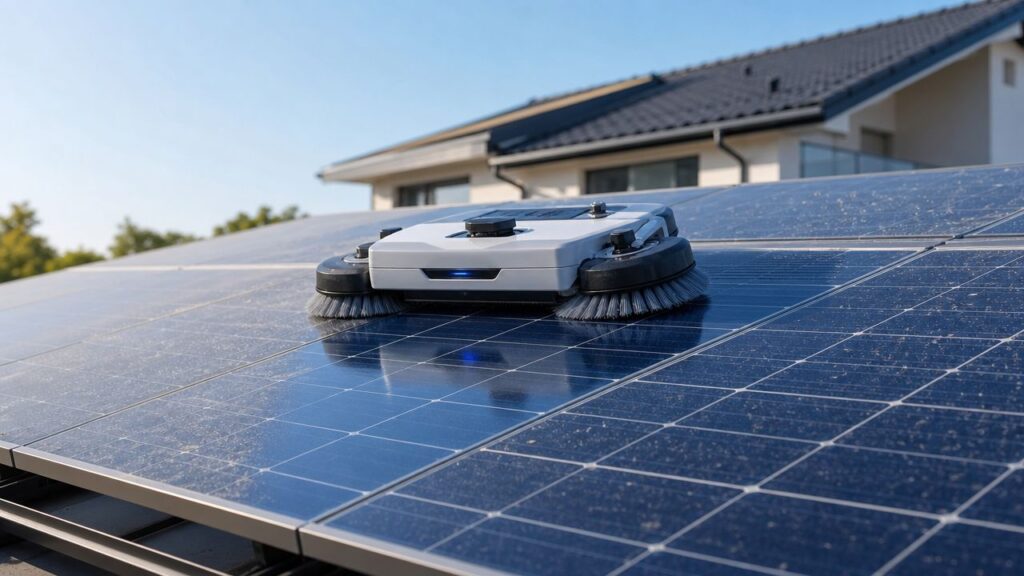
You look up at your panels and they don't seem dirty. That's the problem. Most solar systems don't wear a thick coat of mud. They wear a light film of dust, pollen, and grime that builds slowly enough that homeowners ignore it until production slips or streaking becomes obvious.
That's especially common in dry, dusty parts of Arizona. A little airborne dirt, a few windy days, and the panels stop looking “bad” but also stop performing like they should. At that point, a solar panel cleaning robot starts sounding attractive. It promises hands-free upkeep, less roof work, and less hassle.
That promise is real in some situations. It's also oversold in others. A robot can be a smart maintenance tool, but it isn't automatically the best choice for every home, every roofline, or every type of dirt. The long-term ownership side gets ignored most often. Brushes wear down. Sensors get dirty. Batteries age. Motors don't last forever. If you buy one expecting zero upkeep, you may end up disappointed.
Why Your Dusty Solar Panels Need a Solution
A dusty solar array doesn't usually fail all at once. It loses performance bit by bit. Homeowners often notice it only after a stretch of dry weather, nearby construction, roof work, or repeated wind events that leave a fine layer on the glass.
That's why cleaning has moved from “nice to have” to routine solar maintenance. More owners want a repeatable way to keep panels cleaner without climbing onto the roof every few weeks. Some start by reading practical guidance on whether solar panels need cleaning, then they begin comparing manual service with automated options.
Robotic cleaning has become a much bigger part of that conversation. The global solar panel automatic cleaning robot market is valued at US$ 330.7 million in 2026 and is projected to reach US$ 726.4 million by 2033, with a 11.9% CAGR. North America holds a 39.2% market share in 2026, according to Coherent Market Insights on the solar panel automatic cleaning robot market.
That growth tells you something useful. These machines aren't a fringe gadget anymore. Owners and operators are looking for ways to clean more consistently and with less labor.
Why homeowners start looking at robots
For a homeowner, the appeal usually comes down to a few practical frustrations:
- Roof access is awkward: Panels may sit on a second story, over a garage, or on a roof pitch that doesn't feel safe.
- Dust keeps returning: In dry climates, cleaning once doesn't solve the problem for long.
- Manual cleaning takes time: Even careful owners get tired of hauling equipment, checking footing, and trying not to leave residue.
- Water use matters: Many people want a method that avoids dragging hoses across the roof.
A robot makes the most sense when dirt is frequent, access is annoying, and the array layout is simple.
There's also a business angle behind the scenes. Installers and service companies are trying to explain maintenance better, generate better leads, and educate buyers before the sale. If you work in that side of the trade, this guide on marketing for UK solar installers is a useful example of how companies frame solar services around real homeowner concerns rather than generic promises.
How Solar Panel Cleaning Robots Work
Think of a solar panel cleaning robot as a roof-specific cousin of a robot vacuum. It doesn't just move around randomly. It combines traction, a cleaning system, onboard power, and sensors that help it stay on the panels and avoid trouble.
Some are simple. Others are surprisingly advanced. But the core pieces stay about the same.

If you want a broader look at the tools involved, this guide to solar panel cleaning equipment helps put robots in context with the rest of the equipment category.
How the robot moves
The first job is staying attached to the panel surface and crossing it steadily. Most units use wheels or tracks designed to grip glass without causing damage. On flat or mildly pitched systems, that's fairly straightforward. On slick surfaces, higher tilt angles, or uneven panel spacing, movement becomes harder.
The movement system matters more than most buyers realize. If the robot can't travel smoothly, everything else gets worse. Cleaning becomes uneven, cycle times stretch out, and the motor works harder than it should.
How it actually cleans
The cleaning side usually relies on one or more of these:
- Rotating brushes: Good for light dust and routine buildup.
- Squeegee-style contact points: Better for certain residue patterns when moisture is involved.
- Airflow or suction support: Used on some waterless systems to lift and capture loose material.
For light, frequent soiling, robotic brushing works well. For sticky messes, baked-on bird droppings, or oily grime, it often doesn't.
Practical rule: Robots are strongest at maintenance cleaning, not recovery cleaning.
Power and charging
Most homeowner-focused robots run on an onboard battery. Some are designed for swappable battery packs, while others need a recharge between cleaning sessions. In practice, battery setup affects convenience more than marketing copy suggests.
A robot with weak runtime becomes one more chore. Owners end up planning around charging, carrying extra packs, or stopping mid-job.
Navigation and edge detection
Specific capabilities distinguish cheap from well-designed solar panel cleaning robots. Such a robot needs to detect panel edges, transitions, and obstacles. Better systems use sensors to keep the robot on track and reduce the risk of getting hung up or drifting into places it shouldn't.
Some units also include app controls or scheduling features. Those are nice to have, but they're secondary. Good traction, reliable sensing, and a brush system that matches your type of dirt matter more than smart connectivity.
Comparing Robot Types for Homes and Businesses
A homeowner sees a robot cleaning long rows of panels in a solar farm video, then assumes the same idea will work on a two-story roof at home. That is where bad buying decisions start. The machine class matters as much as the cleaning method.

Array layout, roof pitch, access, and storage all change what makes sense. Homeowners comparing roof-integrated products with standard modules often run into the same issue. Maintenance starts with the installation type, which is one reason practical comparisons like solar tiles vs. solar panels are useful before buying any cleaning equipment.
Residential robots
Residential units are built for smaller arrays and tighter handling. The Solarrow X3 uses a dry brush with integrated suction and is marketed for rooftop and carport cleaning, based on the product specifications noted earlier.
That lighter class is easier to lift onto a roof, move between panel sections, and store in a garage without turning it into a permanent equipment problem. For a homeowner, those details matter more than flashy speed claims. If the robot is awkward to carry, annoying to charge, or hard to set down safely, it gets used less than expected.
There is a trade-off. Smaller robots are better for routine dust control than for neglected panels with stuck-on residue. They also tend to have more ownership friction over time than buyers expect. Brushes wear, batteries lose runtime, wheels lose grip, and sensors get less reliable after repeated exposure to dust, heat, and roof grit.
Commercial and utility robots
Commercial and utility robots are built for long, repetitive runs across large installations. They are heavier, faster, and better suited to broad layouts where the work is scheduled like equipment maintenance, not handled as an occasional homeowner chore.
The X-Human G2, for example, is listed by the manufacturer as an industrial cleaning robot for large photovoltaic sites, with specifications and product details available on the X-Human product page. That class of machine makes sense where there are many rows to cover and staff already in place to manage charging, transport, inspections, and repairs.
For a house, that same size can become the problem. Weight is harder to handle on a ladder. Deployment takes longer. If the roof has hips, valleys, setbacks, or interrupted panel groups, the robot spends more time being repositioned than cleaning.
Residential vs. Commercial Cleaning Robots at a Glance
| Feature | Residential Robots | Commercial/Utility Robots |
|---|---|---|
| Best fit | Homes, rooftops, carports | Large commercial arrays, solar farms |
| Handling | Easier for one person to place and remove | Often needs more planning and safer access methods |
| Cleaning goal | Regular upkeep on small arrays | Repeated coverage across long panel rows |
| Storage | Usually manageable at home | Often stored as part of an operations setup |
| Layout tolerance | Better for shorter, broken-up panel groups | Best on wide, consistent installations |
| Long-term upkeep | Homeowner must stay on top of batteries, brushes, and sensor cleaning | Usually handled as scheduled equipment maintenance |
A lot of guides stop at size and speed. The bigger difference is ownership burden. On a commercial site, ongoing maintenance is expected and budgeted. At home, that same upkeep often gets ignored until the robot starts missing spots, slipping near edges, or sitting unused because a battery pack failed.
The wrong robot class does not just waste money. It adds one more piece of equipment that needs service, storage, and troubleshooting without solving the real cleaning problem.
Evaluating the Benefits and Limitations
Robotic cleaners do solve real problems. They also leave some important ones unsolved. If you strip away the marketing, the value comes down to where they help consistently and where they still need backup.

One of the biggest strengths is water savings. Automated fleets have saved nearly 1.8 billion gallons of water through nocturnal, water-free operations, and a major weakness remains edge dirt accumulation, which can reduce energy yield by up to 15%, according to GM Insights on the solar panel cleaning market.
What works well
For routine dust control, robots are often very effective. They can clean on a schedule, reduce the need to get on the roof, and keep panels from reaching the “obviously dirty” stage where production has already suffered for a while.
The safety angle matters too. A lot of homeowners underestimate the risk of roof access. Even a low-slope roof becomes dangerous when you add early morning dew, dust, or awkward body positioning around panel frames.
A robot is also appealing when water use is a concern. Waterless systems are one of the strongest arguments for automation in dry climates.
Practical advantages in daily ownership
- Consistency: A scheduled cleaning routine is easier to maintain than a good intention.
- Less roof exposure: Fewer climbs usually means fewer chances for a fall or panel damage from foot traffic.
- Convenience: Once the system is familiar, routine cleaning takes less hands-on time than many owners expect.
Where the sales pitch gets thin
Robots struggle when dirt stops being light and dry. Caked-on residue, bird droppings, sticky deposits, and runoff marks from roof edges often need more than a brush pass. Homeowners hear “automated cleaning” and assume “deep cleaning.” Those aren't the same thing.
Edge cleaning is another weak spot. A lot of machines do a respectable job in the field of the panel but miss the edges and border areas where grime can collect more stubbornly.
Then there's cost. I'm not going to pretend a robot is the cheapest path for every household. For many homes, paying for periodic professional cleaning is more sensible than buying, storing, charging, and maintaining another machine.
If your panels only need occasional attention, a robot may solve a problem you don't actually have.
Limitations that matter before you buy
- Heavy soiling remains a problem: Robots don't always remove stubborn contamination in one pass.
- Roof complexity changes everything: Valleys, obstructions, short panel runs, and awkward transitions reduce robotic efficiency.
- You still need oversight: Automated doesn't mean unattended forever.
Robot vs Professional Service When to Choose Each
This is the decision point that matters most. A solar panel cleaning robot is not automatically better than a professional service. It's better in specific conditions.
The simplest way to decide is to look at your roof, your dirt pattern, and your tolerance for equipment upkeep. If you want a done-for-you option for difficult layouts or occasional deep cleaning, professional solar panel cleaning service is often the more practical route.
Choose a robot when the setup is simple
A robot makes more sense when your system checks most of these boxes:
- Simple array layout: Straight panel rows with few interruptions.
- Easy operating conditions: Low to moderate pitch and predictable access.
- Frequent light dust: The panels get dirty often, but not with thick, stubborn contamination.
- You're willing to maintain the machine: Charging, inspection, brush care, and storage don't bother you.
In that setting, the robot acts like a routine maintenance assistant. It keeps the panels from drifting too far into dirty territory and reduces how often you need a more involved clean.
Choose a professional when the roof is complicated
Professional service is usually the better investment when the roof introduces risk or inconsistency. Steep pitches, multi-level rooflines, fragile access paths, and limited room around the array make robotic cleaning less attractive fast.
It's also the better choice when the soiling isn't uniform. Bird droppings, roof runoff marks, pollen paste, and old residue often need judgment, spot treatment, and close visual inspection. A robot doesn't replace that well.
The hybrid approach is often the smartest one
A lot of owners benefit from mixing both approaches. Use a robot for light routine maintenance if your layout supports it. Then bring in a professional periodically for a more thorough cleaning and inspection.
That arrangement tends to work well because each method handles what it's best at:
| Situation | Better choice |
|---|---|
| Frequent dry dust on a simple roof | Robot |
| Infrequent but severe soiling | Professional |
| Steep roof or awkward access | Professional |
| Owner wants hands-off upkeep but regular touchups | Hybrid |
| Need for close visual inspection of the array | Professional |
The best choice isn't the most automated one. It's the one that fits the roof and the dirt you actually have.
The Overlooked Responsibilities of Robot Ownership
A common homeowner story goes like this. The robot works well for the first few months, then one day the panels still look hazy after a run, the unit takes longer to finish, or it starts favoring one side of the array. Many owners assume the dirt was heavier than usual. In practice, that kind of drift often means the robot needs service before it turns into a bigger problem.

That is the part many buying guides gloss over. A solar panel cleaning robot adds its own maintenance schedule. Brushes wear down. Sensors get dusty. Batteries lose runtime. Wheels or tracks lose grip, especially in hot, gritty conditions. None of that means robotic cleaning is a bad option. It means ownership works best for people who are willing to inspect the machine and catch small issues early.
What owners need to check regularly
A robot that lives outdoors or moves across dusty glass needs routine attention.
- Brush condition: Worn, hardened, or grit-packed brushes stop cleaning evenly and can leave more residue behind.
- Sensor cleanliness: Dirty sensors can throw off edge detection or cause odd movement patterns.
- Battery behavior: Shorter runtime, uneven charging, or heat during charging usually means the battery is aging.
- Wheel or track wear: Reduced traction affects travel and puts more strain on the drive system.
- Seals and housing: Cracked seals or a loose cover can let in moisture and dust, which is where expensive repairs start.
These checks are simple. Skipping them is what gets costly.
Early warning signs people miss
Complete failure is rarely the first sign of trouble. More often, the robot starts doing a mediocre job before it stops doing the job.
Watch for these changes:
- Longer cleaning cycles than the robot used to need.
- Uneven travel or hesitation in spots that were easy before.
- Missed strips or repeat passes over the same area.
- Shorter runtime between charges.
- A dirtier-looking array after a run that should have handled the buildup.
I tell homeowners to pay attention to trend changes, not only breakdowns. If performance drops a little each month, the robot is asking for maintenance.
The trade-off owners feel later
The purchase price is only part of the cost. Overall ownership cost includes storage, cleaning the cleaner, replacing wear parts, charging habits that protect battery life, and occasional troubleshooting when the unit behaves strangely.
That trade-off matters most over time. On a simple, low-risk array, those extra tasks may still be worth it because the robot cuts down how often you need outside help. On a roof with awkward access, seasonal grime, or stubborn residue, owners often learn that the robot handles only the light work, while a professional still has to step in for inspection, spot cleaning, and problem-solving.
The ownership mindset that makes a robot worth having
Treat the robot like outdoor equipment, not like an appliance you forget about in a closet. Clean it after use. Store it dry. Check contact surfaces and moving parts. Replace wear items before they start affecting results.
If that sounds like more involvement than you want, a professional service is usually the better investment. If you do not mind a light maintenance routine and your roof setup is a good match, a robot can earn its keep. The key is being realistic about what ownership looks like after the excitement of the purchase wears off.
Frequently Asked Questions About Robotic Cleaners
Can a solar panel cleaning robot scratch my panels
A well-designed robot with the right contact materials is intended to clean without damaging the panel surface. The bigger risk usually comes from trapped grit, neglected brushes, or using a machine on panels it wasn't suited for. Clean the robot itself and inspect the brush area before each run.
Do robots work in rain or high wind
Most owners shouldn't run them in poor weather unless the manufacturer clearly allows it. Wet glass, wind gusts, and unstable footing conditions increase the chance of poor tracking or incomplete cleaning. Good weather windows are still part of responsible use.
Will a robot remove bird droppings and stubborn grime
Sometimes, but not reliably in every case. Robots do best on routine dust and light surface buildup. Thick residue often needs manual attention or a professional cleaning.
How long does a robot last
Service life depends on how often it's used, how well it's maintained, and how harsh the environment is. A lightly used, properly stored robot on a straightforward home system will usually age better than one working in heavy dust with poor upkeep. The key point is that brushes, batteries, sensors, and motors all need attention over time.
Is a robot worth it for a normal homeowner
It can be, but only if your roof and your dirt pattern fit the tool. If your array is easy to access and only needs occasional cleaning, professional service may be the better value. If dust returns often and your system has a simple layout, a robot can make ongoing maintenance easier.
If your panels need expert attention, or you'd rather skip the trial-and-error of robot ownership, Sparkle Tech Window Washing & window screens offers practical help for Arizona homeowners who want clean solar panels, safer roof access, and dependable exterior service from a local family-owned company.