



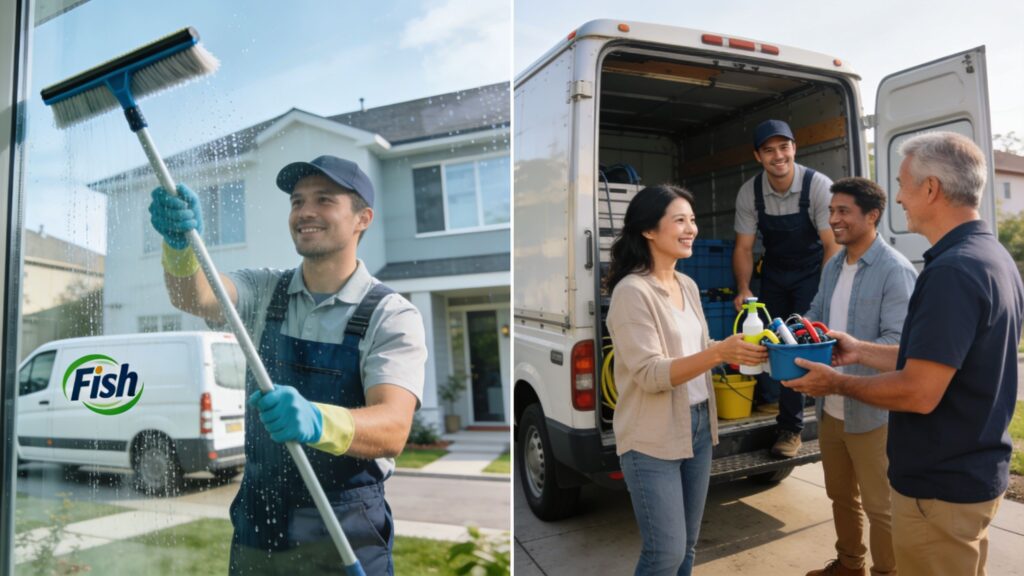
You’re probably here because you’ve seen a Fish Window Cleaning van in your neighborhood, checked a few reviews, and now you’re trying to answer the main question. Is a big national name the safe choice, or does that just mean you’re getting a standardized service that may or may not fit your home?
That’s a fair question, especially in Arizona. A lot of homeowners don’t just need basic glass cleaning. They need someone who understands hard water spotting, dust buildup, heat, and the difference between a quick maintenance clean and careful restoration work on glass that’s been neglected.
This fish window cleaning review is written from the perspective of a family-owned Arizona operator who knows the trade. Not to take cheap shots at a national competitor, and not to pretend every local company is automatically better. The goal is simpler than that. Help you understand what Fish does well, where the franchise model creates trade-offs, and how to judge whether that model fits your house.
Is a National Chain Right for Your Home's Windows
A common Arizona scenario goes like this. You need your windows cleaned before guests come over, before listing the house, or after months of dust and sprinkler overspray have taken a toll. You search around, and a recognizable national brand shows up first. That familiarity feels reassuring.
For some homeowners, it is reassuring. A company with broad name recognition usually has systems, scheduling processes, uniforms, and a polished presentation. That matters. It can also make the buying decision feel less risky than hiring a smaller company you haven’t heard of before.
But window cleaning isn’t like ordering office supplies. It happens on your property, around your landscaping, screens, tracks, delicate glass, and sometimes solar panels. The person doing the work matters as much as the logo on the truck.
That’s why this decision often looks a lot like hiring any other local home service. If you’ve ever compared a chain provider against a neighborhood specialist, the same pattern applies. A useful parallel is this Guide to hiring Prescott landscapers, which gets at a bigger point. Local service businesses often win not because they’re flashier, but because they know the conditions, the neighborhoods, and the practical quirks that national systems can miss.
| What homeowners usually want | What a national chain may offer | What to verify before booking |
|---|---|---|
| Reliable scheduling | Structured booking systems | Who actually performs the work |
| Clean, streak-free windows | Standardized service process | Whether the local crew handles detail work well |
| Fair pricing | Established quoting methods | Whether the quote reflects your actual glass condition |
| Accountability | Recognizable brand | Whether you can reach the local decision-maker |
| Arizona-specific experience | Varies by franchise location | Experience with hard water, dust, and sun-exposed glass |
A national chain can be the right fit. It just shouldn’t get a free pass because the name is familiar.
Understanding Fish Window Cleaning's National Model
A homeowner in Arizona can call a national brand and still get a very local result. That is the main thing to understand about Fish Window Cleaning.
Fish operates as a franchise system. The company has built a wide national footprint, but the crew that shows up at your house is tied to a local office, local owner, and local hiring decisions. For homeowners, that means the brand gives you a starting level of structure, not a guarantee that every location works the same way.
| Model feature | What it can mean for customers |
|---|---|
| National brand | Familiar name, established marketing, and a process that feels organized |
| Franchise territories | Quality can vary based on the local owner and crew |
| Shared systems | Quoting, scheduling, and service menus often follow a consistent format |
| Local crews under a larger name | The badge on the truck matters less than the standards of that specific office |

What Fish has built well
Fish has been around long enough to develop the kind of operating system franchise buyers want. Its press releases point to franchise recognition and industry visibility, which usually suggests an established playbook for branding, recruiting, and repeat service.
That matters. A mature franchise model often does a better job with the parts of the business homeowners notice before the work starts. Phone handling is usually more organized. Estimates tend to follow a set format. Uniforms, vehicles, and service descriptions are often more consistent than what you see from a one-truck startup.
From an owner’s perspective, I can respect that. Process helps. It reduces confusion for customers and gives new locations a template to follow.
Where the model gets uneven
Window cleaning is still a field-service trade. Glass condition changes from house to house. Screens warp. Tracks fill with dust. Hard water stains can turn a simple maintenance job into restoration work. A franchise can standardize the office side of that work more easily than it can standardize technician judgment.
That is where Arizona homeowners need to slow down and ask better questions. A national system may train people on general procedures, but local execution determines whether your crew notices sun-baked seals, fragile older screens, or mineral buildup that needs more than a basic wash.
The trade-off is pretty simple. National chains often feel easier to book. Local performance can still vary a lot.
What that means for an Arizona homeowner
At Sparkle Tech, we see this difference all the time when customers call after trying a larger brand. They are not usually upset about the scheduling. They are upset about the details. Missed edges. Dust left in tracks. Water spotting that was treated like routine dirt. Crew members who cleaned the glass but did not explain what the glass needed.
That does not make Fish a bad option. It means the local office matters more than the national name.
Before you book, ask who owns the territory, whether residential work is a regular part of that office, what insurance they carry, and how they handle callback issues. Ask whether the quote includes screen cleaning, track work, and hard water assessment or only the panes. Those answers will tell you more than the logo will.
Decoding Fish's Services and Pricing Structure
Most homeowners looking at Fish are really comparing two things at once. First, what services are included. Second, whether the quote makes sense for the kind of work their home needs.
Fish is known for residential and commercial window cleaning, and in many markets it also offers related services such as gutter cleaning or specialty glass work. That broad menu is common in a franchise system because add-on services make routing and repeat scheduling easier.

What you’re usually buying
A standard residential visit from a company like Fish often centers on some mix of these items:
- Interior and exterior pane cleaning for routine maintenance and appearance
- Screen handling if the job includes removing, cleaning, and resetting screens
- Track and sill attention which can vary more than customers expect
- Recurring service plans for homeowners who want maintenance on a regular cycle
- Commercial route work where consistency and scheduling matter as much as glass detail
Not every company treats those tasks with the same depth. That’s where pricing confusion starts. One quote may cover a fast pane cleaning with limited track work. Another may build in more labor for details that homeowners assume are standard.
Why franchise pricing feels different
Fish franchise locations report average gross revenue of $488,943 per unit, according to Franzy’s franchise profile. That figure matters because it gives context to how a franchise location is built to operate. It needs enough volume and enough consistency to support local labor, local operations, and the added cost structure that comes with a branded franchise system.
That doesn’t mean the pricing is wrong. It means the pricing is designed for a business model that has to scale. Scaled companies tend to favor quoting methods that are repeatable, trainable, and fast to administer.
For the customer, that can create two very different outcomes:
| If your home is straightforward | If your home has quirks |
|---|---|
| Franchise pricing may feel efficient and reasonable | Standard pricing can miss complexity |
| Easy access, easy glass, routine condition works well | Heavy dust, hard water, awkward access need better judgment |
| Maintenance plans may fit nicely | One-size quoting can feel rigid |
A clean quote isn’t always a detailed quote. Ask what the crew will actually do, not just what the office lists.
Questions to ask before you approve the estimate
Homeowners usually get the best results when they slow the estimate down and ask a few unglamorous questions.
- Are screens included? Some companies clean them routinely, others treat them as a separate line item.
- What about tracks and sills? “Window cleaning” can mean very different levels of detail.
- How do you handle hard water spotting? Basic glass cleaning and stain removal are not the same service.
- Will the same crew who quoted it perform it? Misalignment often starts when the office and field team define the job differently.
- Is this maintenance cleaning or corrective cleaning? Homes that haven’t been serviced in a while usually need more than a surface pass.
Here’s a good visual example of the kind of routine exterior work homeowners often picture when they ask for service:
A franchise can price routine work efficiently. Where customers get disappointed is when the home isn’t routine, but the quote still assumes it is.
Customer Experiences and Quality Control Realities
A homeowner usually feels the difference in quality control in the last ten minutes of the job. The glass looks good from the street, then you walk room to room and start spotting the details. A corner was missed. A screen is sitting crooked. One track still has mud in it. That is the part of a fish window cleaning review that matters most to me as a local operator in Arizona.
National brands can absolutely deliver solid service. The catch is consistency. With a franchise system, the customer is not really hiring a single company in the way many people assume. They are hiring a local branch working under a national name, and branch-level habits shape the outcome.
As noted earlier, employee review patterns for Fish point to a mixed work experience. In this trade, that usually shows up as uneven training, variable supervision, or different expectations from one office to another. None of that guarantees a bad job at your house. It does mean homeowners should read reviews with an eye for patterns, not just star ratings.
Where a national model can work well
Routine homes often fit a franchise model just fine. If the glass is maintained, access is straightforward, and the scope is clearly defined, a structured crew can move efficiently and leave the windows looking sharp.
That appeals to plenty of homeowners.
Uniforms, scheduled routing, office support, and standardized service steps can create a smoother experience on ordinary jobs. For easy residential maintenance cleans, Fish may feel organized and predictable in a way some customers prefer.
Where quality slips show up
The weak point is not usually the sales pitch. It is field execution.
I pay close attention to reviews that mention missed detailing, uneven results from window to window, or a crew that seemed rushed. Those complaints are more telling than a general comment about price or scheduling because they point to training and inspection standards. In Arizona homes, where dust, screens, hard water spotting, and sun exposure make window cleaning less forgiving, small mistakes stand out fast.
Homeowners usually see inconsistency in a few practical ways:
- Edges and corners left dirty after the main pane has been squeegeed
- Screens put back poorly or handled roughly
- Tracks and sills left half-finished because the crew and office described the job differently
- Spotting that reappears quickly when residue or mineral buildup was not addressed correctly
- Different results on different sides of the house because the pace changed or inspection was weak
A good cleaner leaves a consistent finish, not just a few nice-looking panes. If you want a simple outside reference for what proper technique looks like, this guide on pro techniques for clean windows is useful. Homeowners do not need to master the trade, but they should know what careful work looks like.
The review pattern I would take seriously
As a family-owned company, we read competitor reviews differently than a homeowner might. I am less concerned by the occasional complaint from a hard-to-please customer. I pay attention when reviews describe the same service failure in slightly different words.
If one customer says communication was poor, that could be a bad day. If several say the quote sounded more thorough than the work performed, that suggests a process problem. If multiple reviews mention rushed crews, missed windows, or disappointing follow-through, I take that seriously.
That is also why local accountability matters. With an owner-led company like Sparkle Tech Window Washing in Phoenix, the feedback loop is usually shorter. The people setting expectations are closer to the people doing the work, and that tends to reduce the gap between what was promised and what shows up at the house.
What Arizona homeowners should take from this
Fish may be a good fit if your home is straightforward and your local branch is well run. That combination does happen. But the national name alone should not reassure you. In window cleaning, brand recognition does not clean the glass. The crew does.
For Arizona homeowners, I would weigh review comments about craftsmanship more heavily than comments about convenience. Scheduling issues are frustrating. Poor technique, missed detail work, and weak final checks are what turn a normal cleaning into a disappointing one.
Fish Window Cleaning vs Sparkle Tech A Local Showdown
A homeowner in Phoenix books a window cleaning expecting a simple maintenance visit. Then the crew arrives and serious questions begin to emerge. Who is responsible if the scope is unclear, if hard water turns out to be worse than expected, or if the job needs a return visit? That is where the difference between a national franchise and a local owner-led company shows up.

Side by side on what homeowners care about
| Decision point | Fish Window Cleaning | Sparkle Tech |
|---|---|---|
| Business model | National franchise with local territories | Local, family-owned Arizona business |
| Operational style | Structured systems and brand-level processes | Direct, community-focused service |
| Insurance position | Commonly presented as bonded and insured in market-facing materials | Publisher states it carries Workers Compensation, General Liability Insurance, and is Bonded |
| Local specialization | Depends on the franchise location | Arizona-specific service focus |
| Communication style | May run through franchise office systems | More direct owner-led accountability |
| Flexibility | Can be process-driven | Often better suited to custom scope and unusual property needs |
Where the day-to-day difference shows up
From an operator’s perspective, the biggest gap is not branding. It is decision-making on the job.
In a franchise model, service quality depends heavily on the local branch, the crew assigned that day, and how tightly that office manages training and follow-through. A good branch can deliver solid work. A weaker one can feel rigid, especially when the home has unusual glass, neglected screens, baked-on debris, or hard water staining that does not fit a standard cleaning script.
At a local company, the chain of accountability is usually shorter. The person quoting the work is often closer to the person doing it, or is directly involved in setting the standard. That does not guarantee perfection, but it usually makes corrections faster and expectations clearer.
That matters in window cleaning because small misses are the whole job. One skipped pane, one sloppy screen wipe-down, or one misunderstood scope item can change how the entire visit feels to the homeowner.
Arizona homes put more pressure on the service model
Arizona is not a forgiving market for generic process. Dust loads build fast. Mineral-heavy water leaves spotting that routine glass cleaning will not fix. Sun exposure dries debris onto glass and frames in a way crews from milder climates often underestimate.
That is why I give local judgment more weight here than I would in some other states. The company needs to know when a window needs cleaning, when it needs restoration, and when the homeowner needs a realistic explanation before work starts.
For readers comparing local options, Sparkle Tech window cleaning in Phoenix lays out its owner-led approach and Arizona service focus directly.
Where each model tends to fit best
Fish can make sense for homeowners who want a recognizable brand, a standardized service process, and a straightforward maintenance cleaning on a fairly typical home. That is a valid reason to hire them.
Sparkle Tech has the stronger fit when the property needs more judgment than process. That includes homes with mixed pane sizes, older screens, hard water exposure, detailed exterior buildup, or owners who want direct answers instead of a handoff through office layers.
The trade-off is simple. National systems can be efficient. Local ownership is often better at handling exceptions.
The honest comparison
If the local Fish franchise serving your area is well managed, your home may get a good result. That is entirely possible. But for Arizona homeowners, I would still give the edge to the local family-owned model when the job requires careful evaluation, flexible scope, or tighter accountability after the appointment is booked.
That edge comes from proximity to the work. In a family business, reputation lives close to the crew, the estimate, and the callback. In this trade, that usually leads to better follow-through.
Your Checklist for Hiring Any Arizona Window Cleaner
A smart hiring process beats brand loyalty every time. Whether you call Fish, a local independent, or any other provider, you’ll get a better result if you ask the right questions before anyone unloads a ladder.
Arizona homes punish vague service standards. Dust settles fast. Hard water can make “cleaning” and “restoration” look like the same thing to a customer when they’re not. A good checklist keeps you from paying for the wrong scope.

The questions that matter most
Verify insurance in plain language
Don’t stop at “insured.” Ask what kind of coverage the company carries and whether the workers on your property are covered appropriately.Ask about Arizona hard water experience
A provider who treats every spot as routine dust may leave you with glass that still looks dirty after the job.Find out who will be on-site
The estimator, the owner, and the crew are not always the same people. That gap is where expectations often break down.Request a written scope
You want clarity on panes, screens, tracks, sills, and any excluded items before the appointment starts.Check how they handle callbacks
Problems aren’t always a dealbreaker. How a company responds to them is a true test.
A quick decision filter
Use this short filter when comparing quotes:
| Ask this | Good answer sounds like |
|---|---|
| What’s included in the window cleaning? | Clear explanation, not broad sales wording |
| Do you handle hard water separately? | Honest distinction between cleaning and stain removal |
| Who is coming to my property? | Specific names, roles, or team structure |
| Can you put the scope in writing? | Yes, with details |
| What happens if I spot an issue after the job? | Direct callback process with responsibility attached |
One local standard worth using
Arizona homeowners should also look for companies that understand residential service beyond just “making glass shiny.” That means showing up prepared for screens, tracks, and the way local conditions affect maintenance schedules.
If you want a benchmark for what a specialized residential service looks like, review a dedicated home window cleaning service page and compare its level of detail to whatever quote you receive elsewhere. The more specific the company is about the work, the less likely you are to get vague results.
Don’t hire the company that explains the least. In this trade, vague language usually protects the seller, not the homeowner.
What doesn’t work
The worst hiring method is choosing purely on name or purely on price. Big names can underdeliver. Cheap quotes can hide omissions. You need fit, not just familiarity.
The best hiring method is slower and less exciting. Read carefully. Ask direct questions. Make sure the company understands your house, not just its own booking process.
Why Local Expertise Matters for Arizona Homes
You see it all the time in Arizona. A homeowner books a standard window cleaning, the glass looks good for a few days, then the sun hits it in the afternoon and significant problems show up. Mineral spotting around the lower panes, baked-on dust near the frames, and screens that still carry fine debris because they needed more than a quick rinse.
That gap comes from misreading the job.
Arizona homes put different pressure on glass than homes in milder climates. Irrigation overspray leaves mineral deposits. Dry air and dust settle fast, especially on exterior panes and tracks. Strong sun cooks residue onto the glass, which means the technician has to recognize the difference between soil that will wash off and staining that needs separate treatment.
A company that works Arizona routes every week sees those patterns earlier and prices the work more accurately. They can spot when a homeowner needs stain removal, not basic cleaning. They know which homes near active construction or heavy roadside dust need a shorter service interval. They also know that desert screens, tracks, and frames can hold far more debris than a national checklist might assume.
Communication changes too.
With a local company, the person quoting the work often understands the neighborhood, the exposure on the home, and the common issues tied to irrigation, dust, and heat. That leads to clearer expectations before the job starts, which matters more than polished branding after the fact.
If you want a clearer picture of what Arizona weather does to residential glass, this explanation of weather effects on windows in Phoenix lays out the wear patterns homeowners deal with here every season.
A fair takeaway from any Fish Window Cleaning review is simple. A national franchise can be a solid fit for homeowners who want a recognizable brand and standardized process. But Arizona homes reward local judgment. From my side of the trade, that difference shows up in the estimate, the crew's recommendations, and the final result on the glass.